Inspiration
Every team is building AI agents, but an agent without context is just an LLM guessing. We kept running into the same problem: modern data tools can detect that a table is broken, but they can't explain why it matters, who it impacts, or what should be fixed first. A stale payments table doesn't just break one dashboard—it silently cascades downstream. DataHub's Context Platform solves the missing-context problem, and we wanted to prove the full loop: read the context graph, reason across the entire estate, act on it, and—crucially—write those insights back into the graph. The result is DataBard: an AI data analyst that turns DataHub's metadata into prioritized, actionable guidance.
What it does
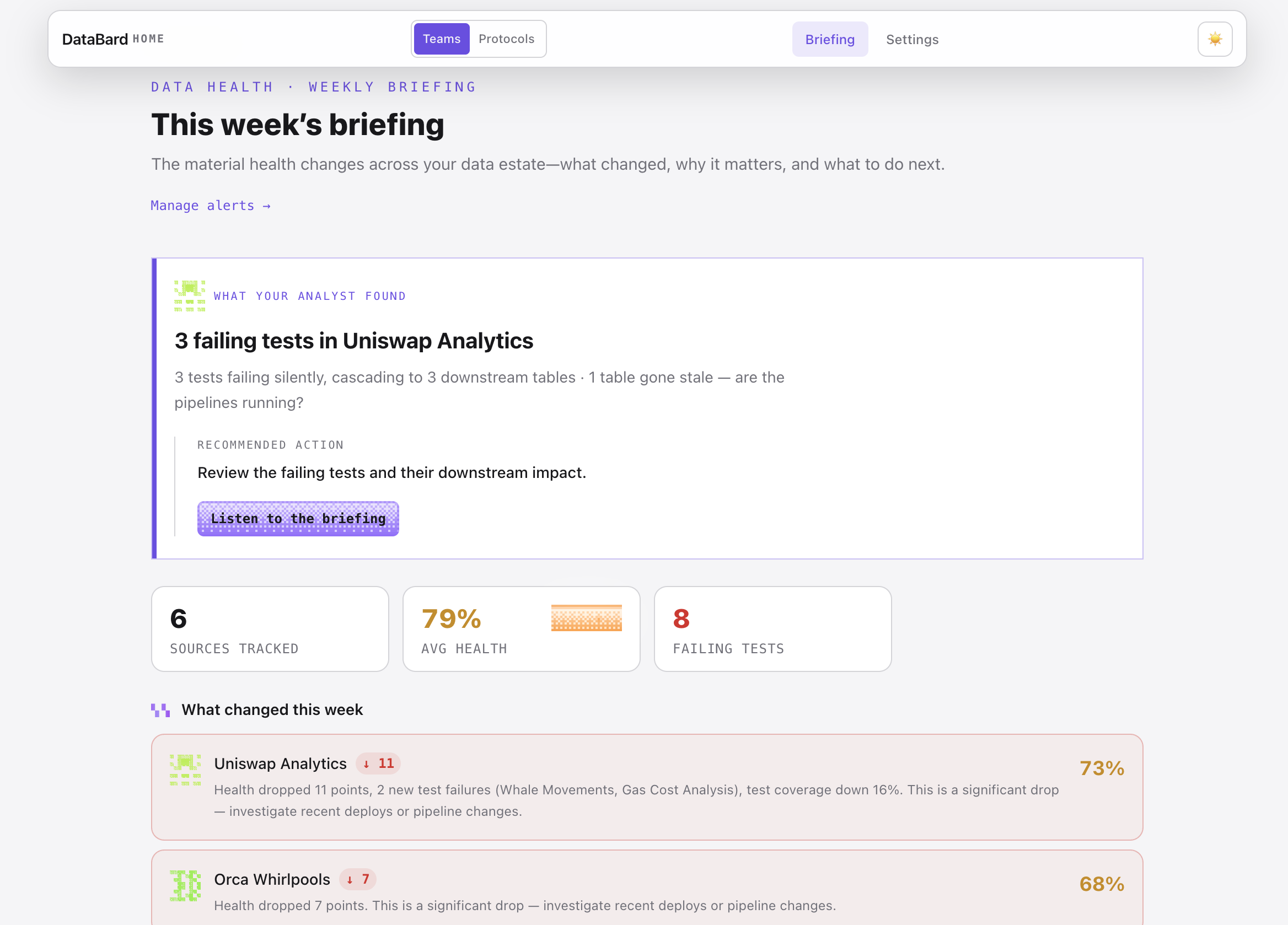
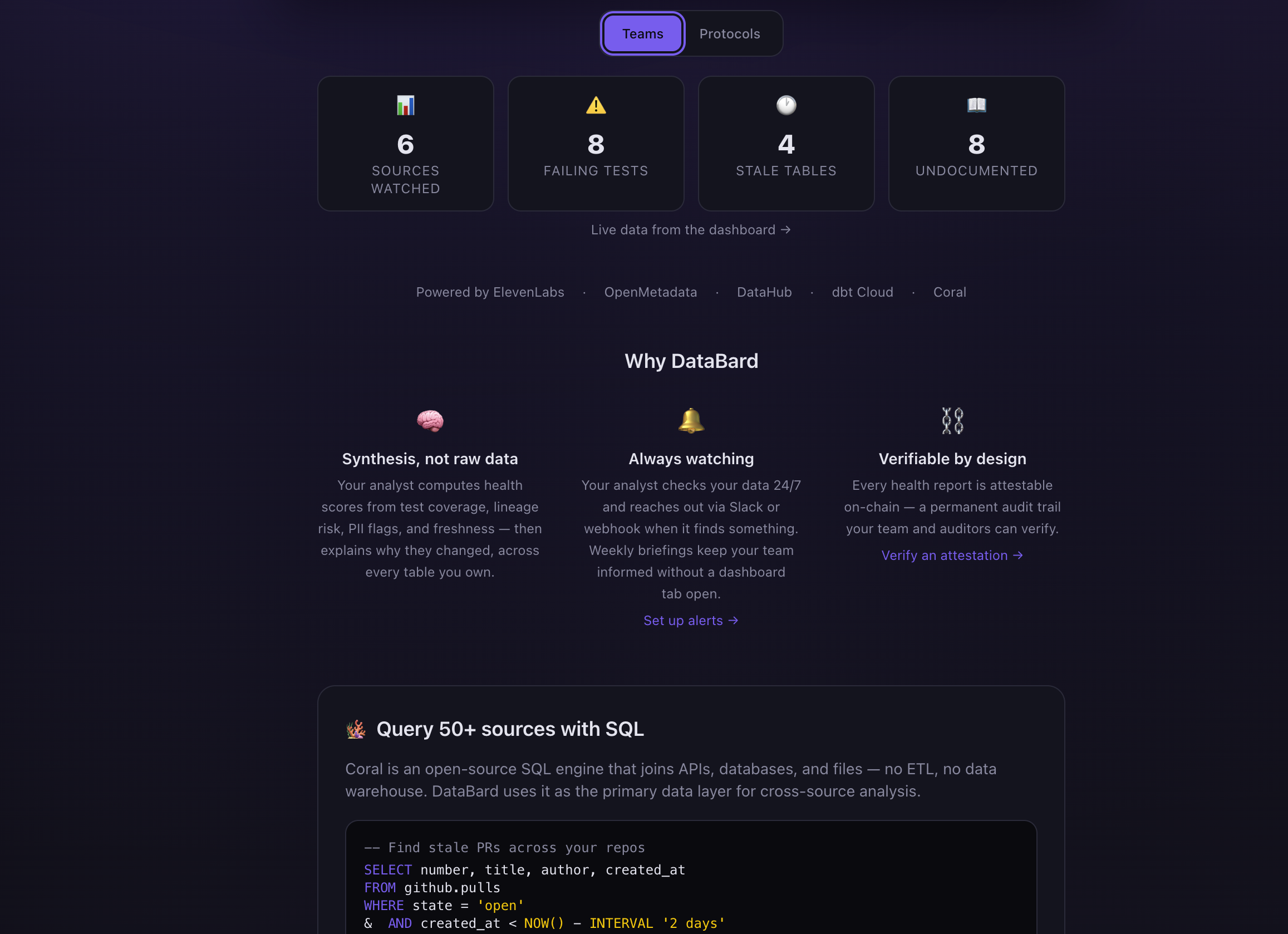
DataBard is an AI data analyst built on DataHub's Context Platform. It connects to a DataHub GMS instance, reads datasets, lineage, ownership, tags, glossary terms, assertions, and dataset profiles through GraphQL, then scores the health of the entire estate, identifies critical risks, and prioritizes what to fix first using lineage-aware blast radius analysis. It generates a conversational "fleet town hall" audio briefing, writes governance improvements back into DataHub with AI-authored summaries, tags, and ownership suggestions, and exposes every capability as A2MCP tools so other agents can use it programmatically.
How we built it
We built DataBard as a Next.js 16 application with a lightweight GraphQL adapter that talks directly to DataHub's GMS API, avoiding SDK dependencies. Our analysis engine computes dataset health, criticality, and lineage-aware cascade impact using a cycle-safe BFS over downstream lineage. The synthesis layer generates natural-language summaries and two-host audio briefings using OpenAI-compatible models and ElevenLabs, while the write-back engine safely applies governance metadata through DataHub's mutation APIs. The same engine powers both the web app and stateless A2MCP endpoints, backed by deterministic unit tests and deployed in production.
Challenges we ran into
The hardest challenge was moving beyond simple lineage into meaningful impact analysis. We built a cycle-safe transitive traversal that handles complex lineage graphs and ranks risk the way a human analyst would. Writing back into a governance platform was equally challenging, so we made every change idempotent, attributed, and non-destructive. Finally, we separated one-shot agent workflows from longer-running recurring features to keep the platform stateless, portable, and easy for other agents to consume.
Accomplishments that we're proud of
We're most proud of creating a complete agent loop: DataBard reads the metadata graph, reasons across the entire estate, produces an executive audio briefing, and writes actionable governance improvements back into DataHub. We also built a robust, tested blast-radius algorithm, shipped the entire pipeline to production, and prepared an open-source contribution documenting the lineage impact analysis approach for the wider DataHub community.
What we learned
We learned that context alone isn't the product—action is. DataHub provides the understanding agents need, but the real value comes from translating metadata into prioritized decisions people can trust. Safe, attributed write-back proved just as important as analysis itself, and ranking issues by downstream impact consistently aligned the agent's recommendations with how experienced data teams actually prioritize incidents.
What's next for DataBard
Next, we want to contribute our lineage impact analysis back to the DataHub ecosystem through documentation and an Agent Context Kit Skill. Beyond that, we're extending DataBard from recommendations into guarded automation by drafting issues, runbooks, and governance updates for human approval, while expanding support for additional metadata sources and continuing to harden the platform for production-scale deployments.
Built With
- datahub
- elevenlabs
- graphql
- next
- react

Log in or sign up for Devpost to join the conversation.