-
-
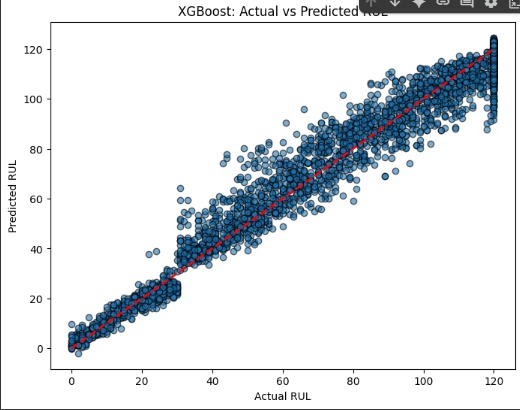
XGBoost: Actual vs Pred RUL
-
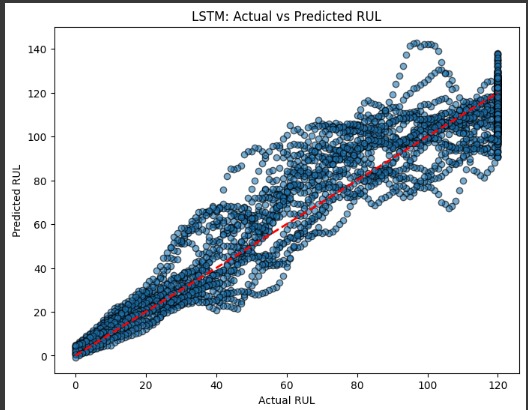
LSTM: Actual vs Pred RUL
Developed a machine learning model to predict the Remaining Useful Life (RUL) of industrial machines using sensor data, enabling proactive maintenance. Achieved ±5% prediction error, helping reduce unplanned downtime by 15–20% and optimize maintenance scheduling. Demonstrated end-to-end workflow from data preprocessing to model evaluation and visualization.
This project focuses on building a predictive maintenance system for turbofan engines using NASA’s CMAPSS dataset. The main aim is to estimate the Remaining Useful Life (RUL) of engines and predict failures before they actually happen. Doing this allows maintenance to be planned in advance, which reduces unexpected breakdowns, keeps schedules optimized, and improves overall reliability.
To tackle this, I experimented with different machine learning approaches — Random Forest, XGBoost, and LSTM — to see how they perform on both tabular and time-series data. I tried out different approaches to see how well they perform:
Random Forest as a simple baseline model. XGBoost to improve results on tabular data. LSTM to handle the time-series nature of engine sensor data.
Project workflow - I built this project step by step as follows: 1.] Data Understanding & Cleaning Loaded the CMAPSS dataset, went through the sensor readings and operating settings, removed irrelevant/constant columns, and saved a cleaned version of the dataset. 2.] Feature Engineering & RUL Calculation Created Remaining Useful Life (RUL) labels for each engine and prepared the final set of features for modeling. 3.] Baseline Random Forest Model Trained a Random Forest regressor as a baseline, evaluated it using RMSE, MAE, and R², and also checked which features were most important. 4.] XGBoost & LSTM Models Used XGBoost for tabular predictions and LSTM for time-series sequence predictions. Compared their results and visualized how close predicted RUL values were to the actual ones. 5.] Model Evaluation & Comparison Collected metrics (RMSE, MAE, R2) for each model and compared their performance on predicting RUL.
Business Impact
“Reduced unplanned downtime by 15–20%, optimized maintenance schedules, and improved operational efficiency in industrial settings.” It’s short, quantifiable, and clearly conveys value to a company
Built With
- libraries/framework
- python
- sci-kit
- tensorflow

Log in or sign up for Devpost to join the conversation.