

For the past 60 years, we've explored the hydrocarbon energy hidden under the rocks using different seismic technology to create maps of subsurfaces. We could only partially utilize the information we collected through various techniques for a long time because the supercomputer couldn't handle the complexity. Things changed when a technology called full waveform inversion appeared. Full waveform inversion (FWI) is a data-driven technology that can use all the seismic data to understand the properties of the subsurface. FWI can process all seismic waves or full wave fields through computer simulation to create a picture of the subsurface in rich detail. This process utilized seismic data to train the deep neural network. The resulting model can give the most geologically accurate map of our subsurfaces.
This project is relevant to the following ethical issues. Many sources of actual seismic data are protected under copyright or not available to the general public. However, a significant amount of data is required for training the model. In this project, I use OpenFWI, a collection of large-scale, multi-structural benchmark datasets for machine learning-driven seismic FWI. OpenFWI is the first open-source platform to facilitate data-driven FWI research. Deep learning is a good approach for FWI problems because the inverse is an ill-posed problem and analytically unsolvable.
Current researchers utilized an open-source dataset named open FWI to train their models. The FWI problem has been attempted by four deep-learning methods: InversionNet, VelocityGAN, UPFWI, and InversionNet3D. This project uses deep neural operators (DeepONet) in this project to solve the FWI problems. It will be the first time DeepONet is used to solve the FWI problem.
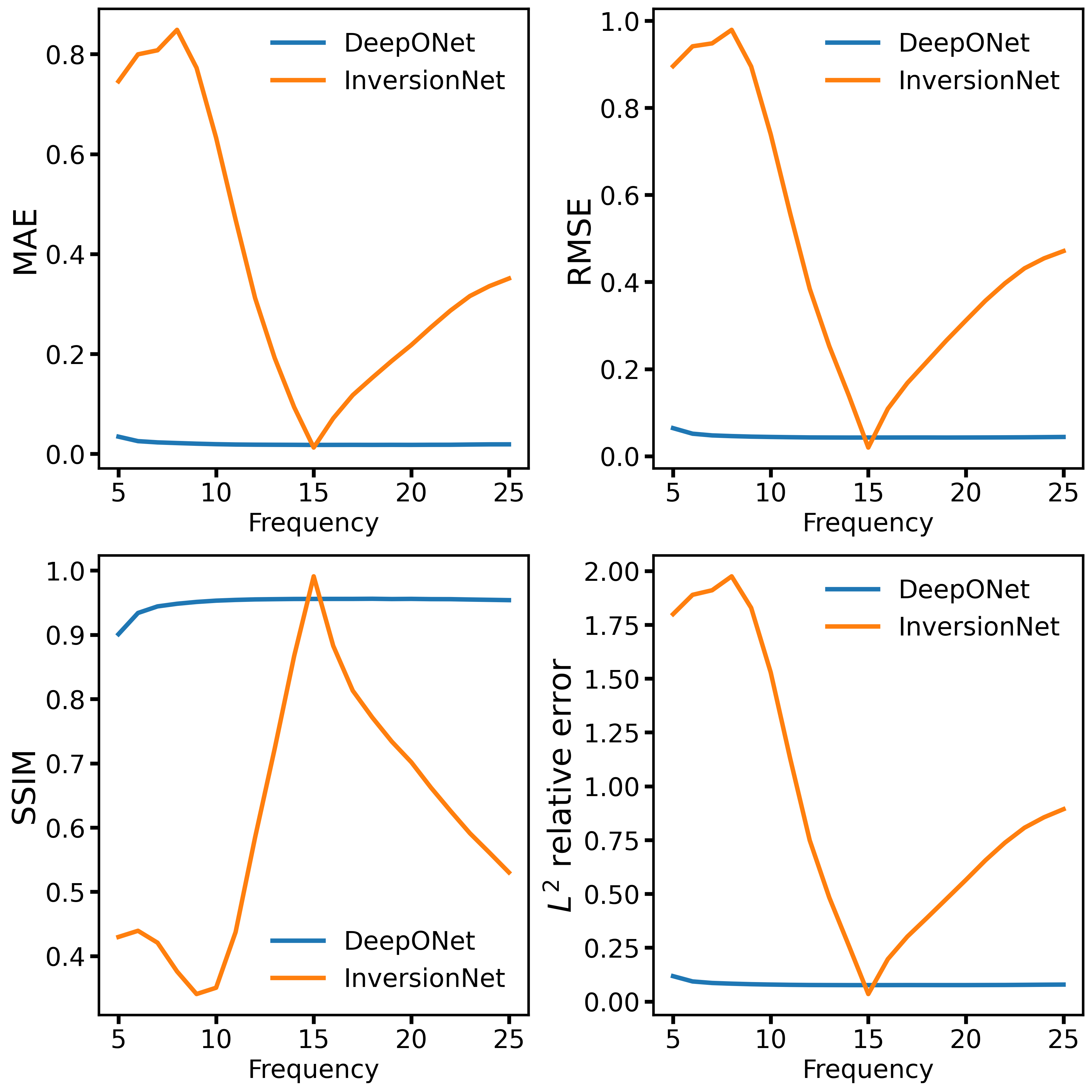
The following three metrics are used to measure the performance of the model: mean absolute error (MAE), rooted mean squared error (MSE), and structural similarity (SSIM). MAE and RMSE capture the numerical difference between the predicted and true velocity maps. SSIM measures the perceptual similarity between two images.
DeepONet has a significant advantage over InversionNet since it can train and predict various frequencies of sources. DeepONet is trained from 5 Hz to 25 Hz in the figure above. However, InversionNet can only train and predict at a fixed frequency. In this case, the InversionNet is trained at 15 Hz. Current results show that DeepONet can achieve relatively stable and low error across the different frequencies of sources. Since the InversionNet is trained at 15 Hz, it performs better than DeepONet when the frequency is 15 Hz. The current challenge is to improve the accuracy of DeepONet so it can have comparable performance with InversionNet even at 15 Hz.
Built With
- deepxde
- openfwi
- python


Log in or sign up for Devpost to join the conversation.