-
-
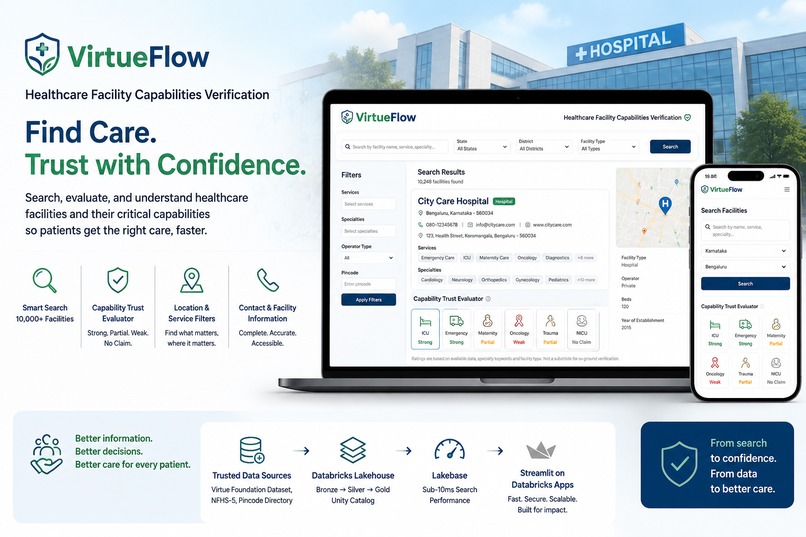
Interface
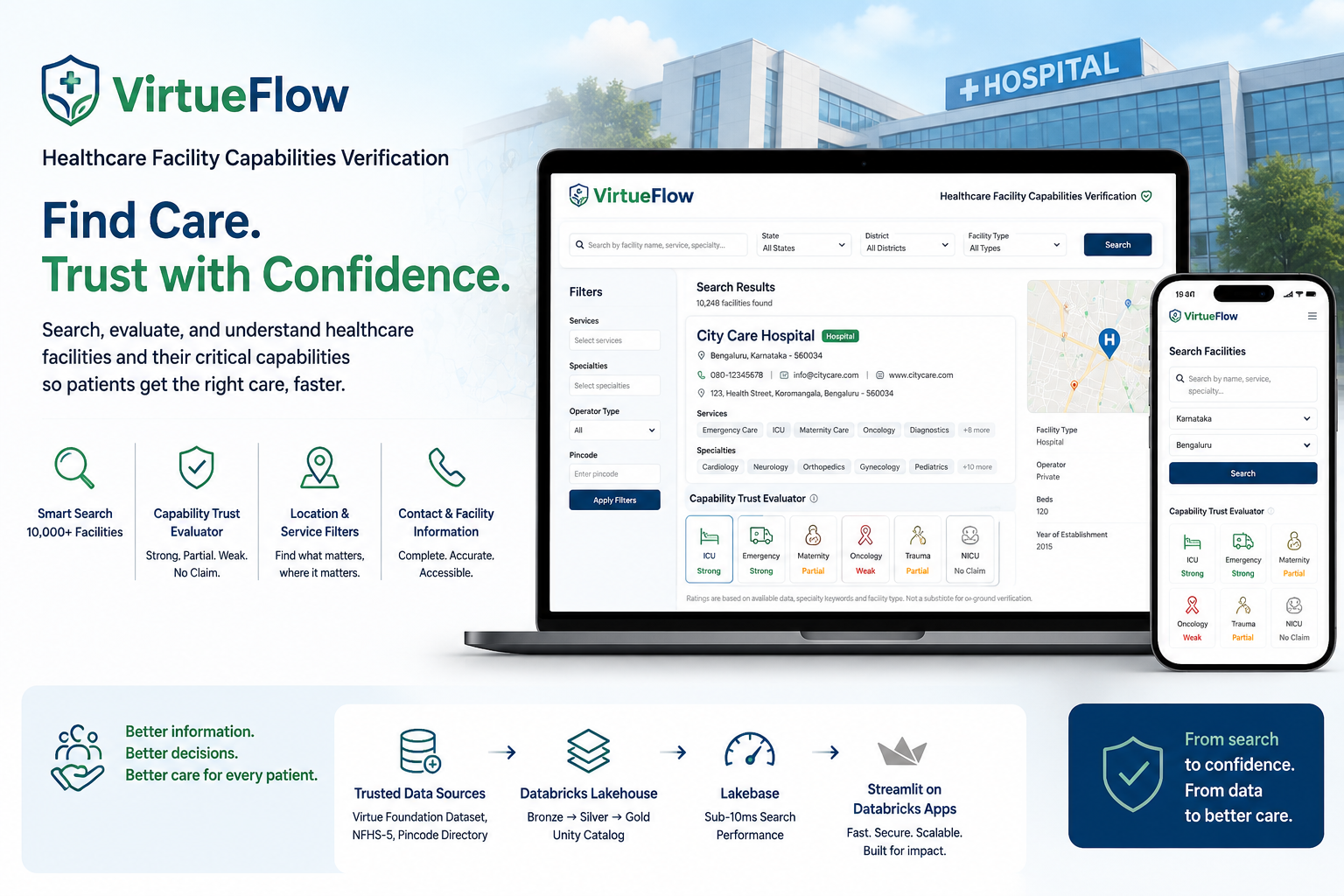
Inspiration
Healthcare facility information is often fragmented, inconsistent, and hard to trust. A facility may list services, specialties, equipment, or contact details, but it is not always clear whether it truly supports critical capabilities like ICU, emergency care, maternity, oncology, trauma, or NICU.
We built Healthcare Facility Capabilities Verification to help users move from raw facility records to faster, more confident decisions. The goal was to create a healthcare facility finder that does more than search. It helps users evaluate whether a facility’s claimed capabilities are supported by the available data.
What it does
Healthcare Facility Capabilities Verification is a healthcare facility finder and capability trust evaluator built on the Databricks Virtue Foundation Dataset.
The app allows users to search over more than 10,000 healthcare facilities using facility name, location, state, district, pincode, services, specialties, operator, and facility type. It also displays useful facility information such as address, phone, email, website, and service details.
The key differentiator is the Capability Trust Evaluator. For each facility, Healthcare Facility Capabilities Verification evaluates claims around ICU, Emergency, Maternity, Oncology, Trauma, and NICU. Each capability is rated as Strong, Partial, Weak, or No Claim based on specialty keyword frequency and facility type.
Instead of only helping users find a facility, VirtueFlow helps them understand how much confidence they should place in that facility’s stated capabilities.
How we built it
We built Healthcare Facility Capabilities Verification using a Databricks-native architecture with Unity Catalog, medallion data layers, Lakebase, and a Streamlit web interface.
The source data comes from the Databricks Virtue Foundation Dataset for DAIS 2026, including healthcare facility records, India pincode directory data, and NFHS-5 district health indicators.
We organized the project into a Bronze, Silver, and Gold architecture:
- Bronze layer ingests the raw marketplace tables and adds ingestion metadata.
- Silver layer cleans, standardizes, deduplicates, and validates the data.
- Gold layer creates a search-optimized facility view for app consumption.
- Lakebase continuously syncs the curated data to support sub-10ms search queries.
- Streamlit on Databricks Apps provides the user-facing facility finder experience.
The app is deployed through Databricks Apps with service-principal permissions and Unity Catalog access controls. The target schema is main.healthcare_facility_finder.
Challenges we ran into
One of the biggest challenges was turning raw healthcare facility data into something that is searchable, reliable, and useful for decision-making. The data needed cleaning, standardization, deduplication, and business-rule validation before it could support a good user experience.
Another challenge was designing the capability trust logic. It is easy to show search results, but harder to communicate whether a facility’s claim is strong, partial, weak, or unsupported. We had to create a practical scoring approach using specialty keywords, facility type, and available structured data.
We also had to work through the Databricks deployment path, including Unity Catalog schema setup, Lakebase provisioning, continuous sync, index recommendations, app deployment, and service-principal permissions.
Accomplishments that we're proud of
We are proud that Healthcare Facility Capabilities Verification is more than a basic facility search tool. It combines fast search, governed data architecture, and capability trust evaluation in one application.
We built an end-to-end Databricks-native solution: ingestion, transformation, curation, Lakebase sync, and Streamlit app deployment. The application supports smart search, geographic filters, service category filters, contact details, and real-time facility lookup with sub-10ms Lakebase-backed queries.
We are especially proud of the Capability Trust Evaluator because it moves the app from “find me a facility” to “help me understand whether this facility’s capabilities look credible.”
What we learned
We learned that healthcare facility discovery is not just a search problem. It is also a trust problem. Users need to know not only where facilities are located, but whether the data supports the capabilities those facilities appear to claim.
We also learned how powerful the Databricks Lakehouse architecture can be for this type of application. Bronze, Silver, and Gold layers helped us separate raw ingestion, data quality, and app-ready search optimization. Lakebase gave us a way to support fast application queries while keeping the data pipeline connected to governed Unity Catalog tables.
Most importantly, we learned that the user experience matters. A good healthcare data app should not expose users to raw tables first. It should help them search, filter, compare, and make decisions quickly.
What's next for Data Avengers - VirtueFlow
Next, we would make the capability trust evaluator more advanced and evidence-driven. Today, the scoring is based on specialty keyword frequency and facility type. With more time, we would add stronger weighting, richer validation rules, source-level evidence, and confidence explanations.
We would also expand the app to support more planning workflows, such as regional care gap analysis, facility comparison, emergency preparedness views, and district-level health insights using NFHS-5 indicators.
Another next step is adding human-in-the-loop review so users can confirm, override, or annotate facility capability ratings. That would make VirtueFlow more useful for NGOs, public health planners, and healthcare operations teams that need both automation and accountability.
The larger vision is for Healthcare Facility Capabilities Verification to become a trusted facility intelligence layer: fast enough for search, governed enough for enterprise use, and transparent enough to support real healthcare planning decisions.
Built With
- and-gold-data-layers-managed-in-unity-catalog.-we-used-the-databricks-virtue-foundation-dataset-from-the-marketplace-as-the-primary-data-source
- and-nfhs-5-district-health-indicators.-for-the-app-layer
- bronze-silver-gold-architecture
- capability-trust-evaluation
- claude
- data-engineering
- data-quality
- databricks
- databricks-apps
- databricks-marketplace
- databricks-notebooks
- district
- facility-search
- giving-us-postgresql-compatible
- health
- healthcare-data
- ibm-bob
- including-facility-records
- india-pincode-data
- india-pincode-directory
- lakebase
- medallion-architecture
- nfhs-5
- postgresql
- python
- silver
- sql
- streamlit
- sub-10ms-facility-lookup-performance.-the-project-was-developed-and-deployed-through-databricks-notebooks
- unity-catalog
- virtue-foundation-dataset
- we-curated-a-gold-facility-search-view-and-synced-it-to-lakebase
- we-used-streamlit-deployed-through-databricks-apps.-for-fast-search

Log in or sign up for Devpost to join the conversation.