🧾 Inspiration
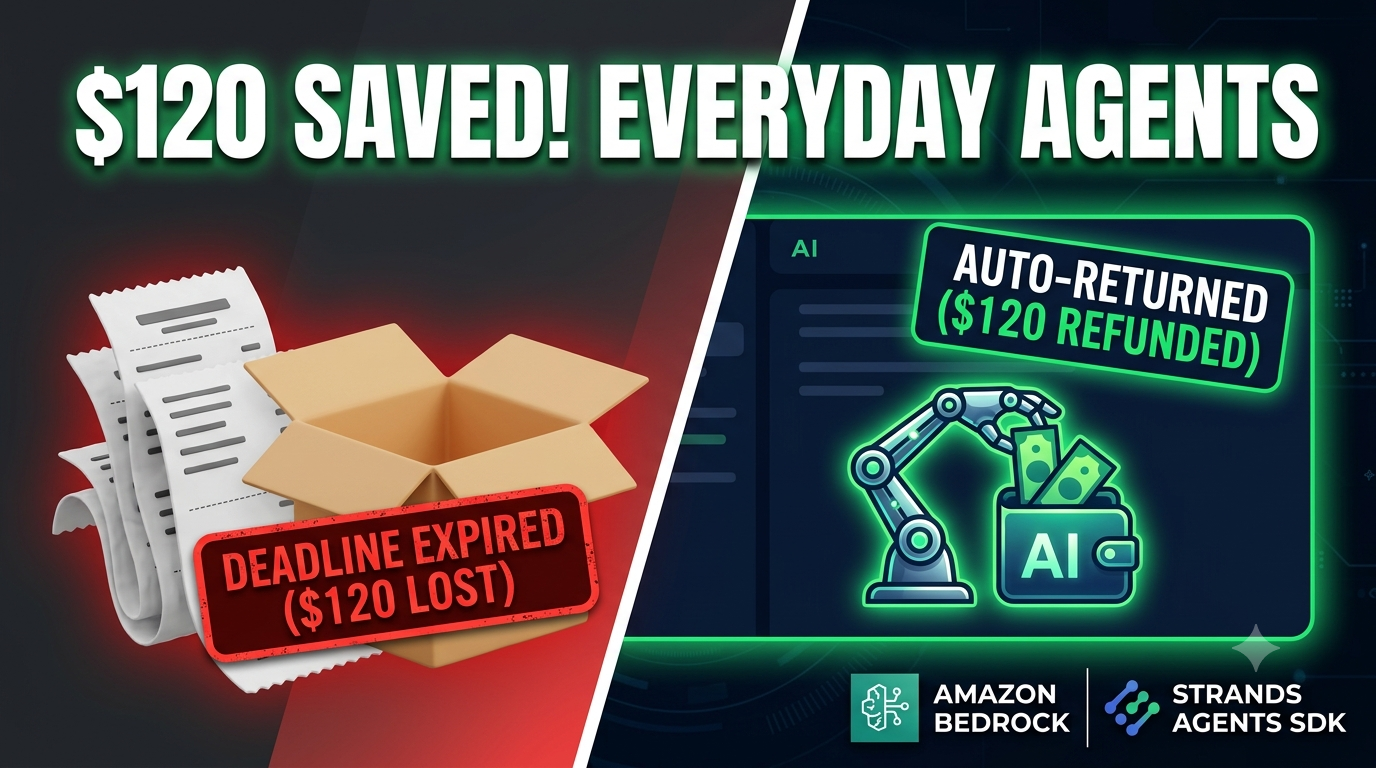
Retailers give you 15–30 days to return something — but the receipts live in four different places: one store's email, another's paper slip, a third app's order history. Nobody tracks all those deadlines in one spot, so people lose real money just because a window quietly closed while they weren't looking. That is exactly the kind of small, repetitive, money-losing chore the Everyday Agents track is about, so I built an agent that quietly handles it.
🤖 What it does
Return Window Tracker watches every purchase's return deadline and:
- Computes each item's exact deadline and status: SAFE, ACT_SOON, EXPIRED, or ALREADY_FLAGGED_FOR_RETURN.
- Decides — on its own — what it can auto-handle vs. what needs you. It only surfaces an item for a human decision when it truly matters: the item is expensive (≥ $150), the deadline is today/tomorrow, your reason sounds uncertain, or the window already closed on something you wanted to return.
- Auto-drafts a polite, copy-and-send return-request message for every actionable item.
- Produces a prioritized daily digest that leads with what needs you, then what it handled for you.
- Remembers across runs (a small state file) so it only re-nudges you when something is genuinely new or newly urgent — like a real background agent.
🧠 How I built it
The core design decision: separate the deterministic work from the language work. An LLM should not be computing "is purchase date + 30 days still in the future?" — get that wrong and you lose money. So:
- Two deterministic Python
@toolfunctions own everything correctness- critical:check_return_deadlines(all date math + status) anddecide_autonomy(the auto-handled-vs-needs-you escalation policy). This is auditable Python, never LLM guesswork. - The LLM on Amazon Bedrock (via the Strands Agents SDK) is used only for what it's great at: drafting the return messages and the digest.
- Strands structured output (Pydantic) returns a reliably-typed result.
- The same
agent.pycore powers three interfaces: a CLI, a Streamlit web UI, and a Bedrock AgentCore Runtime entrypoint — no logic duplicated. - A public-friendly Offline mode runs the full deterministic engine with template messages, so anyone can try the demo with no AWS keys and no login.
🚧 Challenges I ran into
- LLM-written JSON kept breaking (bad escape characters). I fixed it properly by switching to Strands structured output instead of hand-parsing JSON.
- Letting the public try it without credentials. AWS can't hand a browser's console session to a web app, so I built a keyless Offline mode as the default and an optional, session-only "bring your own temporary credentials" path.
🏆 Accomplishments I'm proud of
- A genuinely autonomous Everyday Agent that acts on the safe cases and only interrupts you for real decisions.
- Correctness is deterministic and auditable, not left to the model.
- Anyone can try the live demo instantly — no keys, no login.
📚 What I learned
- Push correctness into deterministic tools; let the LLM handle prose.
- The escalation policy is the product for an Everyday Agent.
- Use the SDK's structured output — don't hand-parse LLM JSON.
🚀 What's next
- Real receipt/email ingestion, calendar reminders, and one-click return filing.
🛠️ Disclosure
Newly built during the submission period. Developed with the help of an AI coding assistant (permitted by the rules) — no pre-existing project was reused. All data shown is synthetic.
Built With: Strands Agents SDK on Amazon Bedrock (with a Bedrock AgentCore Runtime entrypoint). All demo data is synthetic.
Built With
- ai-agents
- amazon-bedrock
- amazon-web-services
- bedrock-agentcore
- boto3
- generative-ai
- github
- llm
- pydantic
- python
- strands-agents
- streamlit

Log in or sign up for Devpost to join the conversation.