-
-
logo
-
ui
Darwin Prompt — Project Summary
The Unconventional Connection
Darwin Prompt is built on a single unexpected insight: the rules that govern biological evolution and the process of AI response generation are structurally identical.
Charles Darwin observed that nature doesn't design the perfect organism — it creates variation, applies selection pressure, and eliminates the weakest until only the fittest survives. We asked: what if an AI system worked the same way?
Most AI tools treat a prompt as a linear transaction — one input, one output. Darwin Prompt treats it as an evolutionary event. Rather than asking one model for one answer, the system throws three competing species of artificial intelligence into a survival trial, subjects them to rigorous natural selection pressure, and lets evolution determine which response deserves to survive.
The connection between Darwin's 1859 theory of natural selection and modern large language model architecture is unconventional precisely because one is biological and the other is computational — yet the underlying mechanics of variation, evaluation and elimination map onto each other with surprising precision.
How It Works
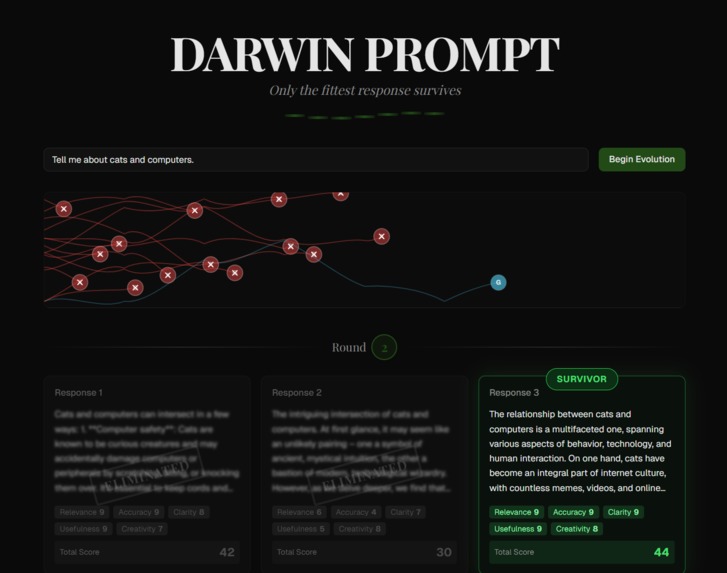
Round 1 — Variation Multiple fundamentally different LLMs — such as Claude (Anthropic), Mistral, and Llama (Meta) — receive the same prompt simultaneously and generate independent responses. Like species in the same ecosystem, each brings genuinely different cognitive strengths, tendencies and blind spots.
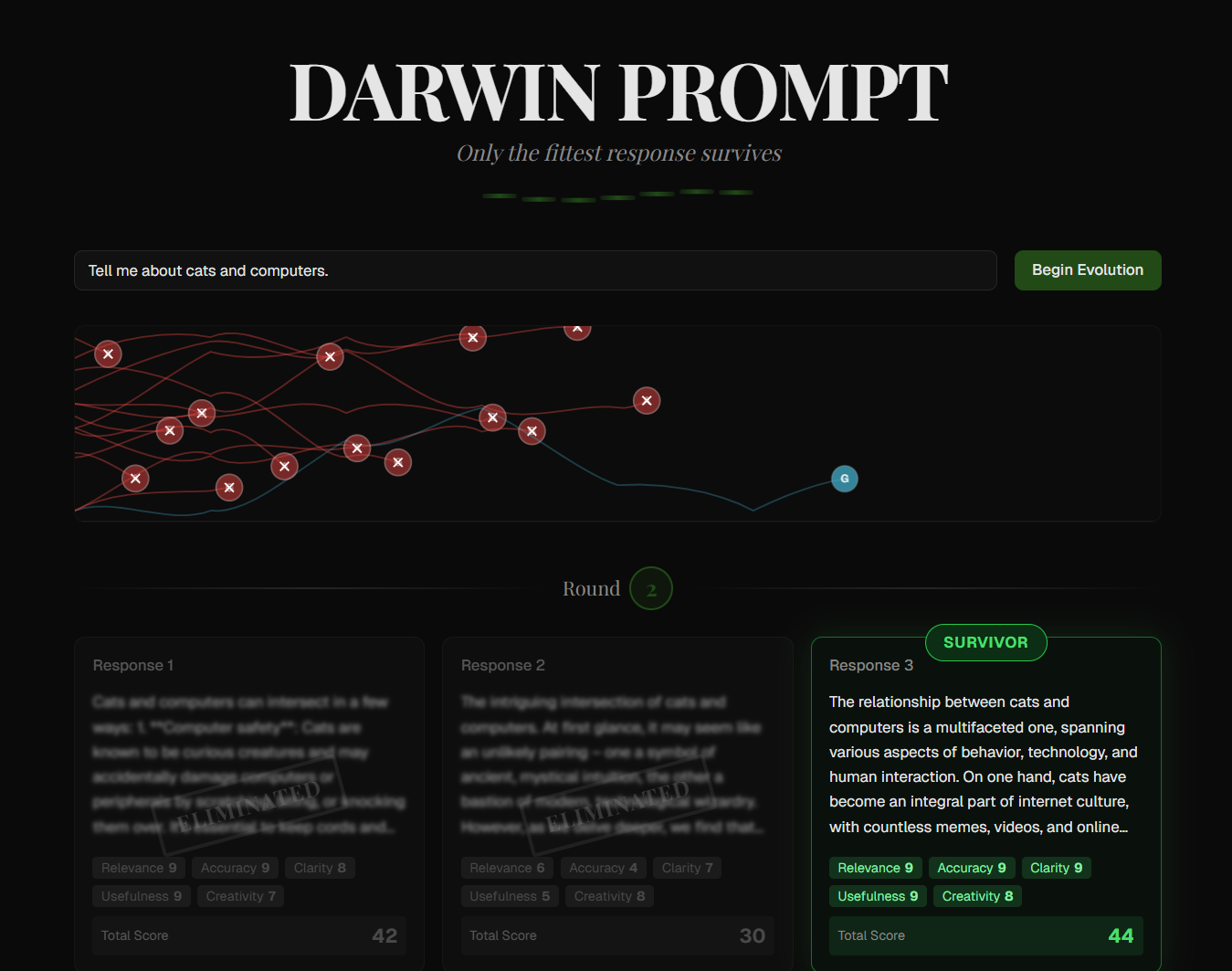
Selection Pressure — The Judge A separate LLM instance acts as the environment's selection pressure, scoring all three responses against a strict five-criteria rubric: relevance, accuracy, clarity, usefulness and creativity. The weakest response is eliminated — not by human judgment, but by the same impartial logic that nature uses.
Mutation Between rounds, the surviving prompt is subtly mutated — rephrased with greater depth and specificity — mirroring how genetic material carries forward with slight variation rather than perfect copying. This is the detail that separates Darwin Prompt from simply running AI multiple times.
Round 2 — Survival of the Fittest Once we get to the two surviving responses, they compete again under the same selection pressure. One is eliminated. The last standing response is declared the winner — not because it was chosen, but because it survived.
The Fossil Record The strongest eliminated responses are preserved in a Fossil Record at the bottom of the interface — a direct nod to how extinct species leave biological traces. The fossils show scores, criteria breakdowns and which round each species perished in, making the full evolutionary story visible.
The Experience
The entire process is narrated in the style of a David Attenborough nature documentary, generated via the ElevenLabs voice API. A BBC-style lower-third banner slides up at each dramatic moment — elimination, survival, victory — while an audio waveform pulses in the corner. The race between species is visualised as a live horizontal track, with each LLM represented by its brand icon advancing toward the finish line or freezing in place upon elimination.
The result is an AI tool that doesn't just produce a good answer — it tells the story of how that answer earned its survival.
Why It Works
Darwin Prompt works as a hackathon project because the unconventional connection isn't cosmetic — it's structural. Every element of the product maps directly onto a real concept from evolutionary theory: variation, selection pressure, mutation, inheritance, extinction and survival. The result is a system that produces meaningfully better answers than a single LLM call, wrapped in a narrative that makes the invisible process of AI evaluation visible, dramatic and human. 🧬

Log in or sign up for Devpost to join the conversation.