-
-

Logo
-
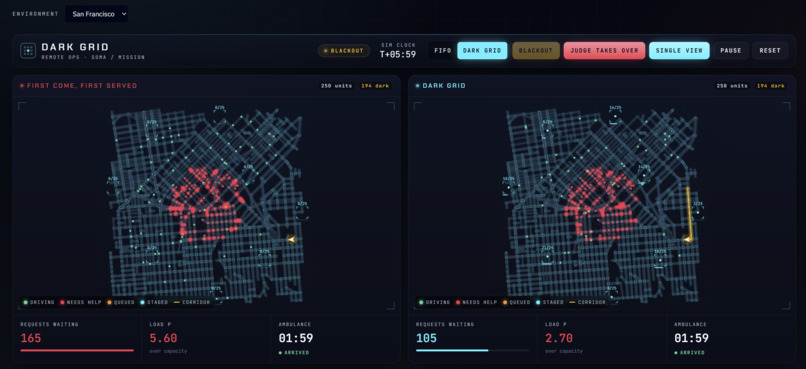
Split View
-
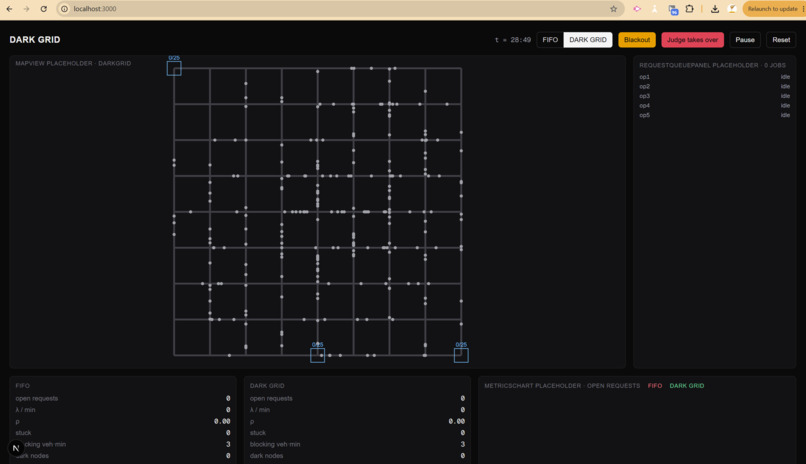
First Draft Mock Data
-
Mock Data
-
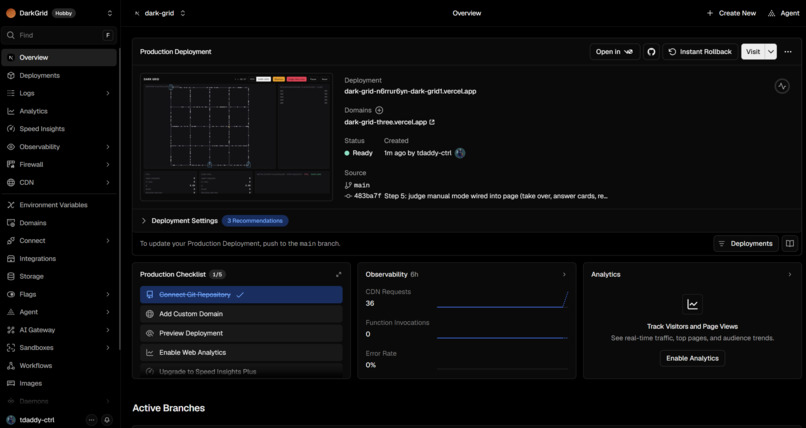
Testing
-
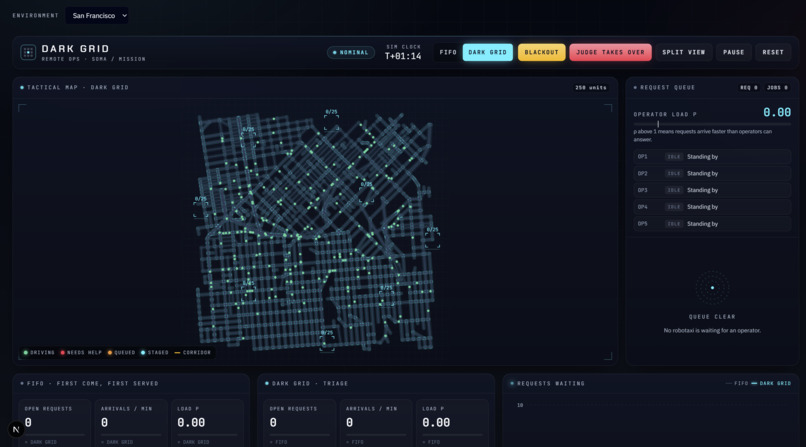
Updated 2d Map
-
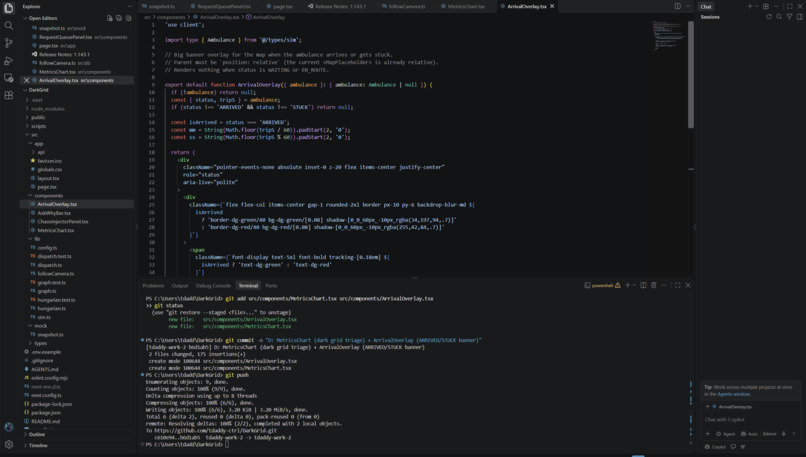
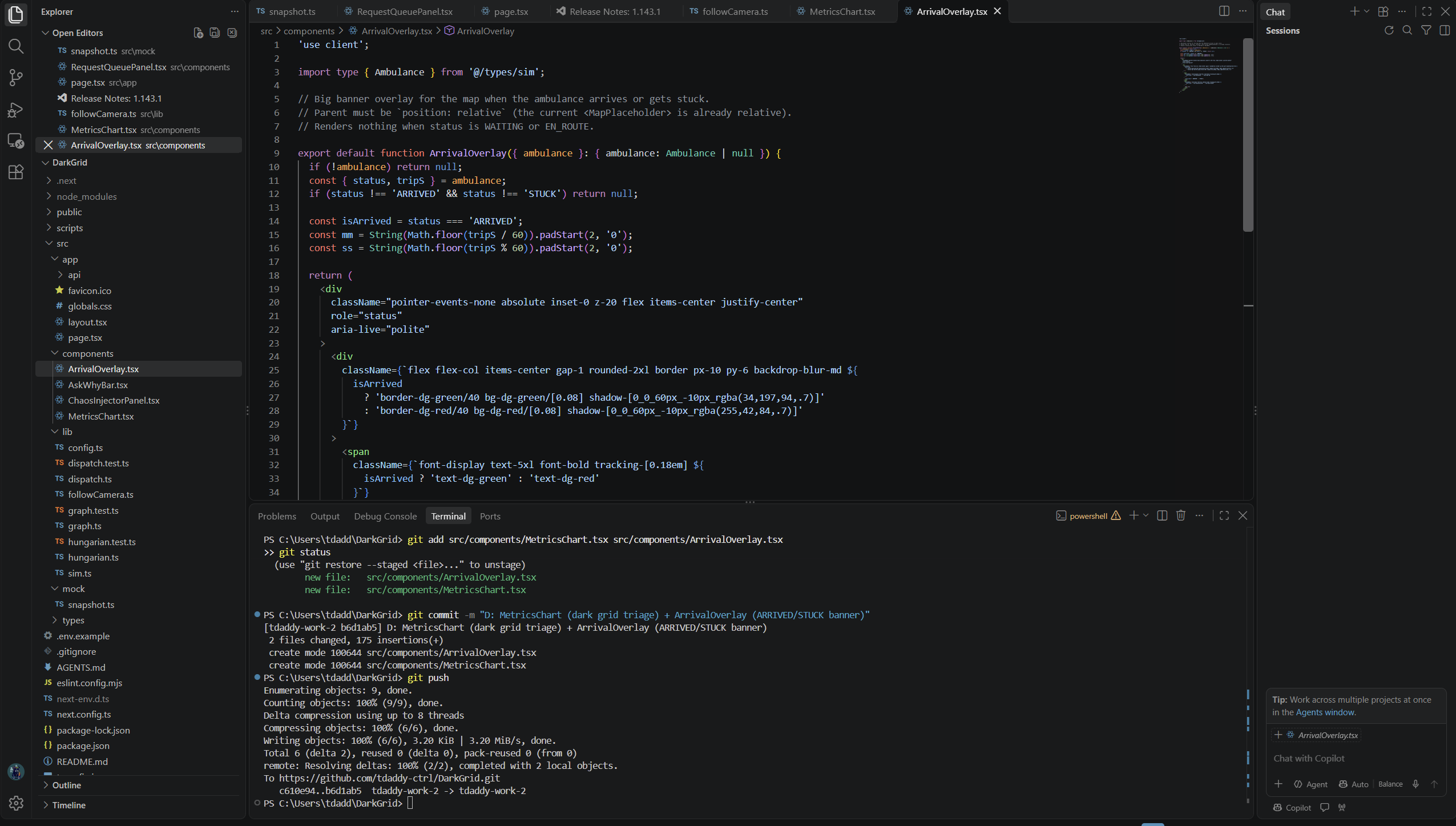
Back End Code of MetricsChart File
-

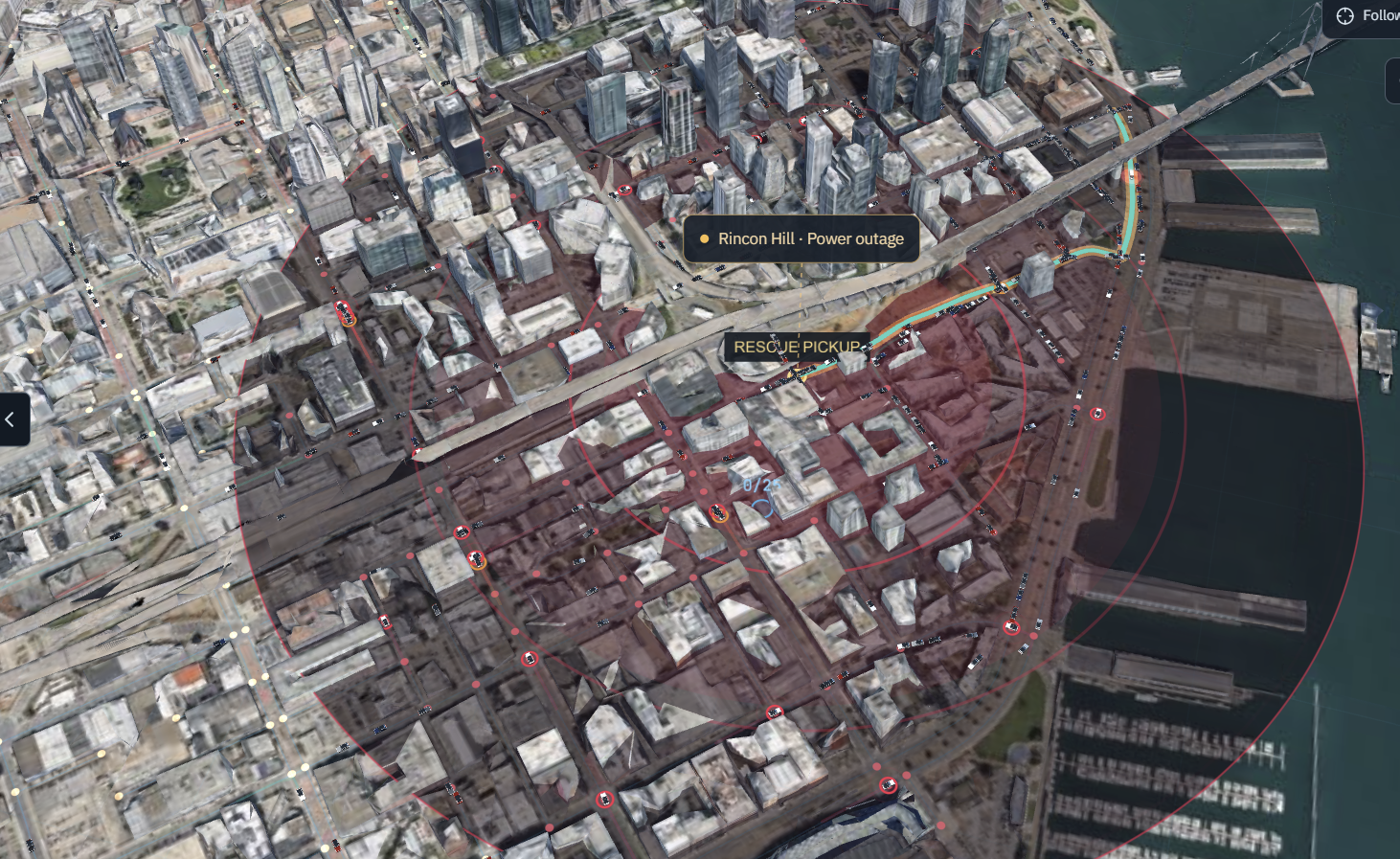
3D Map
-
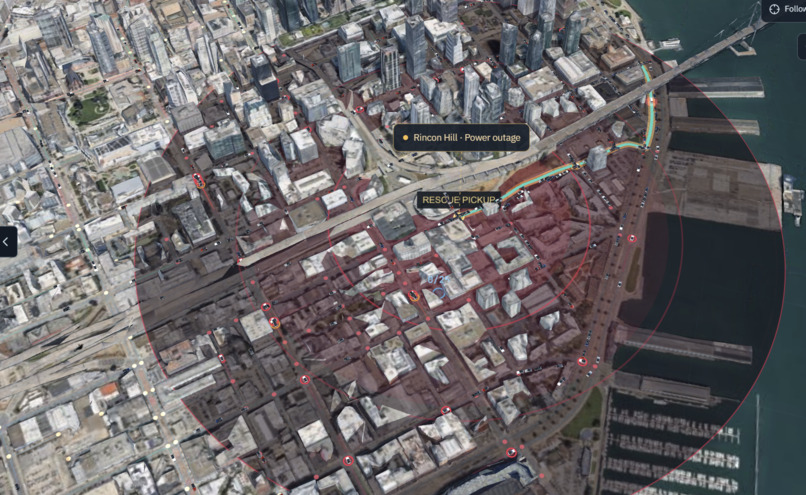
3D Grid
-
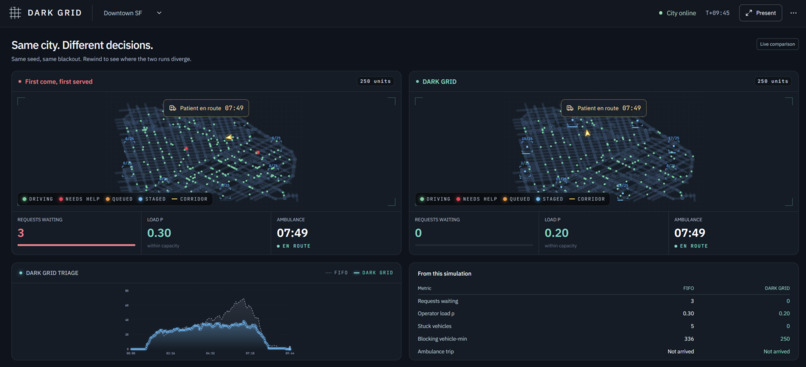
Analysis
-
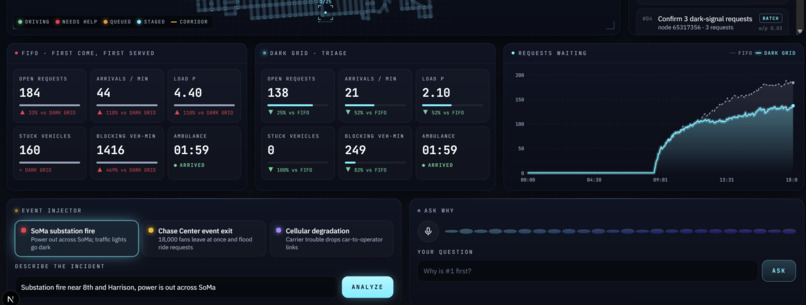
New UI


Inspiration
On December 20, 2025, a PG&E substation fire knocked out power to 130,000 San Francisco customers and disabled traffic lights across the city. Waymo robotaxis, unsure of dark intersections, flooded their remote operators with confirmation requests, causing nearly 1,600 stoppages and a service suspension. This wasn't a driving failure but a queueing collapse where arrival rate λ vastly exceeded human service capacity cμ, pushing utilization ρ above 1. We built DARK GRID to keep that operator queue from collapsing when the grid goes dark.
What it does
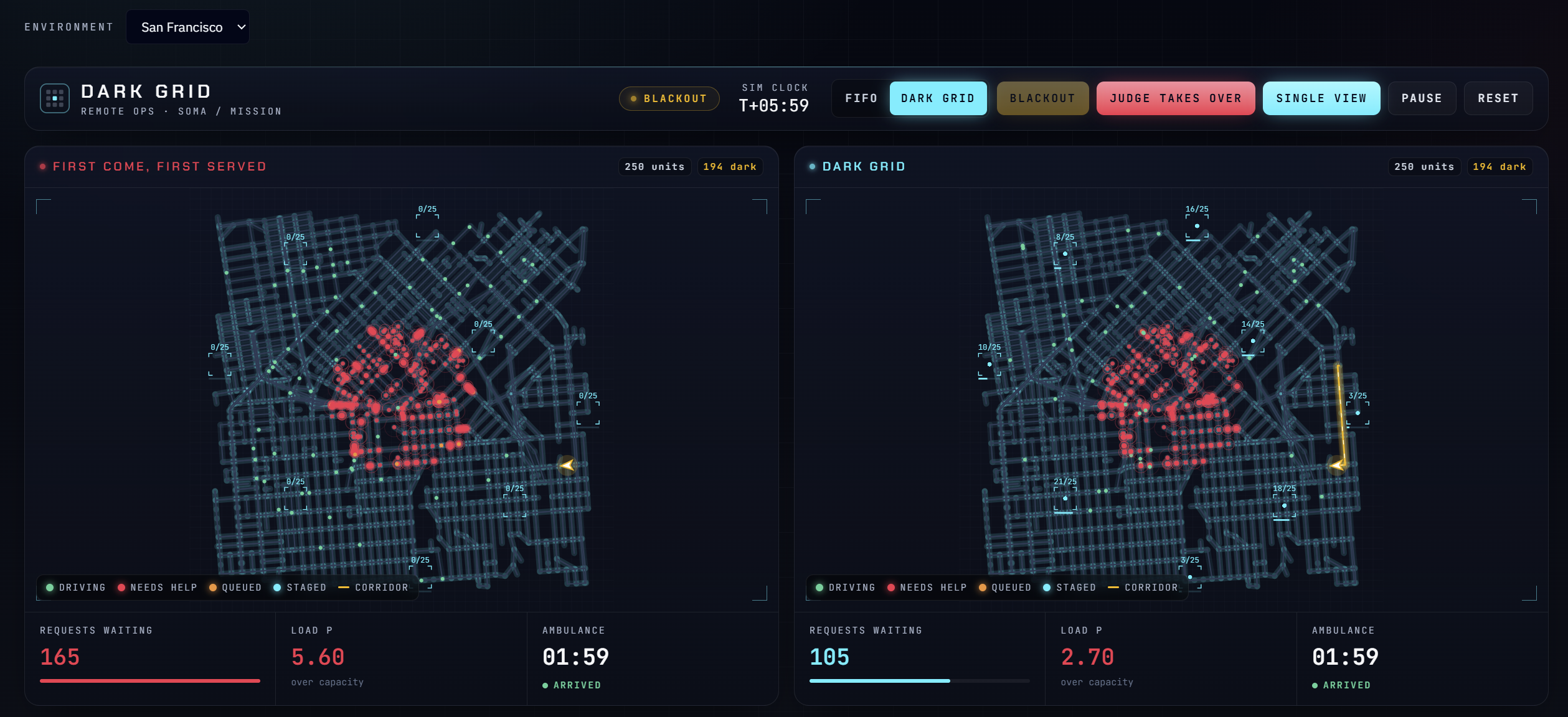
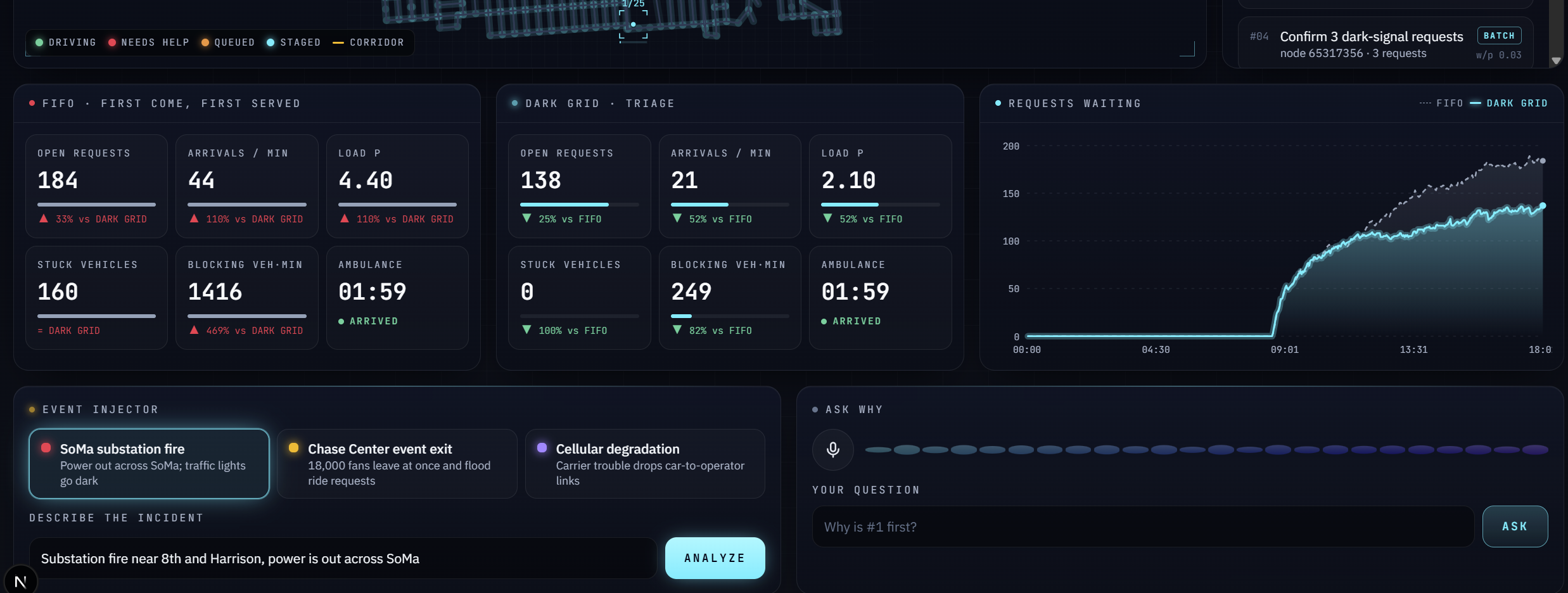
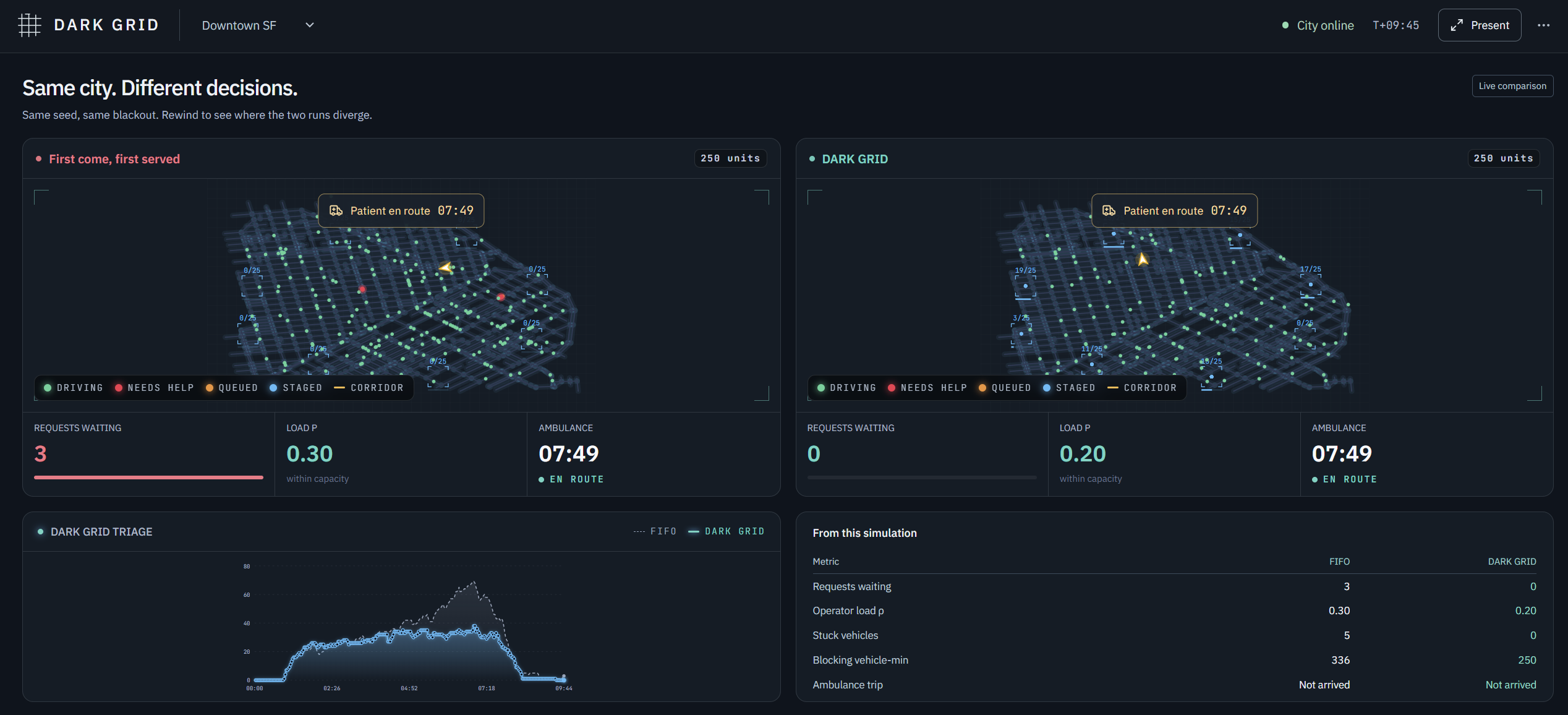
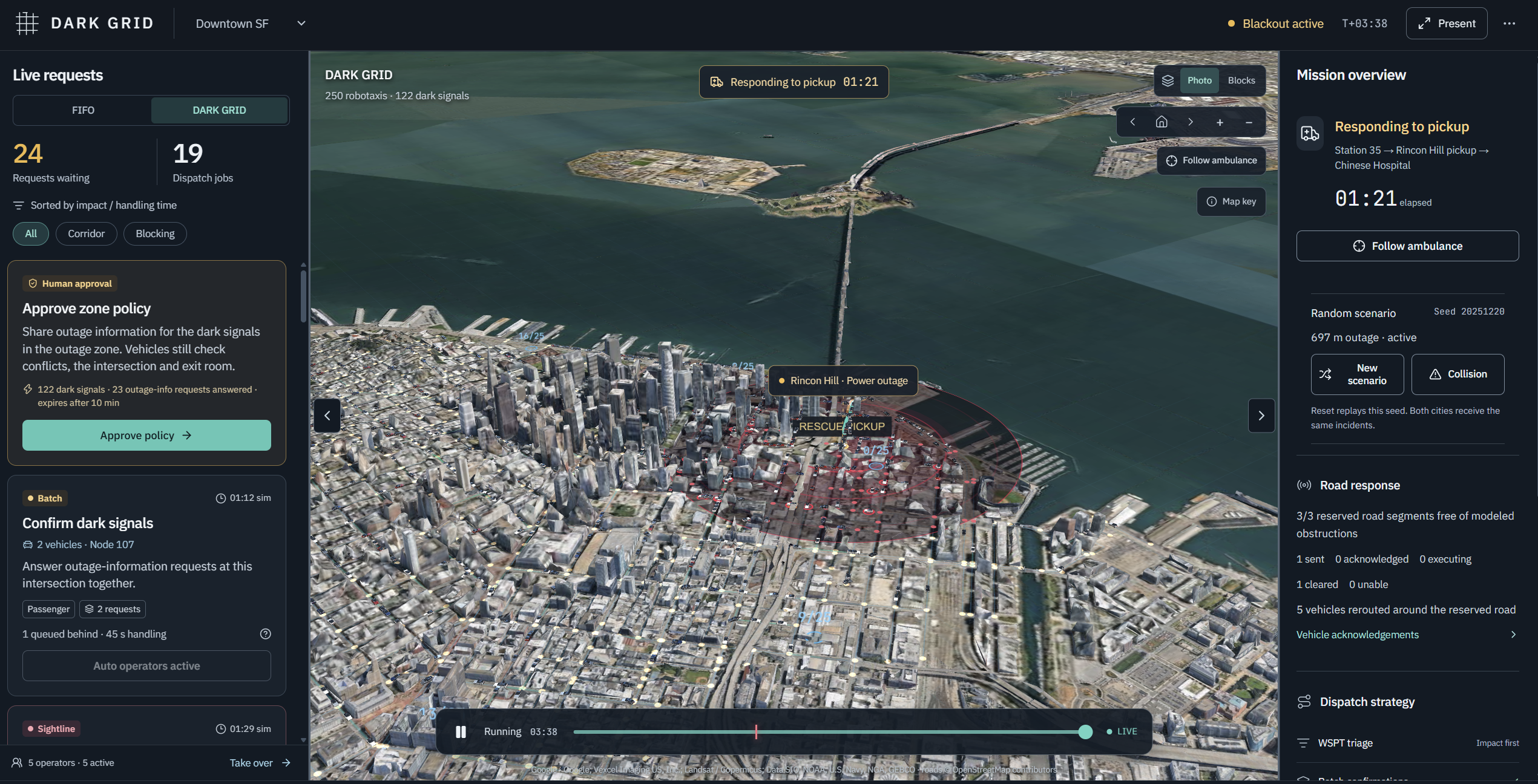
DARK GRID is a dispatch platform for robotaxi fleets during a crisis, ranking help requests by risk using Smith's Rule, batching identical ones, and telling waiting cars to pull over. When operator load ρ exceeds 1, it automatically sheds low-priority requests and pushes zones to clear an ambulance corridor. We prove it works with a controlled experiment, two identical simulated San Francisco cities, same seed and blackout, where FIFO leaves 232 requests and a stuck ambulance while DARK GRID collapses them into 6 jobs and gets the ambulance there in 04:10.
How we built it
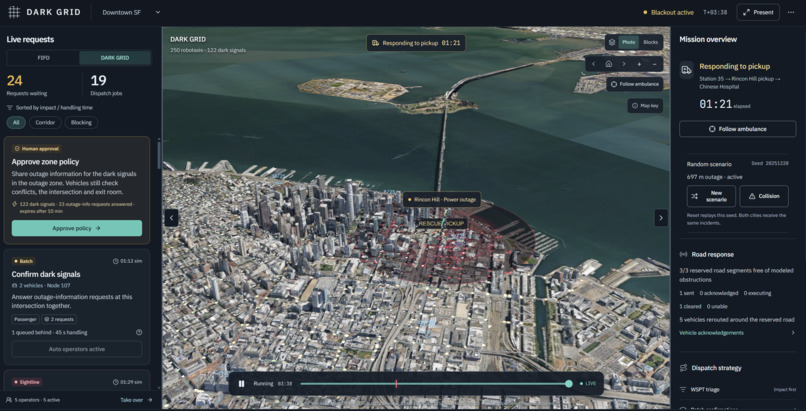
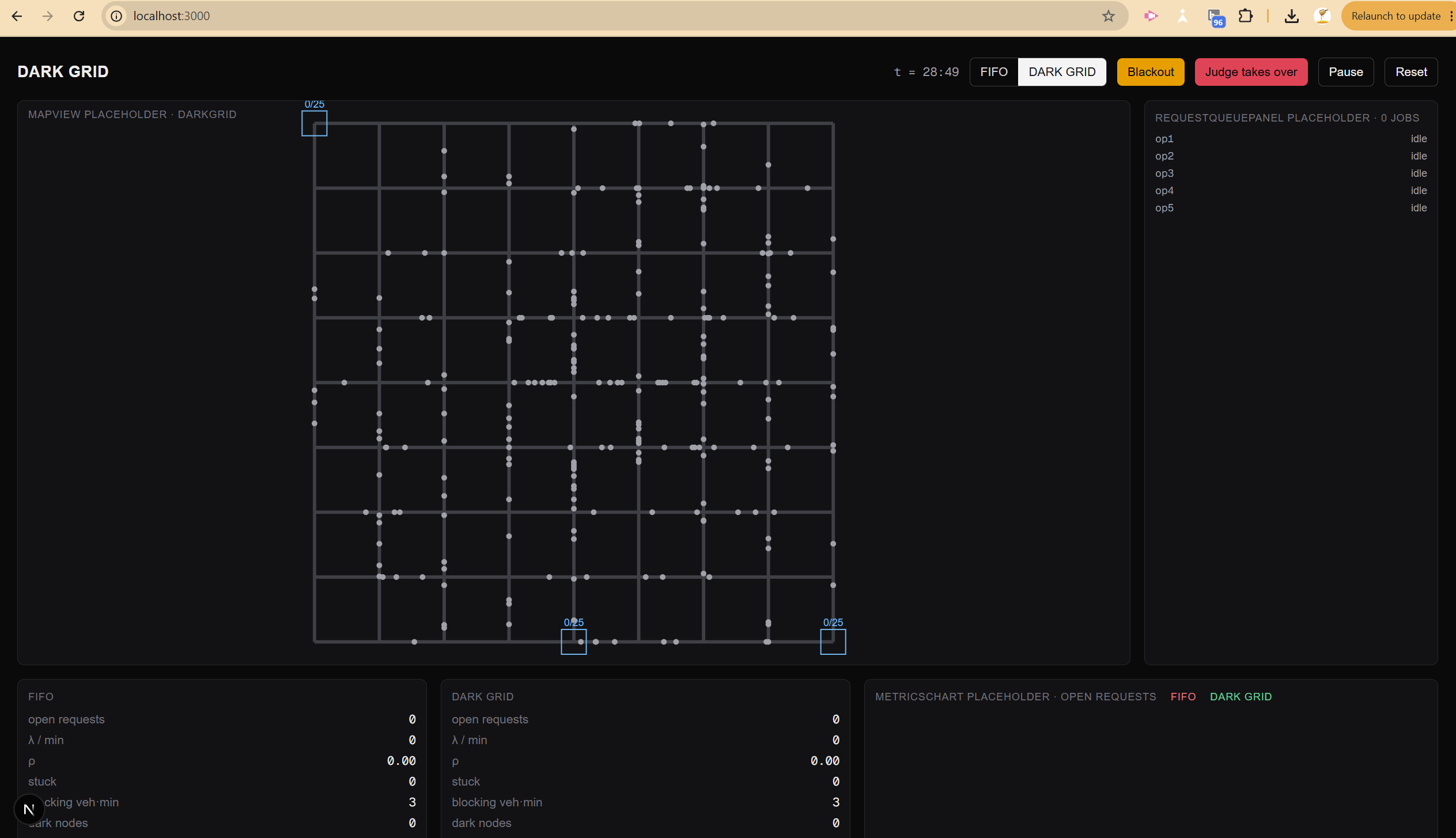
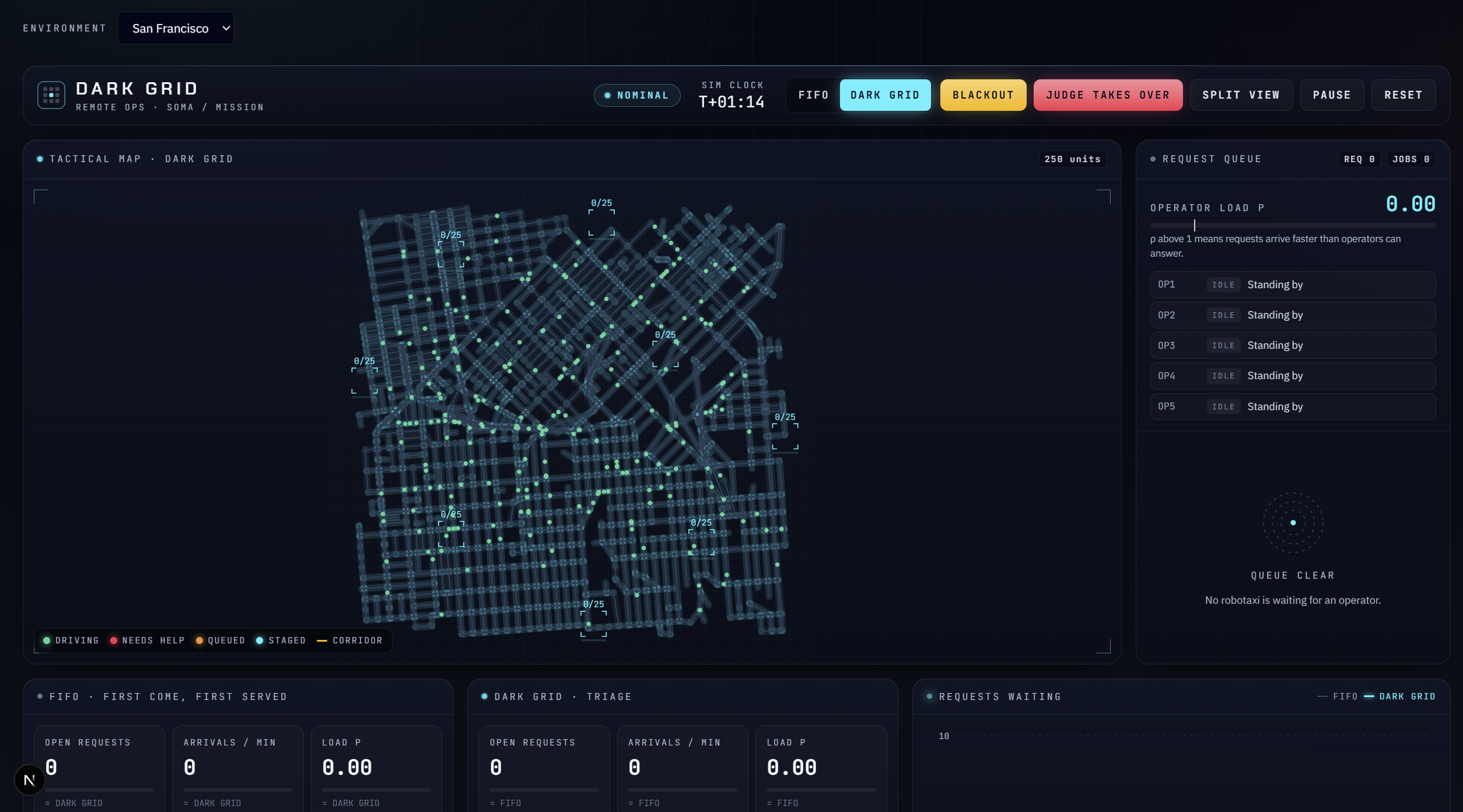
We built a deterministic simulation over real SoMa and Mission streets with 250 vehicle agents, running both the FIFO and DARK GRID cities from the exact same seed. The Next.js and strict TypeScript engine uses a four-stage pipeline: risk scoring, WSPT triage, spatial batching, and Hungarian assignment, while a dark tactical HUD displays a side-by-side split view and real-time queue. A judge can click "Judge takes over" and physically feel the queue collapse as they try to answer requests manually.
Challenges we ran into
Keeping the two simulated cities perfectly deterministic required auditing every random call so they diverged only by policy, not by chance. Early demos took too long to reach the ρ > 1 panic moment, so we re-tuned the arrival curve to explode the queue within 30 seconds of clicking "Blackout." The O(n³) Hungarian assignment froze at 500 jobs, forcing us to cap the batch count per cycle, and rendering 250 moving cars plus glowing trails at 60fps on a demo laptop required separating the simulation state from the visual layer.
Accomplishments that we're proud of
Our demo is a genuine controlled experiment where judges see the ambulance arrive on the right while it stays stuck on the left, all driven by real queueing math. We built a "Judge takes over" mode that lets evaluators play the operator, making the operational management failure viscerally obvious within 30 seconds. We are also proud of our honesty: the fleet is simulated, but the math, routing, and triage are real and reproducible.
What we learned
Queueing theory is a life-safety tool, as ρ=λ/(cμ), which predicts whether an ambulance reaches a hospital. The correct response to an overloaded queue isn't adding operators, but triaging, batching, and shedding low-risk requests—because answering one spatially batched request clears twenty nearby cars. Ultimately, we realized that the human operator queue is a bottleneck, not a feature, and it is the single point of failure for the entire autonomous economy under black-swan load.
What's next for Dark Grid
We want to talk to fleets and city emergency management about standardizing a "city to fleet" zone-push protocol so managers aren't calling companies one by one during a crisis. The next step is hardening the engine using real, redacted operational data from a fleet's remote-ops team to validate our arrival curves and risk weights. Because this same failure mode applies to delivery drones and warehouse humanoids, we plan to publish our zone primitive as an open standard and extend the swarm-agnostic engine to other Physical AI systems.
Built With
- chatgpt
- claude
- codex
- css
- deepseek
- gemini
- javascript
- python
- typescript
- vercel
- vs


Log in or sign up for Devpost to join the conversation.