-
-
-
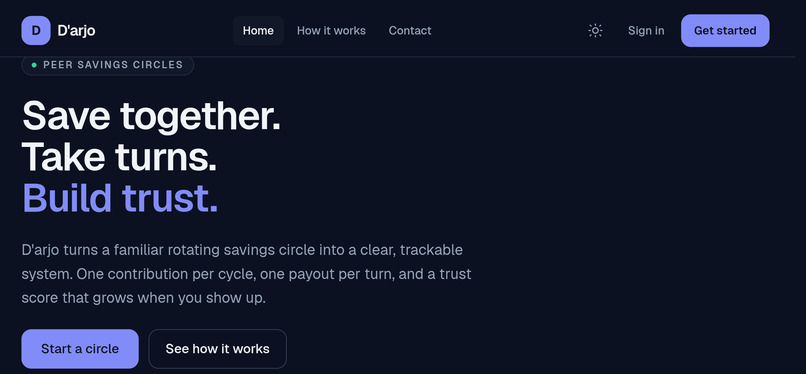
HomePage
-

-


Inspiration
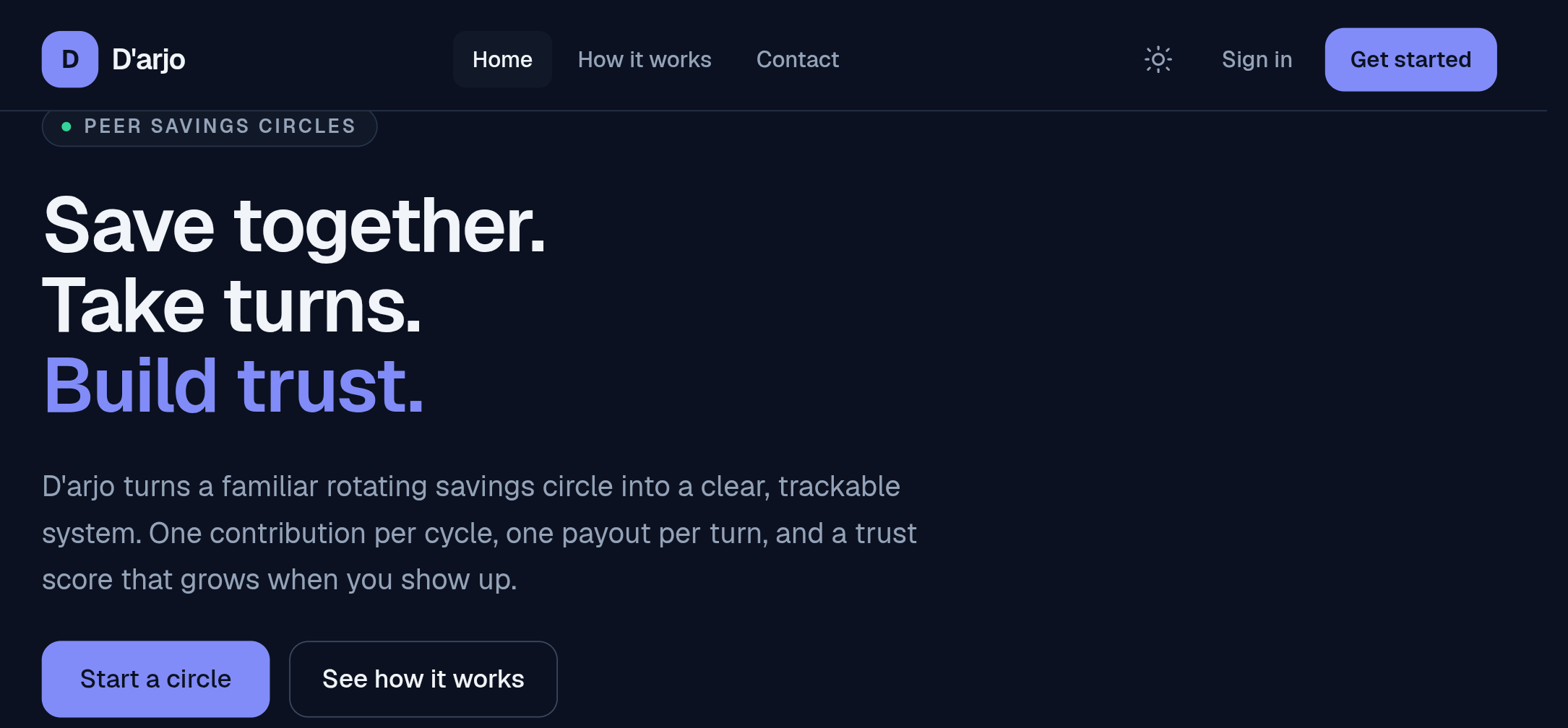
D'arjo was inspired by the savings circles many of us grew up with—ajo, esusu, adashe, chit funds, tandas, ROSCAs—where a trusted group contributes the same amount each cycle and one member takes the whole pot. These systems work because of community trust, but that trust is hard to carry across borders, social circles, or digital platforms.
We wanted to ask: what if the trust built inside a savings circle could become portable? What if someone could join a circle through PayPal rails and bring a verifiable contribution history with them—rather than starting from zero every time? That question became D'arjo.
What it does
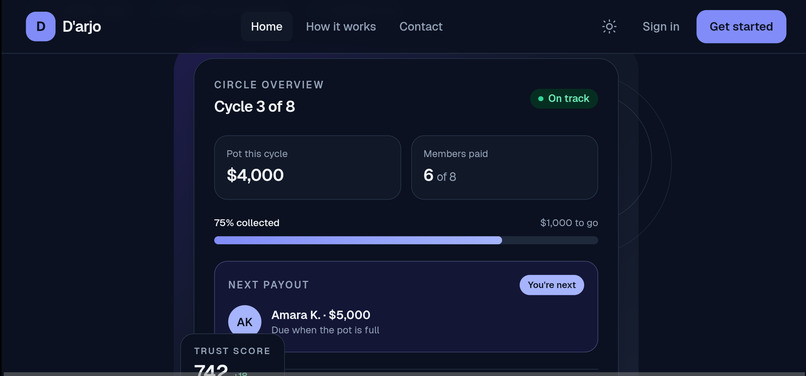
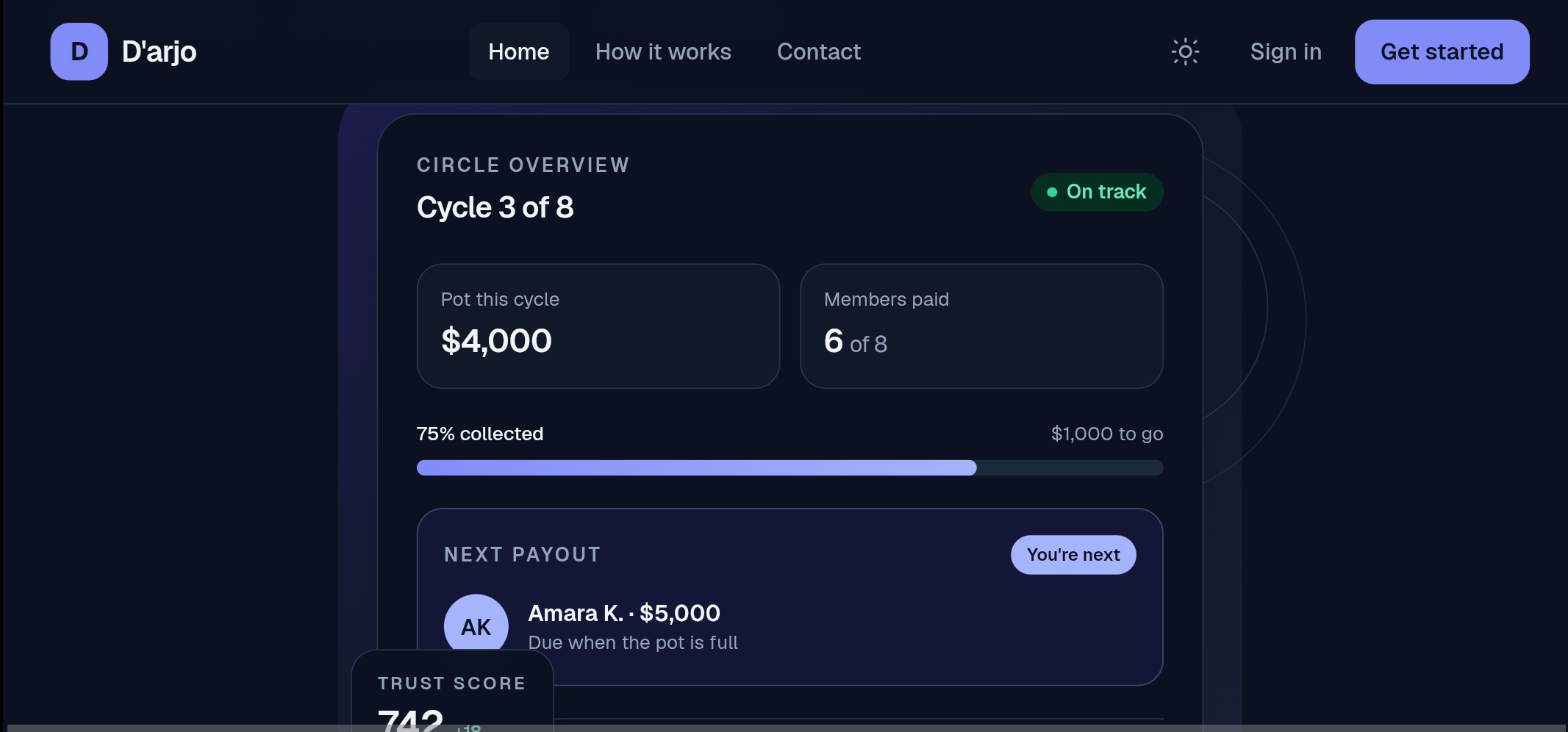
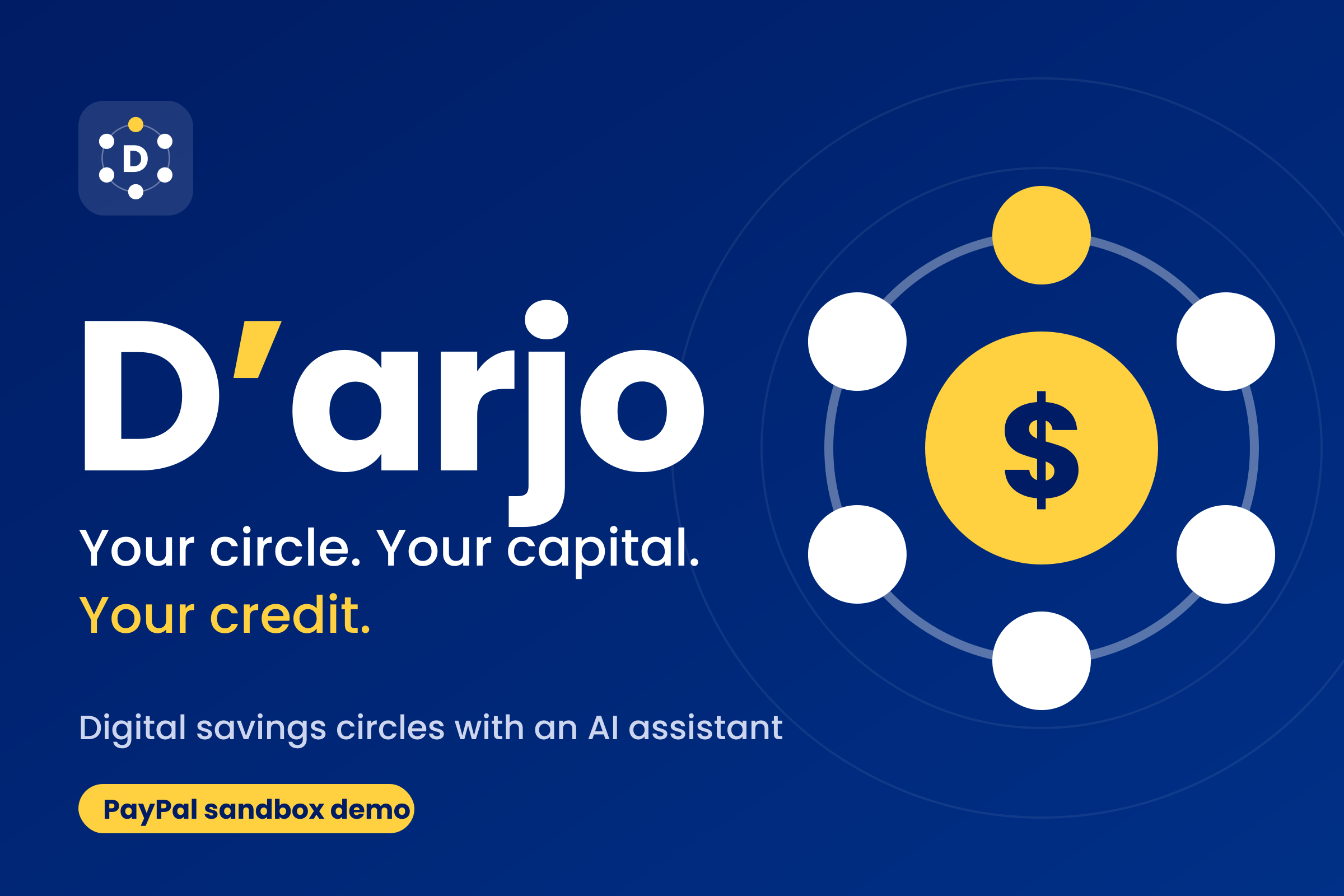
D'arjo is a digital rotating savings circle platform. Small, trusted groups contribute a fixed amount every week or month, and each cycle one member receives the pot.
Key features:
- PayPal-powered contributions and payouts for cross-border participation.
- Portable trust score: every on-time, late, or missed contribution updates a member's score from 0 to 100.
- Circle risk flags: circles are marked safe or risky based on currency volatility and related risk signals.
- Transparent fee model: a 1.5% platform fee is taken from the pot before payout.
For a circle of (n) members contributing (c) each cycle, the pot is:
$$ P = n \cdot c $$
and the payout after the platform fee (f = 0.015) is:
$$ \text{Payout} = P(1 - f). $$
The trust score is designed as a portable reputation signal. In simplified form, a member's score can be updated as:
S(t+1) = clamp(0, 100, S(t) + α·(on-time) − β·(late) − γ·(missed))
where α, β, and γ control rewards and penalties. D'arjo is explicitly not a bank: it does not take deposits or promise returns. It is a demo of how digital savings circles can work with real accountability.
How we built it
We built D'arjo as a demo web platform around the full lifecycle of a savings circle:
- Circle creation and membership — users create or join circles with fixed contribution amounts and payout schedules.
- Contribution tracking — each member's payment status is recorded per cycle.
- PayPal integration — contributions and payouts run through PayPal, with a platform fee deducted from the pot.
- Trust scoring service — contribution events update a portable 0–100 score.
- Risk labeling — circles receive safe/risky flags based on currency volatility and risk inputs.
- Dashboard — members see circle status, payout order, contribution history, and their trust score.
Conceptually, the system separates the circle state machine from the payment layer and the reputation layer, so the trust score can eventually follow a user across circles rather than being locked inside one group.
Challenges we ran into
- Modeling rotating payouts fairly. A ROSCA is simple in theory but tricky in software: payout order, cycle timing, missed contributions, and late payments all affect trust.
- Payment integration and idempotency. Payment flows need to avoid double-counting contributions or releasing a pot twice.
- Designing a trust score that feels fair. A score that is too harsh punishes honest mistakes; too lenient makes it meaningless.
- Communicating risk without pretending to be a bank. We had to be clear that D'arjo is a demo, not a deposit-taking institution, and that risk flags are signals—not guarantees.
- Currency volatility. Cross-border circles face real exchange-rate risk, which is why safe/risky labeling became central.
Accomplishments that we're proud of
- A working end-to-end demo of a digital ROSCA with PayPal-based contributions and payouts.
- A portable trust score concept that turns contribution behavior into a reusable reputation signal.
- Safe/risky circle flags that make currency and group risk visible before joining.
- A transparent fee model: 1.5% from the pot, not hidden charges.
- Clear positioning: D'arjo is not a bank—it digitizes savings circles without pretending to be a deposit institution.
What we learned
We learned that digital ROSCAs are less about payments and more about trust infrastructure. The hard parts are fairness, transparency, and failure handling: what happens when someone misses a contribution? How should the score recover? How do you show risk without scaring people away?
We also learned that small design choices—fee visibility, payout order, score penalties—have a huge effect on whether a savings circle feels trustworthy. And technically, payment idempotency and clear state transitions matter as much as the UI.
What's next for D'arjo
- Add more payment rails beyond PayPal, especially for local African and diaspora corridors.
- Improve the trust score with configurable, transparent rules and dispute handling.
- Add group verification, invite-only circles, and stronger identity checks.
- Build a mobile-first experience for low-friction weekly contributions.
- Run small pilot circles with real users in demo mode to study trust and repayment behavior.
- Explore partnerships and compliance pathways before any real-money launch.
D'arjo's long-term goal: turn "trust me" into "check my score"—while keeping the community spirit of the savings circle intact.
