-
-
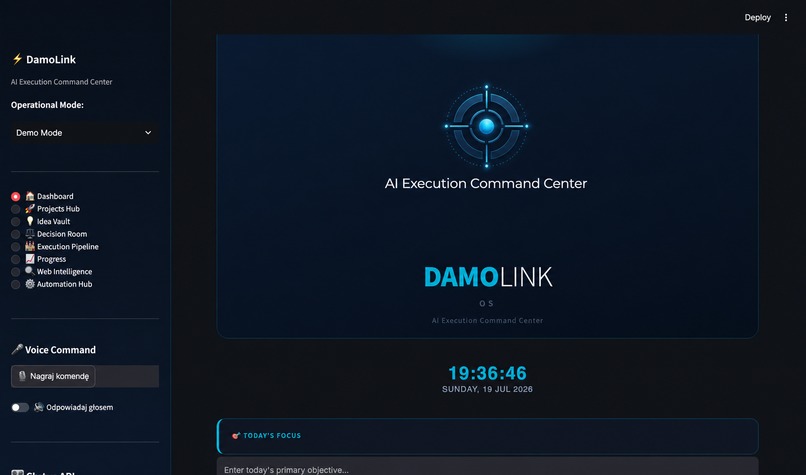
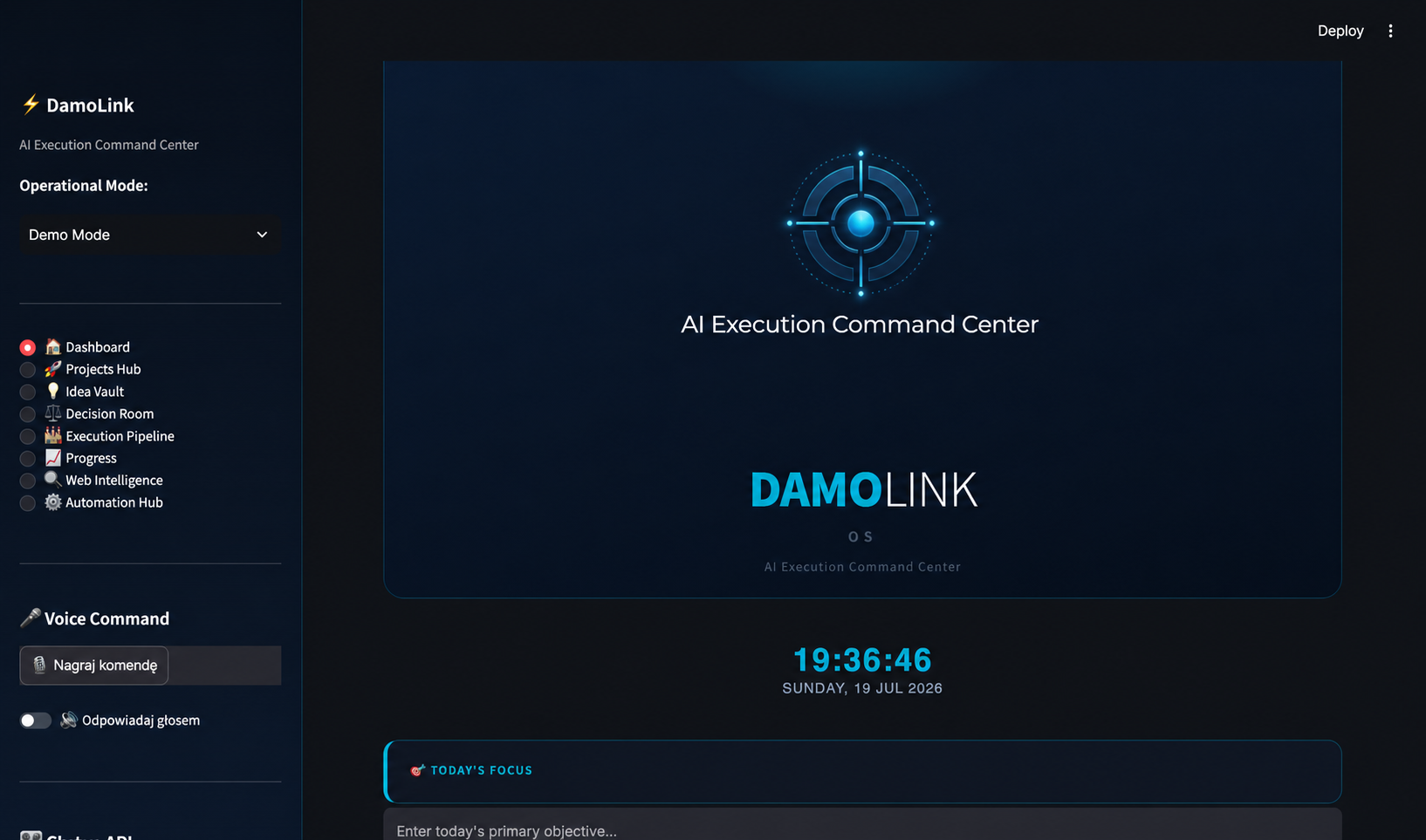
DamoLink OS Command Center – a unified view of ideas, projects, execution and verified outcomes.
-
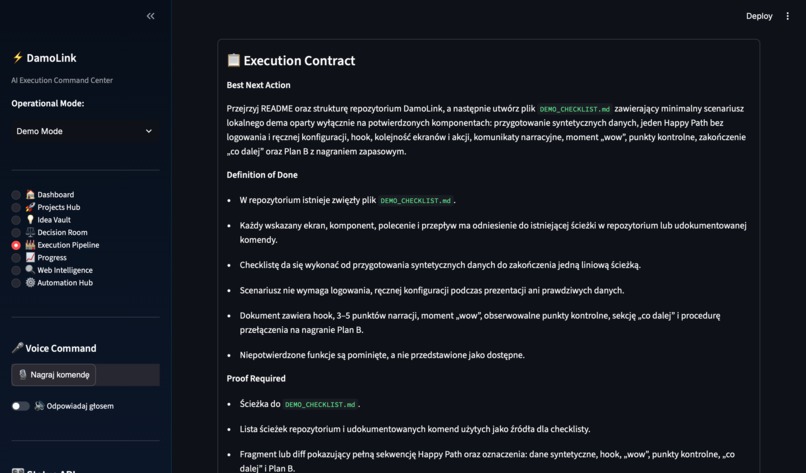
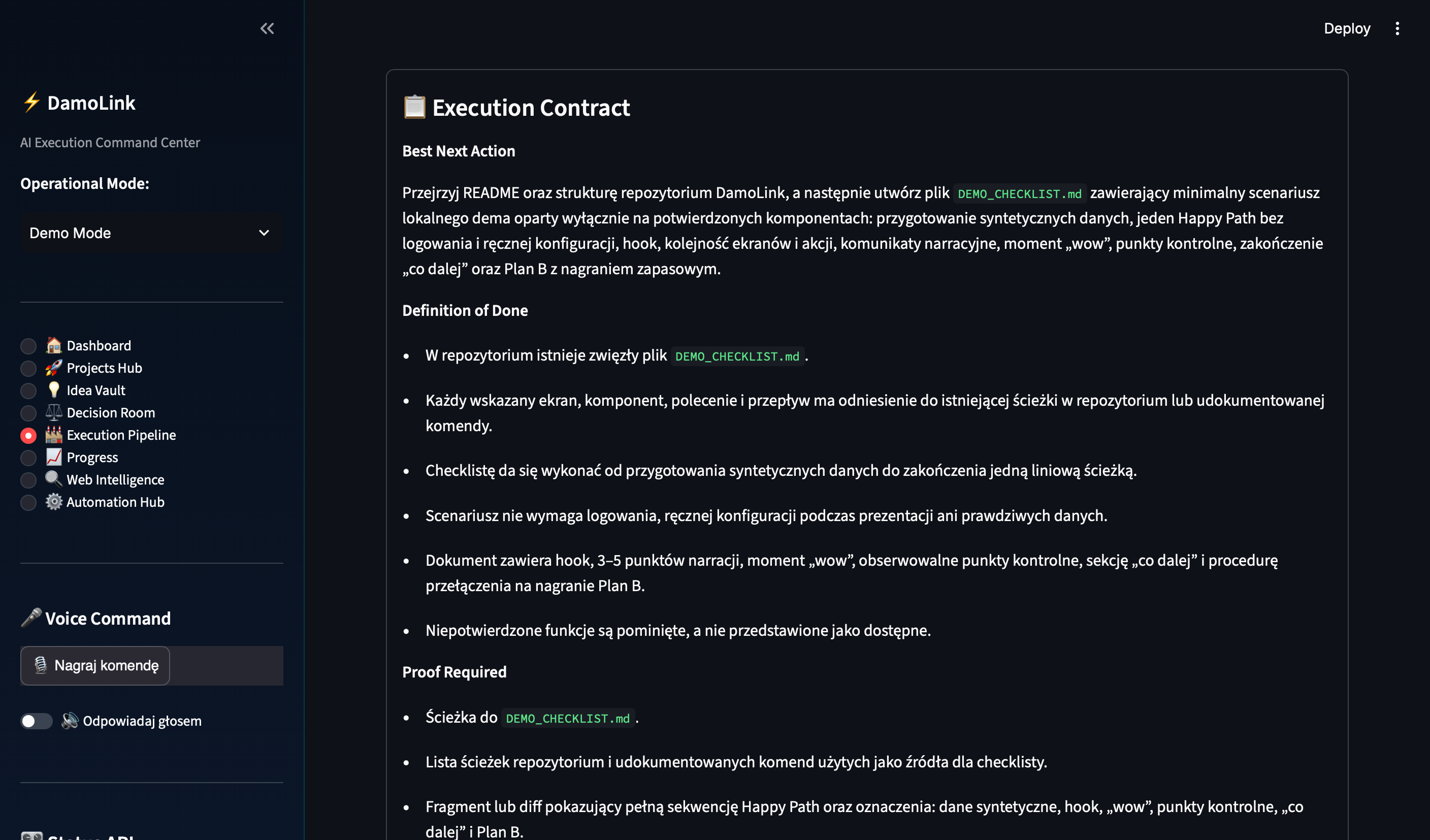
GPT-5.6 creates an Execution Contract with a clear next action and measurable definition of done.
-
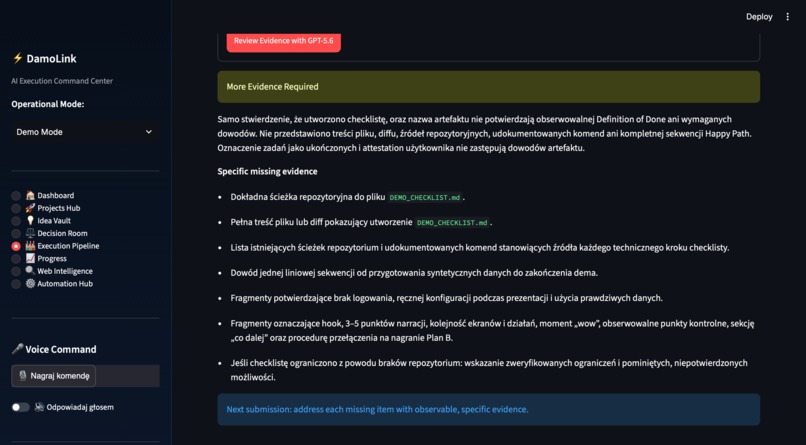
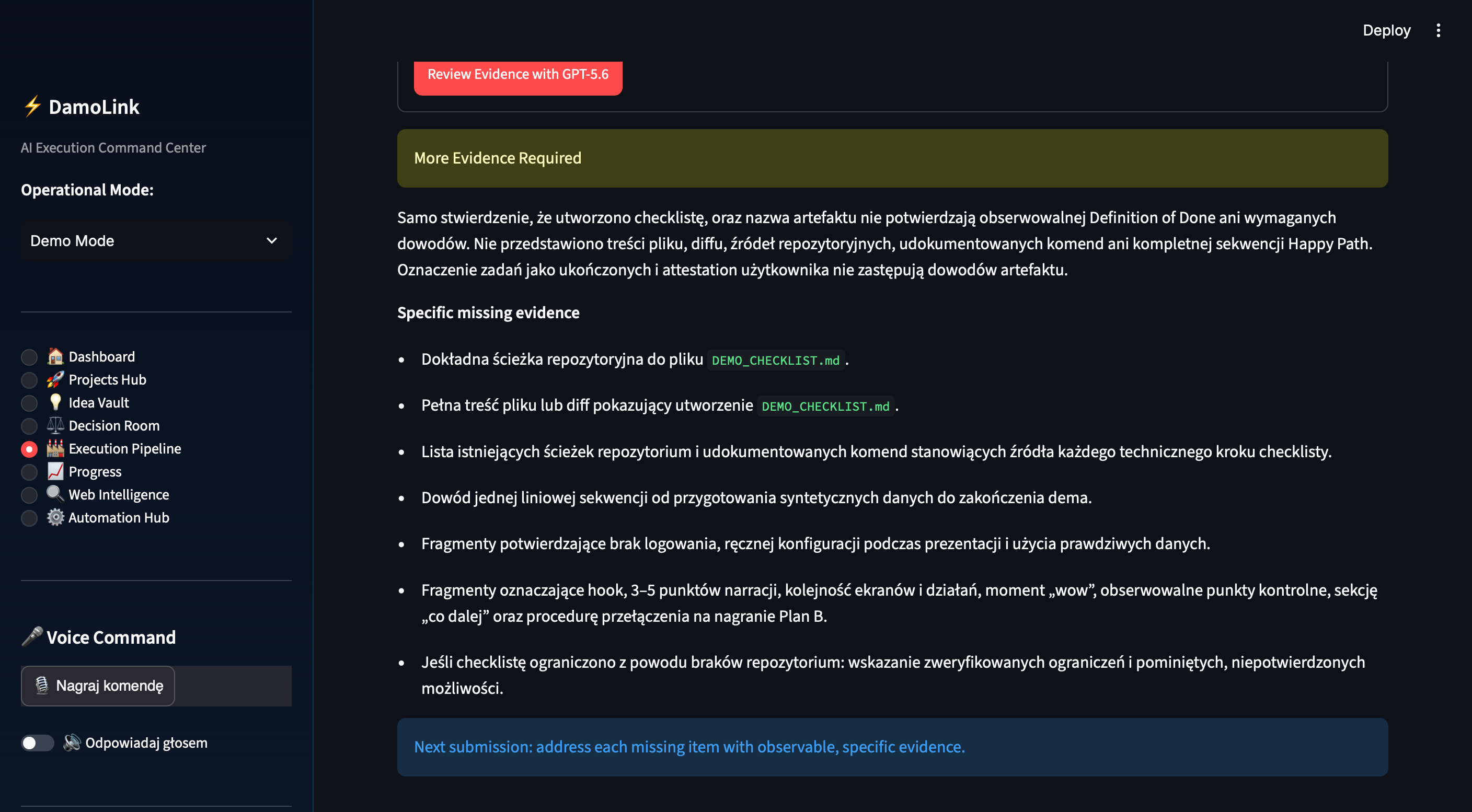
The evidence gate rejects vague or insufficient proof and requests additional evidence.
-
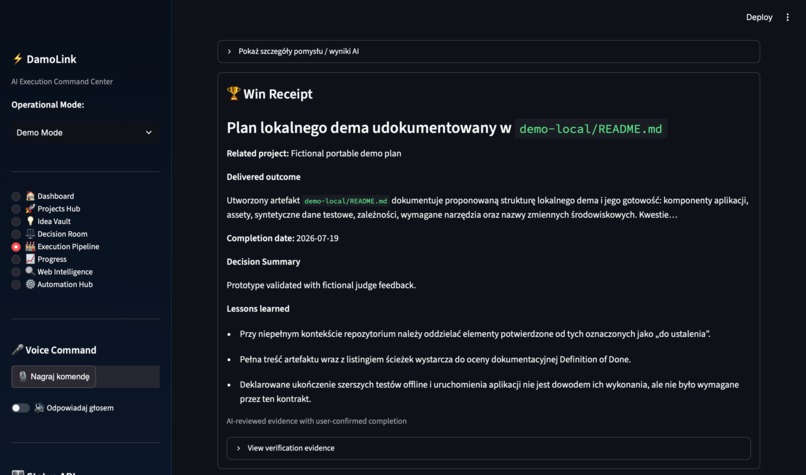
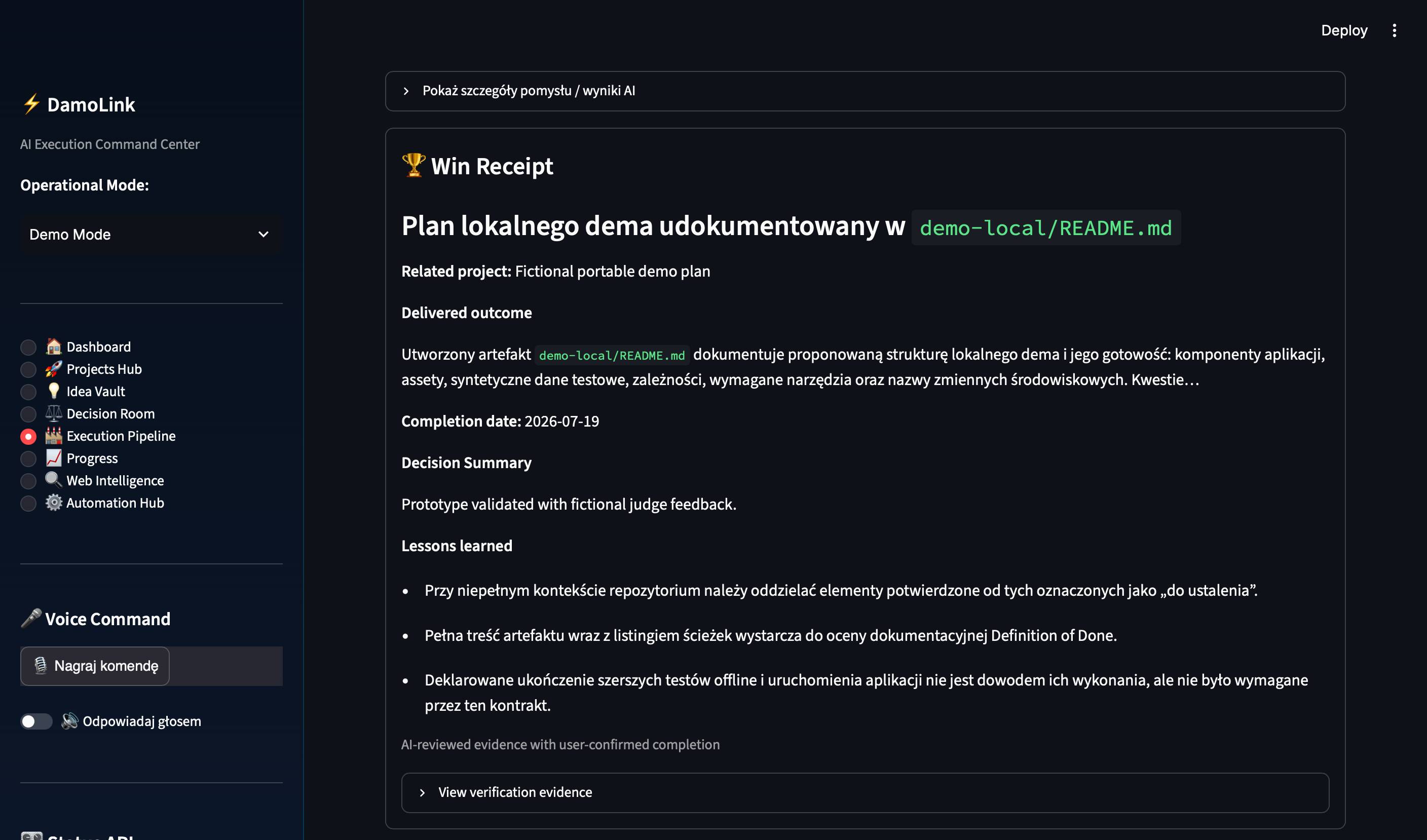
Sufficient evidence produces a permanent Win Receipt for verified completion.
-
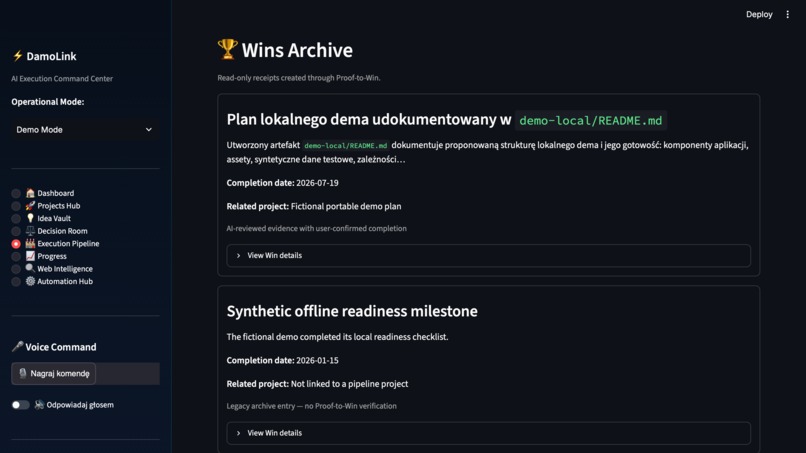
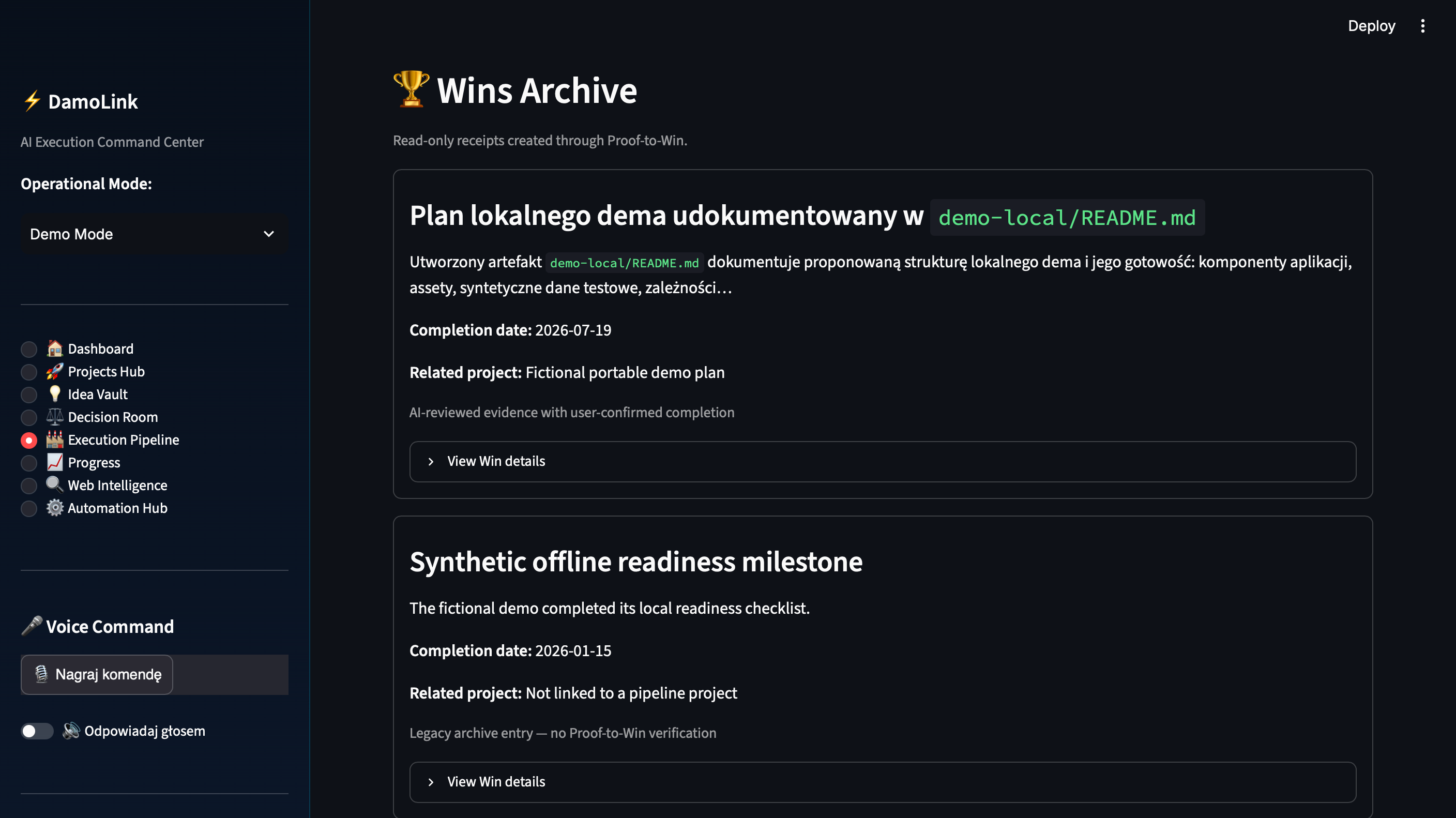
The Wins Archive stores an auditable history of verified outcomes.
Inspiration
DamoLink OS was inspired by a simple problem: many AI tools are very good at generating ideas, plans and recommendations, but they often stop before real execution is completed. I built DamoLink because I have seen how often good ideas and AI-generated plans fail to become real, verified results. I wanted a system that would not accept “done” without clear evidence.
I wanted to build a system that would not treat a task as finished just because someone clicked a checkbox or because an AI produced an answer. The goal was to create an execution layer where every project has a clear next action, a measurable definition of done and evidence that can be reviewed before completion is accepted.
That idea became DamoLink OS: an AI execution operating system designed to transform ideas into verified wins.
What DamoLink OS does
DamoLink guides a project through a structured workflow:
- An idea is captured and organised.
- The project receives an execution contract.
- GPT-5.6 defines the next action, expected deliverable and measurable completion criteria.
- The user submits evidence of completion.
- Weak or incomplete evidence is rejected with a More Evidence Required result.
- Sufficient evidence is validated against the execution contract.
- A successful result creates a permanent Win Receipt.
- Verified outcomes are stored in the Wins Archive.
The central principle is simple:
Completion should be demonstrated, not assumed.
How I built it
DamoLink OS was built as a Python and Streamlit application with a modular workflow covering the Dashboard, Idea Vault, Decision Room, Projects Hub, Execution Pipeline and Wins Archive.
GPT-5.6 is used inside the execution workflow to:
- generate structured execution contracts,
- define measurable completion criteria,
- review submitted evidence,
- identify missing proof,
- and decide whether the result satisfies the contract.
The application also uses deterministic validation around the AI workflow. This means important checks are not left entirely to a model response. The system controls project state, evidence requirements, completion rules and the creation of Win Receipts.
Codex was used throughout development as an engineering partner. It helped me:
- design and refactor the application structure,
- implement new workflow features,
- improve Demo Mode,
- remove authentication friction from the public demonstration,
- write and update regression tests,
- review security risks,
- clean the repository,
- improve documentation,
- and prepare the final Build Week release.
The final public repository includes the application, tests, environment documentation, demo instructions and screenshots of the main workflow.
Challenges I faced
One of the biggest challenges was balancing AI flexibility with reliable execution.
A model can produce a confident answer even when the evidence is incomplete, so I did not want DamoLink to depend on AI judgement alone. I added deterministic checks and explicit project states around the GPT-5.6 review process.
Another challenge was designing an evidence workflow that was strict enough to reject vague claims, but still simple enough for a user to understand. The More Evidence Required state became an important part of the product because it explains that completion has not yet been demonstrated.
Security and public release preparation were also significant challenges. Before publishing the project, I:
- removed fallback credentials,
- separated Demo Mode from authenticated modes,
- removed personal and employer-related information,
- rebuilt the Git history into a clean public-safe history,
- used a GitHub noreply author identity,
- and ran security and regression checks before release.
I also had to make the demo understandable in under three minutes. This required focusing the presentation on the most important difference between DamoLink and a normal task manager: the transition from execution contract, to evidence review, to verified Win Receipt.
What I learned
This project taught me that adding AI to a workflow is not enough by itself. A useful AI system also needs boundaries, state management, validation and clear success criteria.
I learned how important it is to separate:
- AI recommendations,
- user actions,
- deterministic rules,
- submitted evidence,
- and verified completion.
I also learned how valuable Codex can be when used across the full software development lifecycle rather than only for generating code. It supported architecture, debugging, testing, documentation, security review and release preparation.
Most importantly, I learned that trustworthy AI execution requires more than a good response. It requires a system that can explain what needs to be done, ask for proof and record why the result was accepted.
What I am proud of
I am most proud of the evidence gate.
When weak evidence is submitted, DamoLink does not simply mark the task as complete. It returns More Evidence Required. When stronger evidence satisfies the execution contract, the system creates a permanent Win Receipt and stores it in the Wins Archive.
That creates a clear and auditable path:
Idea → Decision → Project → Execution Contract → Evidence → Verified Win
DamoLink OS is my attempt to move AI from idea generation toward accountable execution.

Log in or sign up for Devpost to join the conversation.