-
-
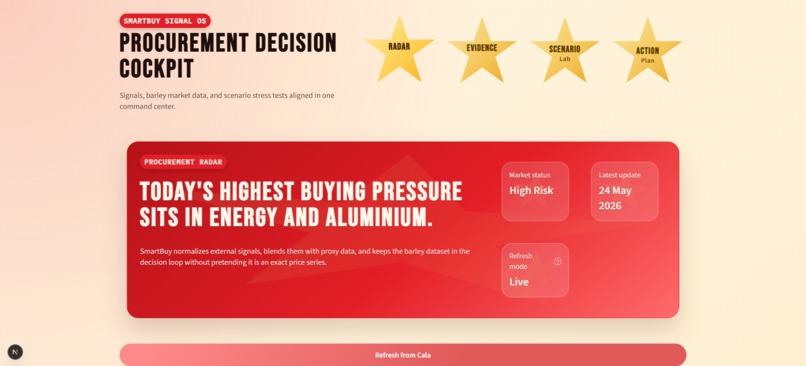
Main page
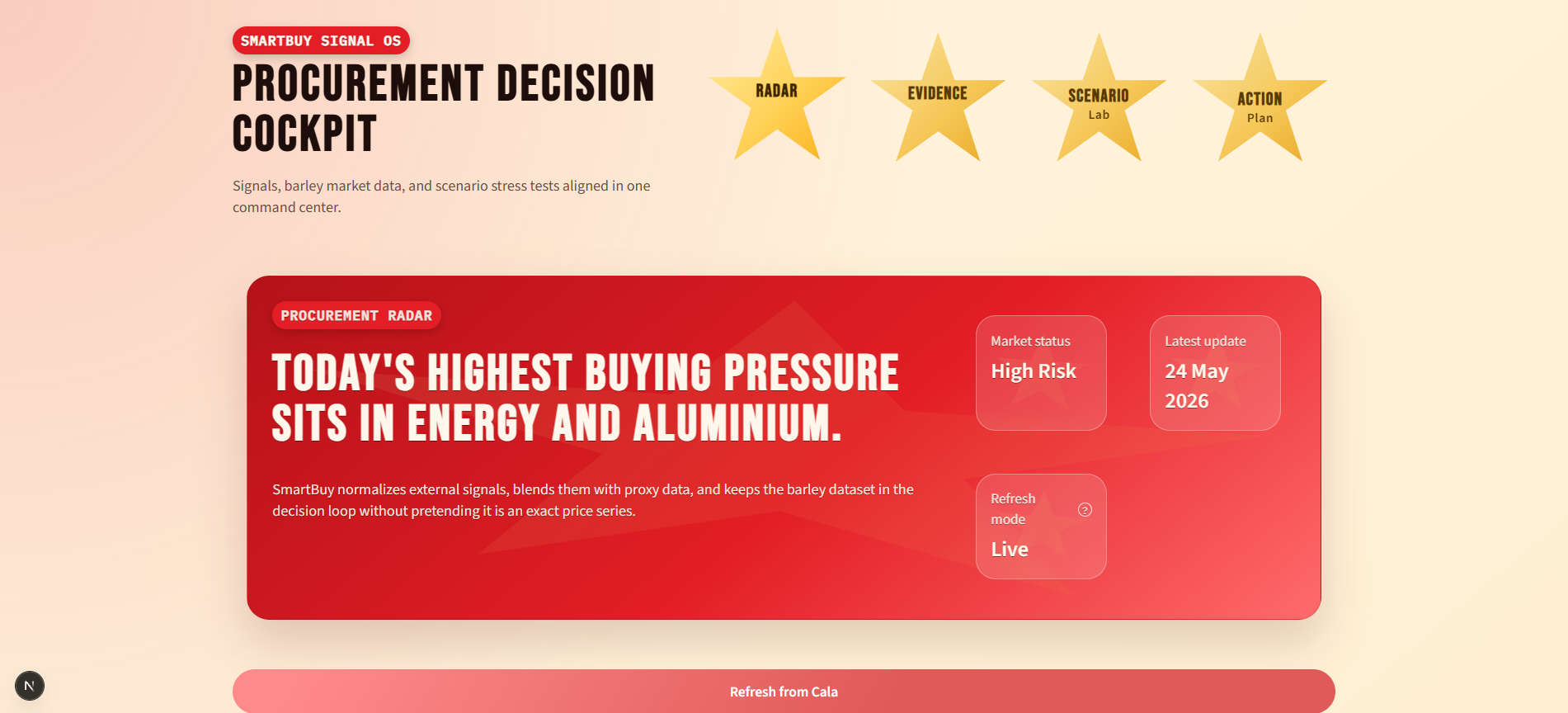
Inspiration
Procurement teams still make high-stakes buying decisions by stitching together fragmented signals from news, prices, regulation, energy markets, weather, and supplier updates. We wanted to turn that noisy process into a decision cockpit that feels fast, explainable, and actually useful in a real buying meeting. DammBuy was inspired by the idea that buyers should not need to be market analysts to act with confidence.
What it does
DammBuy is an AI-powered procurement cockpit for commodity buying decisions. It transforms external market evidence into clear recommendations such as buy, hedge, wait, or monitor across aluminium, PET, energy, and barley.
The platform combines:
live Cala-powered evidence retrieval normalized signal tracing deterministic risk and uncertainty scoring historical benchmark charts scenario simulation action-oriented procurement recommendations It helps users understand not only what the recommendation is, but also why it was made and what evidence supports it.
How we built it
We built DammBuy as a local-first full-stack web app with a Next.js + TypeScript frontend and a FastAPI backend.
On the backend, we created:
a structured Cala integration for commodity-specific evidence queries a normalization layer that converts Cala outputs into comparable signals a deterministic scoring engine for risk, confidence, uncertainty, and recommendation logic a benchmark-history pipeline that stores historical commodity series in JSON for charting On the frontend, we built:
a Radar view for high-level prioritization commodity detail pages with benchmark and score charts an Evidence Board with traceable signal rows a Scenario Lab for stress-testing assumptions an Action Plan page for procurement-ready decision summaries We also designed the app to work safely with fallback local data when live Cala responses are unavailable.
Challenges we ran into
The biggest challenge was working with a very new and still-evolving external AI platform. Cala is powerful, but query behavior, latency, and output consistency required a lot of experimentation.
Some of the main difficulties were:
designing structured Cala queries that returned useful procurement signals handling long response times and occasional timeouts
Accomplishments that we're proud of
We are proud that DammBuy became much more than a dashboard mockup. It works as a real decision-support prototype with explainable logic and traceable evidence.
Highlights we are especially proud of:
turning live Cala outputs into normalized procurement signals building an evidence-first UI where every recommendation can be traced creating a scoring engine that is deterministic and understandable
What we learned
We learned that AI is most useful in procurement not when it replaces judgment, but when it structures judgment. The biggest value came from turning messy external information into comparable, explainable signals.
We also learned:
structured AI queries are often more robust than free-form search transparency matters as much as prediction in decision tools
What's next for DammBuy
Next, we want to make DammBuy more robust, more personalized, and more operationally useful.
Our next steps include:
improving Cala query quality and historical coverage across all commodities refining signal heuristics for direction, impact, and confidence adding AI for some interpretations substituting heuristics
Built With
- cala
- python
- typescript


Log in or sign up for Devpost to join the conversation.