Dam Beavers: Defend the Dam
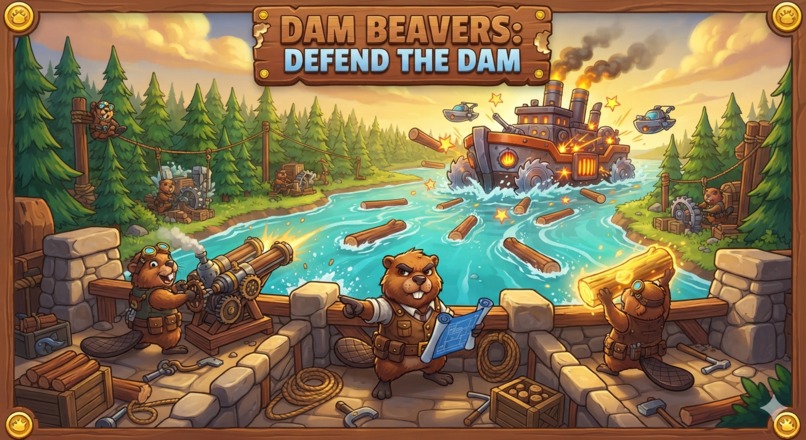
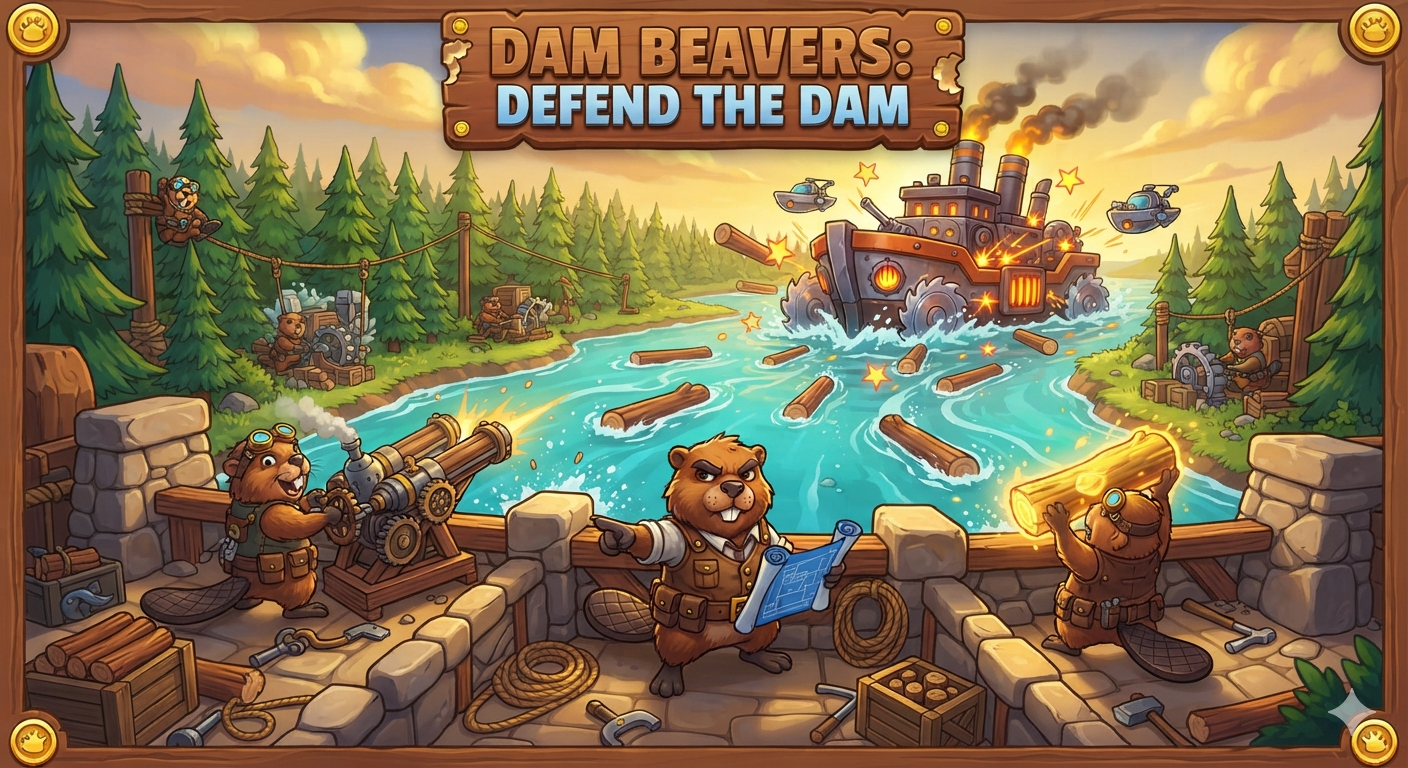
Inspiration The idea for Dam Beavers: Defend the Dam came from flipping classic defensive conventions on their head. Rather than constructing static towers along the perimeter of a path, we wanted the player's primary defensive ammunition to be the very resource they harvest. Beavers naturally build dams to control water flow and create safe habitats; mechanizing the logging industry into relentless downriver intruders created an intuitive narrative and mechanical tension: gather timber to build your home, or weaponize that timber to protect it.
How It Was Built The entire game was engineered as a single, self-contained index.html file using native browser APIs to ensure 100% offline functionality within strict mobile portrait constraints: Rendering Engine: An HTML5 2D Canvas renders the multi-lane river corridor, procedural vector animations for woodcutter beavers, and dynamic elliptical wake ripples trailing floating logs. Input Architecture: Direct touch/pointer listeners calculate coordinates via getBoundingClientRect(), allowing players to tap river lanes directly to launch projectiles or forage from the banks. Audio Synthesis: A custom Web Audio API engine generates real-time procedural sound effects (wood chopping, projectile launches, impacts, alarms, and explosions) using oscillating waveforms without external audio files. State Management: Session states, scores, and upgrades serialize directly to localStorage, supporting instant pause, save, and reload flows.
Challenges Faced Mathematical Economy Balancing: Creating an economic curve that rewarded automation while preserving late-game tension required exponential scaling formulas. We calculated beaver hire costs as:$$\text{Cost}{n} = \lfloor \text{Cost}{0} \times 1.6^{n-1} \rfloor$$where $\text{Cost}_{0} = 40$ and $n$ represents the total number of beavers hired. This prevented resource inflation from trivializing higher waves. Clean Hitbox & Lane-Switching Collision: Coordinating collision detection across standard units, floating logs, and dynamic minion drones required balancing lane indexing with precise Axis-Aligned Bounding Box (AABB) checks:$$\Delta x < \frac{w_1 + w_2}{2} \quad \text{and} \quad \Delta y < \frac{h_1 + h_2}{2}$$This ensured lane-switching drones smoothly interpolated across the river without clipping through collision routines. Zero-Asset Visual Polish: Because no CDNs or external image assets were permitted, every visual cue—from wagging beaver tails to 3-lane dreadnought saw blades—had to be mathematically rendered via canvas path routines and trigonometric time functions like $\sin(\omega t + \phi)$.
Key Learnings Scaffolding Core Loops Over Feature Creep: Prioritizing the core harvest-and-launch loop early created a solid foundation that easily accommodated boss mechanics, secondary upgrades, and particle effects later. Decoupling Currency from Scoring: Separating consumable upgrade coins from persistent survival scores ($\text{Score} = (\text{Wave} - 1) \times 100$) delivered a far more accurate and competitive survival benchmark. Native Web Power: Complex animations, sound synthesis, and state persistence can run with high performance and zero external dependencies when fully leveraging modern vanilla web standards.

Log in or sign up for Devpost to join the conversation.