Inspiration
This project didn't start with a business idea — it started with a person. A market woman, someone who has never sat in a classroom, selling every single day, hustling from morning to night. And yet, if you asked her whether she was actually making a profit or just breaking even, she couldn't tell you. Not because she wasn't working hard — she was working harder than most — but because nothing was being accounted for. Sales, expenses, debts owed, debts she was owed — it all lived in her memory, and memory isn't a ledger. That's not a rare story. It's the story behind most of the small businesses that shut their doors before they even hit their first anniversary. Not because the idea was bad, or the hustle wasn't there, but because there was no system catching the leaks — no record telling them where the money was actually going, and no support system to help them recover when things went wrong. A huge number of small businesses fold in year one simply because they never had anything — or anyone — to help them bounce back. The second half of the problem was just as clear: even the businesses that do keep good books rarely get seen by the institutions that could actually help them grow. Banks and microfinance institutions exist, loans exist, but the bridge between a small trader's daily hustle and a financial institution's willingness to lend almost never gets built. Small businesses and financial institutions operate like two separate worlds that were never properly introduced. DAKADA was built to close both gaps at once — give every business owner, regardless of literacy or background, a way to actually know their numbers, and then use those numbers to connect them to the financial support that could keep them alive past year one.
What it does
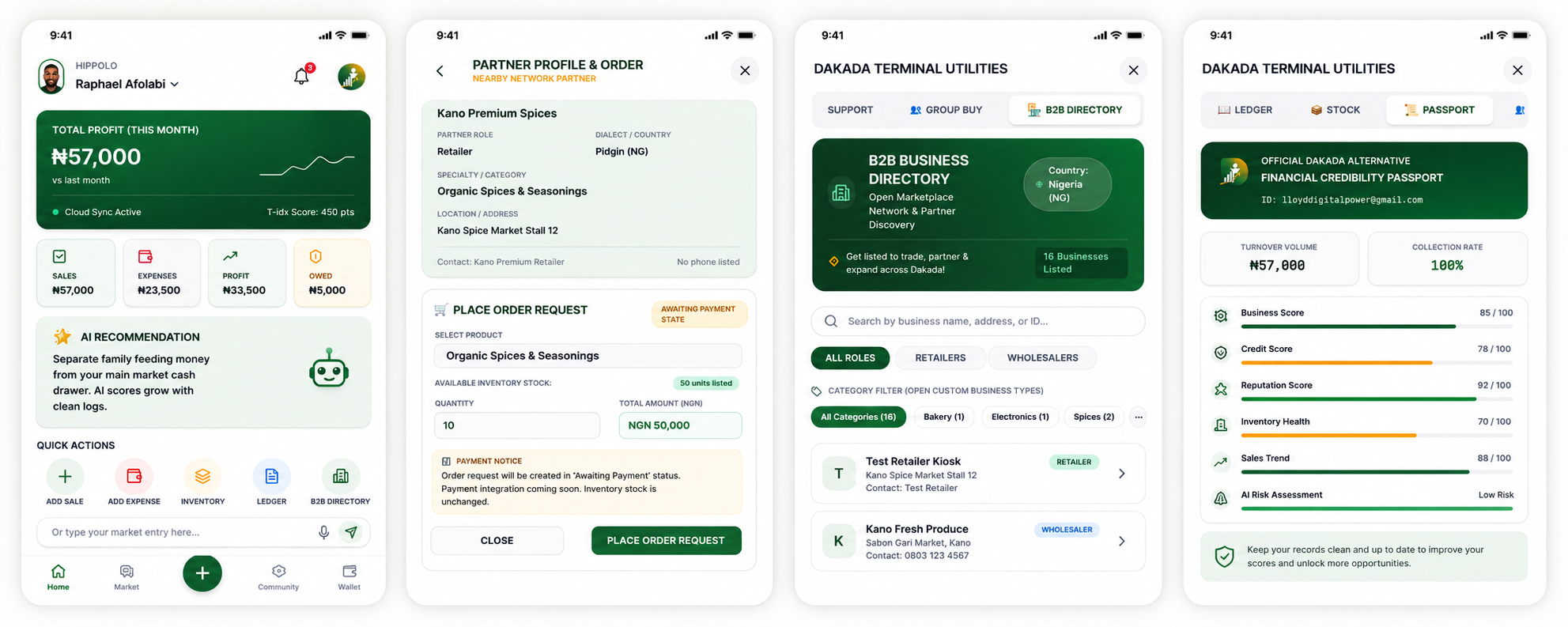
DAKADA is an AI-powered business operating system built for retail traders, wholesalers, and manufacturers — especially the ones traditional software was never designed for. Talks, not types. Business owners speak naturally to DAKADA's AI voice assistant, and it logs their sales, expenses, and inventory automatically — no reading, writing, or literacy required. Turns activity into a score. The AI reviews a business's real cash flow and converts it into a T-idx score — a living, honest picture of how the business is actually performing. Connects that score to real money. That score becomes the bridge to embedded loans from banks and microfinance institutions registered on the platform — access based on proof of work, not paperwork. Watches the stock, not just the sales. When inventory runs low, DAKADA's AI automatically matches the trader with other businesses in the same category and connects them to a registered wholesaler. Buys smarter, together. It creates a secure escrow, bundles everyone's orders into one bulk purchase, unlocks a 15% group discount, and holds the funds until every party confirms their goods arrived. Whether the business is a single market stall or a manufacturing operation, and whether it's based in Nigeria or anywhere else in the world, DAKADA is built to keep it accounted for.
How we built it
The frontend is built with HTML, CSS, and JavaScript, using React for the component architecture and Tailwind CSS to keep the design system consistent across every screen — from the profit dashboard to the escrow and group-buy modals. Data visualizations (the profit cards, the T-idx score ring) draw on lightweight charting libraries to keep the UI fast and legible even on low-end Android devices, since that's the reality of the primary user's hardware. Beyond the interface, the core of DAKADA is the AI layer: the voice assistant that converts spoken input into structured transaction records, the scoring model that turns transaction history into a cash-flow score, and the matching logic that watches inventory levels and triggers trader-to-trader and trader-to-wholesaler connections automatically. The escrow system was designed so funds only ever move when every party in a group purchase confirms delivery — trust had to be built into the mechanics, not just promised in the copy.
Challenges we ran into
The hardest problem wasn't technical — it was designing for someone who has never used software like this before. Every screen, every interaction, had to work for a user who might not read fluently, which meant the voice assistant couldn't be a nice-to-have feature bolted on later — it had to be a first-class way of using the entire app. Getting the AI to reliably turn natural, sometimes messy spoken language into clean, structured financial records — the right amount, the right category, the right transaction type — took real iteration. A market woman describing a sale doesn't talk like a form field, and the system had to meet her there instead of asking her to change how she speaks. Designing the escrow and group-buy logic was its own challenge: it needed to feel completely safe to someone who has likely been burned by informal group-buying arrangements before, which meant being deliberate about exactly when funds move, exactly what "confirmed delivery" means, and never leaving room for ambiguity in how the money is protected. And underlying all of it was the challenge of building trust with two very different audiences at once — the trader who needs this to feel simple and safe, and the financial institution that needs the underlying data to feel credible and creditworthy enough to actually lend against.
Accomplishments that we're proud of
We're proud that DAKADA doesn't ask anyone to change who they are to use it. The market woman who inspired this project could pick up her phone, talk to it the way she'd talk to a person, and watch her business get recorded accurately for the first time — no forms, no training, no literacy test at the door. Building something that meets people exactly where they are, instead of demanding they meet the software halfway, is the accomplishment we care about most.
We're proud of getting the AI voice assistant to reliably turn natural, everyday speech into clean, structured financial records — sales, expenses, and inventory logged correctly without ever asking the user to "speak like a form." That was the hardest technical problem we solved, and it's the one closest to the heart of what DAKADA is actually for.
We're proud of the escrow and group-buy system working end-to-end — from an AI catching low stock, to matching a trader with others in the same line of business, to a real wholesaler connection, to funds held safely until every party confirms delivery. Watching that full chain execute, and knowing it can hand a small trader a 15% discount they'd never get alone, felt like proof the idea actually works outside of a pitch deck.
And we're proud of the score itself — the T-idx — becoming a real bridge to embedded loans. Turning a trader's daily hustle into something a bank or microfinance institution can actually evaluate and trust is, in a lot of ways, the entire reason this project exists. Seeing that connection function is the accomplishment that makes the whole vision feel real, not theoretical
What we learned
The biggest lesson was that accessibility isn't a feature — it's a design constraint that should shape everything else. Once we committed to "no literacy required" as a real requirement and not a marketing line, it changed how we approached the AI, the UI, and even the onboarding flow. We also learned just how much untapped creditworthiness exists in informal markets. The data was always there — it just lived in someone's memory instead of a system. Once it's captured, it becomes something a bank can actually trust, and that single shift — from invisible to visible — is what turns a business that might fold in year one into one that has a real shot at year two, three, and beyond.
What's next for DAKADA
This is a starting point, not a finish line. A few directions we're looking at next:
Deeper financial institution partnerships. Right now DAKADA connects businesses to banks and microfinance institutions registered on the platform — the next step is growing that network significantly, so more traders have more real lenders competing to serve them, not just one or two. Expanding the voice AI to more languages and dialects. DAKADA was built so literacy is never a barrier — the next step is making sure language isn't one either, starting with major Nigerian languages and dialects, then expanding further as we grow beyond Nigeria. A richer B2B directory. More wholesalers, more manufacturers, more categories — so the AI has an even bigger pool of trade partners to match traders with when it triggers a group buy. Smarter, more predictive scoring. Right now the T-idx score reflects what's already happened. We want to push it toward forecasting — helping a trader see a cash-flow problem coming before it becomes one, not just after. Offline-first reliability. Many of the markets DAKADA is built for don't have consistent internet access. Making sure the voice assistant and transaction logging work smoothly even with patchy connectivity, and sync automatically once it's back, is a priority. Scaling beyond Nigeria. DAKADA was designed with the phrase "Nigeria, or anywhere in the world" in mind from day one. The next real step is proving that same model — AI accessibility, cash-flow scoring, group-buy escrow — works for informal traders in other markets facing the exact same problem. Building our own payment platform. We're structuring a payment system native to the DAKADA ecosystem — one that isn't limited to our current region, but built from the ground up to work anywhere in the world, so the loans, escrow transactions, and group-buy payments can all move through a system we truly own end-to-end. Creating more awareness on the ground. We're setting up seminars and direct outreach to small and local businesses — the people this was built for — so DAKADA reaches traders the way it should: in person, in their language, in their markets, not just through an app store listing. Growing the team. We keep building, and that means bringing in more people who matter to this project — the right hands and the right minds to help DAKADA grow the way it deserves to. Registering the DAKADA brand. Formally protecting the name and identity we've built, so we're never limited in how far we can take it.
At the core, what's next is the same thing that got us started: making sure no business owner, anywhere, has to guess whether they're actually making a profit.
Built With
- anthropic-claude-api
- antigravity-ide
- bcrypt
- bcryptjs
- cloud-ru
- esbuild
- express.js
- firebase-authentication
- gcloud-cli
- gemini-3.5-flash
- google-cloud-text-to-speech
- google-gemini-api
- google-genai-sdk
- google-identity-toolkit
- google-maps-platform
- lucide-react
- maps-javascript-api
- node.js
- npm
- places-api
- react
- tailwindcss
- typescript
- vite
- web-speech-api


Log in or sign up for Devpost to join the conversation.