-
-
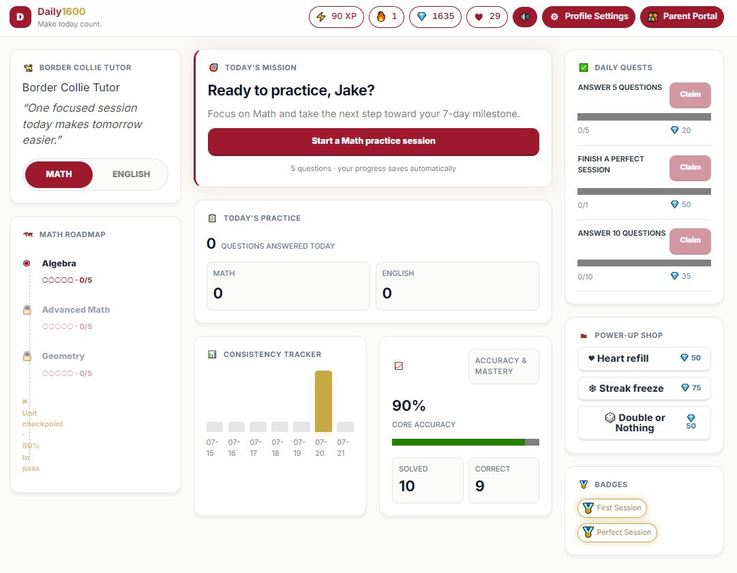
Student View
-
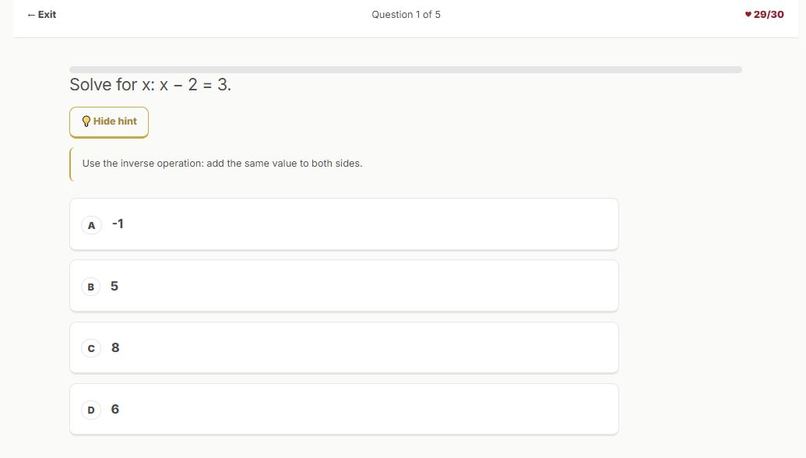
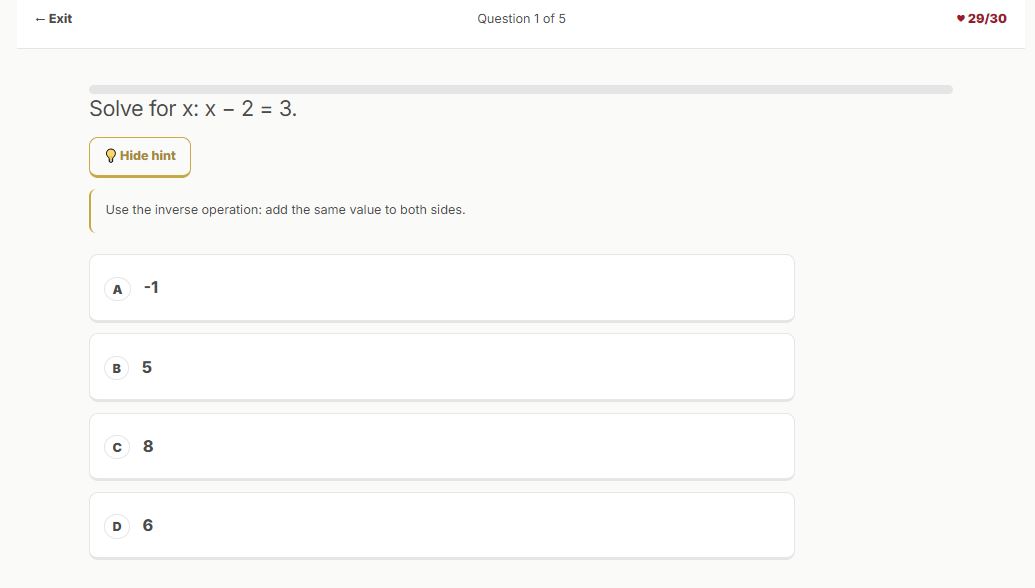
Math Question
-
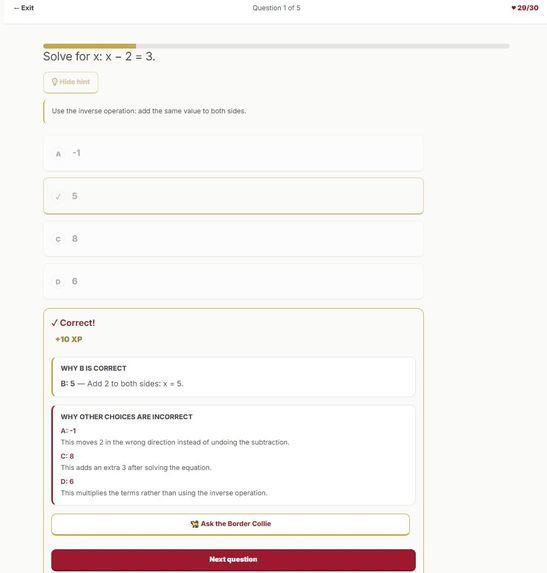
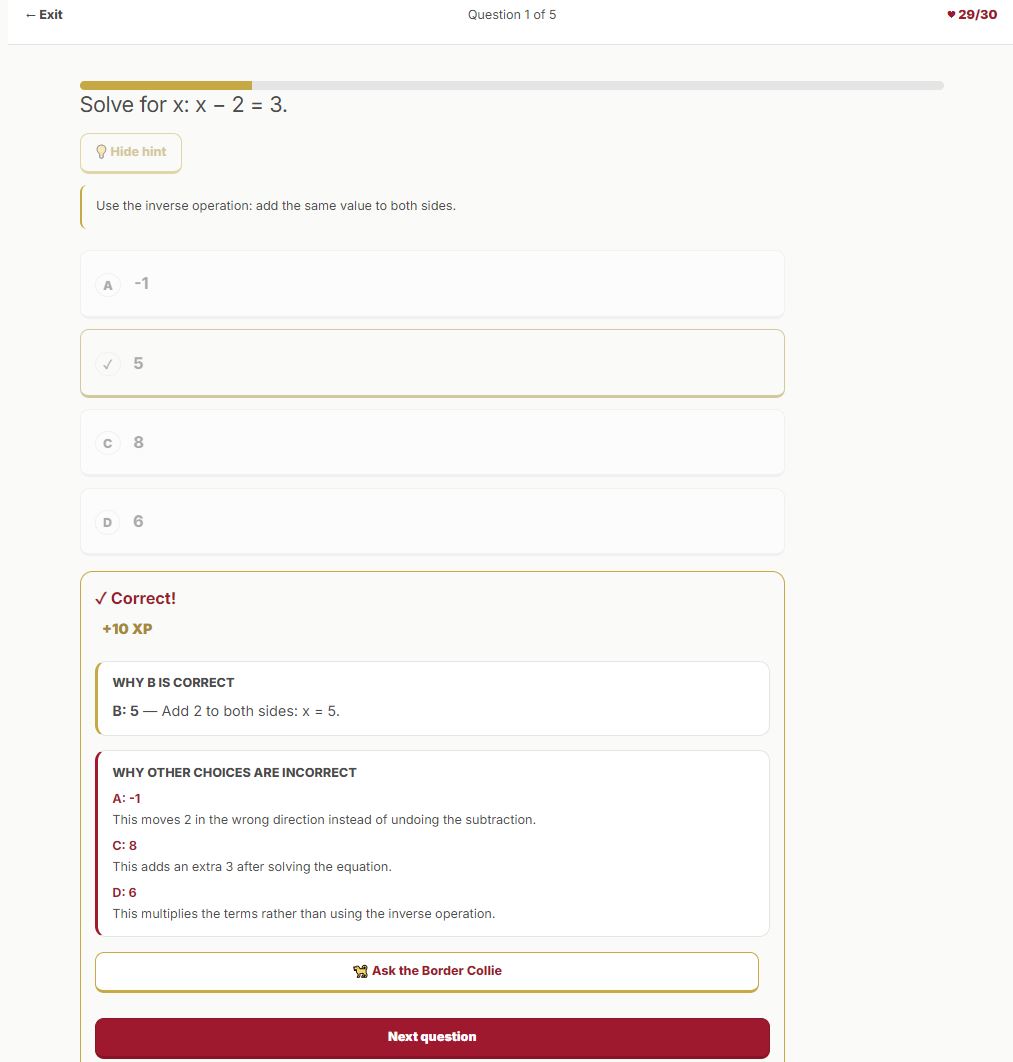
Math Question with Explanations
-
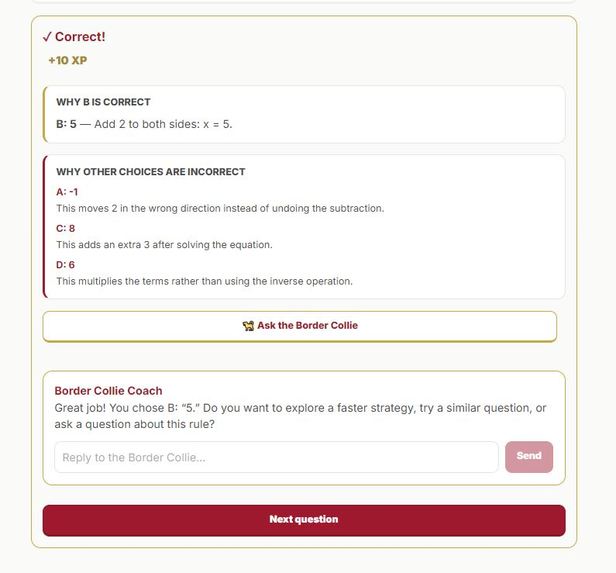
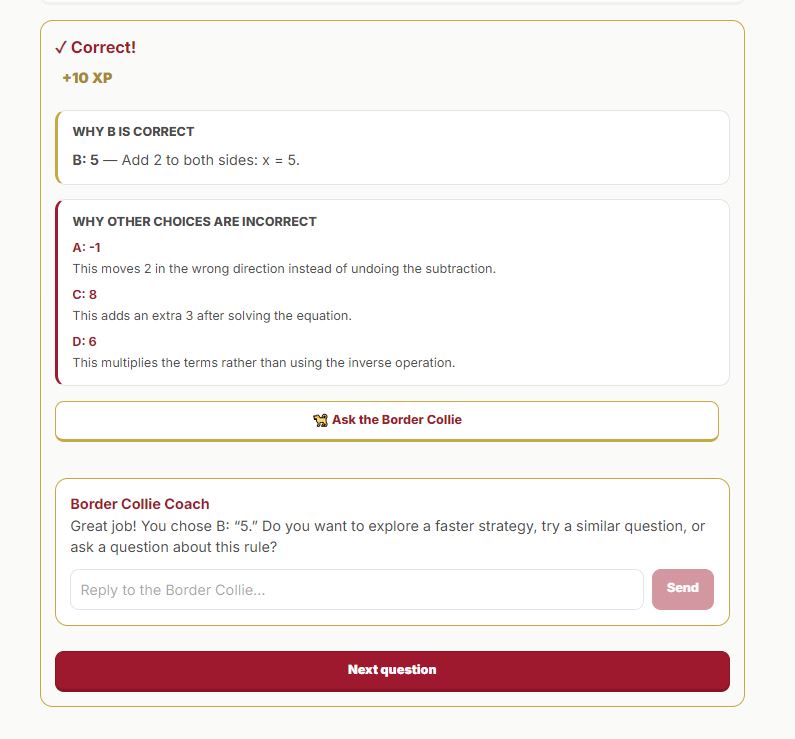
Math Question with Explanations and Ask the Border Collie the AI Tutor
-
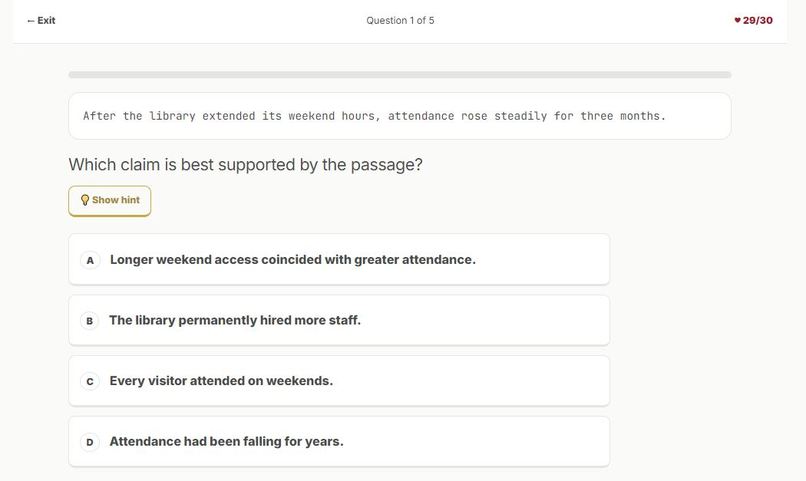
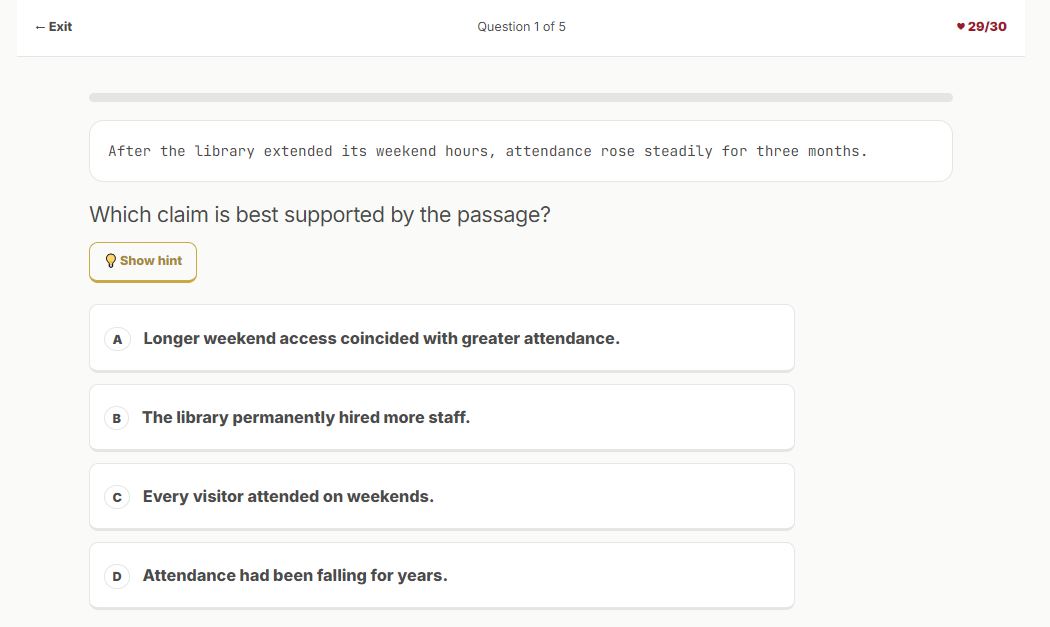
English Question
-
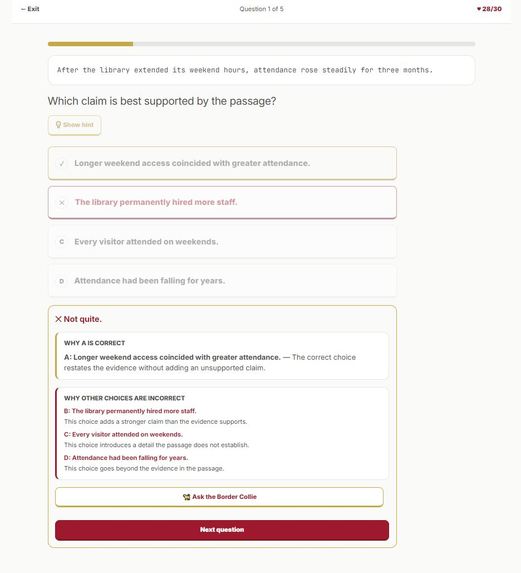
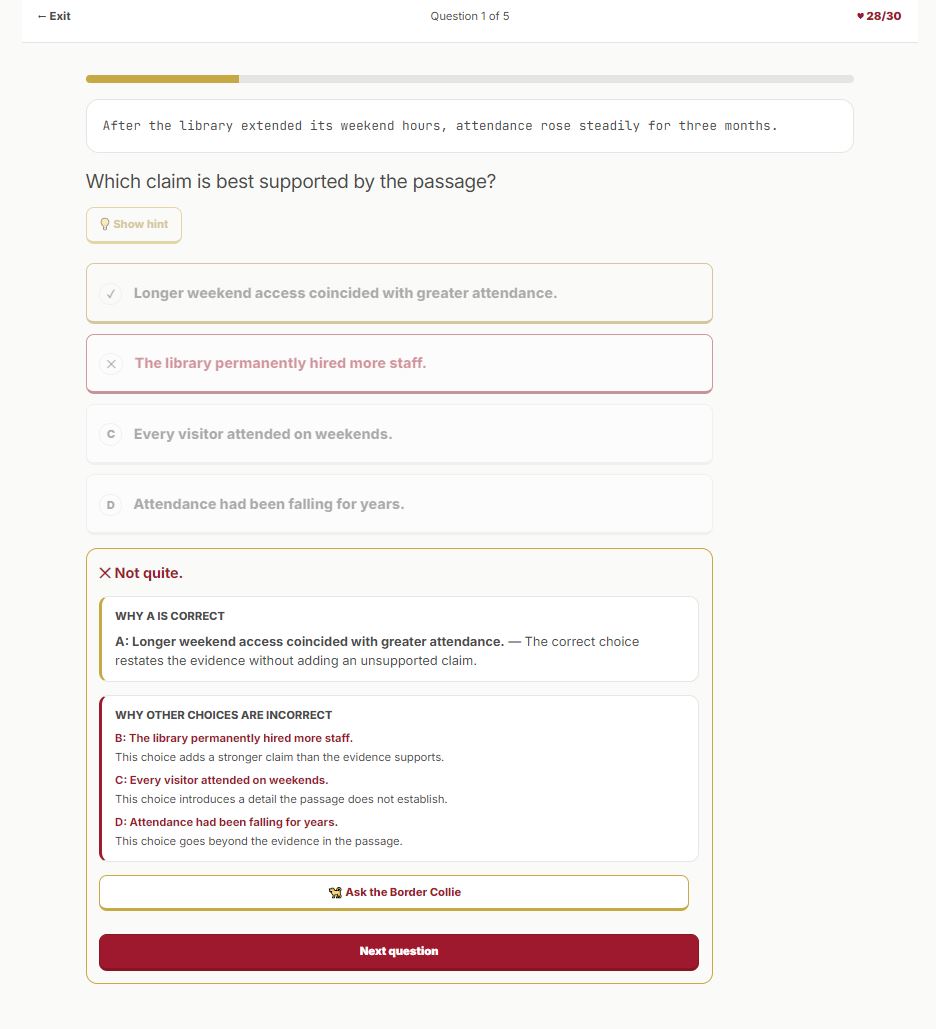
English Question with Explanations
-
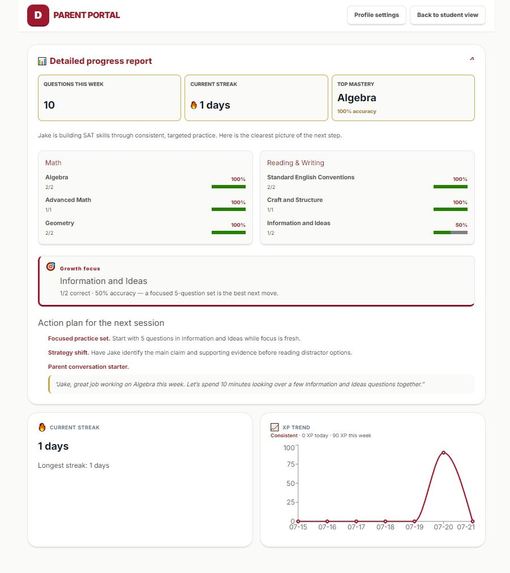
Parent Portal
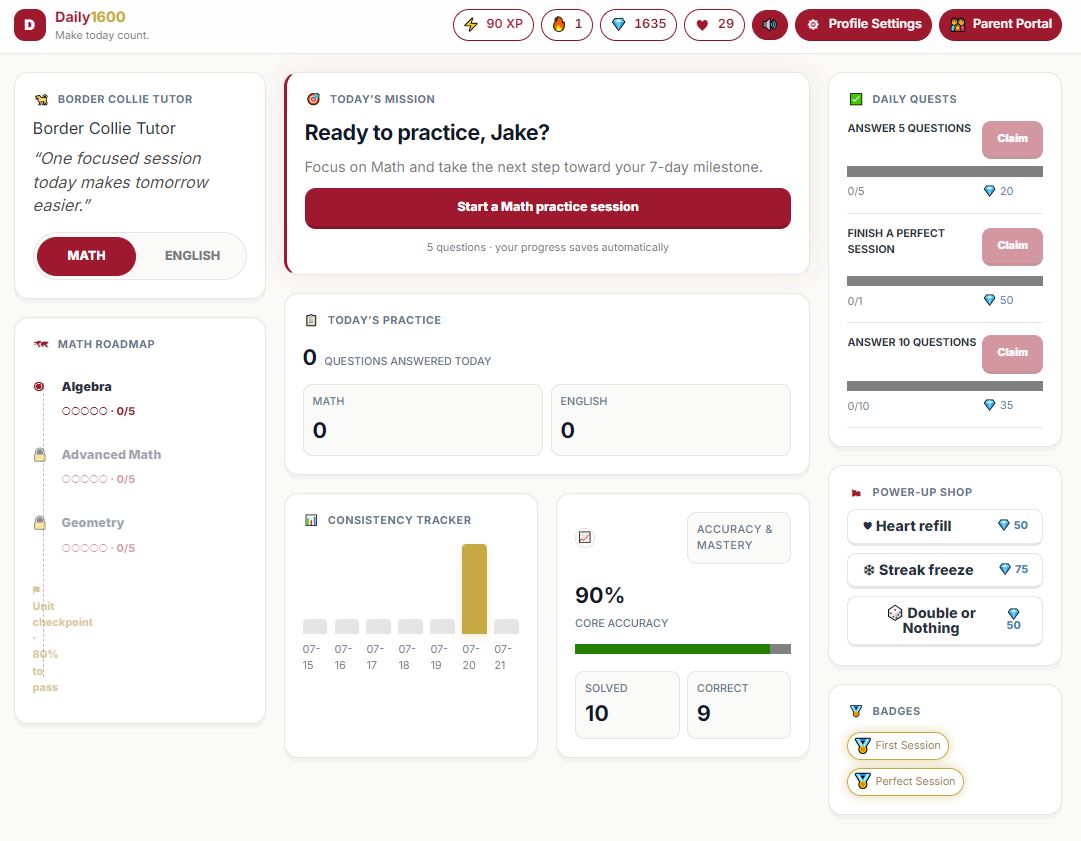

Daily1600: Making a Perfect SAT Score Accessible, Rewarding, and Actually Fun
Inspiration
The story of Daily1600 starts at the kitchen table.
My 15-year-old son Jake is preparing for the Digital SAT. Like millions of families across America, we quickly ran into two walls that most parents don't talk about openly: the cost barrier and the burnout barrier.
Private SAT tutoring in our area runs $150 to $300 per hour. A competitive 10-week program easily clears $3,000 to $5,000 - a number that puts elite preparation out of reach for most families. And for the families who can afford it? We watched Jake disengage anyway. Traditional prep is passive, repetitive, and deeply unrewarding. He'd close the prep book after 20 minutes and pick up his phone.
That phone is where the lightbulb hit us.
Jake had been using a habit-forming language-learning app for years, maintaining a 400+ day streak in Spanish with zero external pressure from us. We watched the same kid who couldn't sit through 20 minutes of SAT drills spend an hour gladly answering vocabulary questions because he didn't want to lose his streak.
The insight was obvious once we saw it: the mechanics are the same. Both language learning and SAT prep require daily repetition, incremental mastery, and long-term habit formation. The best habit-forming apps had already cracked the code on making that loop feel like play instead of punishment.
Daily1600 is our answer: take the gamification DNA that makes those apps genuinely habit-forming - streaks, hearts, gem economies, power-up shops, milestone roadmaps - and rebuild it entirely around the Digital SAT. Then power the whole thing with an AI tutor that is both infinitely patient and strategically withholding, guiding students to their own breakthroughs rather than just handing them answer keys.
Our goal: a perfect 1600 should feel earnable, not just purchasable.
What it does
Daily1600 turns SAT preparation into an engaging, structured daily ritual built around five core systems:
1. The Daily Study Loop
Students answer high-yield, Digital SAT-style questions curated to their chosen track (Math or English/Reading & Writing). Questions are sequenced by cognitive difficulty and surface area vulnerability - students aren't just drilling randomly; they're working a personalized syllabus.
2. The Gamification Engine
We implement a full habit-forming reward loop:
- Daily Streaks - consecutive-day tracking with visual feedback and milestone unlocks
- Heart System - limited "lives" per session that create constructive stakes
- Gem Economy - earned through correct answers and streak milestones
- Power-Up Shop - spend Gems on Streak Freezes (protect streaks during sick days) and Heart Refills
- Double-or-Nothing Gem Wagers - optional high-risk, high-reward daily challenge mode
3. The Border Collie Tutor
This is where OpenAI's GPT-5.6 becomes the heart of the product. When a student answers incorrectly, they don't get an answer - they get a teacher.
The Border Collie Tutor is engineered with a carefully tuned system prompt that enforces a strict Socratic pedagogy: it identifies exactly which reasoning step broke down, then asks the student a targeted question to help them reconstruct the logic themselves. It never spoils. It models the thinking, not the conclusion. This distinction - guiding vs. telling - is the most educationally meaningful design choice in the entire product.
4. The Parent Portal
Parents receive a real-time diagnostic dashboard powered by GPT-5.6. It surfaces:
- Live streak status and session cadence
- AI-synthesized cognitive grit scores (persistence under wrong answers)
- Subject-area vulnerability maps - which SAT domains need more time
- Recommended conversation starters for parent-student discussions
5. Predictive Score Modeling
We model score trajectory using a saturation growth curve: predicted score rises from a student's diagnostic baseline toward 1600 at a rate driven by streak length and Border Collie Tutor accuracy. The longer Jake practices consistently and the more he reasons through corrections, the closer his projected score climbs to a perfect 1600 - the mathematical embodiment of our core promise.
How we built it
We built Daily1600 as a modern single-page web application from the ground up during the hackathon:
Front-End
A single-page application built with React + TypeScript, bundled with Vite, and styled with Tailwind CSS v4. We deliberately avoided "startup neon" and instead developed a scholarly, prestigious visual identity around:
- Crimson (
#A51C30) - ambition, urgency, excellence - Gold (
#C9A84C) - achievement, prestige, reward - Warm parchment backgrounds - evoking academic tradition
Animations include a live daily-goal progress ring, confetti bursts on milestone completions, and a mascot that reacts to student performance states.
Local-First State
All student progress - streaks, hearts, gems, XP, quests, badges, and active sessions - is persisted in browser localStorage via a single UserProfile JSON record. No backend is required for the full student experience.
OpenAI Integration
The GPT-5.6 API powers two distinct subsystems:
Border Collie Tutor - invoked on every incorrect answer when VITE_ENABLE_LIVE_TUTOR=true and a server-side OPENAI_API_KEY are present. The prompt architecture includes a hard Socratic persona lock, a structured error taxonomy, and few-shot examples that distinguish guiding responses from spoiler responses. If the flag is off or the key is missing, the app falls back instantly to a deterministic authored response - guaranteeing 100% uptime with zero console errors.
Parent Diagnostics - GPT-5.6 synthesizes 7 days of practice telemetry into clear mastery metrics and non-nagging conversation starters, translating raw performance numbers into actionable parent-facing narratives.
AI-Assisted Development with Codex
We used Codex throughout the build to accelerate the local state model, gamification hooks, UI components, Tailwind class auditing, and TypeScript type checking - dramatically compressing what would typically be a weeks-long build into hackathon timelines.
Challenges we ran into
Taming the Border Collie Tutor Prompt
GPT-5.6's default instinct is helpfulness - meaning it wants to solve problems for the student. Our earliest prototypes would gesture at the Socratic method and then casually reveal the answer in the third sentence.
Getting the system prompt right required more than 20 iterations. The breakthrough was a three-layer architecture: (1) a hard persona lock ("You are a Socratic tutor. You NEVER state the correct answer or confirm/deny answer choices."), (2) a structured error taxonomy the model must classify before responding, and (3) explicit few-shot examples of what a Socratic response looks like versus a "spoiler" response. Once all three layers were in place, tutor behavior became reliably pedagogical.
Keyless Uptime Architecture
We needed the app to work flawlessly in a demo environment with or without a live API key. Building the dual-engine fallback - where the authored local response is shown immediately and the live GPT-5.6 stream silently overlays it if available - required careful state sequencing to avoid flickering, duplicate responses, or raw network errors surfacing to the user.
Prestigious Visual Identity Under Pressure
Pivoting mid-build from an initial playful neon design to a scholarly crimson-and-gold palette required a systematic audit of every Tailwind utility class and hardcoded hex in the codebase. Color consistency at this level of branding detail matters more than expected to the final premium feel of the product.
Accomplishments that we're proud of
- The Border Collie Tutor genuinely works. Watching Jake reason his way to a correct answer he initially missed - without being given it - is the most satisfying thing we built. It validates the entire pedagogical premise.
- A real student co-built and uses it daily. Jake isn't a test user - he's the co-designer, primary tester, and daily user preparing for his actual Digital SATs. Every UX decision was validated against real 15-year-old behavior.
- The dual-engine fallback is seamless. The app delivers 100% uptime whether a live API key is present or not, with no console errors and no user-visible degradation.
- We shipped a complete, polished product with a full gamification economy, working Parent Portal, and live GPT-5.6 integration - in hackathon time. The animations and transitions feel premium, not rushed.
What we learned
Active struggle beats passive consumption. Every time we were tempted to make the Border Collie Tutor more "helpful" by giving more direct hints, we reminded ourselves of the research: retrieval practice and productive struggle produce dramatically better long-term retention than re-reading or watching worked examples. The Socratic constraint isn't a feature limitation - it's the most important educational design decision in the product.
Gamification works because it externalizes internal motivation scaffolds. Streaks, hearts, and gem economies don't create motivation - they give pre-existing motivation somewhere concrete to attach. The student who already wants to do better has a daily anchor. The student who's drifting gets a natural re-entry point every morning.
Prompt engineering is real engineering. The Border Collie Tutor prompt architecture is as much a design artifact as the React components. It has structure, invariants, edge cases, and failure modes. Treating it with the same rigor as code - versioning, testing, iterating - was the unlock.
Codex compresses feedback loops. Having AI assistance on state modeling, component scaffolding, and TypeScript verification meant we could maintain design quality and move fast. The bottleneck shifted from "can we build this?" to "what's the right thing to build?" - which is where it should be.
What's next for the Daily1600 app
- Peer-to-Peer Streak Duels - Study clubs where students wager gems against friends to maintain the longest active streak, adding a social accountability layer
- Adaptive Question Selection - Using GPT to dynamically select the next question based on the student's live error pattern, moving from fixed tracks to truly personalized pacing
- Offline Syllabus Mode - Downloadable practice packs for students without consistent internet (school buses, commutes)
- Structured PDF Diagnostic Reports - Formal printable reports parents can share with school guidance counselors or college advisors, generated by GPT from cumulative session data
- School Partnership Tier - A classroom dashboard that lets teachers monitor cohort-level SAT readiness across their students, with GPT-synthesized class-wide vulnerability reports
Built With
- ai-tutor
- codex
- digital-sat
- edtech
- education
- express.js
- framer-motion
- gamification
- gpt-5.6
- latex
- localstorage
- node.js
- offline-first
- openai
- parent-portal
- react
- recharts
- rest-api
- socratic-ai
- tailwind
- typescript
- vite


Log in or sign up for Devpost to join the conversation.