-
-
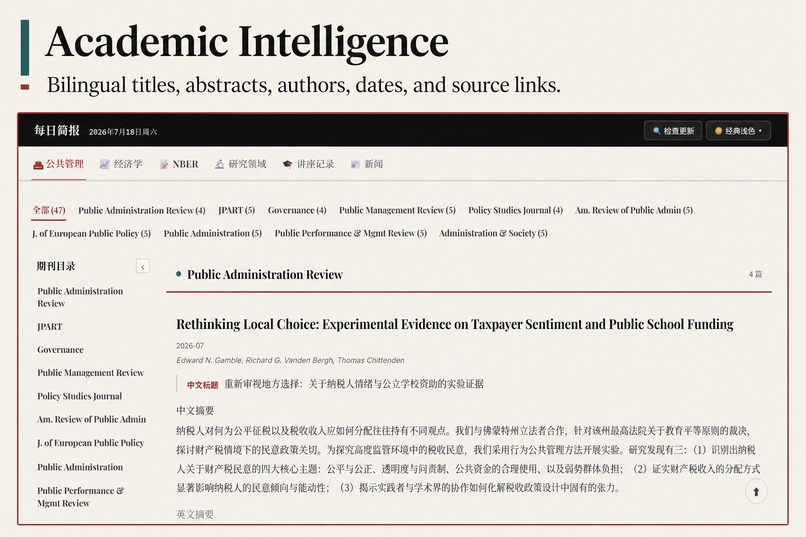
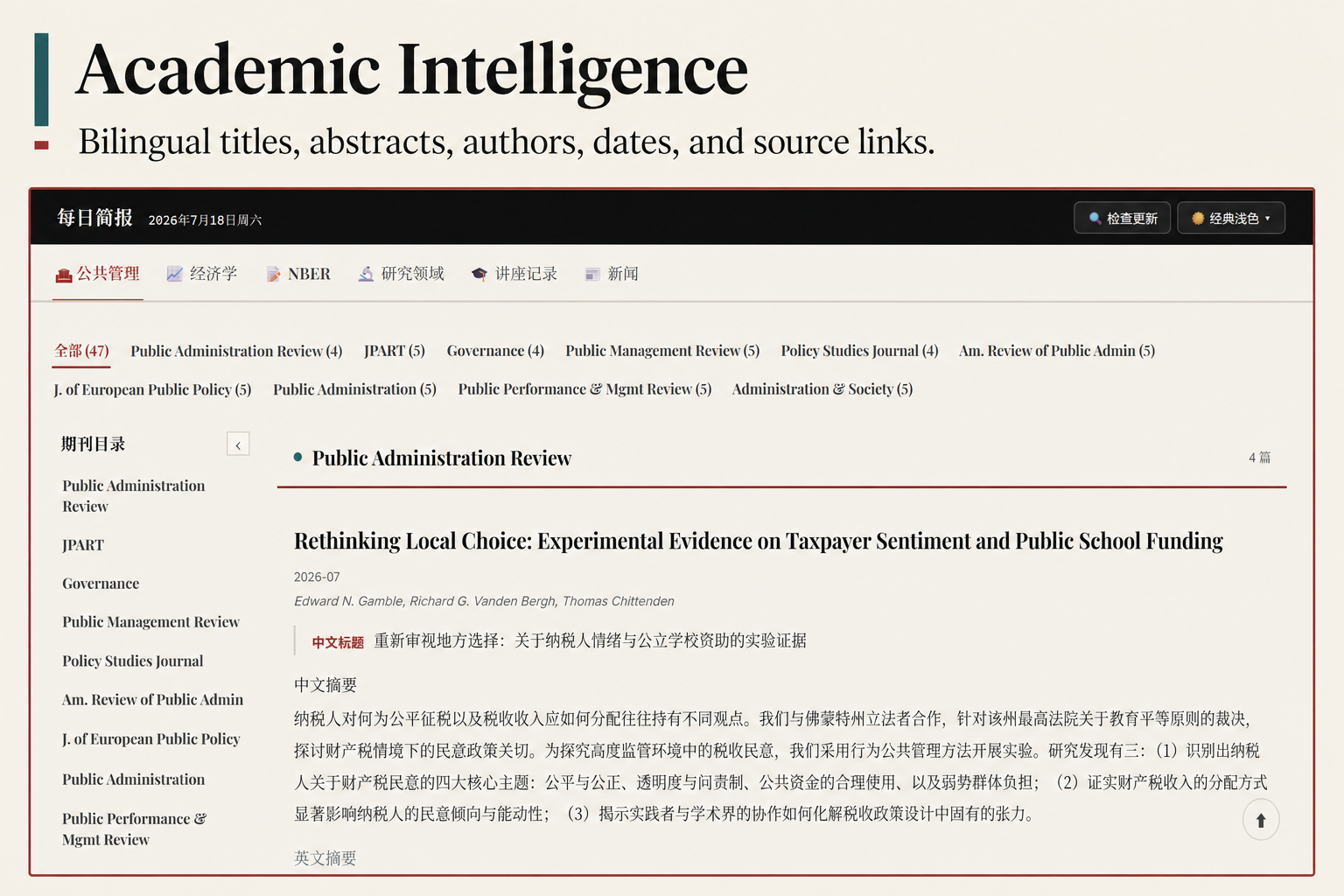
A unified academic reading view with journal filters, bilingual titles and abstracts, author metadata, dates, and links to original sources.
-
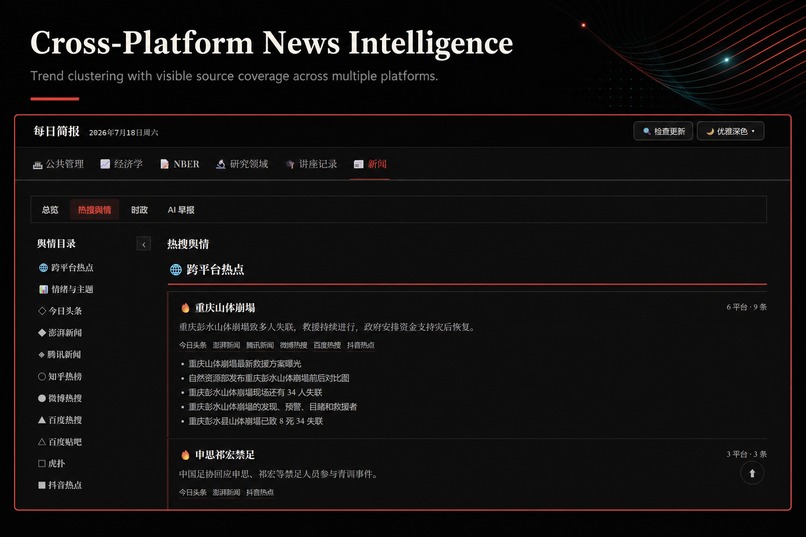
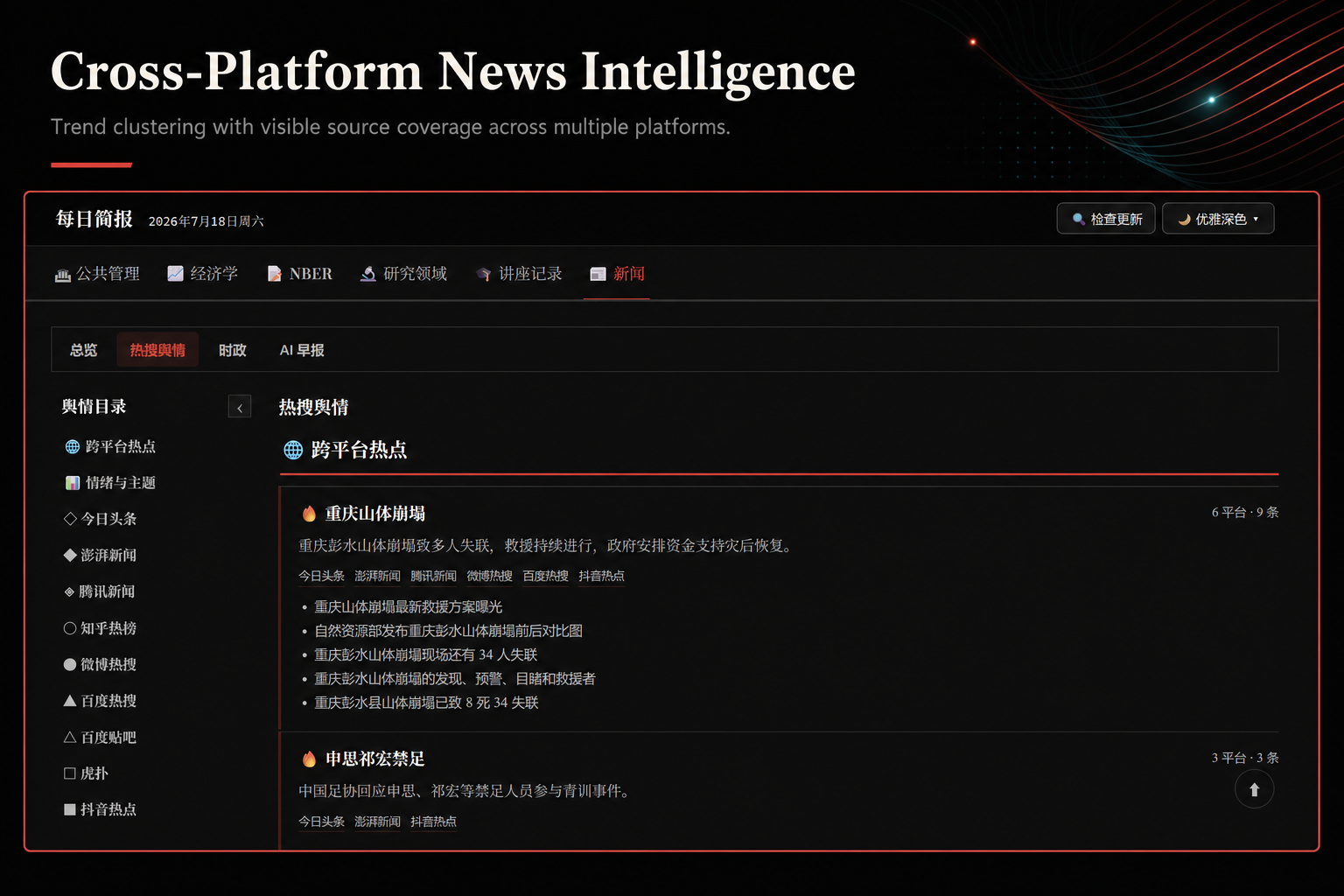
DB clusters related trends across multiple platforms, showing source coverage and grouped headlines instead of an unstructured news feed.
-
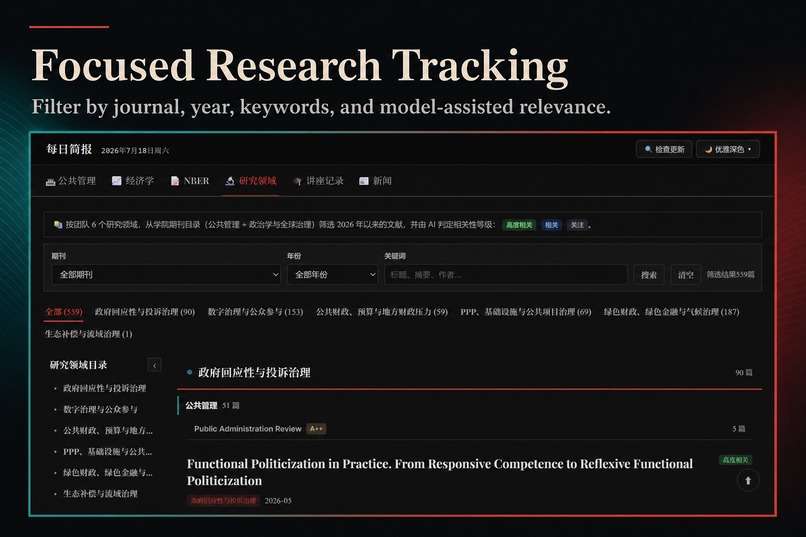
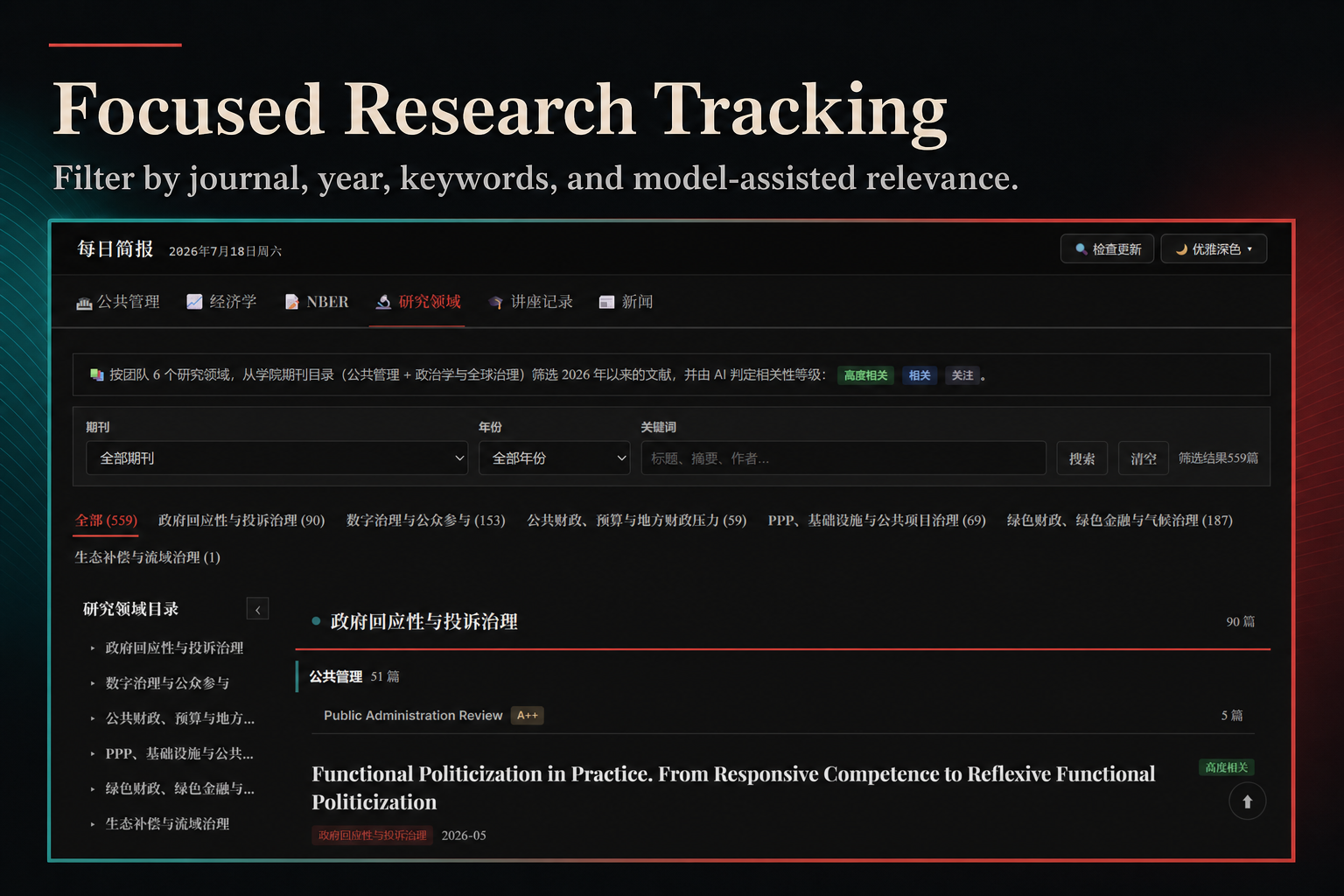
Custom research fields combine journal, year, and keyword filters with model-assisted relevance labels to surface papers that matter most.
Inspiration
A researcher's morning often starts in too many places: journal sites, working-paper feeds, policy news, social platforms, AI newsletters, and personal reading notes. The hard part is not finding one more link. It is deciding what is new, what is relevant, what can be trusted, and what deserves attention today.
Daily Briefing began as a working Flask application for bringing those sources together. For OpenAI Build Week, the goal was to turn that useful application into a more dependable production workflow: safer to expose publicly, clearer when sources fail, easier to maintain, and more efficient to use every day.
What it does
Daily Briefing collects academic publications, NBER working papers, public news, social trends, AI news, and user-defined research material. It deduplicates and organizes the results, enriches them with translations and relevance signals, and presents one stable daily snapshot through:
- a section-based responsive web interface;
- research-field tracking with configurable journals and topics;
- source links and visible provenance;
- HTML reports and scheduled email digests;
- public-safe source and refresh status.
The public demo is intentionally read-only. Visitors can inspect the latest completed briefing, switch themes, browse sections, and follow sources, but they cannot trigger data collection, change settings, export private reports, or send email.
How we built it
The pipeline is organized as:
academic and public sources
        ↓
source-specific collectors
        ↓
refresh round: refresh_id, deadlines, source status, stable snapshots
        ↓
translation, relevance screening, annotation, and clustering
        ↓
Flask API
        ↓
web interface, HTML report, and scheduled email
The browser never calls external research or model providers directly. It reads the latest stable server snapshot. Each refresh receives a refresh_id, so delayed work from an older round cannot overwrite a newer result.
Codex was used as a development collaborator, reviewer, and test partner. I defined the product goals, operating constraints, source priorities, and acceptance criteria. Codex inspected the existing system, converted decisions into bounded tasks, implemented and reviewed changes, reproduced failures, added regression coverage, and verified browser and deployment behavior.
GPT-5.6 Sol with high reasoning was reserved for architecture, concurrency, security, difficult debugging, and adversarial verification. Lower-risk work stayed narrowly scoped, while routine production processing uses cost-efficient models or deterministic code. The application does not use the strongest model for every simple task merely because Codex helped build it.
What changed during Build Week
Daily Briefing existed before the event. The Build Week submission is the meaningful extension completed during the event:
- A dedicated refresh runtime with one state owner, total deadlines, stable snapshots, per-source status, stale fallback, and late-write protection.
- A public-mode security boundary that hides management controls and independently rejects management actions on the server.
- Scheduled-email safeguards that wait only for the current delivery's essential processing, refuse to send after explicit core-task failure, and label timeout-based partial delivery honestly.
- Source-specific backend modules plus responsibility-based JavaScript and CSS modules.
- Section-level lazy rendering, safer event binding, responsive navigation, keyboard support, reduced-motion behavior, and multiple themes.
- Daily
NEWmarkers, Chinese typography normalization, and a redesigned classic-light email presentation.
Challenges
The hardest problem was time, not data structure. A refresh can finish fetching while translation or classification is still running. Without round ownership, a late background task can silently publish stale work over a newer snapshot. We reproduced that failure mode, introduced explicit refresh identities and lock ordering, and added regression tests for timeout, failure, and late-write cases.
Another challenge was making partial upstream failure visible without making the product unusable. An empty but valid source response is different from malformed data, a timeout, or stale fallback. The source-result model now preserves those distinctions instead of turning every problem into an empty list.
Public deployment also required more than hiding buttons. The server independently denies settings, manual refresh, export, push, and test-email actions in public mode, with Origin and CSRF checks for management use.
Accomplishments
- 384 automated tests pass locally and in GitHub Actions.
- Older refresh rounds cannot overwrite newer published snapshots.
- Public and management behavior is enforced on the server, not only in the UI.
- Source failures and stale data are explicit.
- The interface remains usable across desktop, mobile, keyboard navigation, reduced motion, and multiple themes.
- The judge-facing repository contains synthetic examples and excludes credentials, runtime state, generated reports, private notes, and personal development history.
What we learned
The most useful model collaboration was not a single large generation. It was a repeated loop:
real usage signal → bounded task → implementation → test or browser check → correction
Operational corrections became regression tests instead of disappearing into a backlog. We also learned that model routing should follow task risk: frontier reasoning is valuable for concurrency and security, while routine transformations should remain deterministic or cost-efficient.
What's next
Next steps are a domain with HTTPS, a clearer source-health dashboard, more user-controlled research profiles, and a structured feedback-to-evaluation loop for relevance decisions. The current submission focuses first on a reliable, inspectable workflow that judges can run without an account.


Log in or sign up for Devpost to join the conversation.