-
-
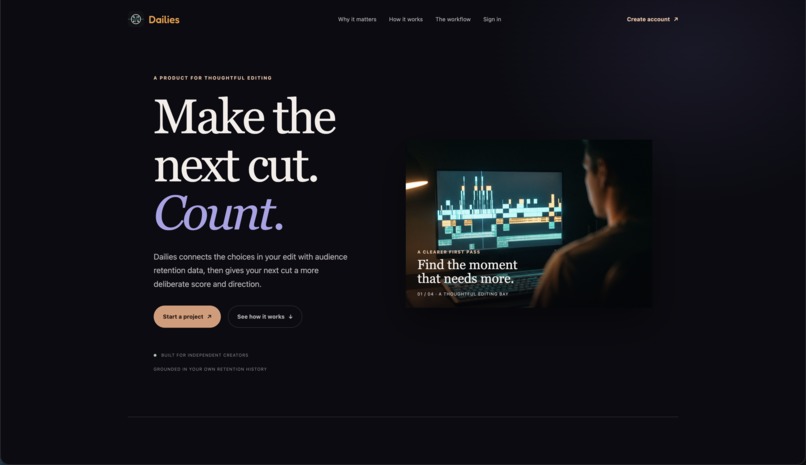
Landing Page
-
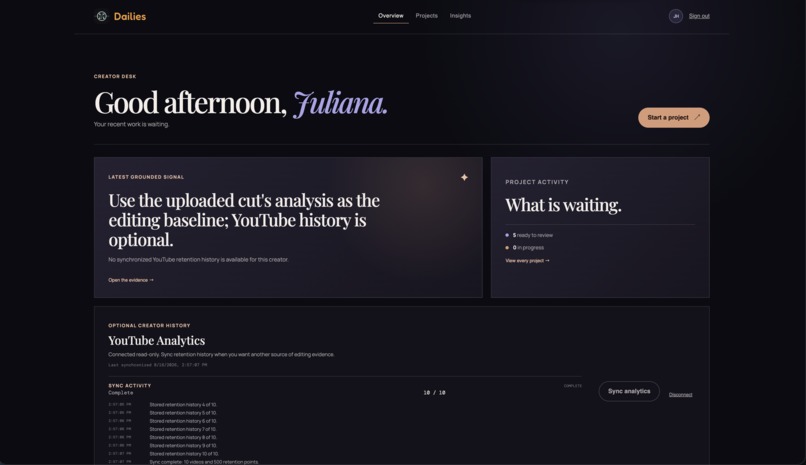
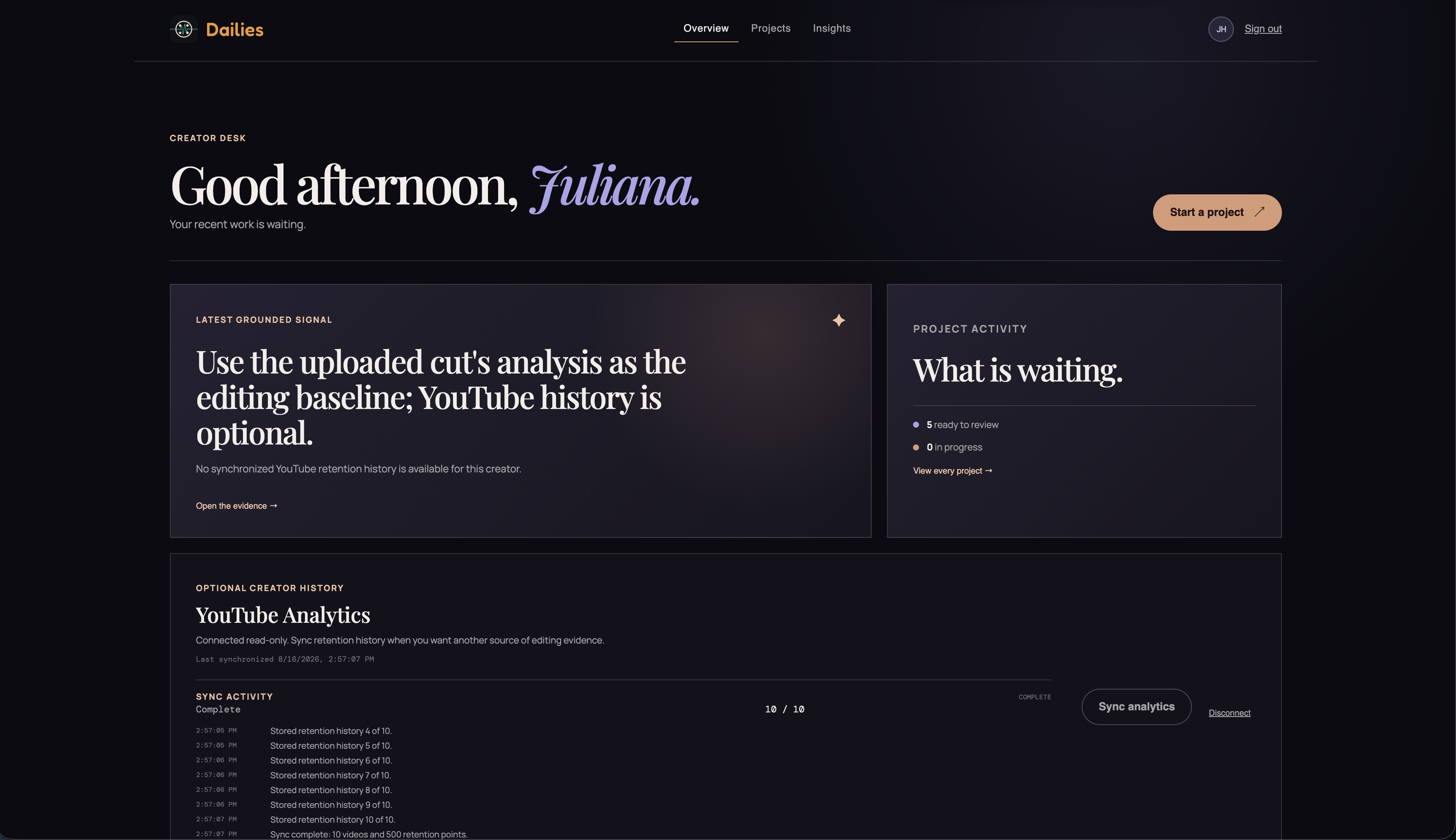
Dashboard
-
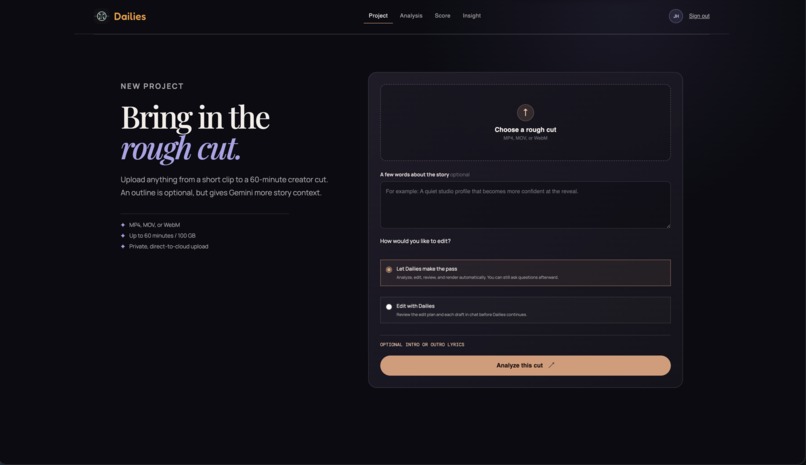
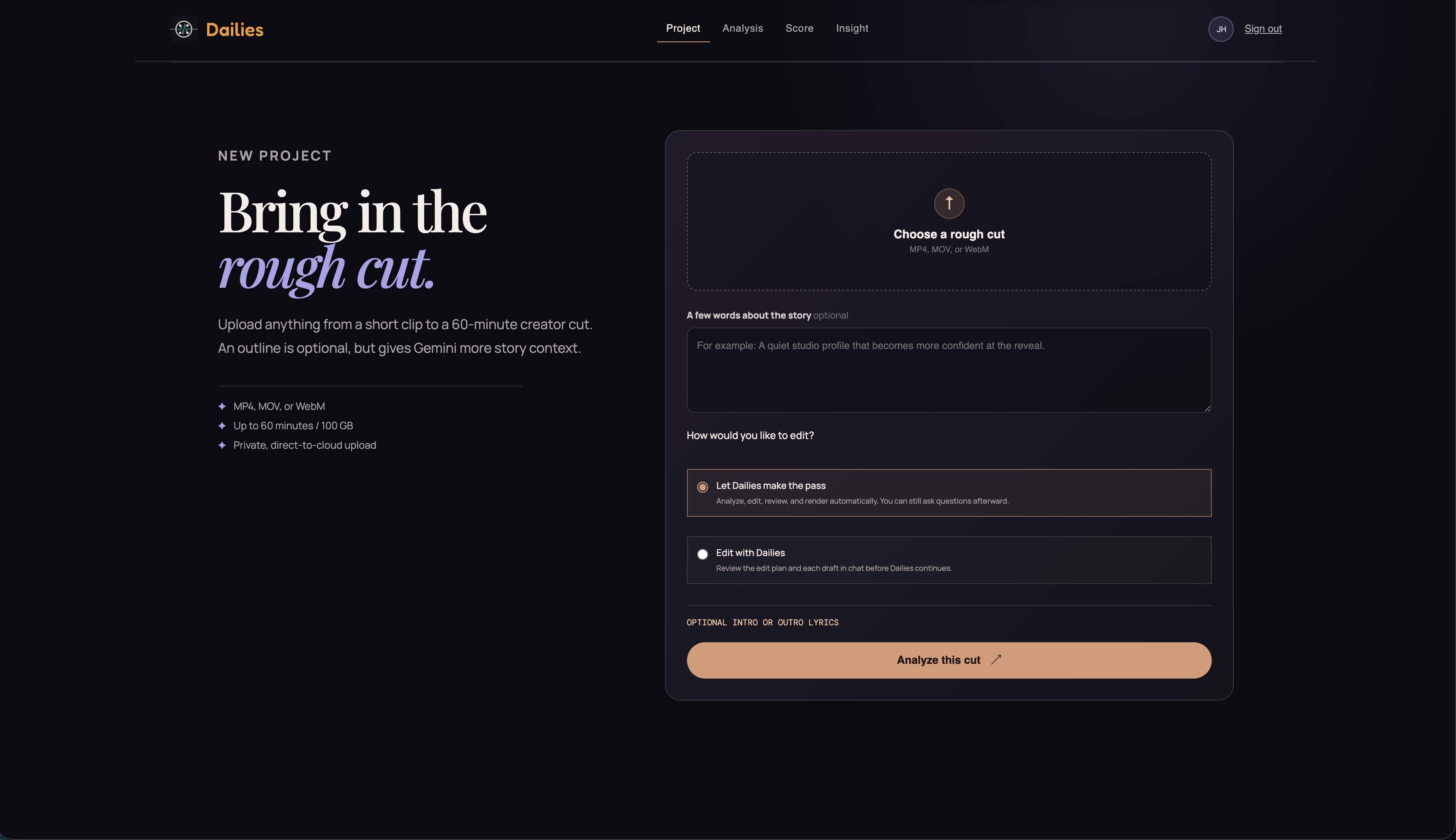
Upload Form
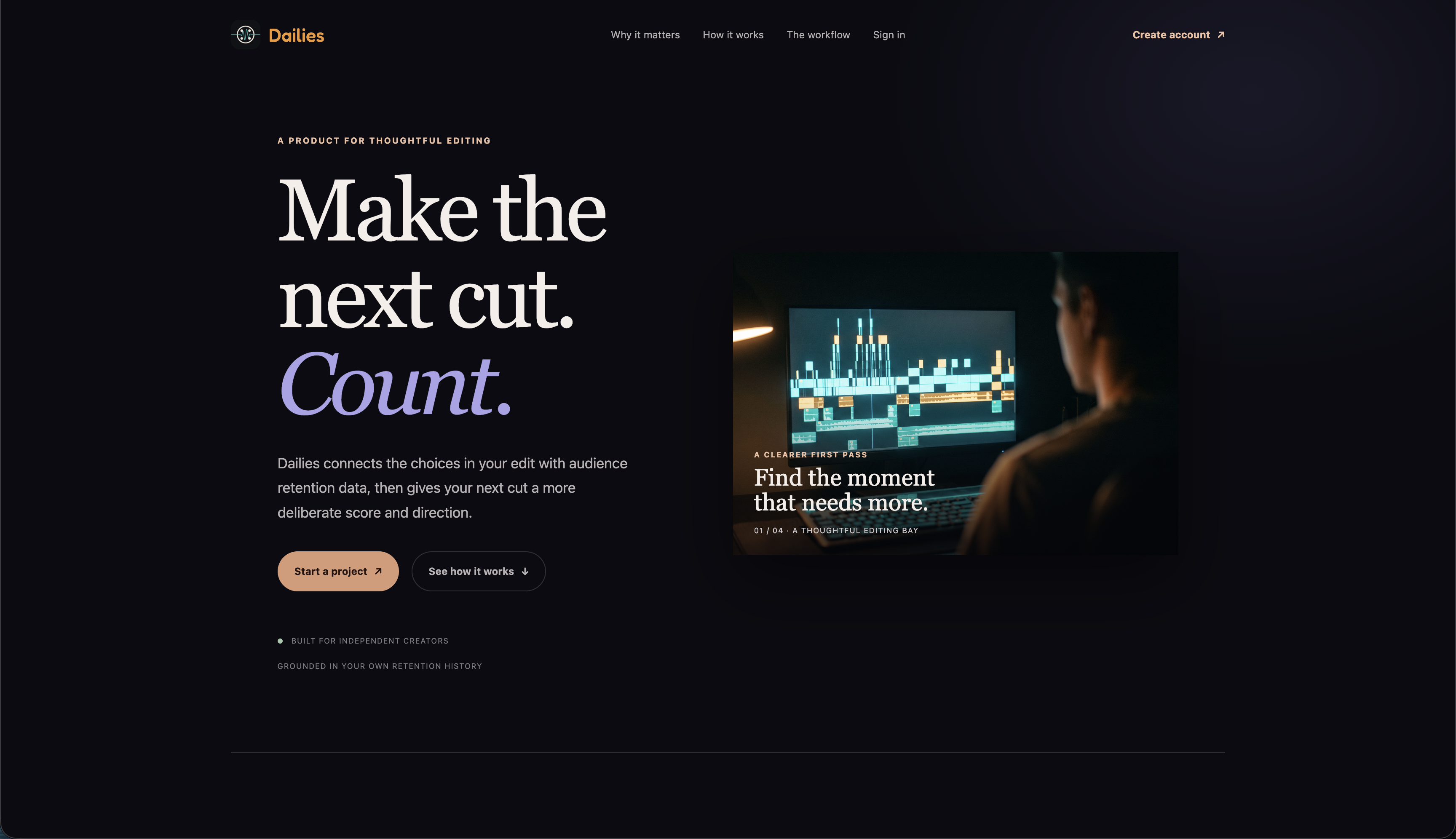
About the project
Inspiration
Every YouTube creator has experienced this outcome: hours invested in an edit, the video is published, and a significant portion of the audience departs at an unexplained point in the timeline. Retention data exists within YouTube Studio, but it remains disconnected from the editing process itself. Nothing currently connects the observation of precisely where viewers stopped watching to a concrete recommendation for what to change in the next edit. Dailies was built to close that gap, and to give creators an original soundtrack for each edit rather than licensed stock music that carries a risk of a copyright claim.
The name comes from film production. "Dailies" are the newly recorded scenes that filmmakers review during production to evaluate the work and decide what to change next. The name fits this product because its agent repeatedly examines footage, renders a draft, reviews the result, and applies targeted revisions.
What it does
Dailies is an agentic post-production assistant for YouTube creators that combines a generative soundtrack workflow with a genuine analytics feedback loop.
A creator uploads raw footage and an optional outline, then chooses Autonomous or Collaborative mode. In Autonomous mode, Dailies completes the entire workflow without further input and can produce up to three self-reviewed drafts before completion. In Collaborative mode, the same workflow pauses after the edit plan and after a draft passes review, so the creator can approve the work or request a targeted change.
The workflow itself:
- Analyzes the footage with Gemini's multimodal video understanding, producing scene-level tagging, pacing flags, and editorial recommendations.
- Designs an edit timeline with a Google ADK
LlmAgent, which selects visual and audio treatments for each segment. - Generates an original soundtrack with Lyria 3, matched to the emotional arc of the footage, and can generate an animated intro or outro clip with Vertex AI Veo.
- Retrieves the creator's own retention curve through the official YouTube Analytics API, stores it in ClickHouse, and queries it through the official ClickHouse MCP server to correlate retention drops against cut and music timing from the creator's own past videos.
- Renders the cut with FFmpeg, reviews the actual rendered video with Gemini, and revises the draft when the review does not pass.
- Checkpoints every stage in Firestore so interrupted work resumes from durable state instead of restarting.
Why it is agentic
Dailies operates beyond a standard chat loop. The creator supplies a goal and source footage. The system determines and executes the intermediate steps itself, invoking scoped tools for analysis, planning, asset generation, rendering, review, and revision. The agent evaluates its own rendered output rather than assuming that a successful render is a successful edit, and it authors its own generation prompts as tool-call arguments rather than relying on a hidden, hardcoded prompt.
How we are using Google Cloud and ClickHouse
- Gemini performs multimodal video analysis, edit planning, rendered-draft review, and the natural-language retention recommendation.
- Lyria 3 generates the soundtrack. Vertex AI Veo generates optional animated intro and outro clips.
- A Google ADK
LlmAgent, running inside a private Cloud Run service, coordinates function tools for analysis, planning, asset generation, rendering, review, and revision. - ClickHouse Cloud, accessed through its official MCP server, stores per-second retention curve data and cut and music timing events. The Retention Insight Agent runs a live correlation query against this data, which makes ClickHouse a functionally necessary component rather than a supplementary one: the core recommendation cannot be produced without it.
- Cloud Run hosts three services: the public frontend and API, the private agent service, and a private ingestion service that handles YouTube OAuth sync and owns all writes to ClickHouse.
- Firestore stores project state, checkpoints, and the activity ledger. Cloud Storage stores source footage and generated media.
- No AWS, Azure, OpenAI, or Anthropic tooling is used anywhere in the stack, consistent with the hackathon's technology requirements.
How we built it
Dailies is a modular TypeScript application with three deployed Cloud Run services. The public service hosts the React studio, authenticates the creator, owns project data, and starts or resumes workflow jobs. The private agent service runs the Google ADK editorial agent, whose function tools perform Gemini analysis, edit planning, optional retention queries, Lyria and Veo generation, FFmpeg rendering, and rendered-draft review. The private ingestion service handles YouTube OAuth synchronization and controlled ClickHouse writes, and it also runs the ClickHouse MCP server that the editorial agent queries; this separation keeps the editorial workflow from ever modifying analytics history. Retention data is retrieved solely through the official YouTube Analytics API under OAuth authorization, using the creator's own verified channel data.
Challenges we ran into
- Making ClickHouse genuinely necessary rather than a supplementary analytics dashboard. The correlation query, which joins retention curves against cut and music timing events, needed to directly inform the agent's recommendation rather than simply populate a chart.
- Sourcing retention data appropriately. Only the official, OAuth-authenticated YouTube Analytics API was acceptable, since retrieving retention data by other means would violate YouTube Studio's terms of service.
- Keeping the agent, rather than surrounding code, responsible for creative decisions. The Veo animation prompt and the soundtrack composition brief are authored by the LLM agent itself as tool-call arguments, not composed by a hidden helper function or a second hidden model call.
- Recovering long-running work safely. Video analysis, generation, and rendering can outlast a single request, so the workflow records durable checkpoints and events in Firestore and can resume from the last completed stage.
Accomplishments that we're proud of
- A genuine feedback loop, in which performance data from previous videos actively informs the recommendation for the next one.
- Soundtrack generation that avoids the risk of a copyright claim, since every track is generated rather than licensed.
- An agent architecture in which every required component of the stack, Gemini, the Google ADK, and the ClickHouse MCP server, performs substantive work within the recommendation pipeline rather than appearing only in documentation.
- A rendered-draft review stage that can catch and revise a flawed cut before the project is marked complete.
What we learned
- Pairing a generative feature, such as soundtrack generation, with a genuine analytics feedback loop, such as ClickHouse-backed retention correlation, produces a considerably stronger product than either feature would on its own.
- A useful creative agent must evaluate its own outputs, not only produce them. Rendering a file proves the pipeline ran; it does not prove the edit is coherent.
- Framing the tool around established film and editing terminology, including dailies, score, and rough cut, reinforced product decisions that felt native to how creators already think about their workflow.
What's next for Dailies
- Extend the Retention Insight Agent to correlate against thumbnail and title selection in addition to cut and music timing.
- Add explainable evidence to each editorial recommendation.
- Support batch retention analysis across a creator's entire catalog rather than only recent uploads.
- Extend collaborative review with comments tied to exact timestamps.
Built With
- agent-development-kit
- agent-engine
- clickhouse
- cloud-run
- gemini
- google-cloud
- javascript
- lyria-3
- mcp
- model-context-protocol
- oauth
- python
- react
- secret-manager
- typescript
- vertex-ai
- youtube-analytics-api

Log in or sign up for Devpost to join the conversation.