Inspiration
Every team shipping AI video has quietly appointed a human test suite: one person who watches every clip and checks it for length, brightness, flicker, brand palette, character continuity, and whether the brief was followed at all. That person is the bottleneck for everyone upstream who owns "correct" but cannot check it themselves.
The failure mode is specific and expensive: AI video fails in motion, after you have already paid for it. A gorgeous keyframe becomes a clip that pans the wrong way, or does not pan at all. The whole industry is optimizing generation. Nobody is testing the product.
So we built the part nobody built: the tests.
What it does
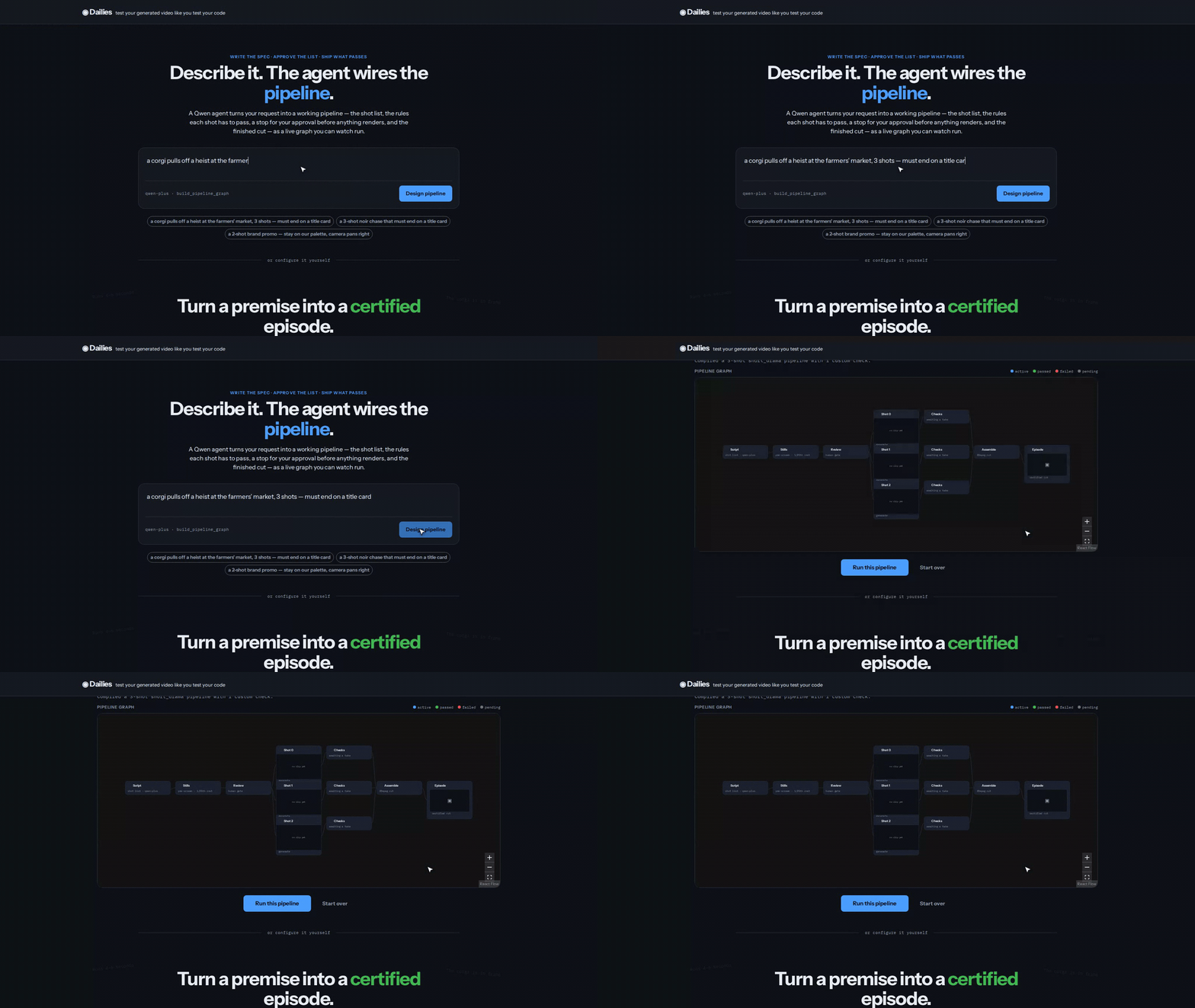
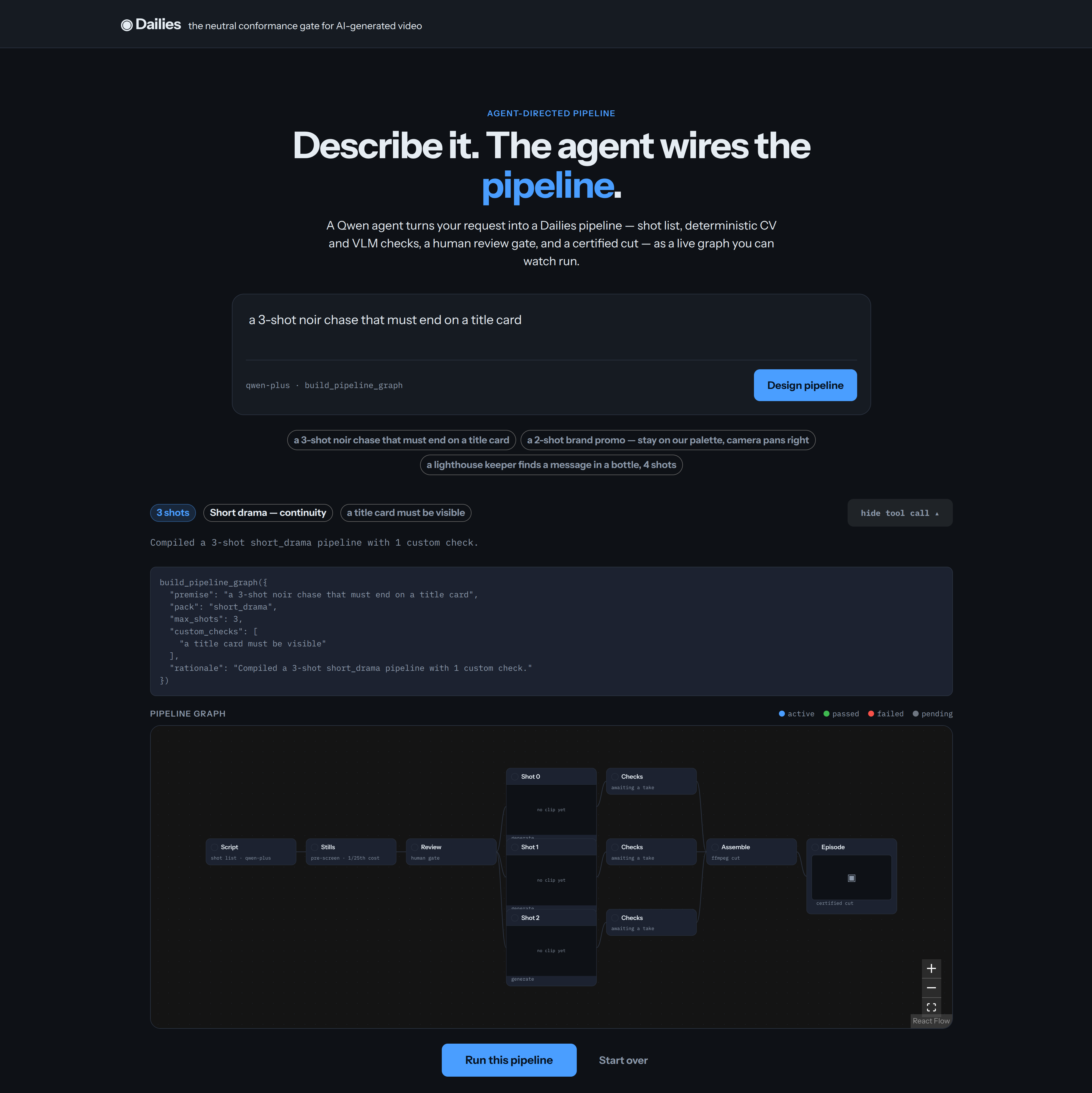
You describe an episode in plain language. A Qwen agent turns it into a pipeline — the shots, the rules, and a stop for your approval — by function-calling a real tool, so the topology is always well-formed. Each rule you write is compiled into a closed assertion grammar of ten sentence types across three tiers. A rule the grammar cannot express is rejected before a token is spent; that rejection is the compile error, and it is the literal "CI" in "CI for generated video".
Then every generated take is measured:
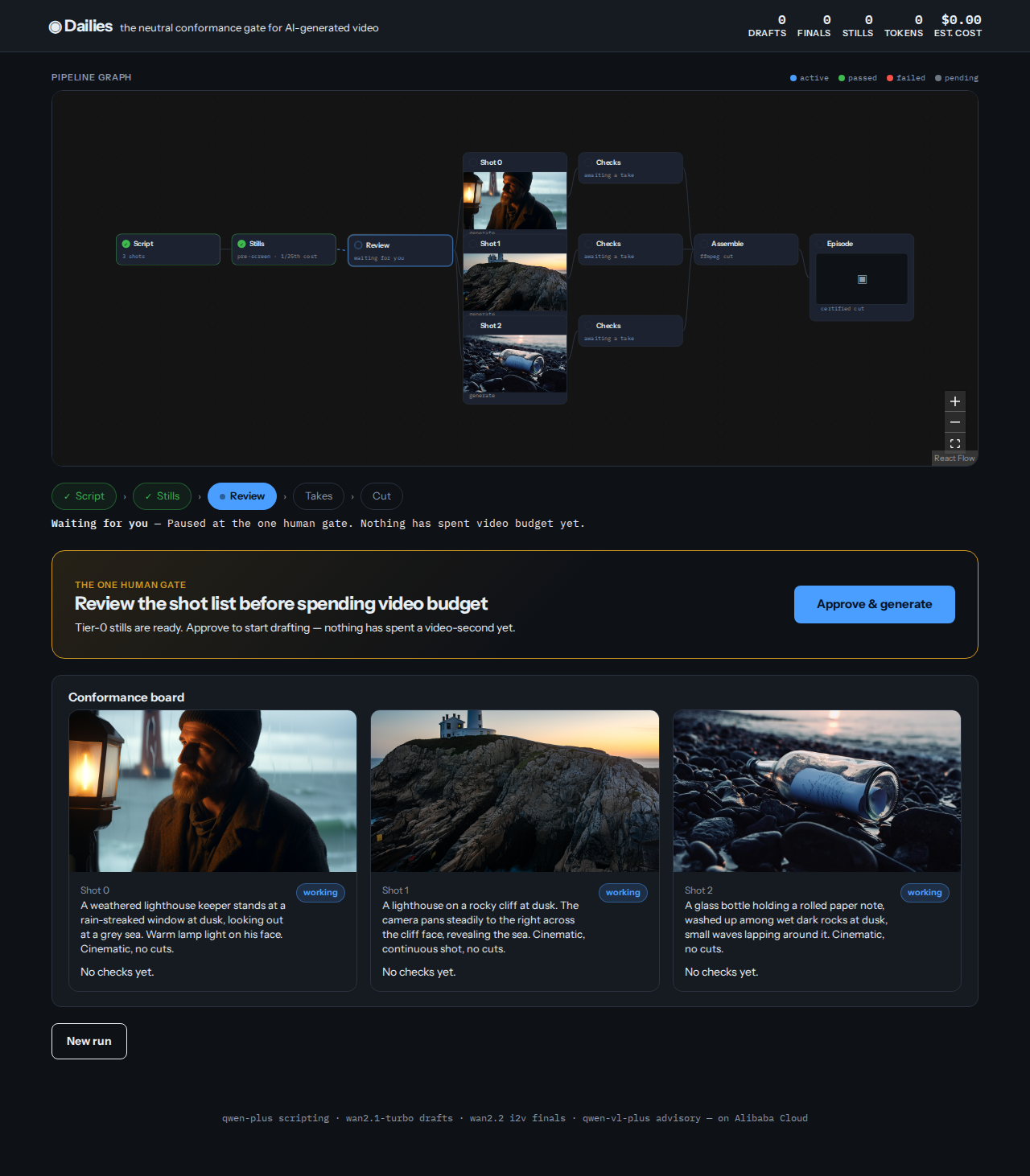
- Tier 0 renders one cheap still per shot and asks Qwen-VL whether the prompt can even produce its own subject — roughly 1/25th of a video second's cost, before any video spend.
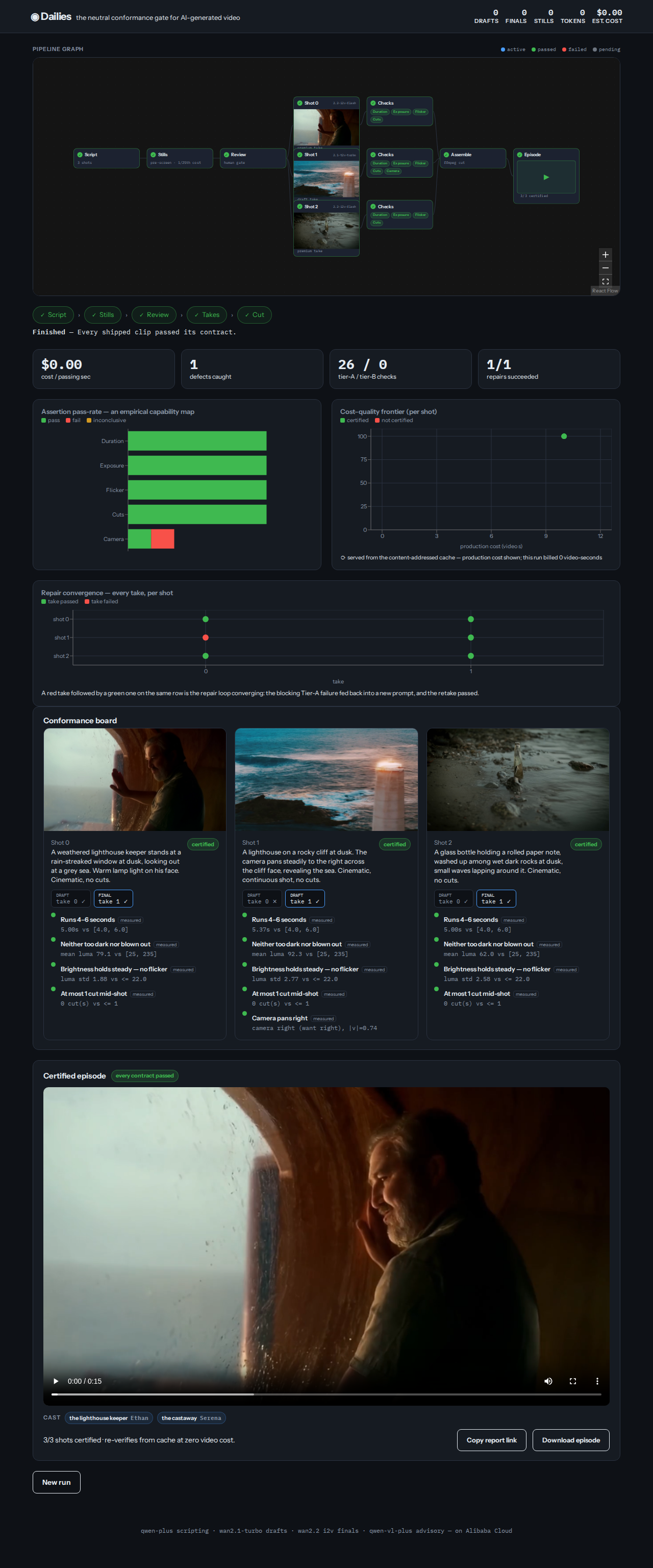
- Tier A is deterministic OpenCV: duration, brightness, flicker, scene cuts, camera motion by optical flow, palette ΔE. Zero tokens, so it runs on every take, and it reports where a check failed, not just that it did — a failure carries a time window and writes the frame it indicted.
- Tier B is Qwen-VL judgment on strided frames — identity continuity, briefed action, title card. Advisory only: a model's opinion never blocks what a measurement approved.
A take that fails a blocking check goes back for a bounded repair: Qwen-plus rewrites the prompt from the failing assertions, and a frame-anchored Wan i2v model re-renders from the last good frame, so the retake is a continuation of the approved take rather than a fresh roll. A patch has to earn its slot — if it still fails, the original stays.
There is exactly one human checkpoint, and it sits before any video is paid for.
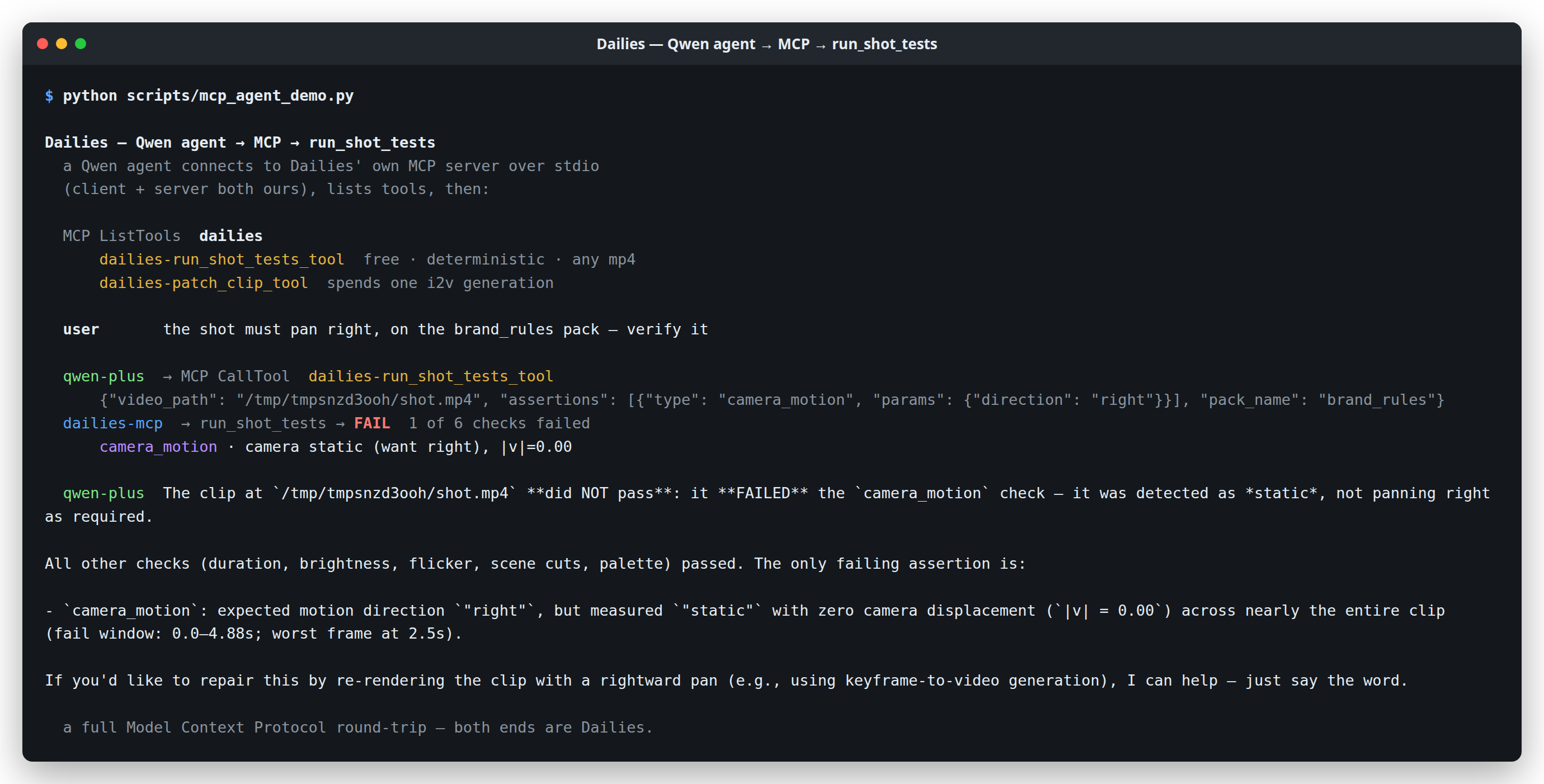
The verification engine is then re-exposed three ways — a native Qwen function-calling tool, a Qwen-Agent custom skill, and an MCP server — so any pipeline or agent can gate video the way it already gates code. We ship the MCP client too, so both ends of that loop are ours.
How we built it
A FastAPI backend runs the pipeline as a background state machine; a React SPA polls one endpoint
whose payload is the conformance report. The whole thing runs on Alibaba Cloud — a Simple
Application Server instance in US (Silicon Valley) running nginx, the API, and a Postgres sidecar
under one docker compose, with published media in a private OSS bucket and a GitHub Actions
workflow that redeploys on every merge to main.
Every model call lands on Qwen Cloud, in two API shapes because the models need different ones. Chat and vision go through the OpenAI-compatible endpoint, so one client carries function calling and structured output. Generation is long-running, so video, image and speech go through the native DashScope async task API — submit, poll, fetch — which the OpenAI-compatible shape has no vocabulary for.
Three design decisions did the heavy lifting:
The agent emits parameters, not topology. The tool takes a premise, a pack, a shot count and custom checks; the server expands those into the canonical graph. The model cannot emit a malformed pipeline because it never emits a pipeline. The "an agent authored this run" story stays completely true, and the failure mode designs itself out.
The deterministic tier is the spine. Tier A calls nothing and costs nothing, which is the only reason it can run on every take. Model judgment sits on top as advice, never as foundation.
Everything is content-addressed. Identical (model, prompt, seed) requests replay from cache, so re-certifying real 1080p video costs zero video quota — measured, not asserted. That is what makes the whole thing demonstrable without burning a quota.
Challenges we ran into
Our green test suite was hiding four real bugs, and they shared one shape. The first end-to-end run against real models found that the premium promote model rejects the draft's frame size — meaning every premium promotion we had ever made had silently failed — that the budget governor was asking the cache about the wrong key and calling every cached final "fresh", that the ledger wrote an empty note for both a no-op and a hard failure, and that state snapshots were written and never read back, so every redeploy discarded every run. Each one was a fallback that made failure look like success. The audit trail was not auditing. We fixed all four, and each fix has a regression test verified by reverting the fix and confirming the test fails.
We had shipped a gate we were billing for and never wired. A Tier-0 verdict was being generated, paid for, and stored — and nothing ever read it. It fell between two tiers and was evaluated by neither. It is documented rather than quietly patched, because that is the exact failure the project exists to catch.
An anchor frame carries composition, but not motion. Frame-anchored promotion made every shot look consistent — and quietly killed camera movement, because i2v holds the anchor's composition. Measured at |v|=0.112 against a 0.4 threshold, versus 4.871 for a fresh roll. So a shot whose contract asserts camera motion now skips promotion and ships the approved take. That is a measurement, not a preference.
Staging a failure is not the same as having one. Our planted kill-shot kept passing. The prompt asked the camera to pan right and follow the dog — and a subject moving laterally hands the model every reason to track, so the ask became self-fulfilling and the check had nothing to catch. We refused to write a prompt designed to fail. We restored the condition instead: a sincere pan request over a scene with no inherent lateral motion. The model returned a beautiful, plausible, completely static shot at |v|=0.028. One bounded repair took it to 4.871 and it certified. That failure is real, and we can show the measurement.
The video API returns 429 on concurrent submits, so generation has to stay sequential while stills parallelize fine.
Accomplishments that we're proud of
- The deterministic layer costs zero tokens and catches the failure the whole demo turns on. It is not a wrapper around a model's opinion.
- Re-certifying real 1080p video costs zero video quota, because the cache is content- addressed. Judges can re-run the pipeline as many times as they like.
- The verification engine is genuinely reusable: a function-calling tool, an agent skill, and an MCP server — plus our own MCP client, so the loop closes with both ends ours. Runnable, not asserted.
- Every measurement in our docs is reproducible from a script in the repo, including the ones that made us rewrite our own claims.
What we learned
A cache key is a contract. Prompts are cache keys here, so "tidying" a prompt string orphans a clip you already paid for. That invariant now lives in a comment above every pinned string.
Advisory has to mean advisory. The temptation to let a model verdict block promotion is constant, and every time we resisted it the system got more trustworthy. A pixel measurement and a language model's opinion are different kinds of evidence and should not have the same authority.
Write the thing that measures before the thing that generates. We could not have found any of the above without a ledger that priced every call and a check that reported where it failed.
What's next for Dailies
- Modalities the grammar cannot yet express, published as roadmap rather than claimed as built: transcript/ASR checks, on-screen-text OCR, and time-windowed assertions like "a conspicuous title in the first three seconds" or "the brand named twice in the outro".
- Assertion packs as a distributable artifact, so a brand's rules become a dependency your CI pins, versions, and regression-tests across generator upgrades.
- The human-override corpus. Every time a reviewer overrules a verdict at the approve gate, that is calibration data no generator vendor can collect — it only exists on the buyer's side of the gate.
Built With
- alibaba-cloud
- alibaba-oss
- docker
- postgresql
- python
- qwen
- react


Log in or sign up for Devpost to join the conversation.