Inspiration
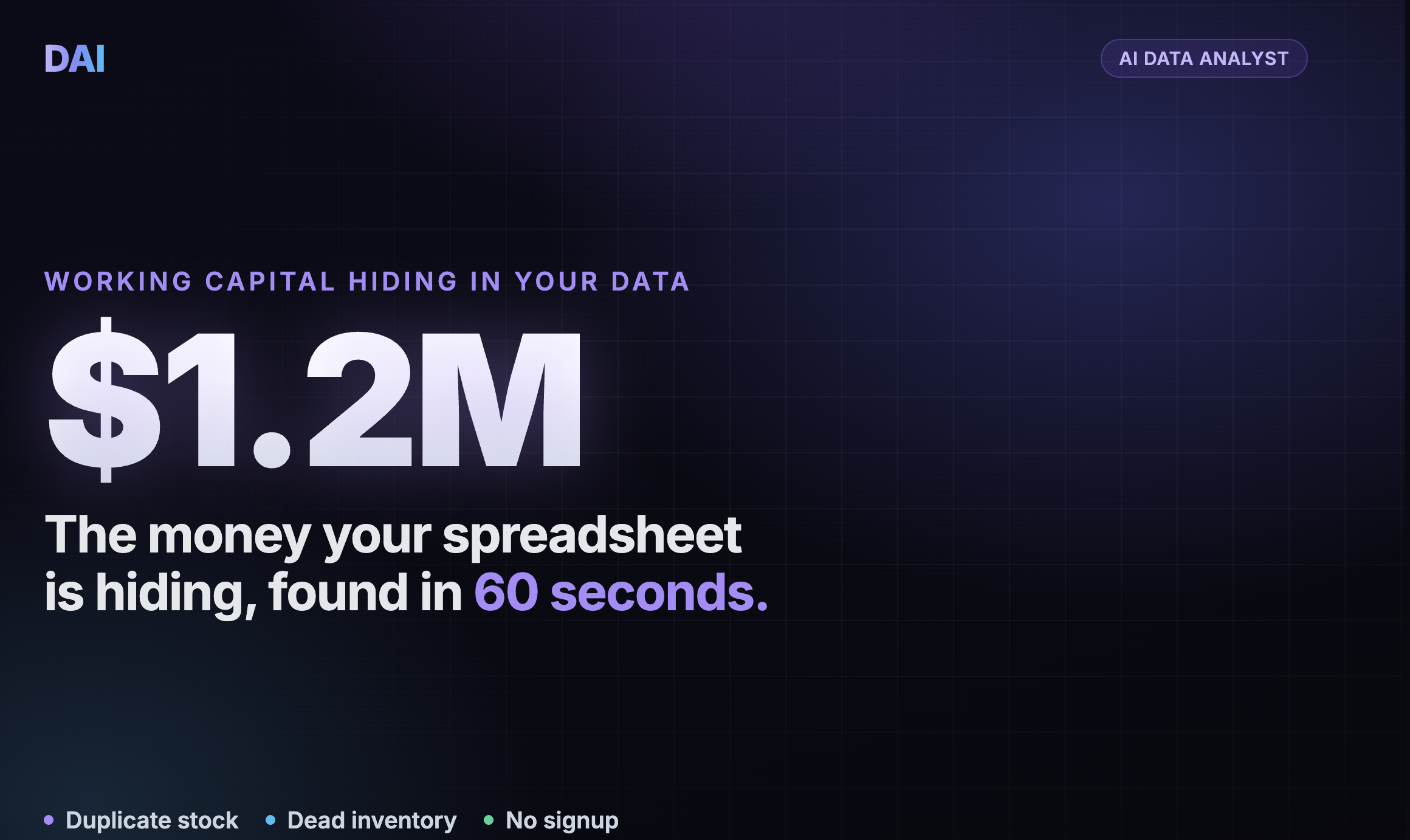
Every distributor and manufacturer is sitting on the same problem: years of messy inventory data, and somewhere inside it, money is leaking. Duplicate parts entered under different codes. Dead stock idle for months. A data analyst would find it in a morning, but a $120K hire is exactly what a 50-person business cannot justify. BI tools do not help either: they answer the questions you ask, while the expensive problems are the ones nobody asks about.
What it does
DAI is an AI data analyst. Drop in an inventory export (CSV or Excel) and in seconds it surfaces the money your data is hiding:
- Duplicate records: the same physical part under different codes, matched with text similarity plus structural signals (manufacturer part number, manufacturer). Each pair shows its match confidence and the proof.
- Dead stock: items with no movement in 6+ months, valued at book value.
- The carrying-cost reframe: dead stock is not just frozen cash. You are paying to hold it. DAI quantifies the annual carrying cost (roughly 25%: storage, insurance, obsolescence, capital) and turns it into a prioritized recovery plan.
- Chat with your data: ask questions in plain English and get real, read-only SQL results with the exact query shown.
- Auto-generated KPI dashboard and one-click shareable reports you can send to a CFO with no signup.
Every figure traces back to a named row. Nothing is a black box.
How we built it
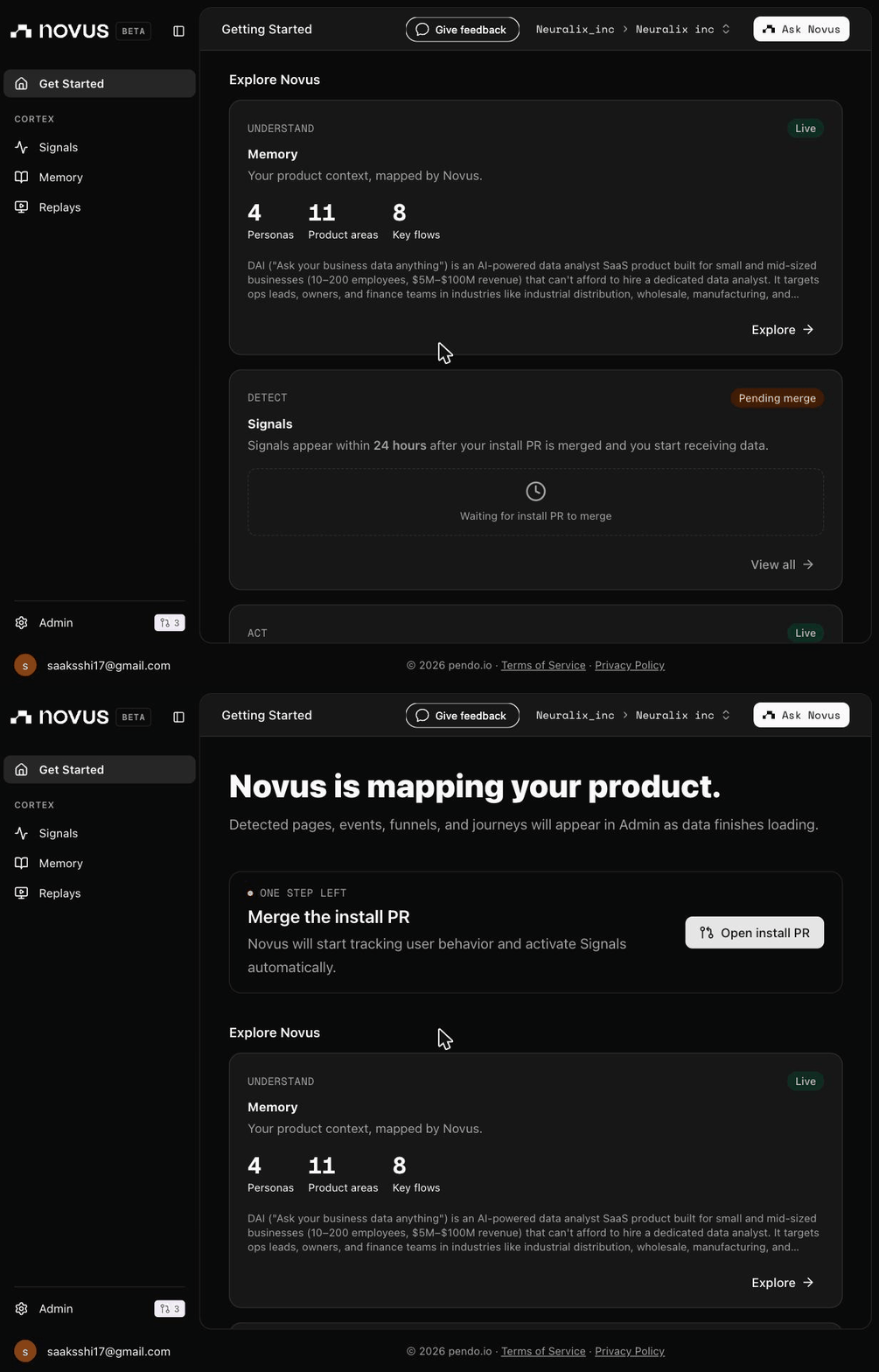
Next.js 14 and Postgres (Neon, using pg_trgm for text similarity and pgvector for the rules layer), with Drizzle ORM, deployed on Vercel. Each assessment runs inside an isolated, throwaway Postgres schema, so your uploaded data is not retained. The chat demo runs server-defined, read-only queries against a sample database. Product usage is instrumented with Novus and Pendo.
Challenges we ran into
Before recording, we tested the assessment against the production database and the duplicate detector flagged about 100 false pairs and "$9M at risk" on a 260-SKU catalog. The cause was same-manufacturer items with templated descriptions. We rebuilt the matcher with confidence-tiered thresholds that exclude size variants (for example, "M6x20" versus "M6x25"). The lesson became the product's whole thesis: confident and wrong is worse than silent. We then validated robustness with a simulation harness across 24 synthetic businesses in 4 verticals. Every one returned named dollar findings, with zero crashes and no false positives.
What we learned
Precision is the product. A missed finding is invisible, but a wrong finding destroys trust in front of exactly the user you are trying to win.
What's next for DAI
Free-form chat on your own connected database, more findings (vendor leakage, margin drift, churn), and a weekly "things you did not ask about" digest.
Built With
- drizzle
- neon
- next.js
- pendo
- pg-trgm
- pgvector
- postgresql
- react
- tailwindcss
- typescript
- vercel

Log in or sign up for Devpost to join the conversation.