-
-
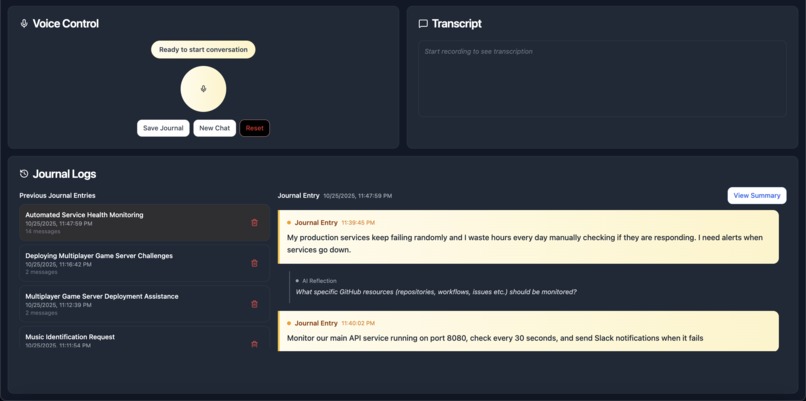
Journal Mode - Talk to AI, log your days, and it will look for ways to assist you if needed
-
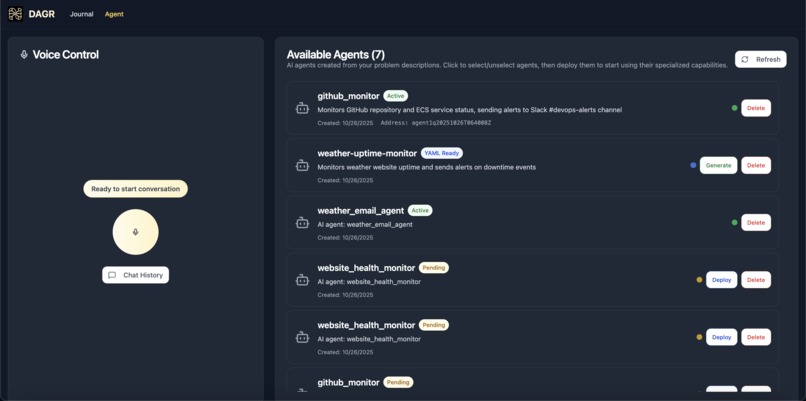
Agent Dashboard - create new agents from voice or deploy/pause existing ones
-
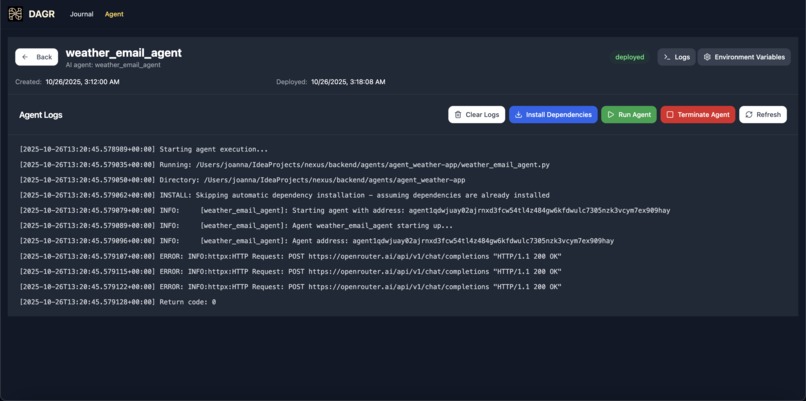
Agent Logs - A deployed agent that sends emails to inboxes. View logs and configure in UI
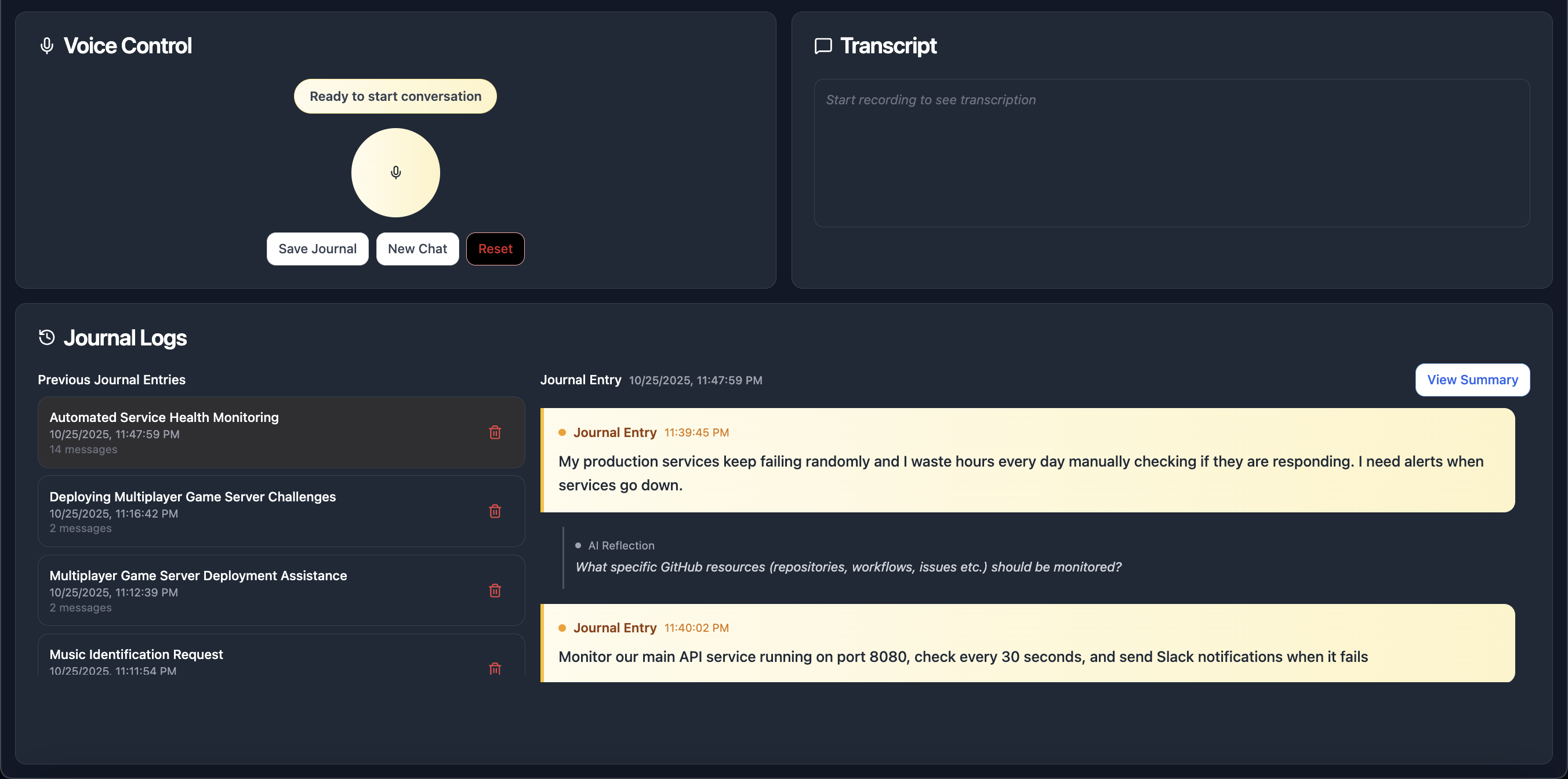
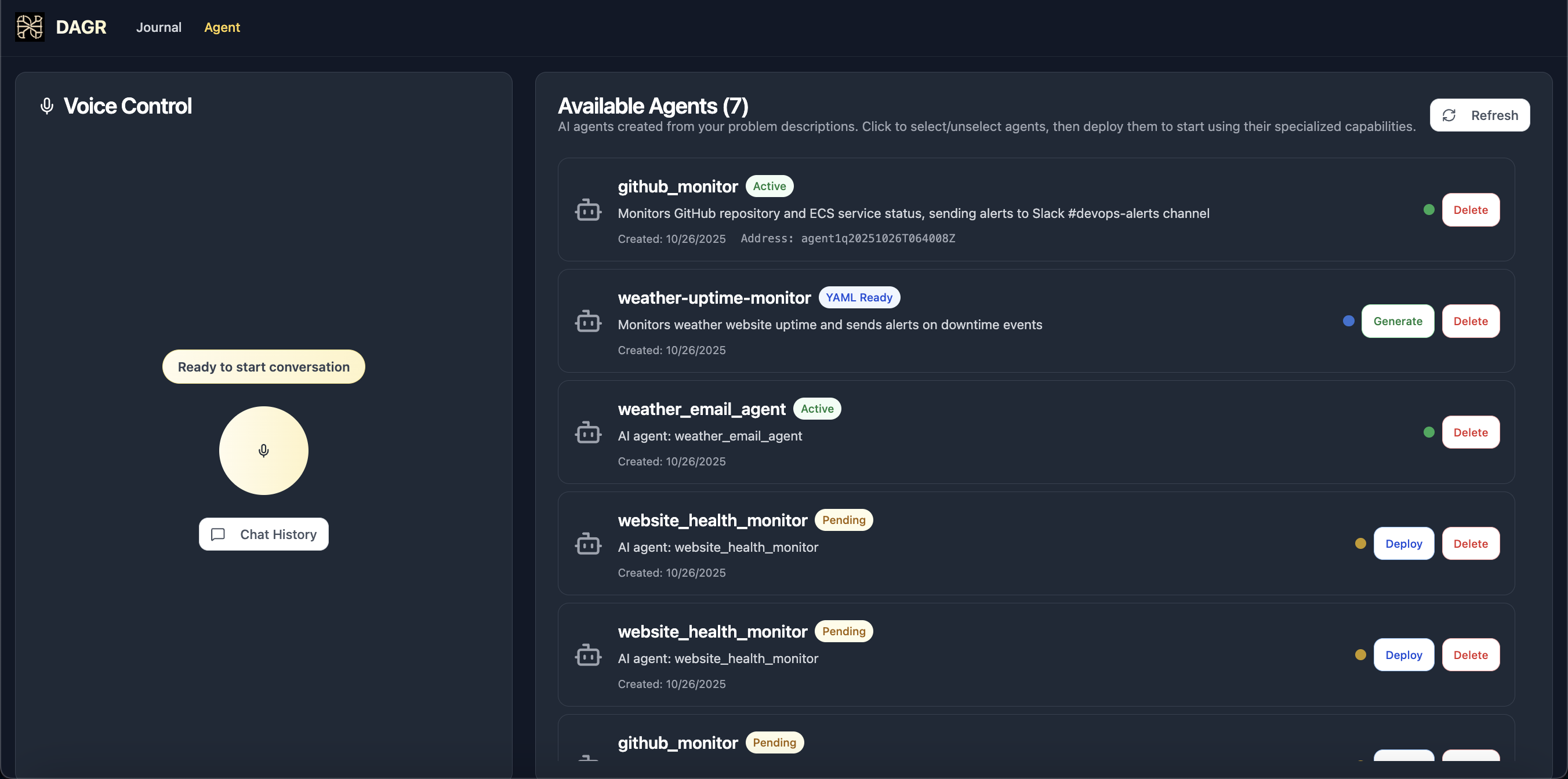
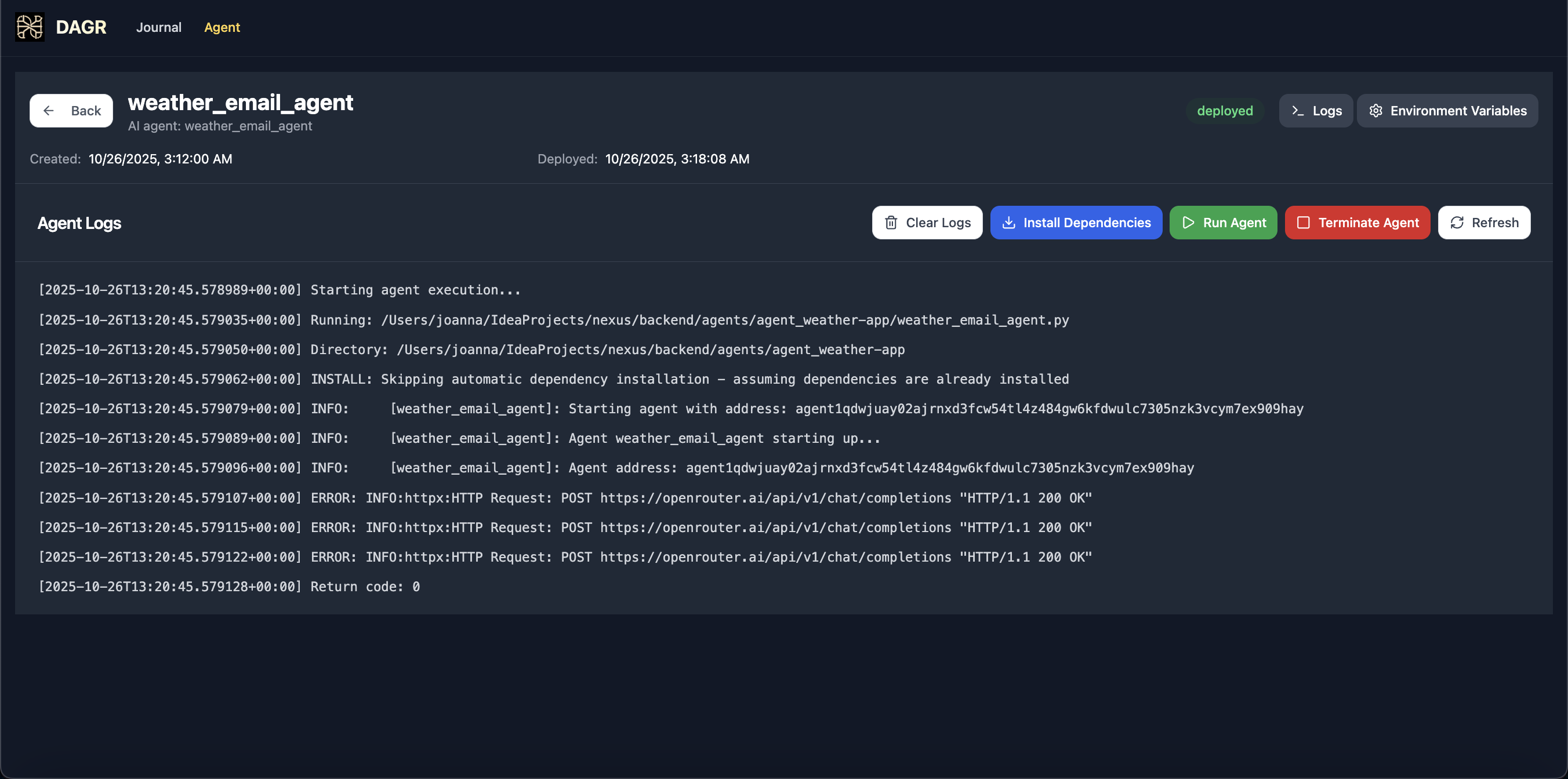
DAGr: Dynamic Agent Generator
What Inspired Us
We imagine a future where you could just talk to an AI about what’s slowing you down — bugs, cluttered data, messy workflows — and instead of giving you another list of “steps to try,” it would actually build the tools to fix them for you.
That’s where DAGr began.
We wanted to merge the intuitiveness of conversation with the autonomy of agents so that a few spoken words could spark an entire AI workforce into action.
We drew inspiration from:
- The human desire to delegate — to have something that truly helps, not just advises.
- The evolution of AI — from chat to reasoning, from reasoning to acting.
- And from our own frustrations — long hours debugging, cleaning data, or managing systems when we knew AI could do more.
DAGr is that missing bridge — between voice and action, between thought and execution.
What It Does
DAGr is a voice-powered AI platform that turns conversation into automation.
- You talk to it like a human: “I’ve been struggling to organize my schedule lately.”
- It listens, transcribes, and sends your words to a reasoning layer, which interprets your goals.
- If the problem is actionable, Claude drafts a specialized agent definition.
- DAGr then deploys that agent using the Agentverse network — instantly creating a helper that works for you.
With DAGr, a simple log into your journal transforms into conversation that creates capability.
Two Modes:
- Journal Mode – A reflective, conversational mode where you share thoughts or ideas. DAGR listens and offers intelligent, memory-aware responses, drawing on past conversations and stepping in to create an assistive agent when necessary.
- Agent Mode – When DAGR identifies a concrete task, it automatically creates or activates a dedicated agent to solve it (e.g., scheduling, cleaning data, managing logs).
Every dialogue has the potential to birth a new digital teammate.
How We Built It
DAGR is built on the intersection of voice interaction, reasoning LLMs, and autonomous agents:
Speech-to-Text & Text-to-Speech (Fish.AI)
- Converts natural conversation into text and back to speech for a seamless two-way dialogue. In journal mode, this enables the AI assistant to have a conversation with you.
Reasoning Engine (Claude)
- Interprets user intent, determines whether to respond conversationally or generate an agent plan.
- Outputs structured JSON/YAML defining which agents to call or how to create a new one.
- Interprets user intent, determines whether to respond conversationally or generate an agent plan.
Agent Execution (Fetch.ai)
- Each agent is a uAgent with a specific purpose — like DataCleaner, Scheduler, or LogAnalyzer.
- The Orchestrator Agent manages creation, coordination, and communication between agents.
- Agents are deployed to AgentVerse.ai, where users can go in and make manual changes as necessary.
- Each agent is a uAgent with a specific purpose — like DataCleaner, Scheduler, or LogAnalyzer.
Dynamic Agent Generation (Python Backend)
- When Claude outputs a “create_agent” instruction, DAGr compiles it into code, deploys it as a new Fetch.ai uAgent, and registers it for future use.
Frontend (Web App)
- Clean React + Tailwind interface that allows switching between Journal and Agent modes and deploying your active agents.
Challenges We Ran Into
Bridging AI reasoning and real-world execution:
Getting Claude to produce usable, secure agent definitions required tight prompt engineering and validation layers. We ultimately wrote a proprietary algorithm that loops over natural text, extracting as much information as possible into a more parsable YAML file.Managing live agent lifecycles:
Creating, running, and communicating with dynamic Fetch.ai agents in real time while maintaining state coherence wasn’t trivial, especially automating the Fetch.ai agent generation from a single Claude prompt. We decided on YAML to pass in the most detailed information we could.Seamless voice integration:
Synchronizing speech recognition (STT), reasoning latency, and speech synthesis (TTS) so that the user experience felt natural took careful orchestration, especially in journal form. We wanted an experience where the AI felt helpful, not intrusive.
Accomplishments That We’re Proud Of
- We built a full-stack system that connects voice, reasoning, and autonomous agents — live.
- Our LLM can not only chat, but actually design and deploy new AI helpers on the fly.
- DAGr can create Fetch.ai Agentverse agents from natural conversation — a glimpse into a true agentic AI swarm.
- The system works across domains: DevOps, data organization, personal productivity, and more.
What’s Next for DAGR
We see DAGR as more than a hackathon project; it’s the beginning of a new AI paradigm.
Coming soon:
- Enterprise Integrations – Connecting DAGR to APIs like Slack, Notion, Jira, GitHub, and Google Workspace.
- Mobile App – A portable voice-first AI workspace that travels with you.
- Desktop App – Overlays on your computer so you can watch the agents complete tasks in live time, not just through logs but with your own eyes.
Our vision:
To create an ecosystem where anyone can speak their needs and watch a custom AI team assemble itself to help.
Team DAGR
Built by Max Fan, Akshat Kannan, Josh Pham, and Parth Sheth at CalHacks 2025.
“From conversation to creation, DAGr AI builds custom AI solutions for you.”


Log in or sign up for Devpost to join the conversation.