Inspiration
A generation is turning analog. After years of AI-generated content, infinite scroll, and screen fatigue, adults are craving tactile, IRL experiences: pottery, paint & sip, cocktail making, glass blowing. Creative hobby venues are growing 17% YoY in a $1.2T experience economy, and 47% of young adults say they want more activities with friends.
But the way group plans actually get made is completely broken. Someone drops a class link in the group chat. Three friends reply "omg yes." A week later, nothing has happened. No date locked. No booking made. No hangout.
We've all lived this. It's not a motivation problem, but a coordination problem. And it's costing the creative experience industry billions in lost bookings every year. We built Dabble because nobody has closed that loop yet.
What it does
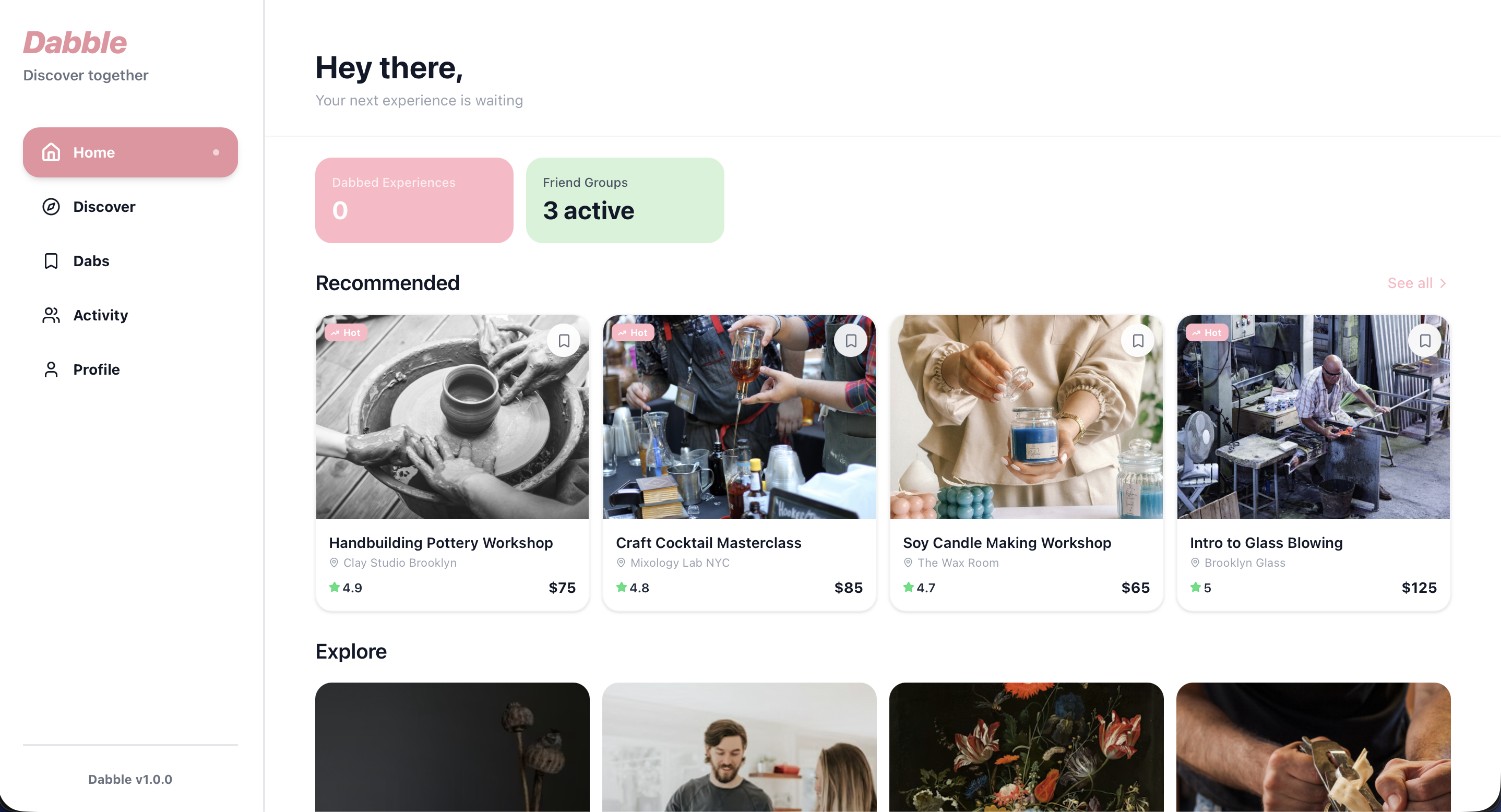
Dabble is the social discovery and booking platform for creative experiences. It turns "we should do something" into an actual hangout.
New users complete a 5-card taste onboarding quiz that instantly seeds a personalized discovery feed of local creative experiences. When something looks good, users don't just save it: they Dab it and Propose it directly to their friend group with date options. Friends tap "I'm In," the confirmation count builds in real time, and when the group threshold is met, Book Together unlocks automatically with a group discount applied instantly.
After the experience, users upload what they made. That photo appears in friends' feeds. Someone taps "I want to try this." The next hangout starts there.
The full loop: Discover → Dab → Propose → RSVP → Group Checkout → Share Creation → Repeat.
Our north star metric is hangouts completed.
How we built it
We built the prototype as a web application, optimized for mobile browser so it feels native without requiring an app download. The core product loop involves our taste quiz, personalized discovery feed, Dab mechanic, Propose flow, RSVP tracking, group checkout, and creation sharing.
Planning and product thinking ran entirely through Claude Projects, where we used Claude to pressure-test the PRD, refine the demo script, and align the build priorities across the team in real time. On the engineering side, Claude Code and Codex handled the heavy lifting, generating component scaffolding and debugging state sync issues.
The feed and recommendation layer uses the Anthropic API as its AI backbone, aggregating venue data and weighting results by the user's quiz preferences and friend group's collective booking history. For live event and experience discovery, we integrated LinkUp to surface real local listings in real time. Claude powers the group preference engine on top of that, learning not just individual taste but what a specific friend group is most likely to actually book together.
On the backend, Supabase handles our database and auth layer, giving us real persistence for Dab saves, RSVP state, and user profiles across sessions. Stripe is integrated for the group checkout flow, and the app is deployed and hosted on Vercel.
For UI and design, we used the Claude Figma MCP alongside plugins such as Impeccable and Claude's built-in design skills to generate and iterate on high-fidelity components rapidly.
Stack: Web App (mobile-optimized) · Claude API · Claude Code · Claude Projects · LinkUp · Supabase · Stripe · Vercel · Figma + Claude MCP · Impeccable
Challenges we ran into
The hardest product challenge was designing the group coordination mechanic so it feels frictionless rather than obligatory. Getting the RSVP → threshold → Book Together unlock to feel like a satisfying payoff — not a pressure tactic — required multiple iterations on copy, timing, and visual feedback, all within a very tight time window.
On the technical side, we had to make decisions about what to simplify for the demo versus what had to work for real: the core loop, Dab persistence, and creation upload to Friends Feed all had to be functional.
We also wrestled with the cold start problem: a social app with no friends feels empty. Seeding the right demo accounts and creation uploads to make the social feed feel alive — without it looking obviously fake — took more iteration than expected given the time constraints.
Accomplishments that we're proud of
We came in with strong prior conviction on the problem. Talking to friends, roommates, and people in our own networks confirmed the pattern immediately: group plans die in the chat, and nobody has fixed it.
In the sprint itself: we shipped the full core loop end to end, and the "Book Together" CTA unlock (the product's single most important moment) works exactly as designed, and the demo is self-explanatory.
We're also proud of the positioning clarity we landed on: Dabble isn't a booking app with a social feature. It's a social product where booking is the conversion event. That distinction shapes every design decision.
What we learned
Building in 4 hours forces a clarifying level of prioritization. Every feature that didn't directly serve the core loop — Discover → Dab → Propose → Book → Share — got cut immediately. That constraint made the demo tighter and the pitch clearer than it might have been with more time.
We also learned that the group coordination mechanic is novel but needs to be demonstrated, not explained. Every time we described the RSVP threshold in words, people understood it abstractly. Every time we showed the Book Together button light up green, people got it immediately. The product teaches itself better than we can.
What's next for Dabble
Immediately after the hackathon: convert the prototype into a stable beta and begin a closed NYC pilot, onboarding 20–30 Brooklyn studios and an initial wave of users. We'll track first booking rate, repeat sessions, and hangouts completed to validate that Dabble builds a creative habit — not just one-time transactions.
On the product side, the next priorities are user auth and friend graph, real push notifications, and a lightweight merchant portal.
On AI, we want to move from category-matching to true group preference modeling — using booking history, Dab overlap between friends, and post-experience creation engagement to surface the specific experience that a given friend group is most likely to actually book together.
The city-by-city playbook: prove density and unit economics in New York, then roll to Chicago, San Francisco, Los Angeles, and Sydney. Our Year 1 target is 200 NYC venues and $1.8M ARR. The coordination gap is real, the cultural moment is here, and the market is enormous. We're closing the loop.
Built With
- claude
- codex
- figma
- stripe
- supabase
- vercel


Log in or sign up for Devpost to join the conversation.