-

Logo
-
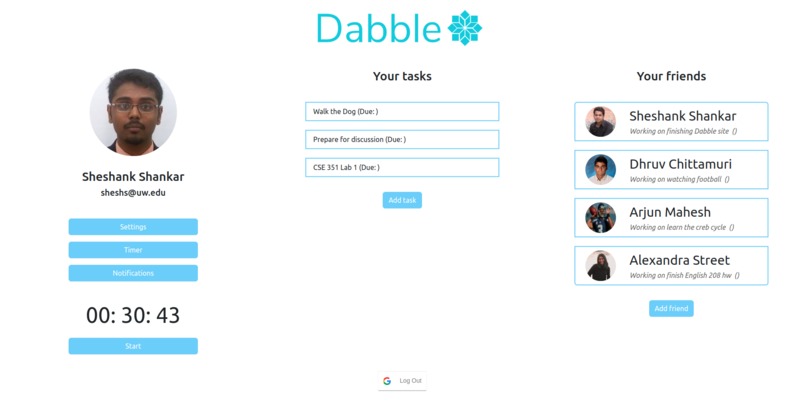
Mainpage
Inspiration
Our idea sparked when our friend Sheshank was working out at the IMA. As he looked around, he clearly observed what everyone else was doing - what exercises, what weights, what programs, etc. All of this information was available to him, but rather than overwhelm him, he told us how much it motivated him. Seeing everyone else lift bigger weights and do more reps gave him a sense of urgency. As he recanted how this made him feel like he too needed to do more and get stronger, we began to realize how powerful this extrinsic source of motivation was. We realized that this feeling was something that we could apply to school, the one place we all could frankly use more motivation. That openness of data is not something that we experience in an academic setting, but if we did, we would begin to really see where we stand and what we need to be doing. That is why we came up with Dabble, a web application with the purpose of publicizing this data among peers. By seeing what assignments others are doing, how long it is taking them, and how efficient they are, that same extrinsic motivation can be experienced in a school-setting.
What it does
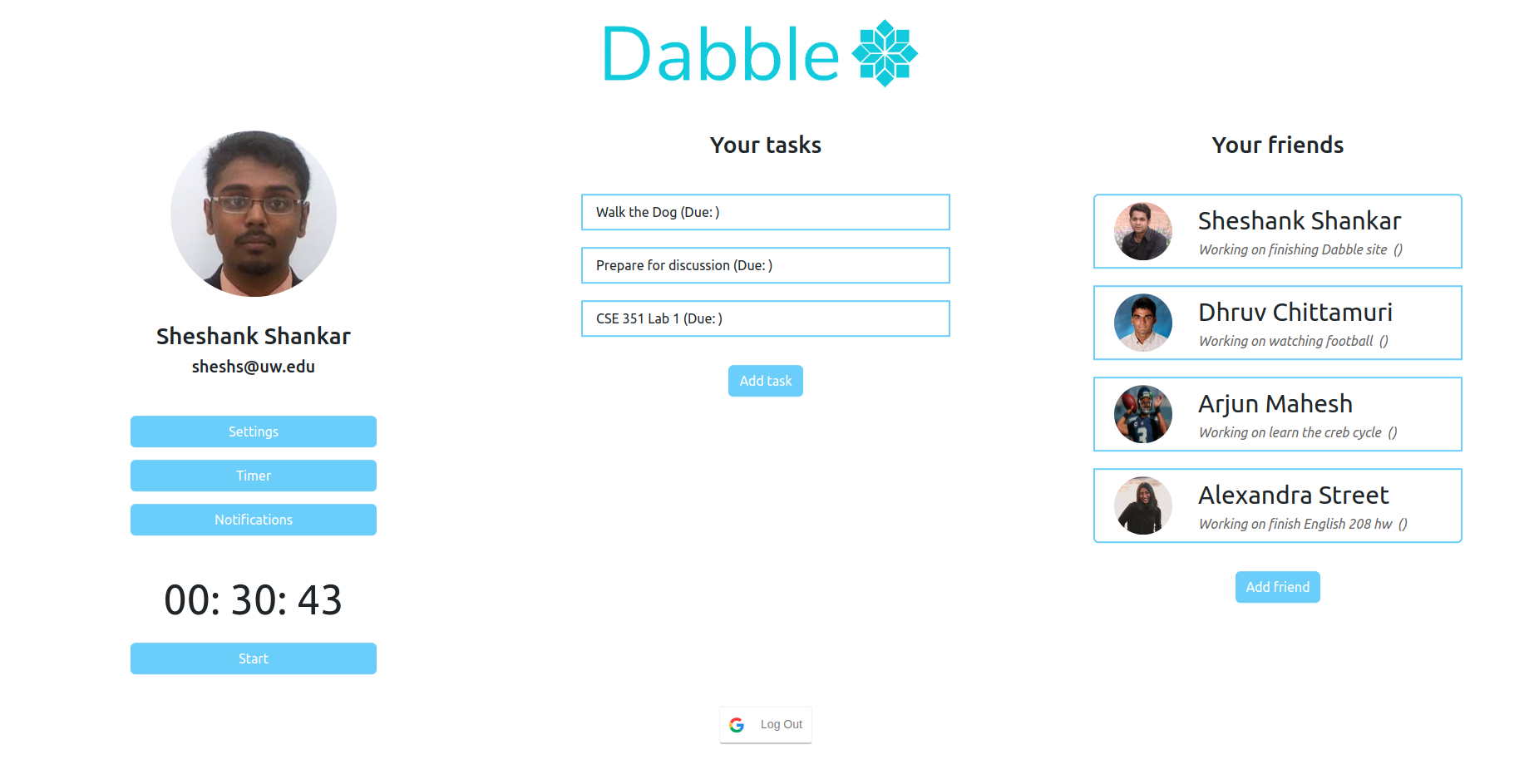
Dabble aims to increase productivity through extrinsic sources. The Dabble application brings together friends in a so-called ‘fight’ for efficiency. Dabble allows users to write out all their tasks, then sorts it by due date. It then allows the user to make friends, and see if their friends are working and what they are working on, as well as how long they have been in a work session for. It also allows users to be able to time their sessions, telling the total hours they worked on a task for, with a nudge feature that is used to “nudge” their friends who they can see have not been active.
How we built it
We built the application from scratch using a ReactJS framework along with Google Firebase for the backend database. It required the downloading of various Node dependencies including react-google-login, react-router, bootstrap, etc. The authentication system is build through using React components for Google and Google API scripts.
Challenges we ran into
Attempting to build this from scratch proved to be time-consuming; this was seen in the start as we developed the authentication system for users. Additionally, there was trouble with configuring our databases to store user information and their respective tasks - after some back-and-forth between Google Firebase and Google Cloud, we stuck with Firebase for our storage. Furthermore, there was some trouble navigating between our different operating systems as we integrated our front and backend together.
Accomplishments that we're proud of
We are proud of how much we were able to get done in the short time we had, especially considering that we built everything to scratch. Getting the authentication system done using ReactJS and integrating it with the frontend was challenging, but we were able to eventually get it done.
What we learned
We learned a lot about using Google Cloud and Firebase authentication and connecting it to the front end development. We also learned how to effectively collaborate using different operating systems. Building the app from the bottom up was more time consuming than we thought, especially as most of the front-end was built on a different operating system then the back-end.
What's next for Dabble
We have many ideas for the future of Dabble. First, we would want Dabble to be more interactive for the user and their friends. For instance adding a chat box, or a better way to nudge someone. We also want to add a calendar feature that would allow the user to create new tasks and it automatically be added to their google calendar. Being such a flexible website, we are excited to see what Dabble turns into in the future.


Log in or sign up for Devpost to join the conversation.