Inspiration
We've had enough epidemics. We can't allow loneliness to be yet another one.
Note: The em dashes are my own and I apologize sincerely for them.
🚗 The Backstory
At the end of a cold November day in 2022, I packed all the belongings I could fit into my small red Nissan Sentra and made the two-day drive down the East Coast, from Boston to Raleigh, NC. It was the only time I'd let my poor little car make that ambitious of a drive.
I wasn't just running from the cold up in New England, though that was certainly one motivator. No—I was heading towards something. Something I hadn't yet articulated fully to anyone, even myself.
A few months earlier I had sat down with my journal and envisioned my deepest desire—finding a community:
I pictured a living room filled with laughter, friends who wanted to read classic literature, to discuss podcasts and think pieces on a mishmash of topics, to try new sports and activities, go to museums and shows, go camping and on adventures, and maybe even create our own traditions. People who would run with crazy ideas, play off each other's creativity, and who wanted to develop and grow in the same ways that I did.
This seemed like a wildly wishful—dare I say delusional—ask from a socially anxious twenty-something drifting in the post-covid era. I had been working remotely as a software engineer throughout the pandemic and post-pandemic years, feeling my social skills slowly atrophy as my childhood anxiety crept out from where I'd buried it, and grew roots.
I refused to accept this as my new normal. That is how I showed up in Raleigh without a permanent place to stay—just an Airbnb, ten apartments to tour, and some hope.
A strange coincidence
The hope did have backing. A week prior, back in Boston, something strange had happened. It was one of those eerie synchronicities that are hard to shake off as pure coincidence. I had been sitting in my room one evening, trying for perhaps the third time in my life to get through the first chapter of Crime and Punishment, when a thought crossed my mind:
"They must have book clubs in Raleigh."
I was planning to leave for Raleigh in just a week, and had been laying the groundwork for social events—opportunities to meet "my people." So I opened meetup.com, a site I had never had much luck with, and on a whim searched for book clubs in the area. What I saw stopped me in my tracks. I sat there, stuck mid-inhale, staring at the screen.
There was a book club, indeed, with a date set for Crime and Punishment, scheduled to meet exactly one week after I was to arrive in the city.
How insane. I looked down at my copy, lying on the bed. In the next few days, I embarked on reading at a ferocious speed I hadn't known was possible (I'm a very slow reader), supplementing with the audiobook when I could. I'm doubtful that I soaked up Dostoevsky's full essence at that pace, but I was determined to finish by whatever means necessary. Because deep down, I somehow knew: these people in this book club would become my closest friends.
What grew from it
There were many more coincidences and synchronicities to come, but I will make a long story short for now. Building a community in Raleigh came so naturally, it truly felt preordained.
But please don't get me wrong: it took work and intentionality on the parts of so many people. It took organizing events, showing up, connecting with intention outside of meetings, and running with the energy and enthusiasm of getting out of one's comfort zone. I personally also had unsuccessful attempts (I tried some rock climbing meetups, some social events, an adult gymnastics class, etc.).
In the end, I got lucky. I showed up (shaking and sweaty-palmed) when a meetup was just forming, when everyone was recovering from pandemic isolation and Raleigh was the new hot spot to move to from all across the country. I got in at the start of a friend group, filled with members who shared the same values and vision that I had arrived with.
I got to be there for all the new traditions:
- 🎂 A monthly birthday celebration, each more ambitious than the last
- 🎆 Themed New Year's parties, Halloween costume and storytelling competitions
- 🌒 A cross-country eclipse trip, camping, and paddle boarding
- 🎥 Movie nights, improv nights, and karaoke
- 🏓 Sunday morning pickleball, Sunday evening potlucks
- 📊Power point nights, coding projects, writing groups (I'm writing this from one as we speak)
- 🤝 Volunteering, mutual aid, and a few therapy-like support group sessions
Our friend group somehow did it all, and more that I've likely forgotten.
The stars aligned so magically for me, I can hardly express the gratitude and disbelief I feel. But not everyone is so lucky...
The Lingering Question
Our community grew, and as it did, the complexity of maintaining it grew alongside it. And people would often ask: what made this group succeed? I repeatedly tried to give a good answer, but the truth is, I wasn't sure. I'm not sure any of us had a good answer.
Was it our common interests and personalities? The level of effort? A core activity that we had engaged with until the friendships grew outside of it? Proximity? The right time? An anomaly? Luck?
I wondered: if I packed up my car and moved to another city, could I find this sort of community again?
The Problem Breakdown, as I Can Best Dissect It
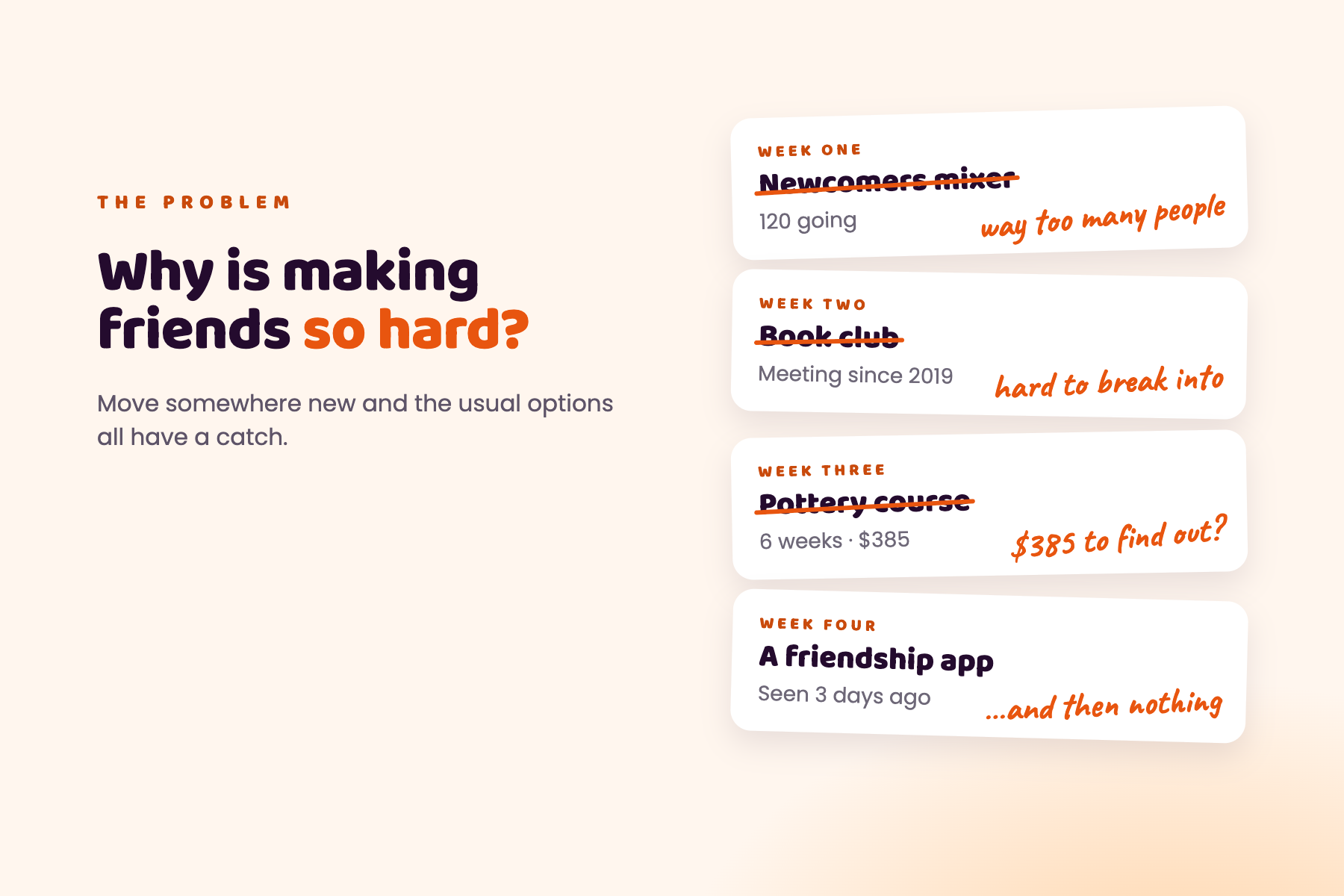
So yet again, I sat down with my journal and sketched out what I thought to be the problem and ideas for solutions. Details on https://dabbel.app/problem-breakdown
🎯 Interest overlap.
🔁 Taking a class isn't enough
💸 Cost and commitment.
📋 The organizer problem.
🚪 Breaking into existing groups.
😰 Social anxiety.
📱 The online-to-offline gap, and decision fatigue
🔑 One person can unlock an entire community.
🕒 Scheduling compatibility.
⚡ Activation energy
The Same Question, Again and Again and Again
Once I started paying attention, the same question showed up constantly. Just from this year, here are a few of the posts you can find weekly in the local subreddits:
- "Why is making friends as an adult so hard?" — r/raleigh — already tried Bumble BFF, Facebook groups, events, and "putting myself out there."
- "Where are people actually meeting friends ... besides the apps?" — r/raleigh — joined the local Discord, but wasn't finding people actually meeting up.
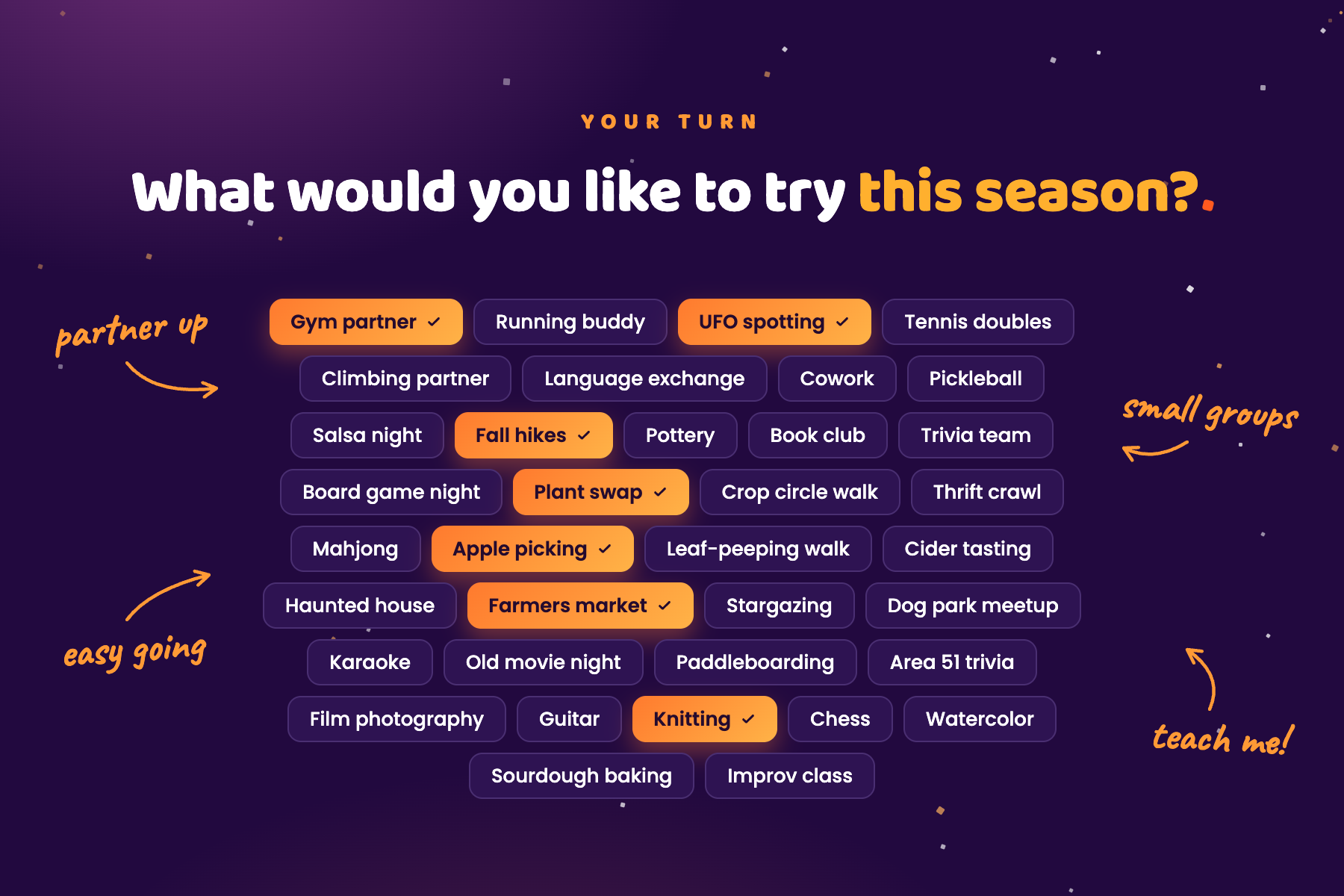
- "Where can I make friends?" — r/raleigh — looking for friendship alongside pickleball, pottery, and knitting.
- "Looking to make friends!" — r/raleigh — had joined Discord but was struggling to navigate it and get responses.
- "25F, looking for friends!" — r/raleigh — a year in Raleigh and still struggling to make friends despite getting out and doing activities.
- "New to the area, looking to make friends!" — r/raleigh — had already joined a tennis club but hadn't found the right social fit.
- "Ways to meet adults in Cary?" — r/cary — a remote software engineer in his twenties describing loneliness and asking what he could actually do around the Triangle to meet people.
- "New to Raleigh/Cary Looking to Make Friends" — r/triangle — realizing that making new friends as adults was harder than expected.
- "New to the state" — r/triangle — another newcomer struggling to build friendships after moving.
- "How to make friends." — r/durham — a socially awkward adult over 30 asking how people actually form friendships.
I'll spare you, dear reader, from listing more, but believe me, I've accumulated a backlog.
What's in a Name?
They say write what you know, and build what you know. I know community building. I know overwhelming social anxiety that stops you from walking into a supermarket, let alone a meet-up group. I know loneliness. I wanted to make an app that a younger version of myself would have appreciated.
That is how Dabbel was born.
It is surprisingly hard to find a name for an app that has not been used yet. In addition to loving the sound of the name, it is a tongue and cheek reference to the fact that I do love to try new things and explore...and sometimes struggle to stick to one hobby for too long. I want Dabbel to make that ok. To give people permission to test out the waters, to try new things without pressure, gain new experiences, and generalize. I also want a place for the niche activities that cannot gather a large group to still have an outlet. A mentor once told me, there are specialists and generalists in the world, and we need both. I hope Dabbel becomes a place for the dabblers, who gain insight from across their experiences, and for the specialists, who become experts in their craft.
But Aren't There Already Apps to Meet People?
Yes, I am certainly not the only one to raise this question or to try to solve this problem. The friendship-app market is growing quickly.
Apps like Bumble BFF, Timeleft, Pie, 222, and others are experimenting with how to turn online discovery into real-world friendship. What's especially interesting is that the category itself seems to be moving away from simply "swipe on people and chat" and toward groups, activities, and meeting offline.
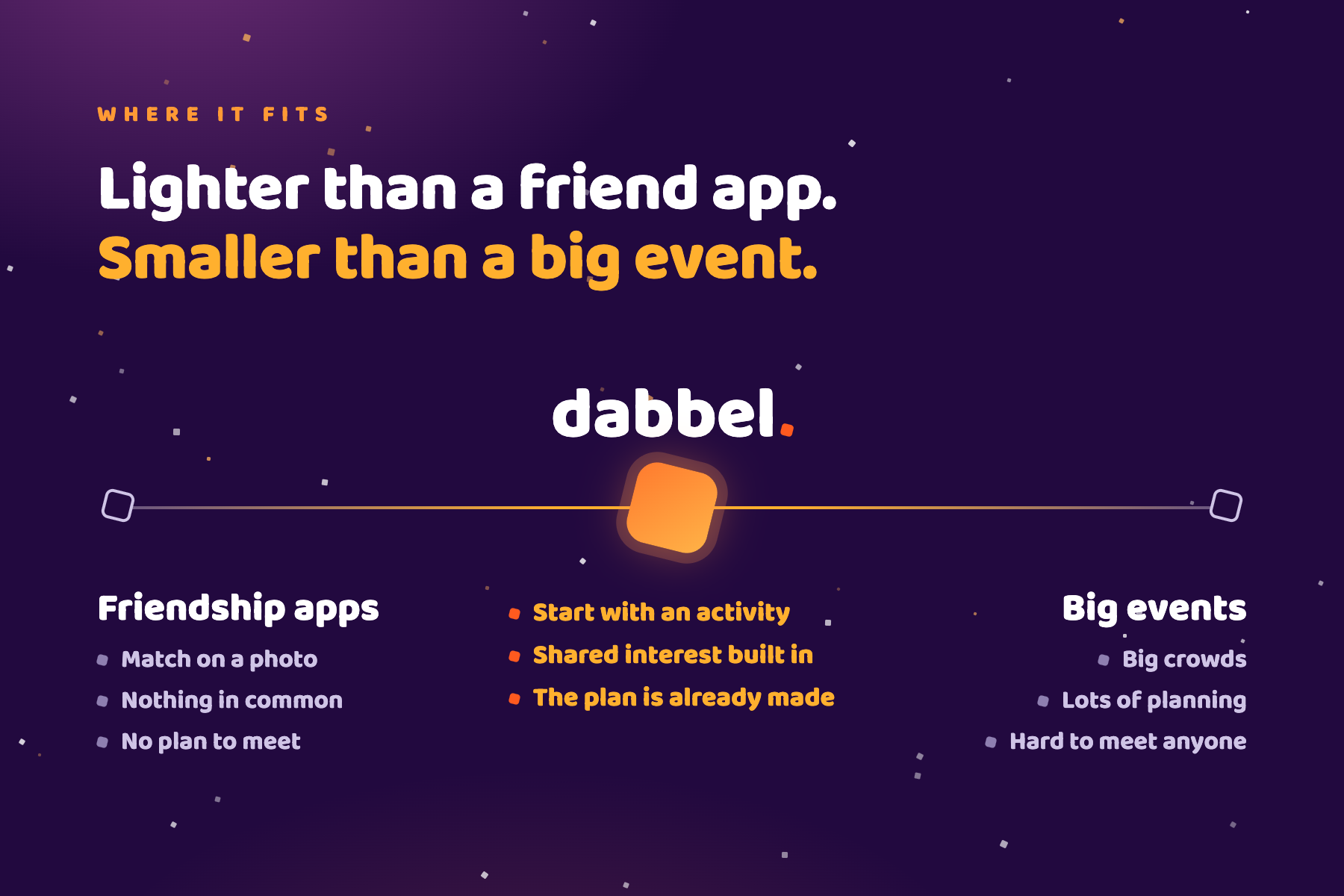
That direction makes sense to me. Dabbel just approaches it from a slightly different starting point: the thing you already want to do.
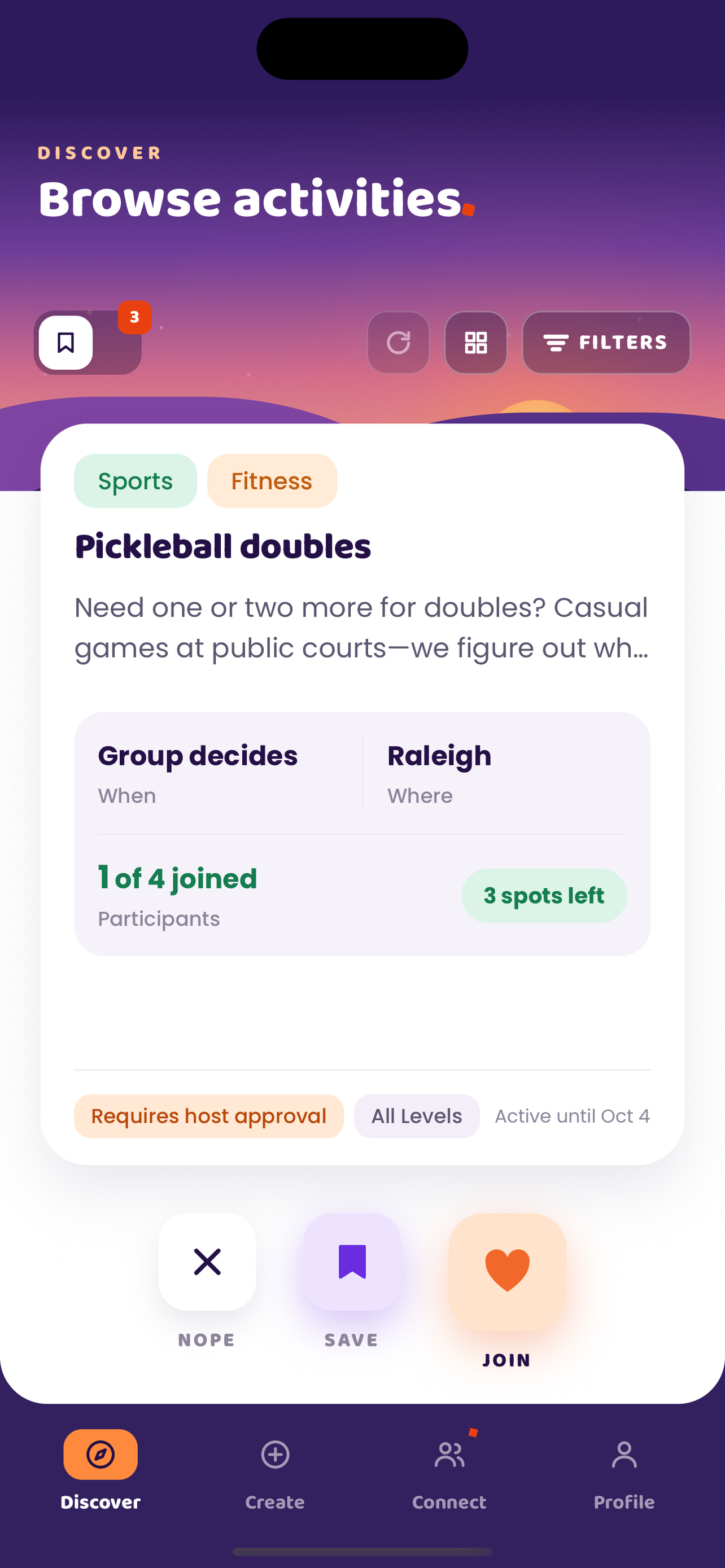
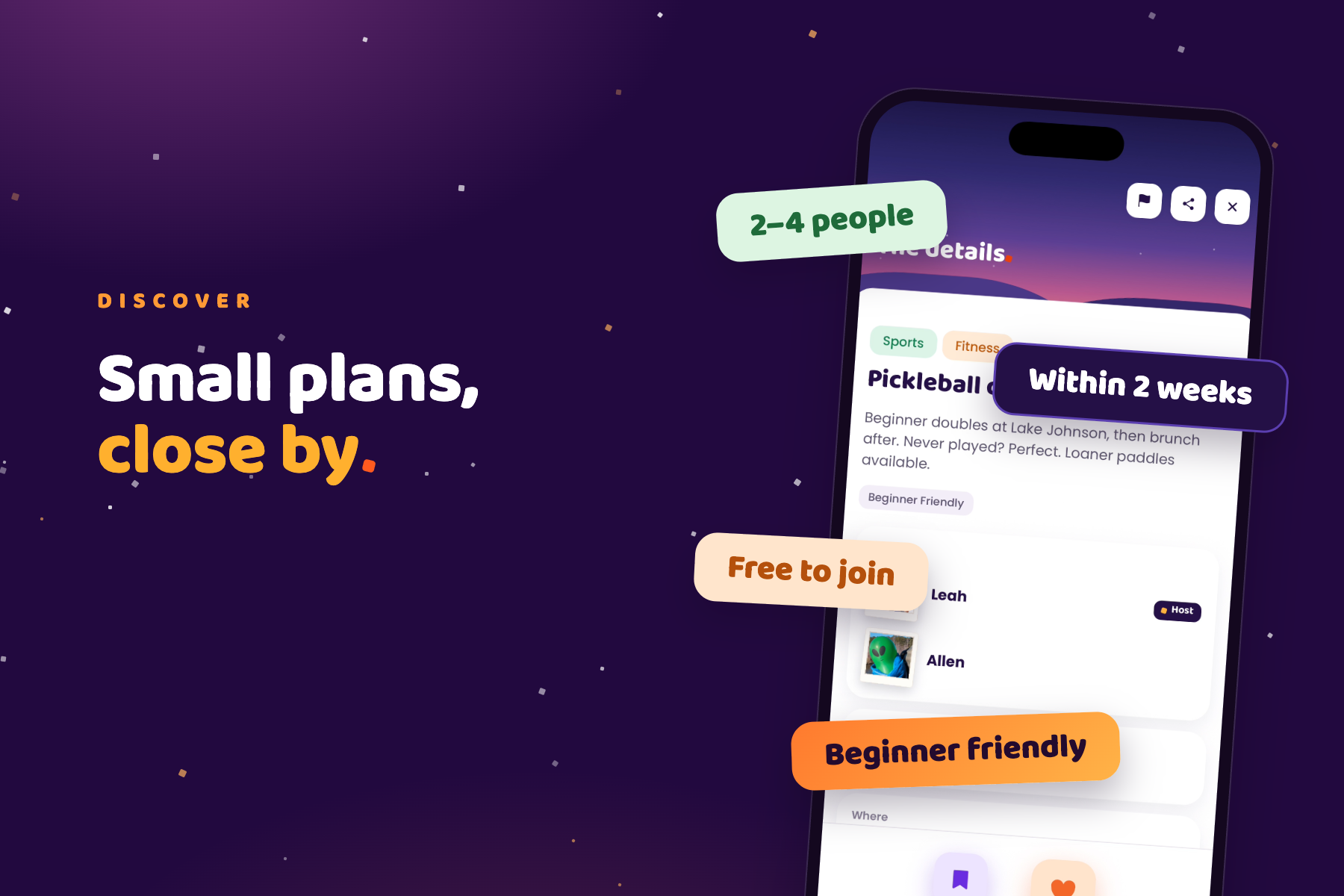
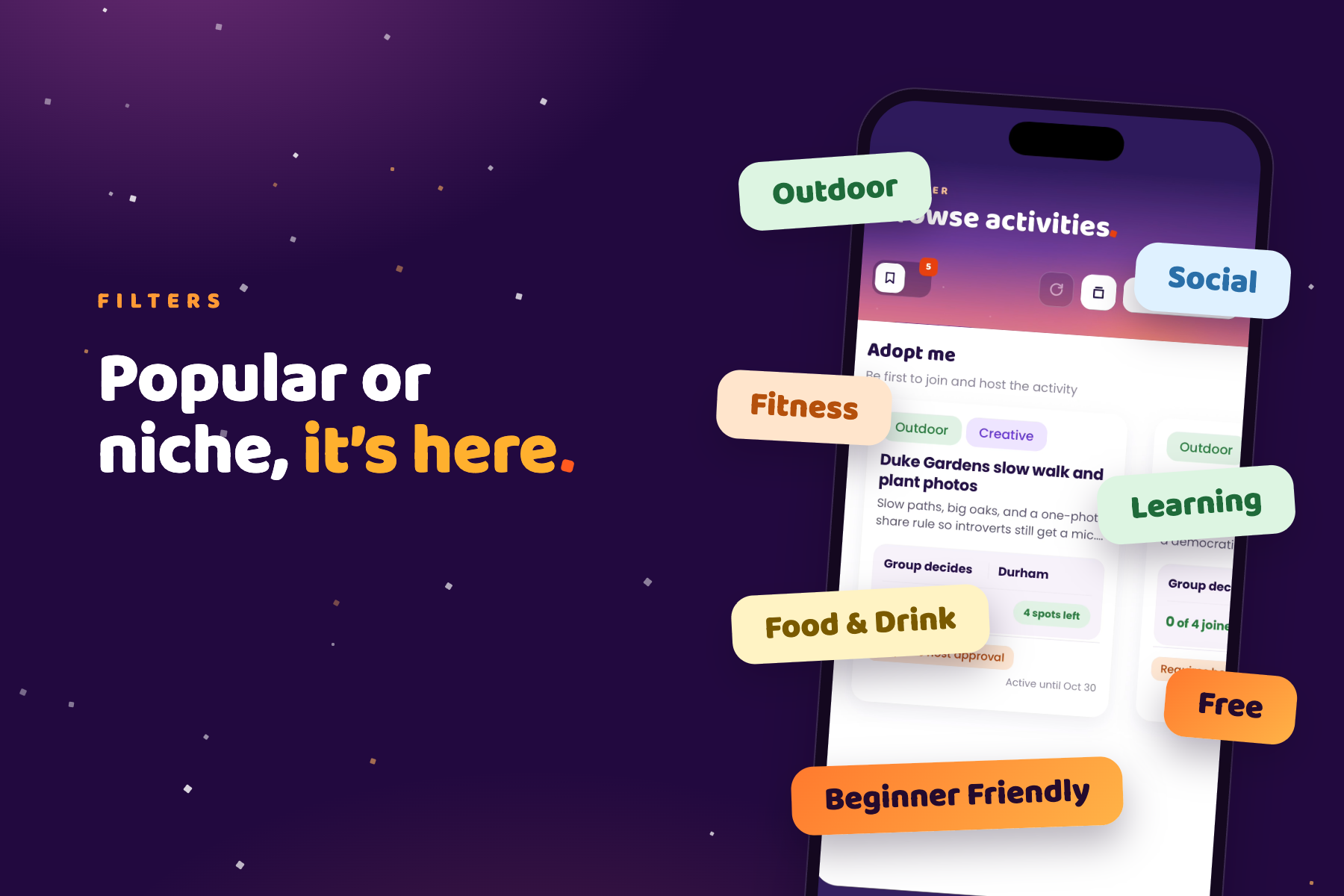
Rather than matching people first and asking them to invent a reason to meet, Dabbel lets someone start with "I want to go climbing," "I want to try this restaurant," or "I need two people for an escape room." Groups stay small—currently 2–4 people—so coordination stays lightweight and people actually have a chance to talk.
That puts Dabbel somewhere between a friendship app and an event platform: less pressure than choosing a friend, less overhead than organizing a Meetup, and small enough for niche activities that may only need two or three interested people.
The existing apps are also useful validation of something I've come to believe independently: getting people offline matters. The question I'm exploring is how little structure we can add while still getting people to actually show up.
That brought me back to the question I couldn't quite shake:
Could we make some of this less dependent on luck?
And that became Dabbel.
What it does
Dabbel helps 2–4 nearby people actually go do something together.
Someone creates or joins an activity: climbing, pickleball, trying a restaurant, volunteering, going to a concert, visiting a museum, lifting, learning a craft, or something niche enough that creating an entire Meetup group around it would be absurd.
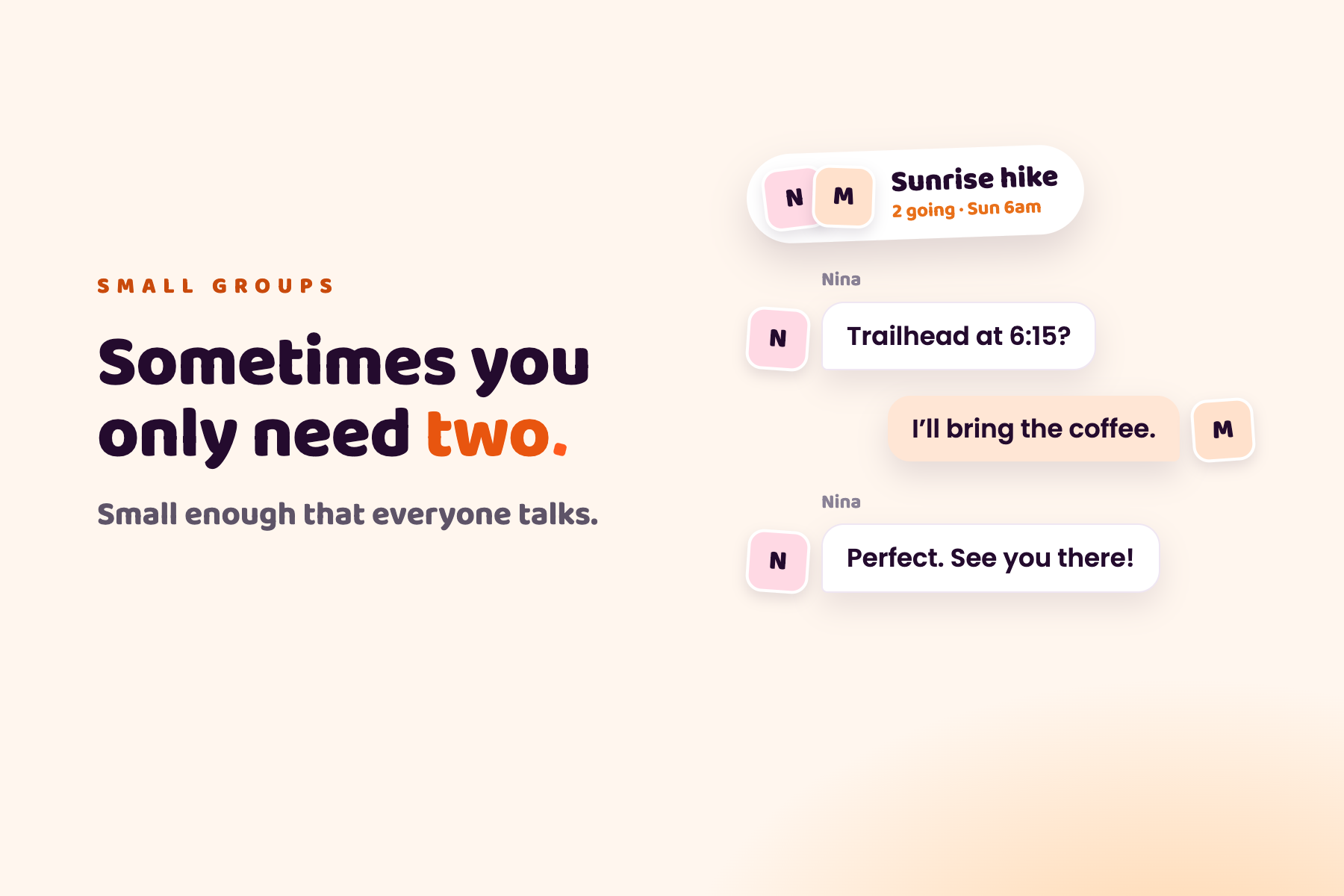
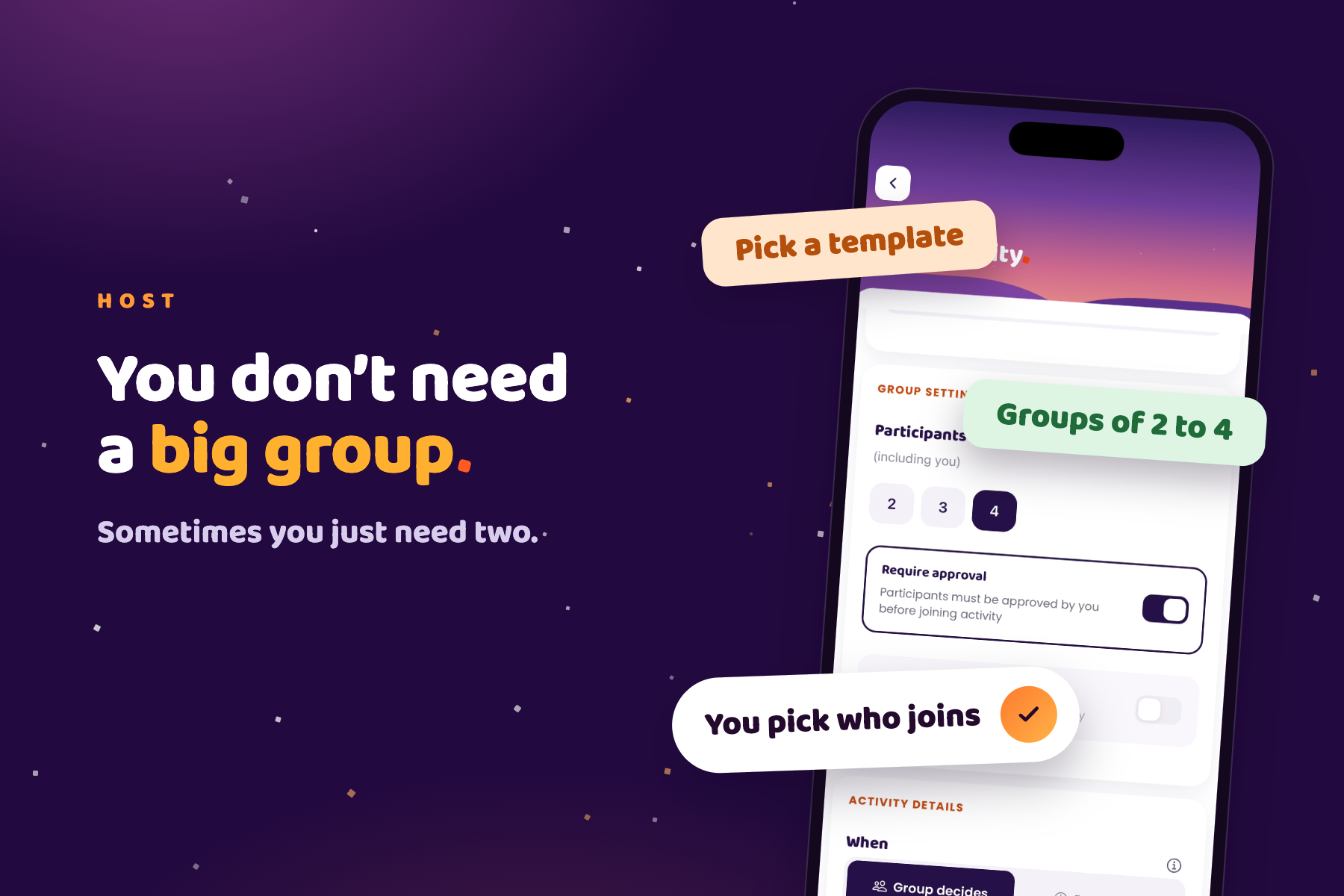
Groups stay deliberately small. Two to four people are easier to coordinate, everyone has a chance to participate, and the interaction is personal enough for people to actually get to know one another.
Activities are also intentionally near-term. Free users plan within two weeks; paid users can plan up to four weeks ahead. An activity can have an exact date and time or stay flexible while the group decides the details together in chat.
The point is low overhead. You shouldn't have to become an event organizer because you want three people to try a ramen restaurant, split an escape room, attend a local event, work out together, or experiment with a new hobby.
This also creates natural opportunities around the places where activities already happen: local businesses, restaurants, gyms, studios, venues, volunteer organizations, museums, parks, and community events.
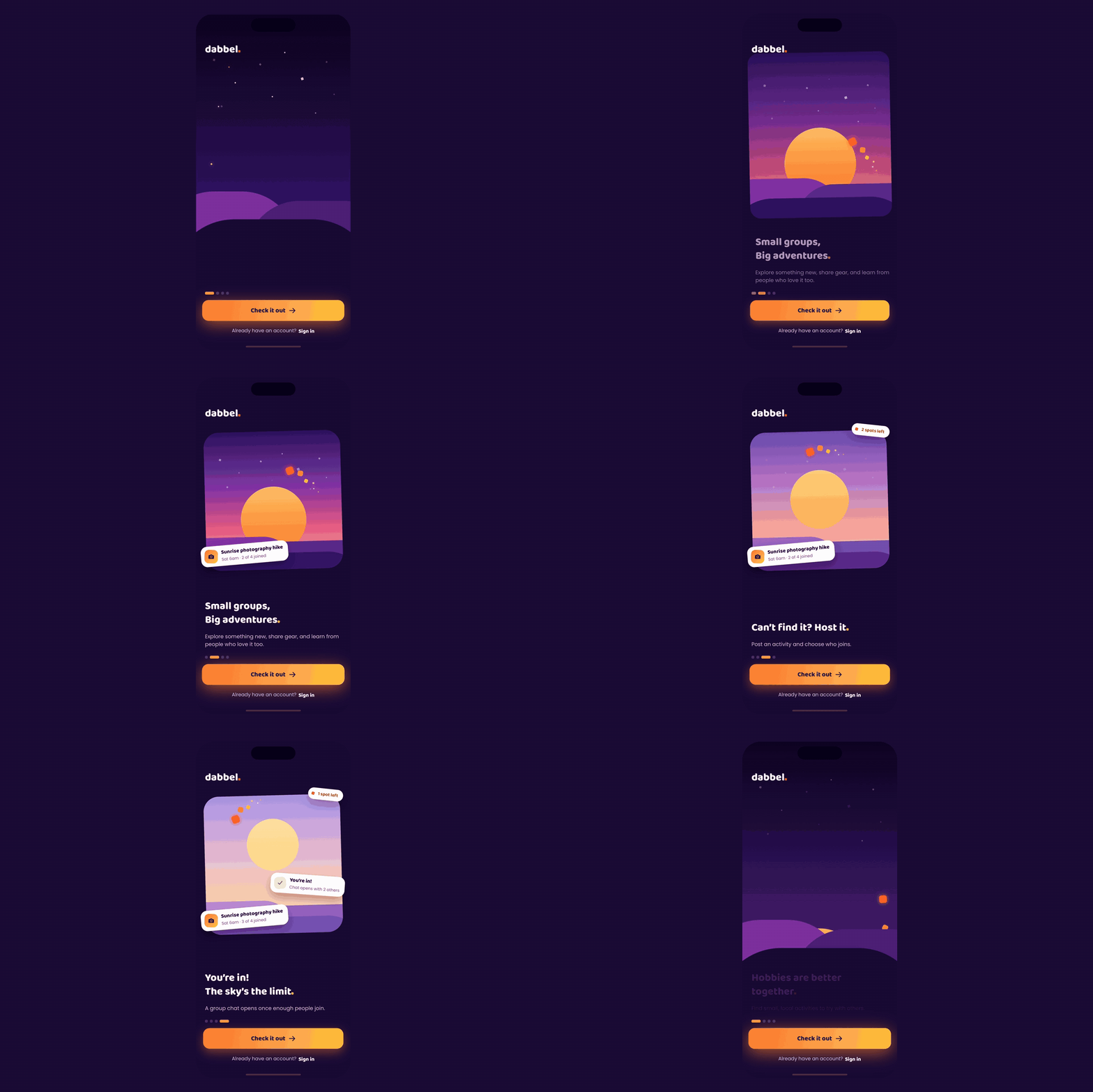
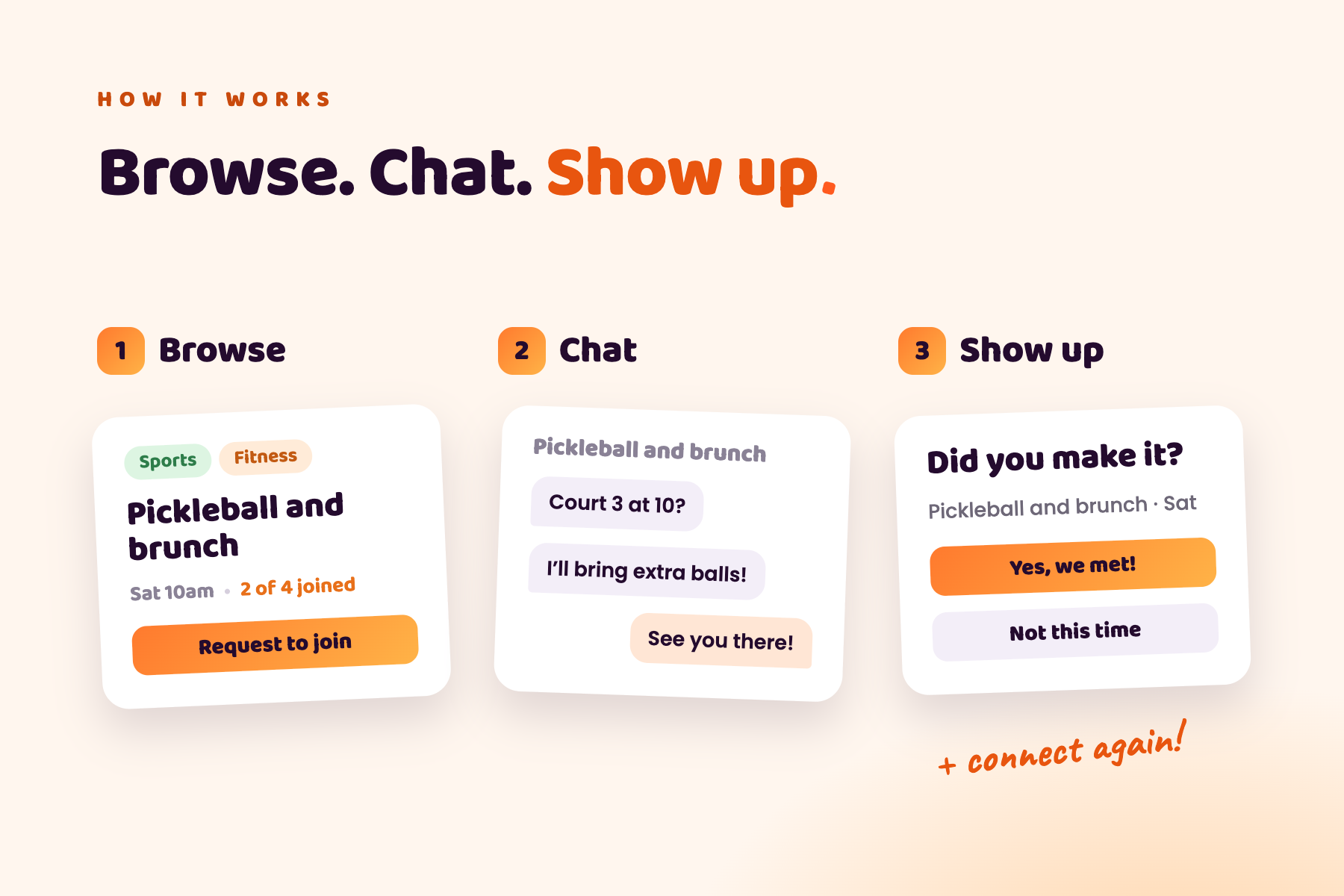
The flow is simple: Browse. Chat. Show up.
How we built it
Dabbel is built with React Native, Expo, and TypeScript, with Supabase for backend infrastructure and authentication and PostHog for analytics.
Activities include a location, small group size, scheduling preferences, participants, group chat, and a limited window in which the activity is meant to happen. I wanted the product itself to encourage action rather than accumulating dormant groups.
For this hackathon, I integrated RevenueCat for subscriptions and entitlements. One current distinction is planning range: two weeks for free users versus four weeks for paid users.
More importantly, RevenueCat forced me to answer a harder question than how do I add subscriptions?:
What should a social app actually charge for?
I want the core social experience to remain accessible, with paid features focused on additional flexibility, discovery, convenience, and eventually better tools for people who organize communities.
Challenges we ran into
Local density.
Coordination.
Talking to strangers
Getting people to actually show up.
Monetization.
Scope.
Partnerships
Accomplishments that we're proud of
Dabbel has moved from an idea in my journals to a real cross-platform product.
- The iOS app has been accepted to the Apple App Store.
- Waitlist in the hundreds before a full public launch.
- I built the product across React Native/Expo, TypeScript, Supabase, PostHog, and RevenueCat.
- The idea itself has survived repeated changes as I've learned more about how people actually build community
I'm particularly proud of that last part. The earliest version was mostly about matching two people based on hobbies. Now I think the more interesting question is simpler:
Can we make it easier for people to actually do things together?
What we learned
I've learned that friendship may be the wrong thing to ask people to commit to upfront.
"Do you want to be friends?" is a strangely big question. "Want to try this restaurant Thursday?" isn't.
I've also learned that small groups change both the social and logistical problem. Everybody gets to participate, coordination is easier, and niche interests become viable. You don't need fifty people nearby who want to try something obscure. Sometimes you need two.
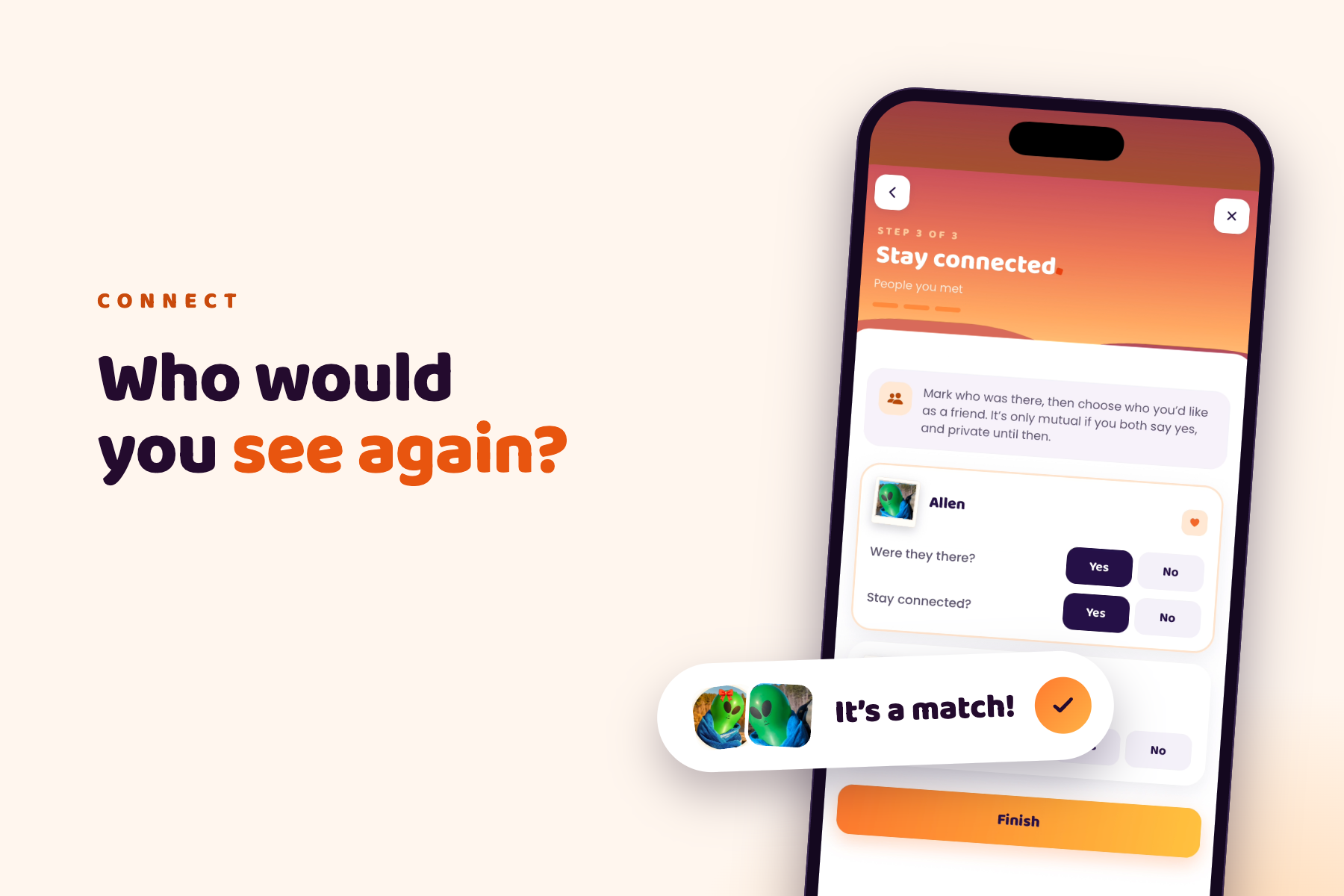
Repetition still matters. One successful activity doesn't create a friendship, but it can create the opportunity for a second interaction, then a third, until the app is no longer necessary.
And community itself can't be manufactured. Technology can lower barriers, help people discover each other, and create more opportunities to meet. It can't force chemistry.
The goal is simply to create more chances for something real to happen.
What's next for Dabbel?
The next step is getting Dabbel into more local hands and learning what actually turns into real-world activity: what people join, where coordination breaks down, which scheduling options work, and which groups actually show up.
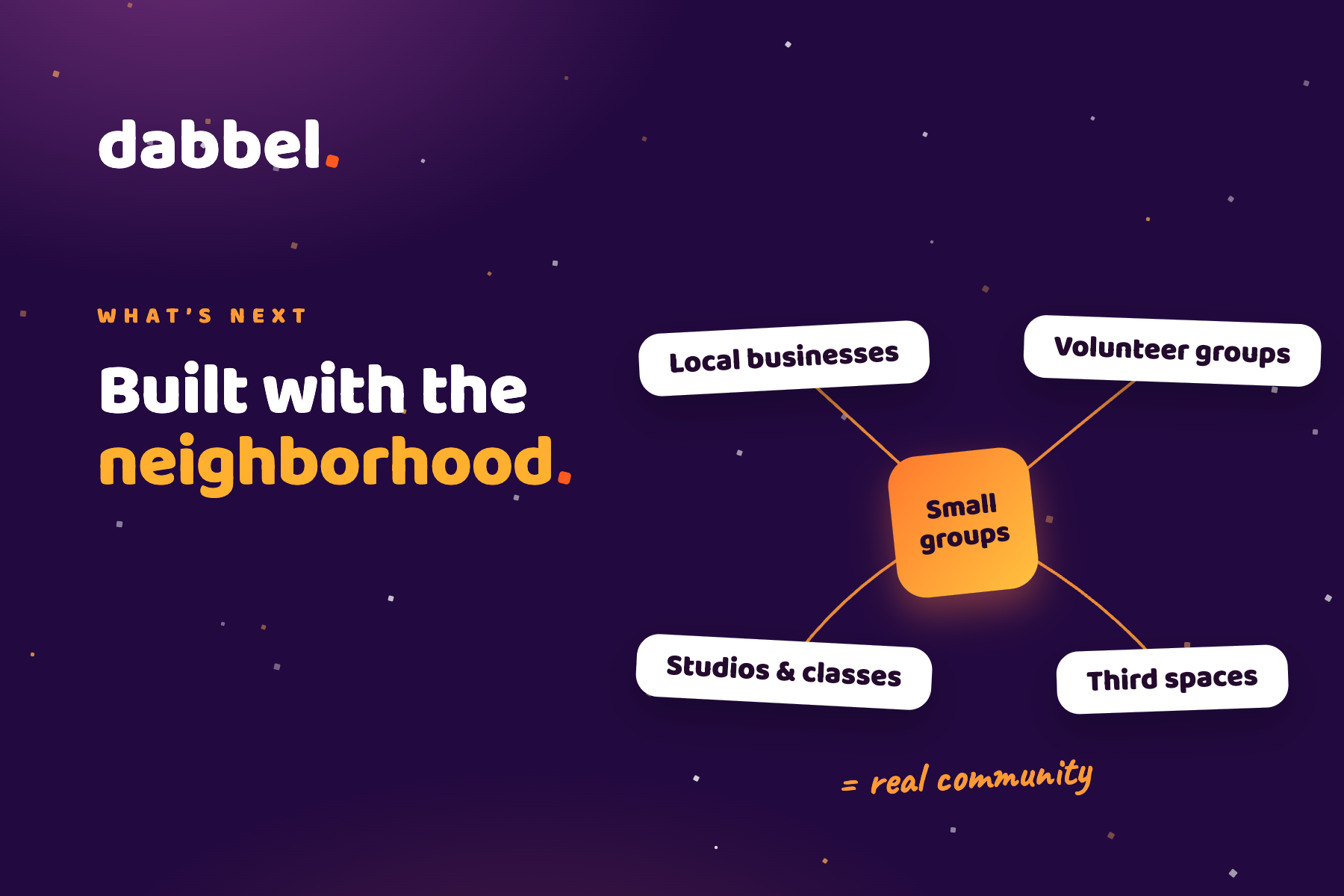
We are in talks to work more closely with volunteer groups and nonprofits, local businesses and third spaces. There is also room to explore skill and equipment sharing.
RevenueCat gives me a way to keep experimenting with a sustainable premium model while protecting the principles I care about around accessibility.
And if Dabbel works here in the Triangle, I eventually get to return to the question that started all of this:
Could I do it again somewhere else?
Could someone arrive in a new city with an Airbnb, a list of apartments to tour, and some hope, need just a little less luck?
Built With
- claude
- cursor
- eas
- expo.io
- node.js
- posthog
- react-native
- revenuecat
- supabase
- typescript

Log in or sign up for Devpost to join the conversation.