Inspiration
More than 500 years ago, Leonardo da Vinci conducted the first recorded systematic studies of friction and described principles that underpin modern tribology—the science of friction, lubrication, and wear. Tribology remains enormously important today. A widely cited study estimates that tribological contacts account for approximately 23% of global energy consumption, while advanced friction-reduction and wear-protection technologies could reduce these losses by as much as 40% over the long term (Holmberg and Erdemir, 2017). Yet tribology engineering remains fragmented. Engineers must search specialized literature, select models, estimate material properties, configure numerical solvers, interpret results, and document their decisions across several disconnected tools. We created Agent Da Vinci to bring these steps together. It combines the accessibility of conversational AI with trusted tribology knowledge and deterministic engineering tools, helping engineers move from a natural-language problem to a traceable analysis.
What it does
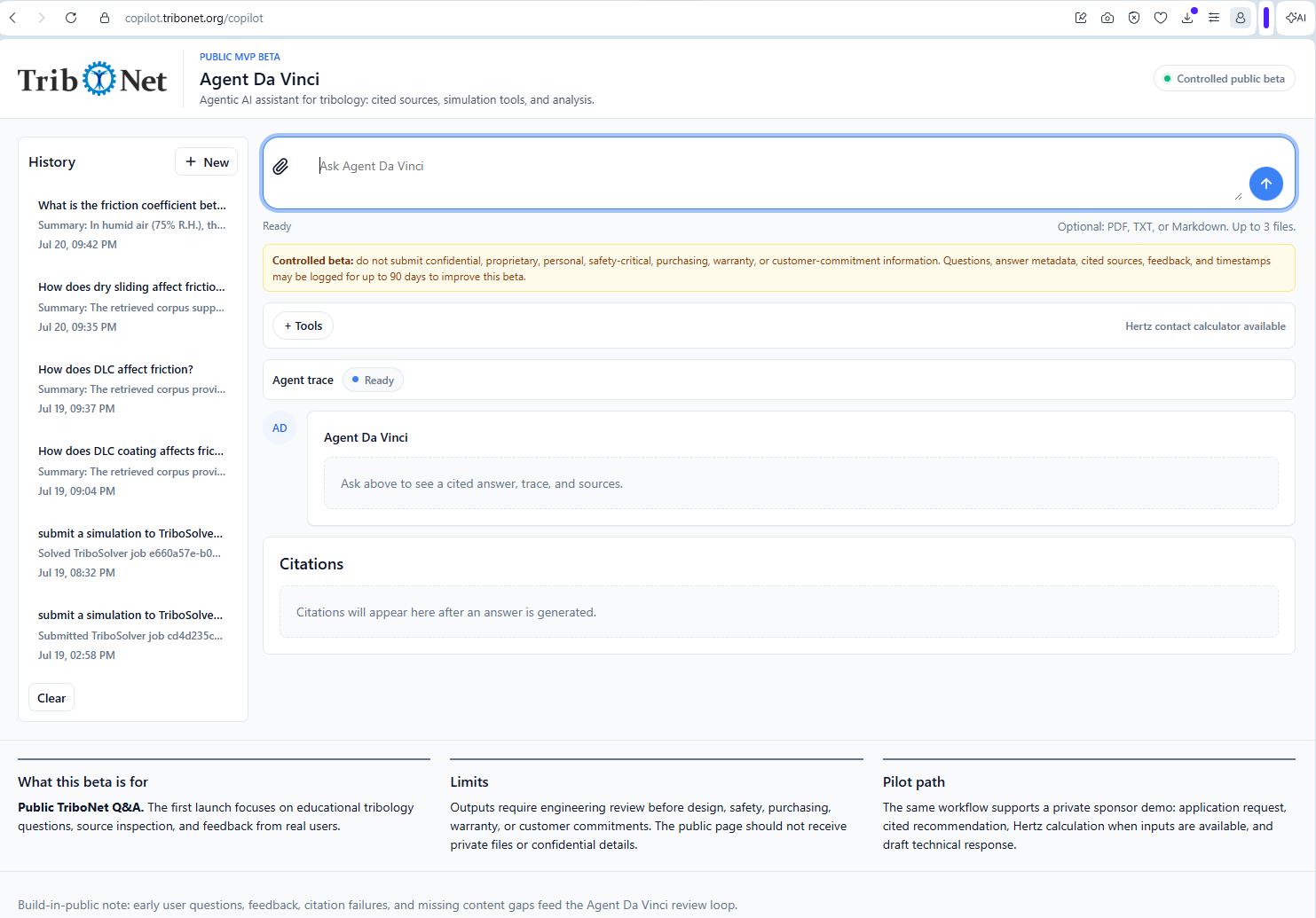
Agent Da Vinci is an AI copilot for tribology engineering. Users can describe a contact, friction, lubrication, or wear problem in natural language, and the agent determines the appropriate workflow.
The system can:
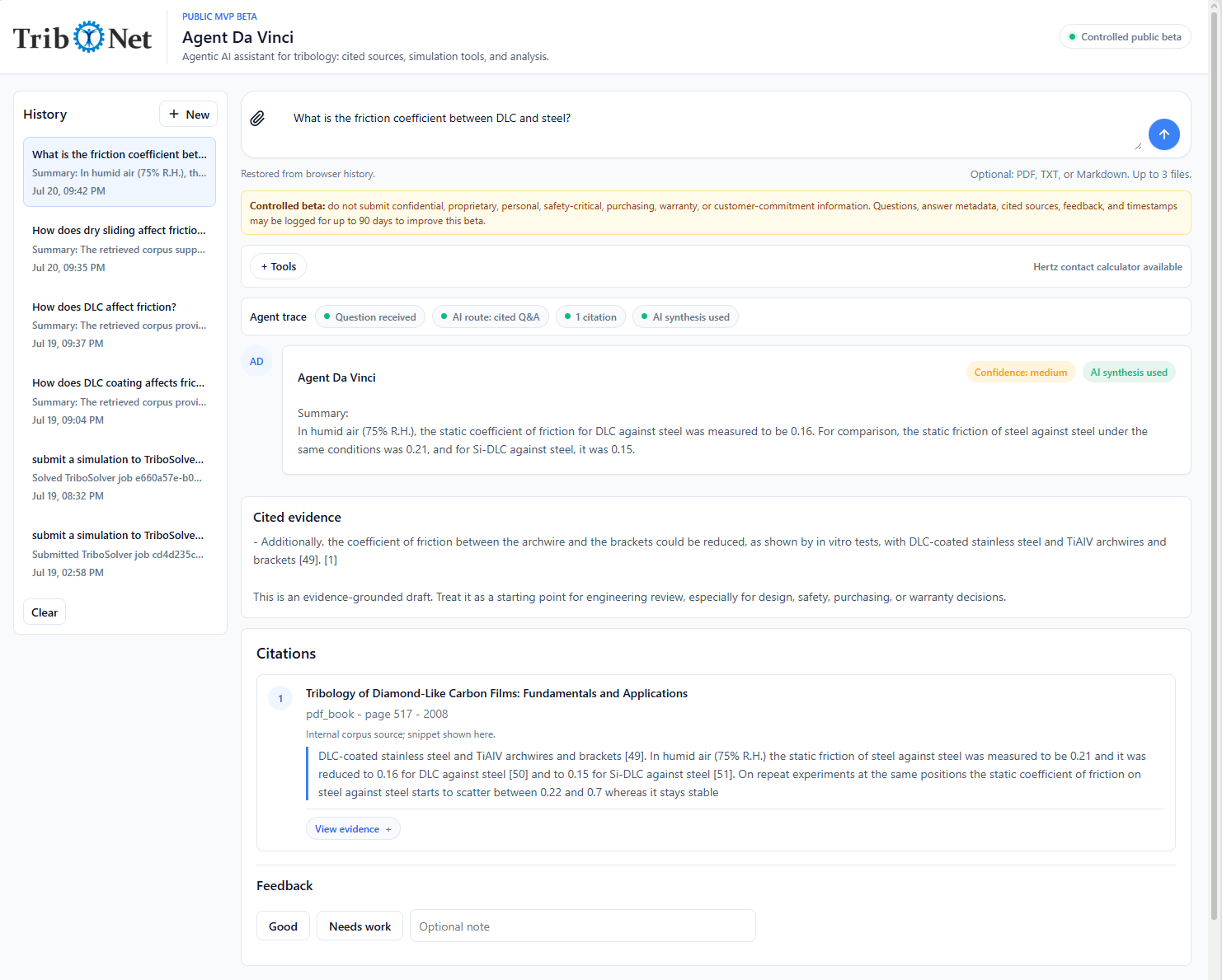
- Answer tribology questions using retrieval-augmented generation and cited sources.
- Distinguish between knowledge questions, engineering calculations, and simulation requests.
- Perform numerical and analytical simulations using various tools.
- Prepare editable simulation inputs while clearly exposing assumptions.
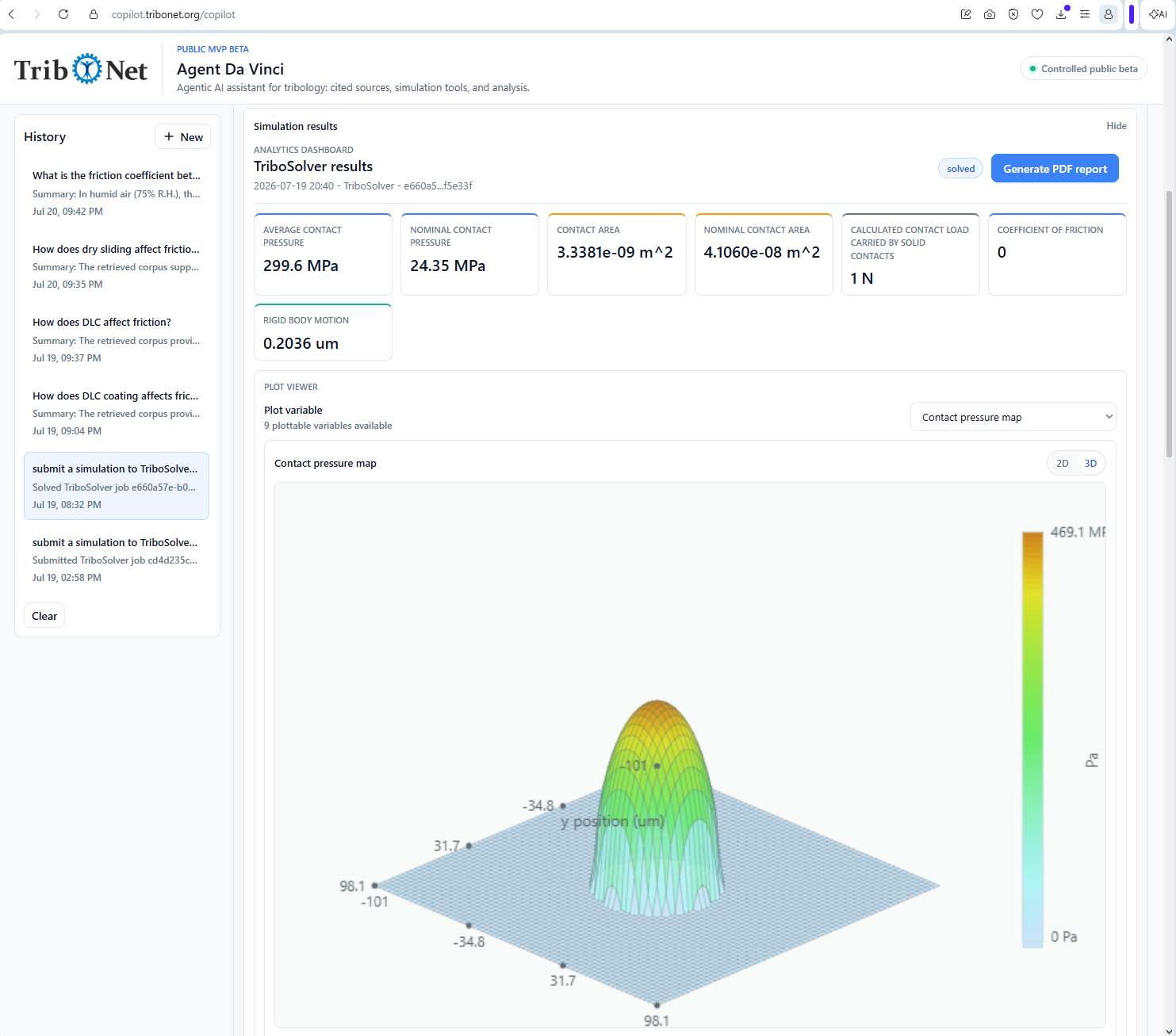
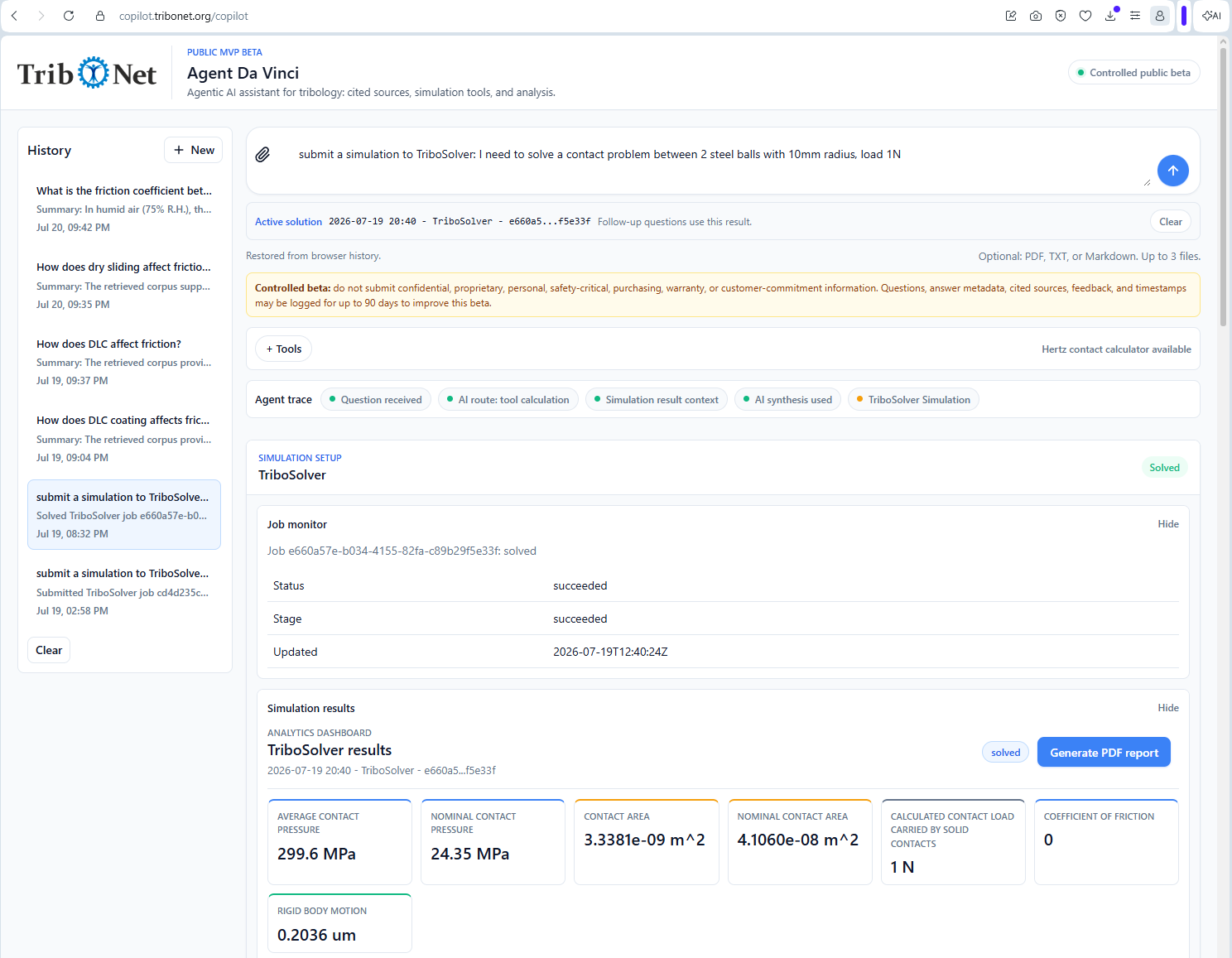
- Monitor solver jobs and summarize their results.
- Generate plots from large numerical result fields on demand.
- Produce downloadable PDF reports containing inputs, assumptions, and results.
- Present the entire workflow through an integrated, dashboard-style conversational interface.
The language model handles intent, orchestration, and explanation. Numerical results come from dedicated engineering calculators and solvers rather than being invented by the model.
How we built it
We built Agent Da Vinci as a Python application with a web-based engineering workbench using Codex and GPT-5.x/5.6. Reasoning and response synthesis performed via LLMs through APIs (currently Gemini 2.5 Flash Lite is used for cost efficiency). A retrieval-augmented generation pipeline searches a curated tribology corpus and supplies relevant evidence, allowing the agent to produce answers with inspectable citations.
An intent-routing and tool-selection layer decides whether a request requires document retrieval, a simulation, or follow-up analysis of existing results. Before running a simulation, the agent creates an editable input configuration so the engineer can review the assumptions.
We integrated a third party tool (TriboSolver) through its API, including input normalization, validation, job submission, status monitoring, result retrieval, scalar summaries, on-demand plotting, and report generation. Large matrix results are loaded only when requested, keeping the interface responsive.
Codex was our primary engineering collaborator throughout the project. It helped us analyze the problem in general, inspect and understand the existing codebase, design the architecture, implement backend and interface features, write tests, run the application, verify workflows in the browser, diagnose integration failures, and iterate on the final product experience.
Challenges we ran into
The most important challenge was establishing a reliable boundary between AI reasoning and engineering computation. Language models can produce plausible-looking numerical values even when they have not executed the required calculation. In engineering, a confident but fabricated result is far more dangerous than an explicit failure.
We addressed this by separating responsibilities:
- The model interprets the request, selects tools, and explains results.
- Deterministic calculators and numerical solvers produce engineering values.
- Inputs are normalized and validated before execution.
- Tool activity and solver status are exposed to the user.
- Results remain connected to their inputs, assumptions, and sources.
Integrating an external numerical solver introduced additional challenges around payload compatibility, long-running jobs, large result matrices, network failures, and error reporting. We built explicit job states, compact scalar summaries, deferred plot loading, validation checks, and actionable failure messages to make this workflow reliable and understandable.
Another challenge was combining literature search, calculations, simulations, visualizations, and reporting without making the interface feel like a collection of unrelated tools. We designed the assistant as part of the engineering dashboard so users can move through the complete workflow in one conversation.
Accomplishments that we're proud of
We are proud that Agent Da Vinci is more than a question-answering chatbot. It is a working agentic engineering system that can move from an informal problem description to cited research, validated inputs, numerical computation, interactive results, and a repeatable report.
We are especially proud of:
- Combining cited domain knowledge (10000 articles from OpenAlex) with real engineering tools.
- Making solver assumptions visible and editable.
- Preventing the language model from acting as the numerical solver.
- Integrating a complete TriboSolver workflow into a conversational interface.
- Presenting complex numerical outputs in a compact, accessible dashboard.
- Building tests and validation around safety-critical workflow boundaries.
Most importantly, the project demonstrates that advanced simulation tools can become easier to access without hiding the engineering decisions behind them.
What we learned
We learned that the greatest value of an engineering agent comes from combining the model with curated knowledge, deterministic tools, validation layers, and a user experience that makes every step inspectable and user friendly.
We also learned that agentic systems require different engineering practices from conventional applications. It is necessary to test routing decisions, tool execution, failure recovery, numerical provenance, and the way results are communicated.
Codex showed us how quickly a small team can now work across architecture, implementation, testing, debugging, and interface design. Workflows that seemed completely unrealistic only months ago can now be assembled into a coherent and usable product within weeks.
What's next for Agent Da Vinci
Our next step is to release Agent Da Vinci to a broader group of engineers and researchers for structured testing and feedback, luckily we have TriboNet audience as a help.
We plan to:
- Expand the curated tribology knowledge base.
- Add more contact, lubrication, friction, and wear models.
- Integrate additional specialized engineering solvers.
- Introduce stronger numerical validation and benchmark suites.
- Improve unit handling and automatic consistency checks.
- Add richer comparisons between simulation cases.
- Make reports and analyses easier to share and reproduce.
- Continue improving usability for both tribology specialists and engineers who are new to the field.
Our long-term goal is to make Agent Da Vinci a platform that can be applied and used by companies and engineers to explore tribology problems, optimize design choices, and move from evidence to simulation with greater speed and confidence.
Built With
- codex
- openalex
- tribosolver

Log in or sign up for Devpost to join the conversation.