-
-
Virtrue
Inspiration
Virtrue was inspired by the gap that often exists between what people believe and how they behave in everyday life. Many people care deeply about values such as honesty, empathy, fairness, and responsibility, but it can be difficult to consistently act according to those values in real-world situations. Small decisions like avoiding difficult conversations, breaking commitments, or making convenience-based purchases often go unnoticed in the moment but accumulate over time.
While modern technology tracks many aspects of our lives such as health, sleep, and productivity, ethical behavior and personal integrity remain largely invisible to digital tools. This project explores the idea of creating a new type of awareness: the ability to perceive when our actions align with our values. Similar to how fitness trackers helped people understand their physical health, Moral Compass imagines a future where people can reflect on their ethical patterns through technology.
What it does
Virtrue is a speculative wearable system that helps users track the alignment between their personal values and their daily behavior. The system introduces a new sense called value alignment awareness, allowing users to notice patterns between what they believe and what they actually do.
The system consists of three components: a wearable band, Apple Watch integration, and a companion mobile app. The wearable band and Apple Watch passively detect signals from everyday activities such as speech patterns, tone of voice, stress signals, commitments made in conversation, and contextual information like purchases or calendar events. When the system detects a potential value conflict, the wearable can provide subtle haptic feedback to encourage reflection.
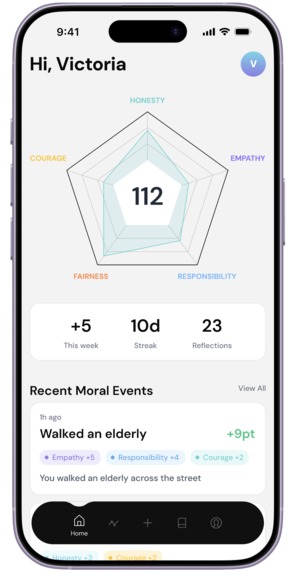
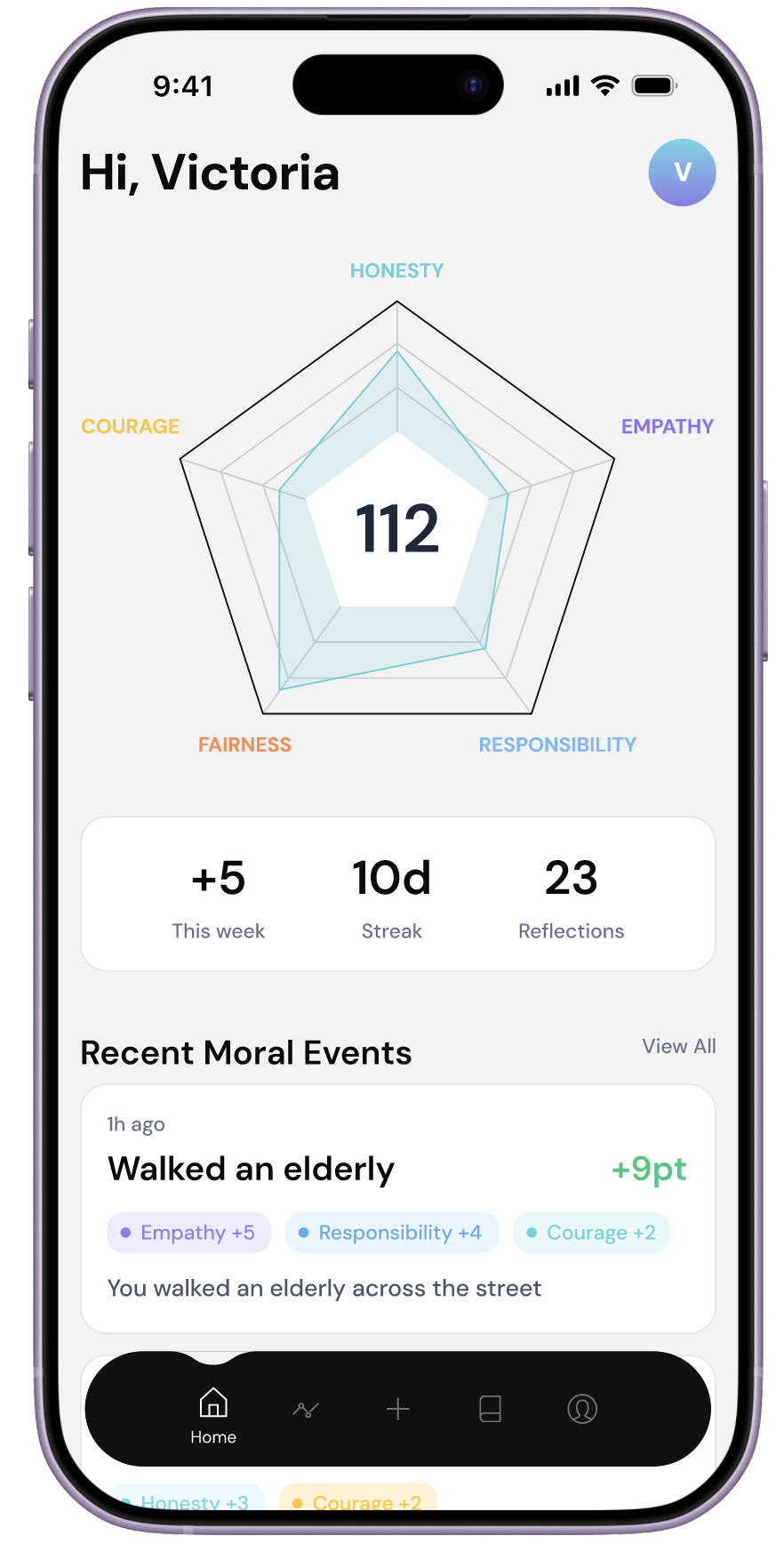
The mobile app processes this information and presents it through several interfaces. A moral dashboard visualizes how aligned the user is across different values, a daily timeline shows meaningful ethical moments throughout the day, and a report screen summarizes alignment patterns and insights. Together, these features help users understand behavioral trends and reflect on how closely their actions match their intentions.
How we built it
The project was developed through a design process that combined speculative design thinking with practical interface design. The first step was defining the core concept of a new sensory input: the ability to detect alignment between values and actions. From there, we designed a system architecture consisting of wearable sensing devices and a mobile application.
The wearable concept includes both a dedicated wearable band and Apple Watch support. These devices detect contextual signals such as vocal tone, hesitation during conversations, biometric stress indicators, and commitment detection from speech patterns. The Apple Watch can additionally provide biometric data such as heart rate and stress indicators that may signal moments of tension during ethical decisions.
The mobile app was then designed to visualize these insights. Key screens include a radar-style moral compass visualization, a chronological timeline of ethical moments, and a daily moral report summarizing alignment scores. The interface focuses on clarity and reflection rather than judgment, using neutral language and simple visualizations to help users understand their behavior patterns.
Challenges we ran into
One of the biggest challenges was designing a system that analyzes behavior without becoming judgmental or intrusive. Ethical behavior is complex and subjective, and it is difficult for technology to interpret social situations accurately. This meant the design needed to avoid making strong claims about what is right or wrong.
Privacy was another major challenge. Because the system analyzes speech patterns and behavioral signals, it was important to ensure that user data would remain secure and under the user's control. To address this, the design assumes that voice analysis happens locally on the device and that conversations are never recorded or stored.
Another challenge was visualizing abstract concepts like honesty or empathy in a way that feels meaningful to users. Translating these values into simple visualizations required experimenting with different representations, such as radar charts and timeline-based reflections.
Accomplishments that we're proud of
One accomplishment we are proud of is designing a system that translates abstract ethical ideas into a clear and understandable interface. The radar-style moral compass visualization makes it easy for users to see how balanced their values are across different dimensions such as honesty, empathy, responsibility, and fairness.
Another accomplishment is creating a timeline that shows everyday moments of alignment and drift. This helps users see ethical behavior not as a single score but as a collection of small decisions made throughout the day.
We are also proud of designing a system that works across multiple devices, combining a wearable band, Apple Watch signals, and a mobile app into a unified reflection experience.
What we learned
Through this project we learned how challenging it can be to design technology that deals with human values and emotions. Unlike physical metrics such as steps or heart rate, ethical behavior is nuanced and context-dependent. This required careful consideration of language, feedback, and visual design to avoid making the system feel judgmental.
We also learned how speculative design can be used to explore future possibilities for technology. By imagining a new type of sensory feedback, the project raises questions about how technology could help people become more self-aware and reflective about their behavior.
Finally, the project reinforced the importance of designing systems that prioritize user control, privacy, and emotional safety when dealing with sensitive personal data.
What's next for Virtrue
If this concept were developed further, the next step would be exploring more advanced sensing technologies and AI models capable of understanding social context more accurately. This could include better natural language processing to detect commitments or conversational dynamics, as well as improved biometric sensing through wearable devices like the Apple Watch.
Future versions of the system could also focus more on personalization. Users could define their own values, adjust how strongly each value is weighted, and receive more tailored insights based on their personal goals.
Ultimately, the long-term vision is to explore how technology might support personal growth and ethical self-awareness, helping people better understand the relationship between their intentions and their actions.
Built With
- figjam
- figma
- figmamake
- lovable


Log in or sign up for Devpost to join the conversation.