-
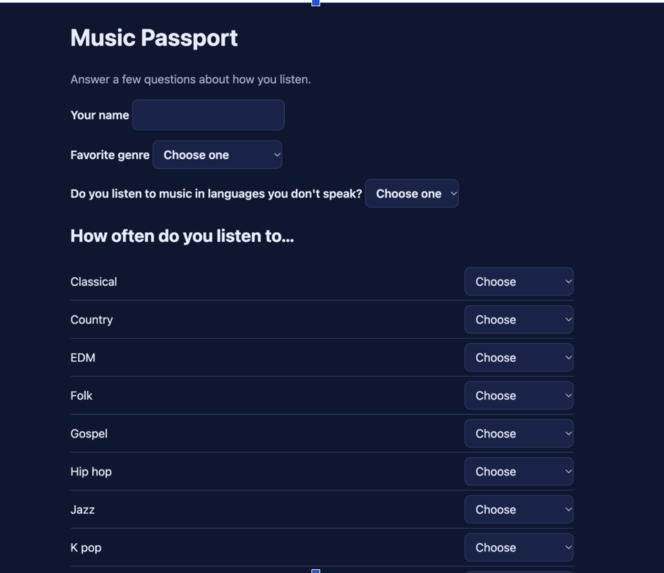
Prototype
-
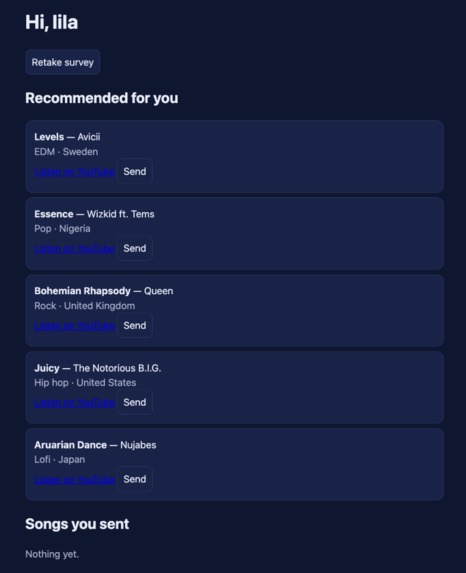
As international students, we have experienced how cultural diversity can bring people together, and music has always felt like one of the most universal forms of connection. Inspired by this, as well as the potential of AI for social good, we wanted to explore whether music could help us understand and connect people experiencing mental-health challenges.
We began with a simple research question: Do people with similar self-reported mental-health profiles have similar music-listening patterns? Using survey data from 437 young adults aged 17–26, we compared participants’ listening patterns across 16 genres with their self-reported Anxiety, Depression, Insomnia, and OCD scores. However, our initial analysis revealed only a very weak relationship between music similarity and mental-health similarity. Rather than forcing the data to support our original hypothesis, we decided to pivot our research question and ask: Are more exploratory music listeners associated with better self-reported mental-health outcomes among young adults aged 17–26?
This pivot shifted our project from simply looking for “music twins” to exploring whether the breadth of someone’s musical exploration might be related to their mental-health experiences. Through this process, we built a data-driven exploration of music, mental health, and human connection, while learning that research is not always about confirming the question you started with, but it is also about allowing the data to guide where you go next. We ultimately envisioned our analysis as the foundation for a global music map where shared musical interests could become a bridge for cultural exchange, conversation, and connection.
Built With
- chatgpt
- claude
- google-sheets
- python

Log in or sign up for Devpost to join the conversation.