Inspiration
Most scam advice assumes you can spot the scam. Check the URL, look for the padlock, read the reviews, don't click strange links. Many people can't do that, and they shouldn't have to: our parents and grandparents, people new to online shopping, anyone buying something on their phone in a hurry.
Scams don't hurt when you click. They hurt days later, when a strange charge shows up on your statement. By then the link and the checkout page are long gone, and the victim has to work out alone where the charge came from and what to do about it.
Not everyone can judge a website, but nearly everyone has a bank statement and can read a text message. We wanted to protect customers in ways that go beyond classification. So we started where every scam eventually shows up, the card statement, and asked: what if something checked every charge for you and texted you when one looked wrong?
That is Bluff. Call their bluff.
What it does
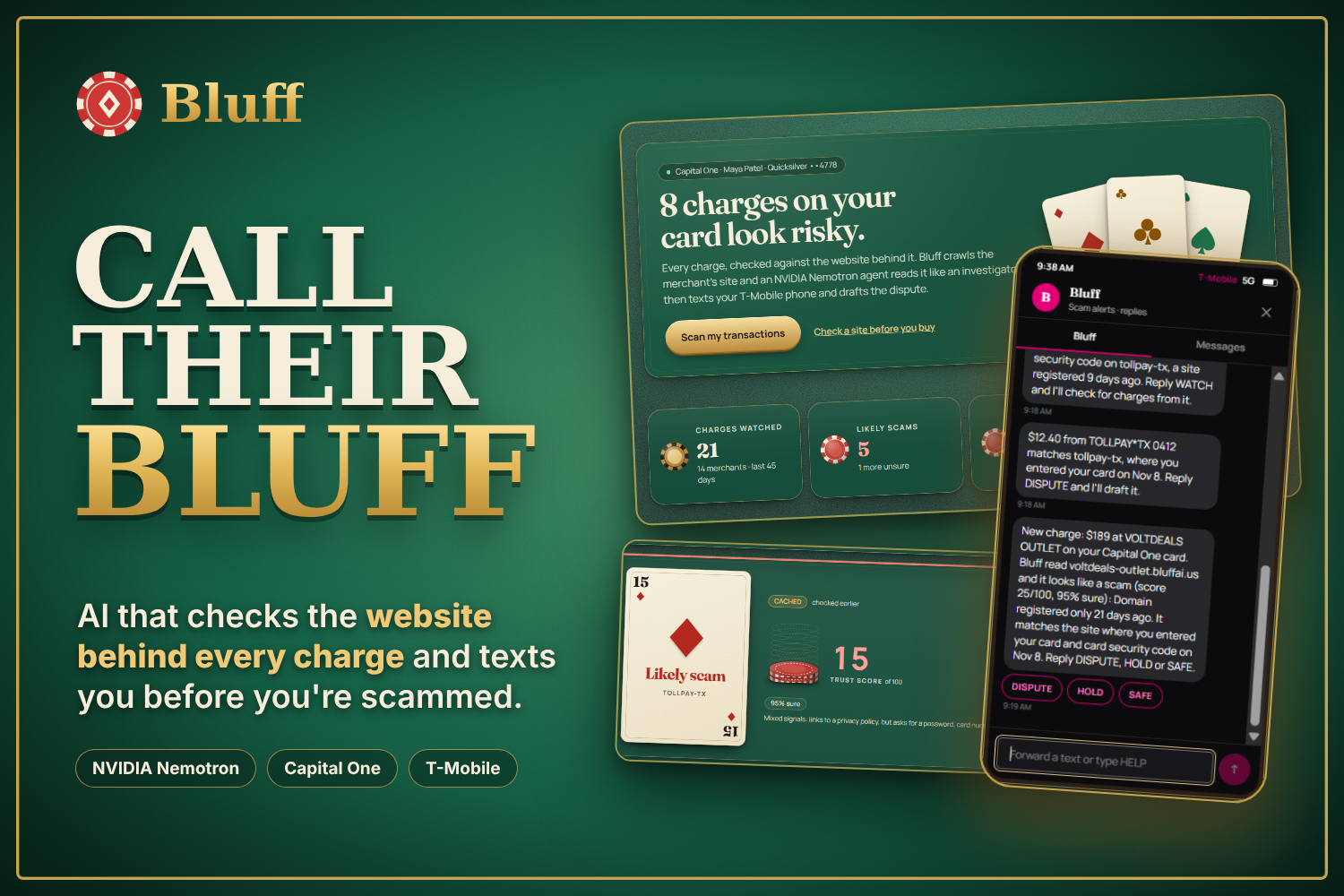
Bluff watches your card so you don't have to. You don't need to know what a phishing link looks like or how to look up who owns a website. If a charge looks risky, you get a text that tells you what's wrong and what you can do, and you answer with one word.
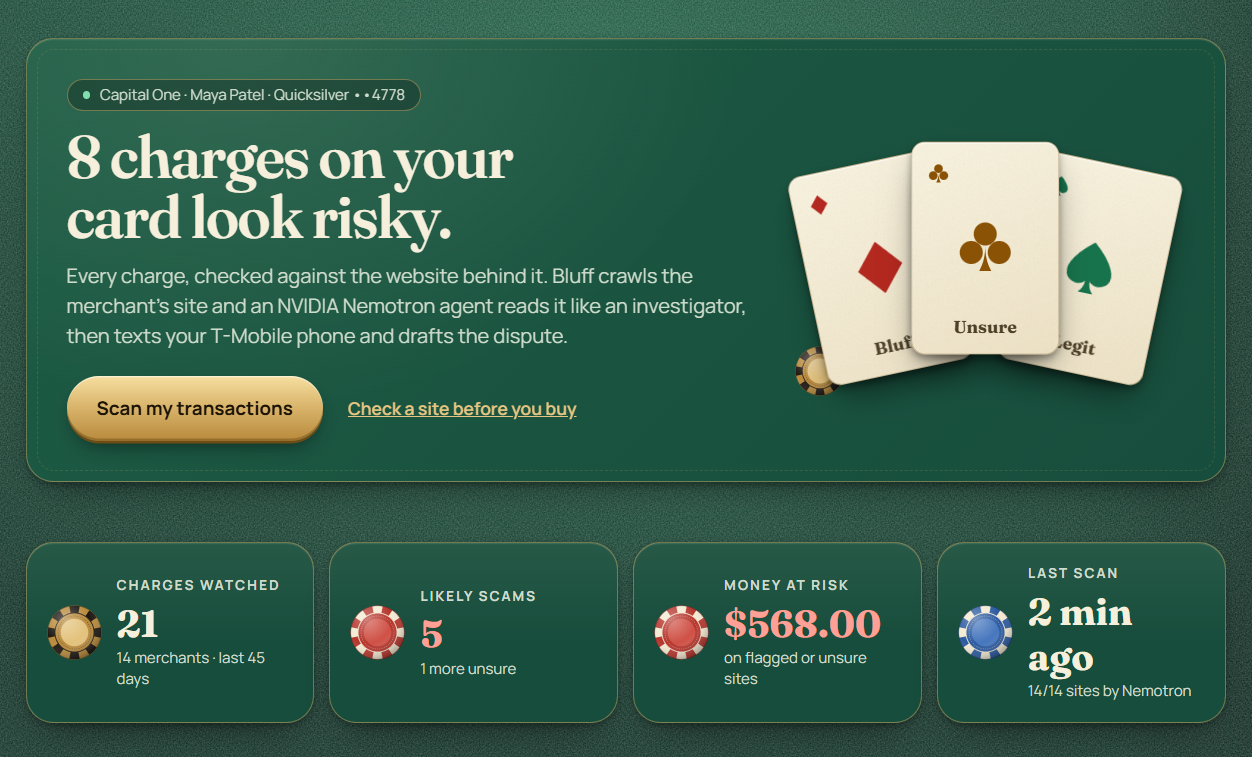
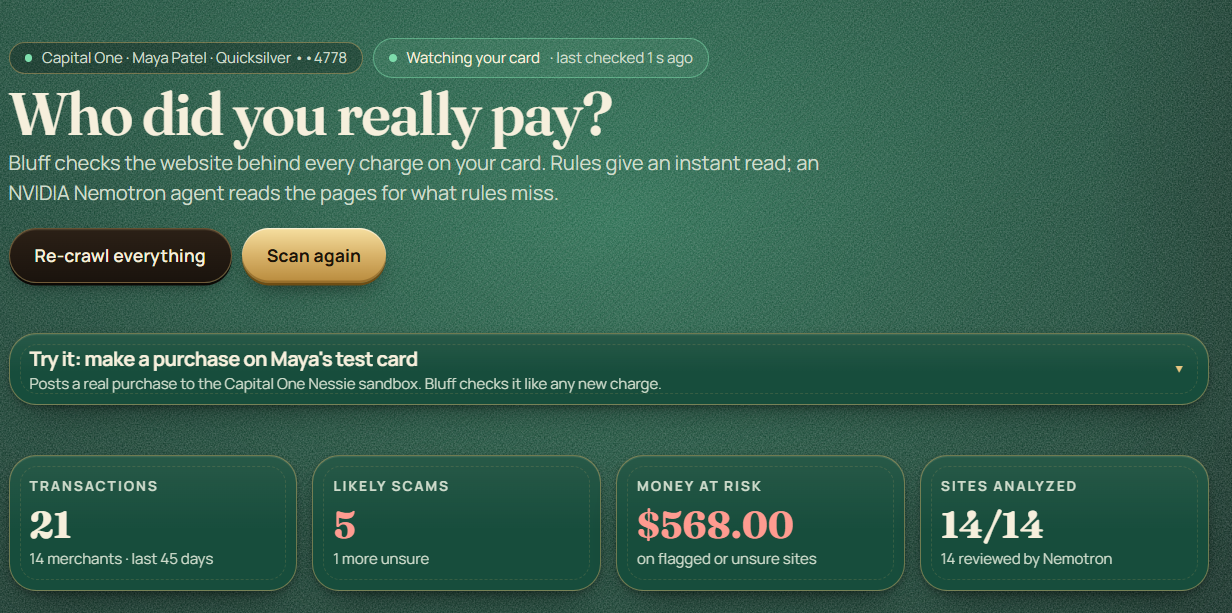
- It scans your transactions. Bluff pulls your purchases from Capital One's Nessie API and groups them by merchant website. For each merchant it reads up to 10 pages of the site, including the refund policy, terms, contact, and checkout pages.
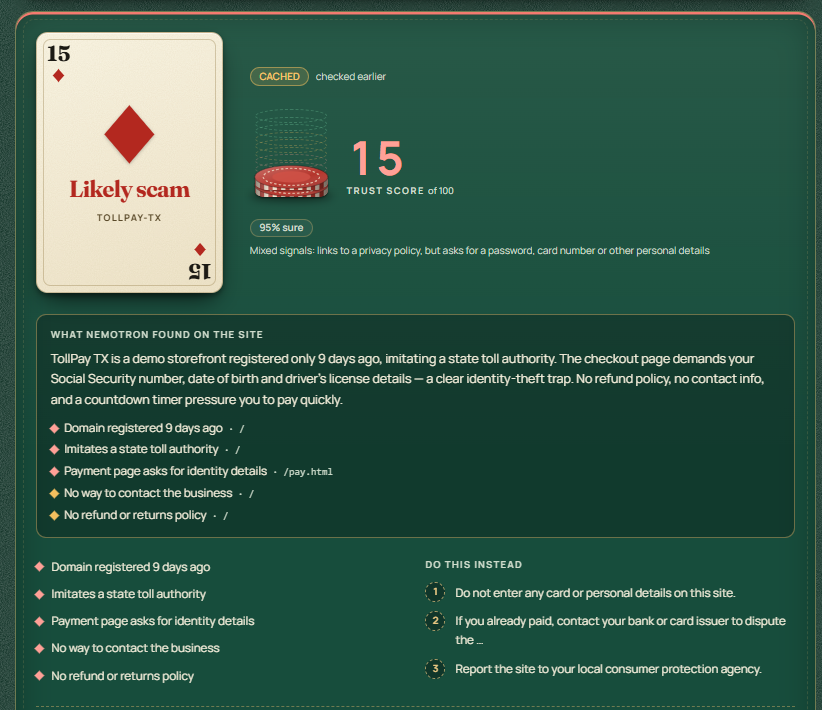
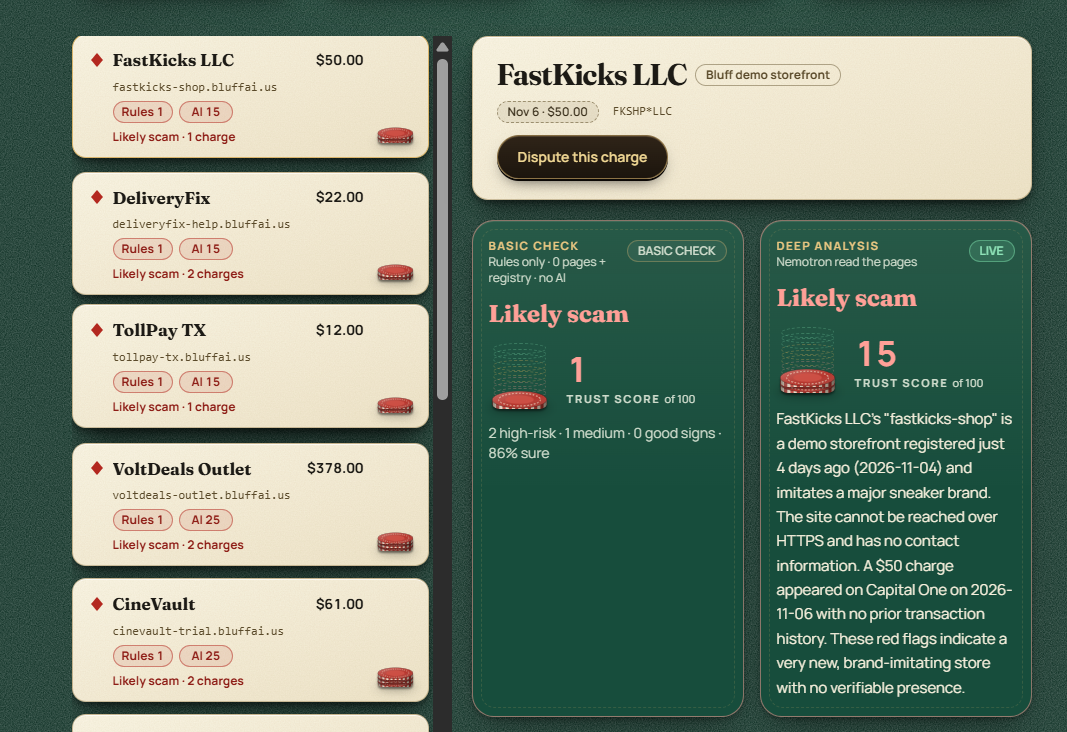
- It rates every merchant. A quick rules check gives a first answer within seconds. Then an NVIDIA Nemotron agent reads the pages and writes a verdict with a trust score and the reasons behind it, each linked to the page that proves it. The score comes from how many warning signs agree, not from the AI's own claim of how sure it is.
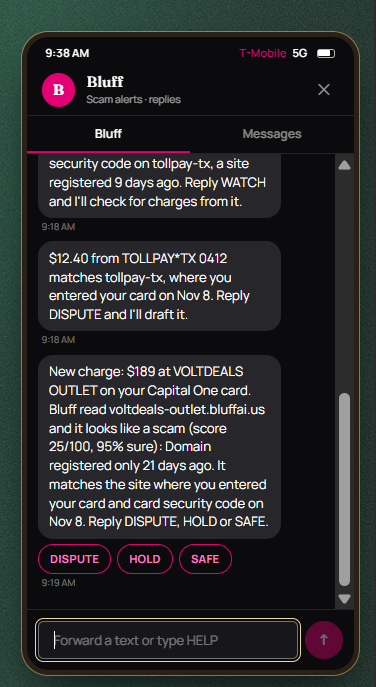
- It texts you when something looks wrong. New purchases are scanned and texted to your phone. The text names the merchant and its rating, with three one-word replies. Reply DISPUTE and Bluff drafts a dispute letter. Reply HOLD to put a hold on the card. Reply SAFE to tell Bluff you trust the merchant.
- It helps you get your money back. A dispute comes with a letter, a timeline of evidence linked to the pages that back it up, and clear next steps. Bluff drafts. You decide. It never files or sends anything on its own.
- It's built for people who aren't tech savvy. The most important part of Bluff happens in a text message, which almost everyone already knows how to read and answer. Every action is one word or one button with a plain label. The poker theme in the web app sits on top of those labels and never replaces them.
Bluff also protects you before a charge happens:
- Report a suspicious text. Forward a text you're unsure about. Bluff checks it, throws away the message body, and remembers the scam link, so if a charge from that site appears later, Bluff ties it back to the text.
- Check a store before you pay. The same crawler and agent can review a store from the Bluff website or our Checkout Guard Chrome extension. If you buy anyway, Bluff remembers the site and links the later charge to it.
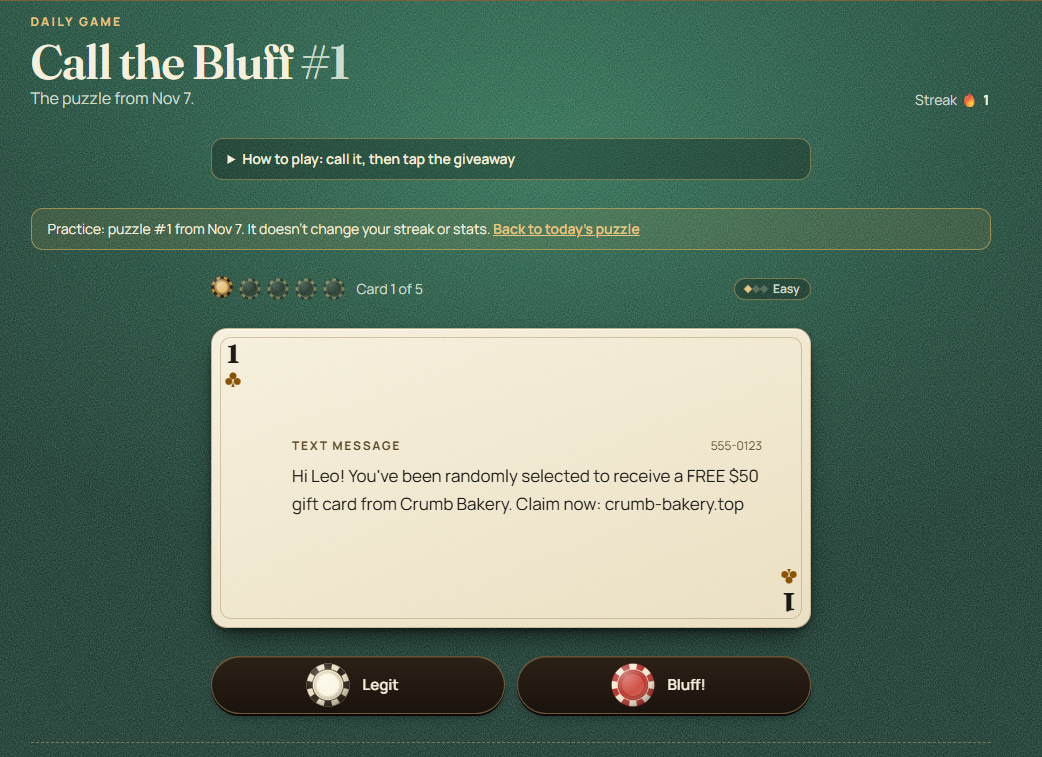
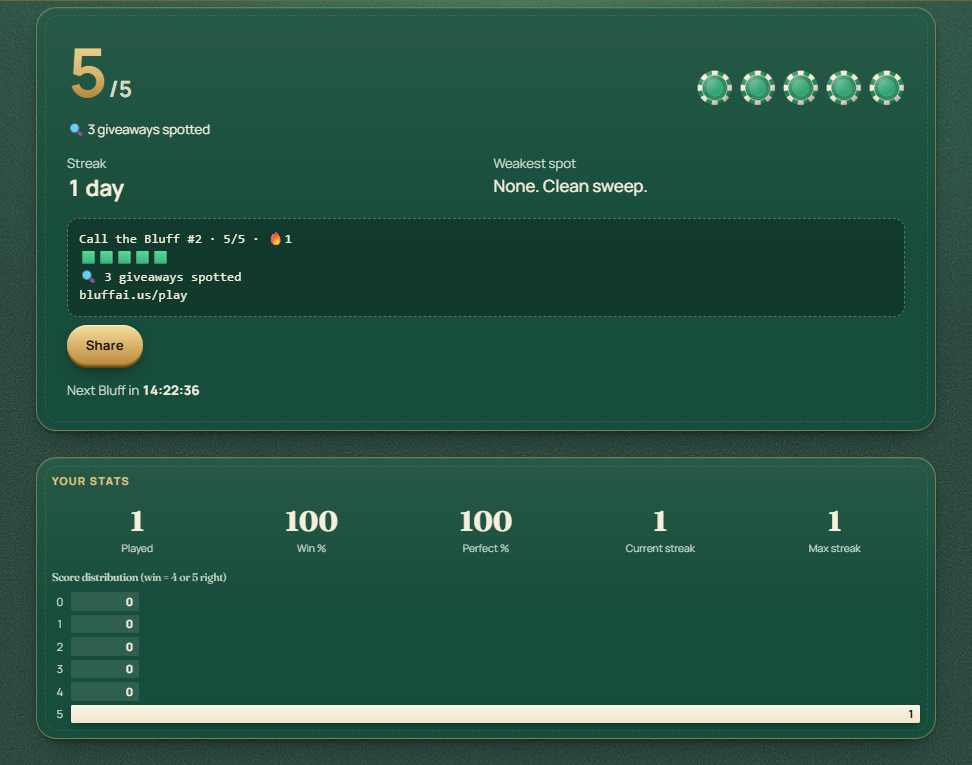
- Call the Bluff. A daily five-card game that teaches the same red flags the detector uses, with a bonus card made from your own bank scan. It's a low-pressure way to learn the warning signs.
Honest by design. Every result is labeled live, cached, replayed, or basic check. Our proof page shows the baselines and where Bluff is still wrong. Everything runs on synthetic data.
How we built it
- Bank feed. Capital One Nessie provides customers, accounts, merchants and purchases. Bluff polls the card for new purchases, and we write test purchases back to Nessie, so the demo is a real round trip.
- Crawler. A TypeScript crawler with SSRF guards on every redirect, a sandboxed headless Chromium for JavaScript-only pages, and registry facts from RDAP, TLS, DNS and the Internet Archive.
- Agent. Nemotron runs as a multi-step tool-calling agent per merchant. It plans, reads the crawled pages, fetches more pages from the same site when needed, checks payment history, then submits a verdict that is validated and repaired. The trace streams to the UI. Nemotron embeddings match messages to a 25-category scam taxonomy, and Nemotron also generated and audited our synthetic message set.
- Linker. It normalizes charge descriptors, scores name similarity and timing (a charge 0 to 45 days after an exposure), and applies a threshold. The agent can confirm a link but can never invent one.
- Data. Postgres with TimescaleDB on Tiger Data: a
transactionshypertable, amerchant_dailycontinuous aggregate for price history, andpg_trgmfor matching messy charge descriptors likeFKSHP*LLCtofastkicks-shop. - Frontend. Next.js 15, React and Tailwind, designed as "The Table": green felt, a chip stack for the trust score, and playing cards that flip when a verdict arrives. All motion respects reduced-motion settings.
- Hosting. Docker on a Vultr VPS behind Caddy, on a GoDaddy Registry domain.
Our detection score is the usual F1:
$$F_1 = \frac{2 \cdot \text{precision} \cdot \text{recall}}{\text{precision} + \text{recall}}$$
On a held-out split of 91 synthetic messages, Bluff live scored $F_1 = 0.93$ against 0.58 for a simple "contains a link" baseline.
Challenges we ran into
- Rate limits. The trial API key is throttled, so we pace calls and retry on 429s. When a deep review can't finish, Bluff falls back to the rules check and labels it, so the user still gets an answer instead of a blank screen.
- Crawling safely. Fetching arbitrary websites is risky. We check addresses at connect time on every redirect, never submit forms, and firewall the headless browser away from private networks.
- Sandbox limits. Nessie stores whole dollars and has no card-lock or delete endpoint, so our card hold is simulated and labeled, and test purchases are scoped to the visitor who made them.
- Trusting the model. We kept the agent from inventing links or confidence. The server computes confidence from signal agreement and checks every verdict against a schema.
What we learned
- Scam detection is the small part. The valuable part is reaching the person at the right moment, in a form they already understand, with a clear next step. Connecting a site, a text and a charge is what makes that next step possible.
- A text message with a one-word reply works for almost everyone, including people who would never install a security tool.
- Honest labels build trust. Users believe a tool that shows "basic check" when the agent was rate limited.
- An agent with tools and a strict output schema is far more reliable than a chatbot answering a prompt.
- A theme can carry a product if it never replaces clear labels.
What's next
Real SMS delivery through a carrier, a real card lock, evaluation on T-Mobile's own message data, PDF export for disputes, and a Checkout Guard that runs in more browsers.
Built With
- caddy
- capital-one-nessie
- chrome
- docker
- godaddy-registry
- next.js
- node.js
- nvidia-nemotron
- nvidia-nim
- pg-trgm
- playwright
- postgresql
- python
- react
- tailwind-css
- tiger-data
- timescaledb
- typescript
- vitest
- vultr
- zod