-
-
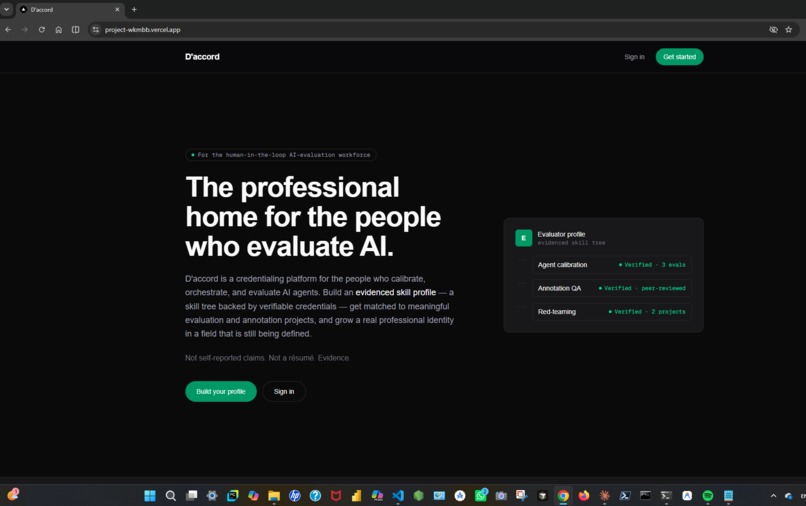
Home Page
Inspiration
AI is only as good as the people who train, annotate, and evaluate it — yet this is a brand-new field of work with no good way to prove who's skilled at it. Existing HR systems and résumés don't map cleanly onto annotation, RLHF, red-teaming, or evaluation work, and most people moving into it don't even know how their existing experience translates. We wanted to build a professional home for these people: a way to turn what you've already done into an evidenced, shareable credential — and connect that credential to real paid work.
What it does
D'accord turns your CV into an evidence-based skill profile for AI evaluation and alignment work. You upload a CV; two AI models read it and extract the skills you've demonstrated; those skills are translated into the AI-data-work domain. They are then mapped onto a visual skill tree. You refine what the models found, then mint a shareable public credential card. From your skills, D'accord matches you against a curated set of annotation and evaluation projects — showing for each whether you're Satisfied, Partial, or Locked, and the exact skills you'd need to qualify. Honest scope: today the credential is evidenced from your CV — grounded in your real work history, but not independently audited by us; and the projects you're matched against are a curated seed set while we build out real project provisioning and the team-facing side (see "What's next").
How we built it
- Frontend + deploy: Next.js 16 (App Router, React Server Components, Server Actions) on Vercel (Fluid Compute).
- Database: Amazon Aurora PostgreSQL (Serverless v2) as the primary back end. All app and user state lives there.
- Password-less DB auth: no static database credential exists anywhere. A Vercel function presents a short-lived OIDC identity token to AWS IAM, which returns temporary role credentials that mint a 15-minute RDS IAM auth token, used as the password by Prisma 7 over a pooled pg connection.
- Auth: Clerk, with a Svix-verified webhook performing the first Aurora write on sign-up.
- AI extraction: two-model — Google Gemini 2.5 Flash as the primary engine, cross-checked by Claude —to reconcile for correctness.
Challenges we ran into
- Password-less Aurora over IAM with Prisma 7. The integration injects no DATABASE_URL or password, so we wired Prisma's pg adapter to a signer callback that mints a fresh IAM token per connection — and rediscovered several Prisma-7 changes (config moved out of the schema, IAM-token-as-password for migrations, mandatory SSL) the hard way.
- Aurora scale-to-zero cold starts producing first-connection errors → retry-once.
- Local dev against the cloud DB needs a 12-hour OIDC token that silently expires mid-session.
- Clerk's dev instance loops on its hosted auth pages on the vercel.app domain"…(one refresh clears it). The fix is a production instance on a custom domain.
- Bare email sign-ups pass no name (the card showed "New member") — fixed by signing up with Google. Something still to resolve for a full fix.
- Gemini's free-tier rate limit is 5 requests/min. Not an issue for development but something to resolve once live. The inherent stochasticity of LLM extraction meant we sometimes had different results.
Accomplishments that we're proud of
- A genuinely password-less path to the database — zero static credentials anywhere, tokens that rotate automatically. Nothing to leak from a log, screenshot, or committed .env.
- Two-model extraction (Gemini primary + Claude cross-check) rather than trusting a single model.
- A credential modeled as a path — a visual skill tree of what you've earned and what's adjacent — not a flat label.
- A complete, working golden path shipped on the "zero stack" (Vercel + AWS database) end to end.
What we learned
- How to architect a fully password-less cloud-DB connection via OIDC federation + RDS IAM auth — and what breaks (cold starts, token expiry, Prisma-7 deltas).
- How to reconcile two LLMs into a single, more trustworthy extraction — and where LLM extraction is unreliable (stochasticity, rate limits, over-mapping).
- Modern AI-assisted development end to end — and the value of being honest about what's evidenced vs. verified.
What's next
D'accord ships today as v0.1; it's the foundation for our entry to the Build with Gemini XPRIZE. The next step closes the credibility gap: moving from evidenced (read from your CV) to verified — validating skills you actually train and complete on the platform, matched against work on real project tasks. Alongside that: a more rigorous taxonomy engine, the team-facing side — real project provisioning, access, and posting — a production Clerk instance on a custom domain, and the payments system to make paid-project matching real.
Built With
- amazon-aurora
- amazon-web-services
- anthropic-claude
- aws-iam
- clerk
- google-gemini
- next.js
- node.js
- oidc
- postgresql
- prisma
- react
- tailwindcss
- typescript
- vercel


Log in or sign up for Devpost to join the conversation.