Inspiration
The concept of crowd refers to the gathering a large number of people in one place, religious special crowds Hajj and Umrah became highly congested. This kind of gathering is dominated by appearance positive, and there is another kind negative gathering is to protest and vandalism or escape from the alarming situations such as floods and natural disasters. The system also provide an analysis of the rites types and their saturation degree.
What it does
it detects normal and abnormal detection as well as rites saturation degree in crowded scenes.
How we built it
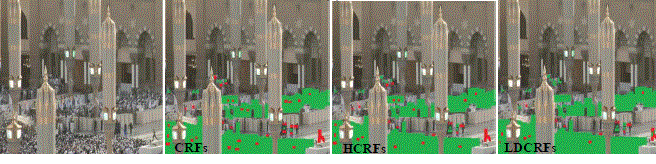
First, we sectioned video segments into spatio-temporal flow-blocks which allow the marginalization of arbitrarily dense flow field. Second, the observed flow field in each flow-block is treated as 2D distribution of samples and mixtures of Gaussian is used to parametric it by keeping the generality of flow field intact. Moreover, we implemented, K-means algorithm to initialize the mixture model while Expectation Maximization algorithm is employed for optimization. These mixtures of Gaussian result in the distinct flow patterns (i.e. precisely a sequence of dynamic patterns) for each flow-block. Third, discriminative models such as Conditional Random Field, Hidden Conditional Random Field and Latent-dynamic Conditional Random Field were employed one for each flow block and were learned from the sequence of dynamic patterns which was then classified for each flow-block as normal and abnormal.
Challenges we ran into
Parallel tracking. Occlusion handling and changing illumination
Accomplishments that we're proud of
It helps the securities of Hajj and Umrah to control the tracking of pilgrim
What we learned
learning techniques, image processing, Matlab and c++ programming languages
What's next for D-067-Smart system for crowding detection in Hajj
start coding

Log in or sign up for Devpost to join the conversation.