-
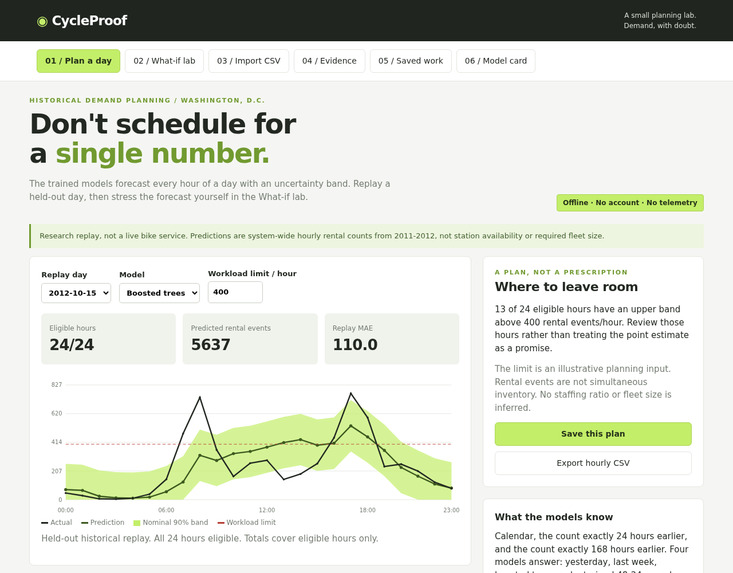
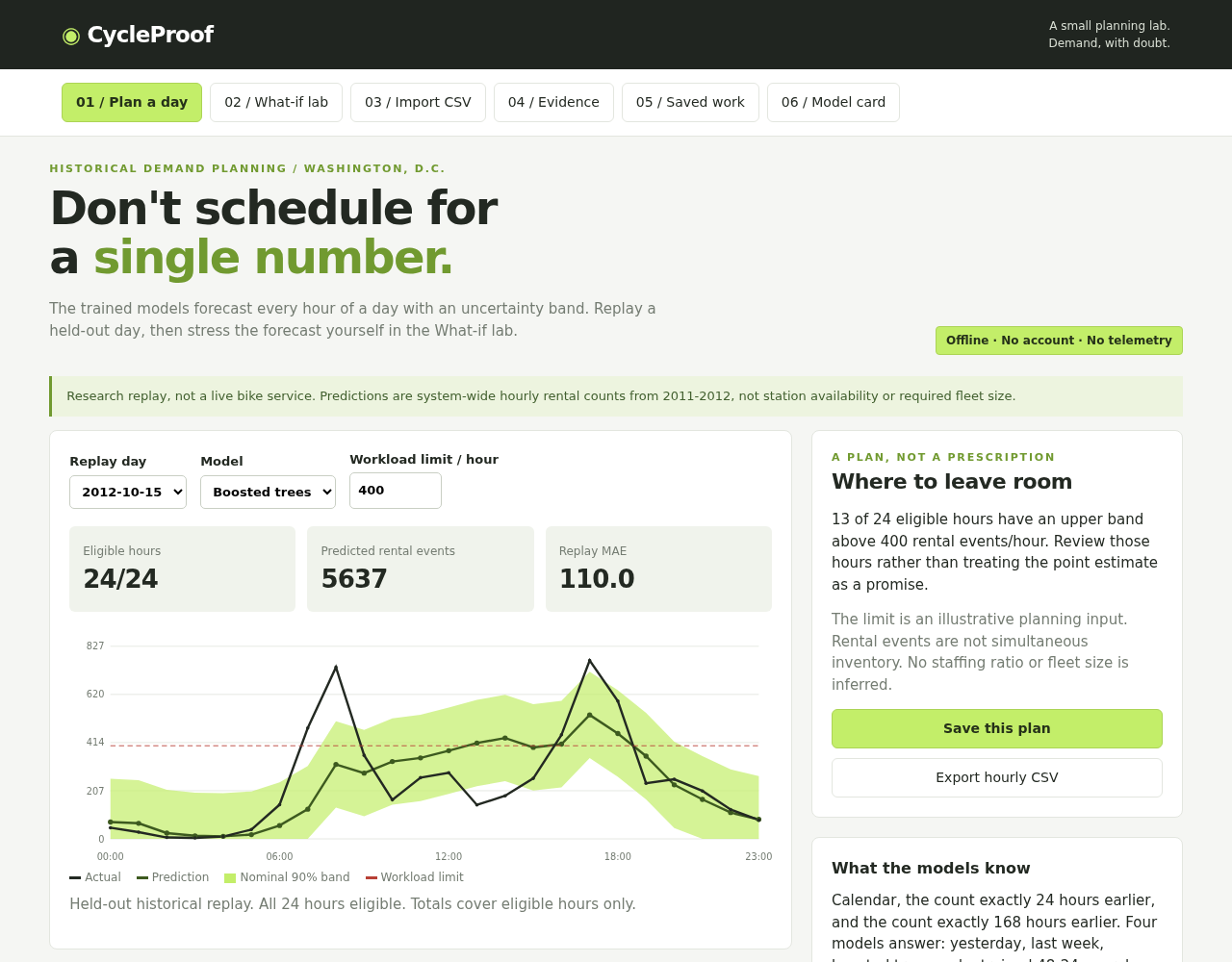
Plan a day: trained models replay a held-out day with uncertainty bands and a workload review limit (current app).
-
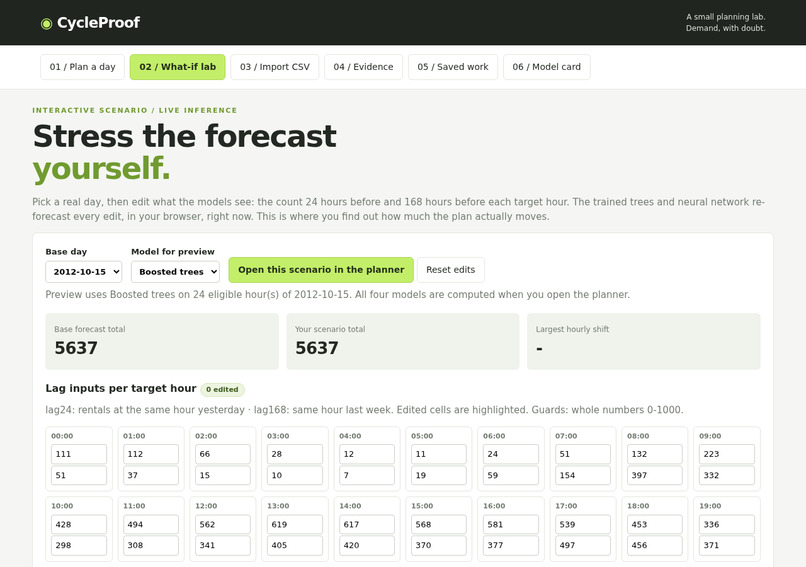
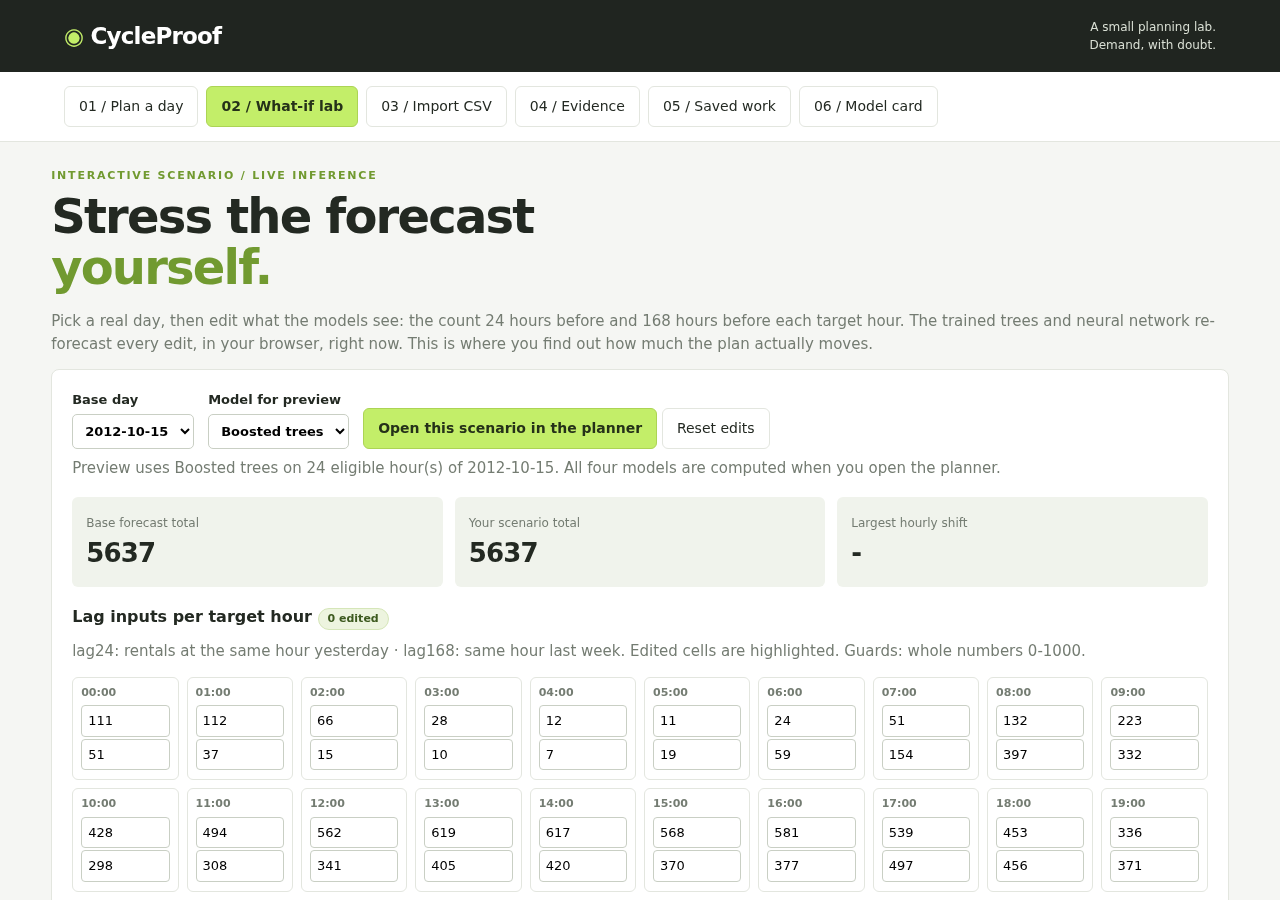
What-if lab: stress the forecast yourself with 48 lag inputs, scenario totals and a hand-off back to the planner (current app).
Why this exists
A bike-demand forecast can become a confident number before anyone asks what happens when it is wrong. CycleProof puts the uncertainty, baseline and missing-data limits into the planning workflow itself. It is a historical research prototype for students and early-stage community-mobility planners, not a live bike service.
What it does
Replay a held-out day from Washington D.C.'s 2011-2012 system-wide rental history. Compare yesterday, last week, boosted trees and an actually trained neural network. Inspect hourly uncertainty, change a hypothetical rental-workload limit and review the flagged hours. Rental events are not simultaneous bike inventory or a fleet-size estimate.
Import a strict historical scenario CSV, validate it before prediction, inspect the preview and run the exported models locally. Save a plan in browser storage, reopen or delete it, export hourly CSV, and export a model card. The single HTML app works offline with no account, paid API, telemetry or remote inference.
Live app: https://mjanthony819.github.io/cycleproof/ Source, complete offline/source ZIP, narrated captioned demo and 14-page interview manual: https://github.com/mjanthony819/cycleproof
What was actually trained
CPU scikit-learn trained a 160-round Huber gradient-boosted tree model and a two-hidden-layer ReLU neural network with widths 48 and 24. The neural model is an MLP over engineered features, not a temporal CNN or a pretrained model. Actual tree arrays, neural weights and training-only preprocessing are exported for JavaScript inference. Imported rows execute those models; this is not a static dashboard of prerecorded scores.
The ten features are cyclical hour, weekday and day-of-year pairs; known holiday and workingday flags; and the count at exactly t-24h and t-168h. No target count, casual/registered component counts, row ID or target-day observed weather is an input. At the start of each target day, previous-day counts are assumed complete and available. This is rolling day-ahead evaluation, not a single three-month-ahead forecast.
Measured results, including the loss
Training ends June 30, 2012 (12,641 eligible rows). July-August validation (1,488) selects tree depth 3 from {2,3}; September calibration (720) sets residual intervals. October-December is the untouched fixed-model test (2,101 eligible hours).
Test MAE / RMSE in rental events per hour:
- Yesterday: 75.48 / 125.86.
- Last week: 69.47 / 114.77.
- Boosted trees: 58.39 / 91.38.
- Predeclared neural seed 7: 79.68 / 118.76.
Deep learning does not win. Neural seeds 19 and 31 have test MAE 77.78 and 71.19; they are sensitivity runs, not selected from the test. All neural runs hit the 180-epoch cap, so convergence is not claimed. Four separate rolling-quarter checks are shown even when the weekly baseline wins.
Nominal 90% bands use September absolute residuals, not the test. Actual test coverage is 94.19%, 87.05%, 92.96% and 95.05% in the same model order. Time dependence and drift mean nominal coverage is not a guarantee. Wider bands are not automatically more useful.
The challenge that changed the product
The source has 17,379 actual rows and 165 absent timestamps. Row shifts would quietly use the wrong hours. Exact timestamp lags instead exclude 429 existing rows with unavailable history, including the first week. Evaluation is conditional on complete lags, not all hours. Only one October 29-30 storm-period row remains eligible, so the app explicitly refuses a storm-robustness claim. Missing hours are never invented as zeros, and partial-day totals are marked.
The neural loss and missing-data selection bias are findings, not presentation problems to hide.
Evidence and engineering
55 engine/data/schema checks include 40 parity fixtures checking all four browser outputs against Python within 1e-7. Sixteen desktop/mobile workflow checks cover import failures and success, local persistence, CSV download, all five tabs and offline reload. Actual desktop and 390px mobile pixels were inspected. A fresh public repository clone passed the checks, reproduced the full training/build exactly, and matched model, results, test-record, parity and final HTML hashes. The complete ZIP includes readable source, source data, weights, tests, measured predictions, licences, manual and demo.
Limits, possible harms and next month
This is one historical city's served demand, not unmet demand, station availability, neighborhood equity or current-city generalization. Wrongly treating it as staffing or fleet advice could misallocate resources. Import validation checks format and ranges, not the truth or availability of supplied lags. No operational actions are taken.
Next: obtain permitted newer data, model reporting delays and all-hour missingness, use rolling calibration, compare a calendar-aware seasonal model, audit neighborhood outcomes and ask planners whether the review actually changes decisions before any human-reviewed pilot.
Built during this event, with credit
The concept, training/evaluation/export pipeline, usable offline planning app, strict import, save/export workflow, tests, narrated captioned demo and documentation were built during November 2026 for Peninsula Innovation Hackathon. Solo entrant: M J Anthony. Historical data and dependencies are reused with credit.
AI assistance was used for concept development, implementation, tests, documentation and synthetic narration. Models were genuinely trained from scratch, and all performance claims are computed from the packaged experiment. No claim of unaided authorship or a novel learning algorithm is made.
Data: Fanaee-T, H. (2013), Bike Sharing [Dataset], UCI Machine Learning Repository, DOI 10.24432/C5W894. Current official UCI page identifies CC BY 4.0: https://archive.ics.uci.edu/dataset/275/bike+sharing+dataset . Original README and citation to Fanaee-T and Gama (2013), "Event labeling combining ensemble detectors and background knowledge," DOI 10.1007/s13748-013-0040-3, are preserved. App code/docs are MIT; dataset rights remain CC BY 4.0. No endorsement by the dataset creators or Capital Bikeshare is implied.
Narrated captioned walkthrough and downloads
The 112-second narrated, burned-in-caption demo (recorded for the original submission, shows its earlier interface; the gallery screenshots show the current app) is available as an MP4: https://github.com/mjanthony819/cycleproof/raw/refs/heads/main/CycleProof_Demo.mp4
The complete offline app, original source paths, trained weights, dataset credits, reproduction/tests, demo and detailed DOCX/PDF interview manual are bundled here: https://github.com/mjanthony819/cycleproof/raw/refs/heads/main/CycleProof_Complete.zip
