CyberSphere LineF: Project Story
🌟 Inspiration
As a cybersecurity analyst and researcher passionate about building solutions that bridge technology with user engagement, I wanted to design a portfolio that reflected not just my resume, but my mindset. The idea was to move beyond traditional static pages and craft a fully immersive 3D digital space that feels alive—where every animation, click, and transition tells a story of security, innovation, and purpose.
The name "CyberSphere LineF" combines cybersecurity, immersive spheres of knowledge, and LineF, representing my personal branding as Fenil Chauhan.
🚀 What it does
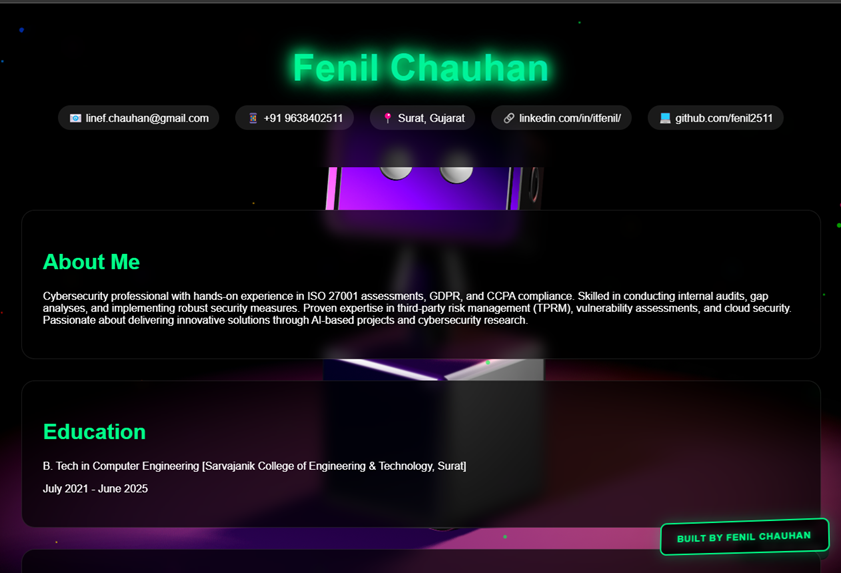
CyberSphere LineF is a 3D portfolio website that showcases my skills, projects, certifications, and achievements in a futuristic, interactive interface. It highlights:
- My contributions to cybersecurity research, ISO27001 audits, and AI-based security tools.
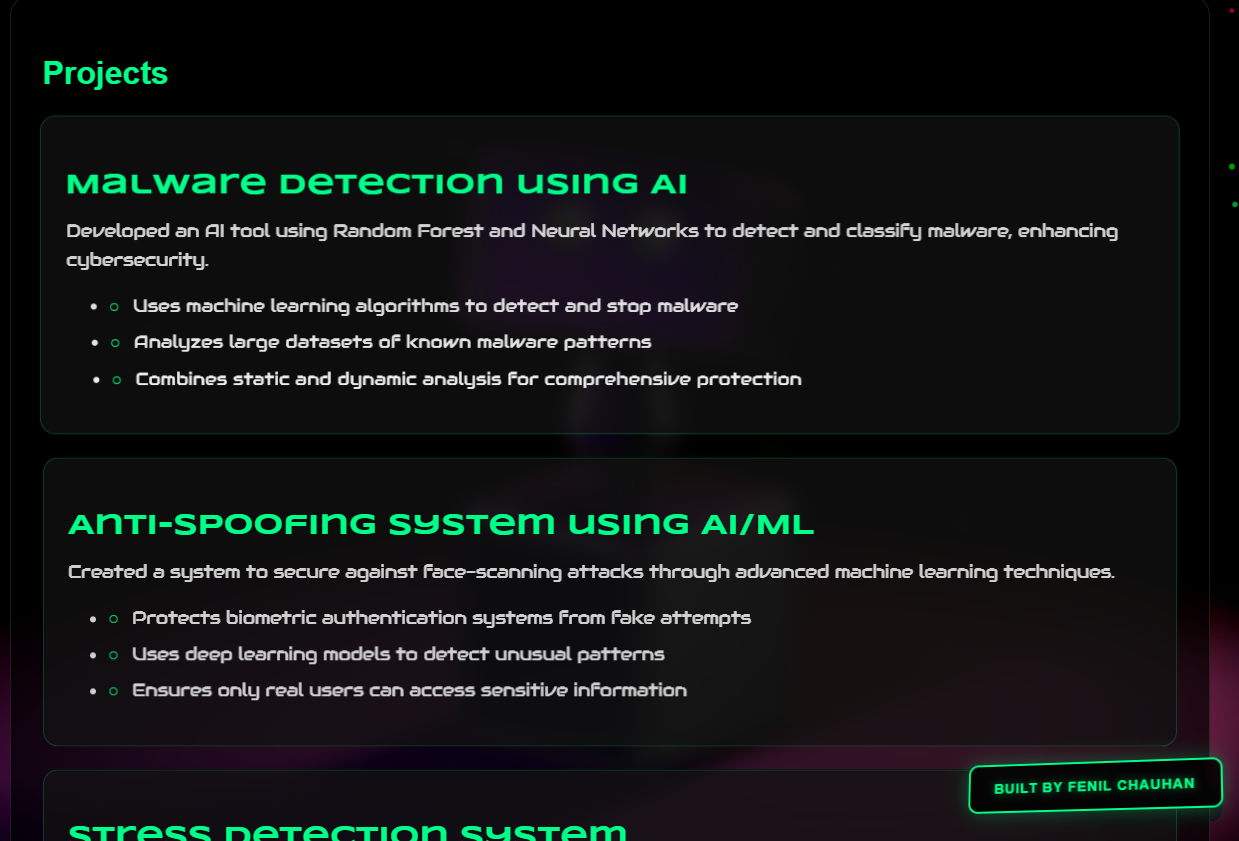
- Visual storytelling of key projects like malware detection, anti-spoofing systems, and blockchain analysis.
- A real-time responsive interface with parallax depth, 3D animations, and intuitive navigation—all running without any framework, just HTML, CSS, and JavaScript.
🛠 How we built it
The project was built entirely from scratch with vanilla web technologies:
- HTML for structuring the site.
- CSS (including advanced transforms and keyframe animations) for styling and visual effects.
- JavaScript for dynamic interactions, 3D simulations using
requestAnimationFrame, and event-based rendering logic.
For 3D-like effects, I used a combination of:
- CSS
transform: perspective()and 3D transforms, - Custom camera-like parallax movements based on mouse and scroll,
- Layered content sections simulating depth.
🧱 Challenges we ran into
- 3D without frameworks: Creating smooth, 3D-like animations and transitions without using WebGL libraries like Three.js or Babylon.js was a major challenge. Every animation had to be optimized for performance.
- Cross-browser compatibility: Some 3D effects and transforms rendered differently across browsers—tuning that for consistency took effort.
- Responsiveness: Making 3D visuals work seamlessly on both desktop and mobile while maintaining user experience was tricky.
- Performance tuning: With heavy animation and DOM manipulation, performance was initially laggy on lower-end devices. Fine-tuning JavaScript and CSS animation cycles was key.
🏆 Accomplishments that we're proud of
- Built a fully immersive, dynamic 3D site with zero external frameworks.
- Successfully demonstrated my security domain knowledge in an interactive and futuristic format.
- Received praise from peers and mentors for both technical complexity and visual creativity.
- Optimized the site for performance across screen sizes and device types.
📚 What we learned
- Deepened my understanding of the rendering pipeline in browsers and how animations are handled at the frame level.
- Learned how to simulate 3D without dedicated libraries using just CSS and JavaScript math.
- Improved my design thinking by integrating user experience with storytelling in a technical context.
🔮 What's next for CyberSphere LineF
- Integrate voice-controlled navigation using Web Speech API.
- Add live project demos with embedded AI simulations and code sandboxes.
- Expand the site into a personal security dashboard for visitors—offering tools like IP info lookups, vulnerability scanners, and more.
- Eventually convert the static site into a PWA (Progressive Web App) to allow offline viewing with full animations.
🧰 Built With
- Languages: HTML5, CSS3, JavaScript (ES6)
- Design & Animation: CSS Keyframes, CSS 3D Transforms, Custom JavaScript Animation Loops
- APIs: (planned) Web Speech API, IP Geolocation APIs
- Tools: Visual Studio Code, GitHub Pages, Ngrok (for local testing)
- Hosting: GitHub Pages
Built With
- css3
- css3dtransforms
- github
- githubpages
- html5
- javascript
- javascriptanimation

Log in or sign up for Devpost to join the conversation.