Inspiration
Growing up in India, I've seen how easily people around me — parents, relatives, friends — fall for scams. A fake SBI alert here, a suspicious "Amazon" email there. The scary part isn't that these scams exist, it's that most people have no way of knowing whether something is dangerous or not. There's no tool that just tells you, in plain language, "this is a scam, here's why, here's what to do." I wanted to build that.
What It Does
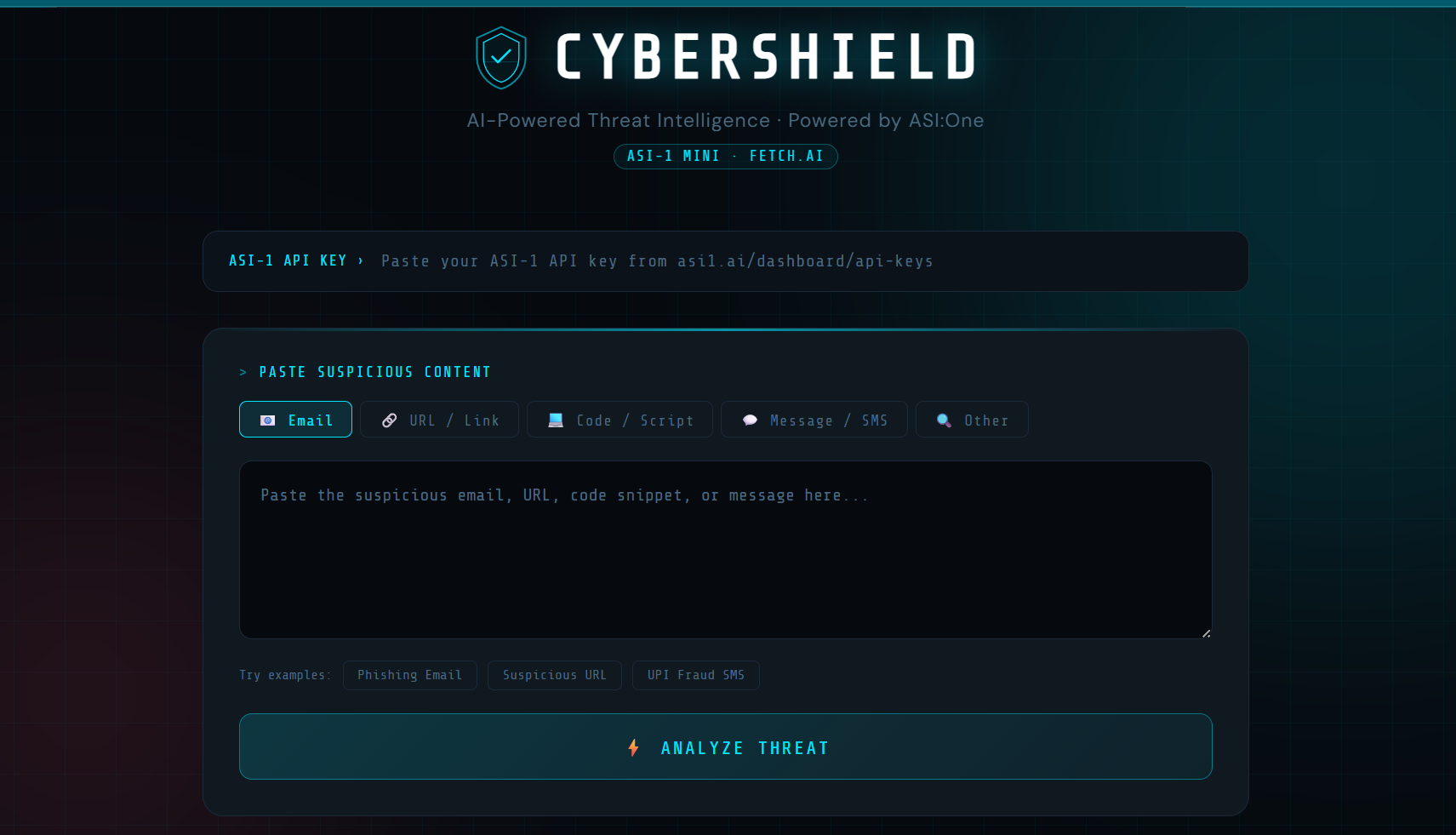
CyberShield lets you paste any suspicious content — an email, a link, an SMS, a piece of code — and returns a full threat report in seconds. It tells you how dangerous it is, what specific red flags it found, the techniques being used against you, and exactly what steps to take next. It also gives context specific to India, since scams targeting UPI, NPCI, and Indian banks follow their own patterns.
How I Built It
I built it as a single HTML file — no frameworks, no backend, no complicated setup. Anyone can download it and open it in a browser. The core of the app is the ASI-1 Mini API by Fetch.ai, which does all the heavy thinking. I wrote a detailed system prompt that instructs ASI-1 to behave like a cybersecurity analyst, reason through the content, and return a structured report. The UI is designed to be readable by someone with zero technical background, while still being detailed enough to be useful for developers.
How ASI-1 Powers It
This wasn't a case of just asking ASI-1 "is this a scam?" and displaying the answer. I used it as a genuine reasoning engine. It identifies specific attack techniques — spoofed domains, urgency manipulation, pretexting, homograph attacks. It reasons about who the content is targeting and why it's designed the way it is. It connects patterns to known fraud types in India. The depth of analysis comes from how the prompt is structured, not just the question being asked.
Challenges
Getting ASI-1 to return consistent, parseable JSON on every request took several iterations of prompt refinement. I also spent a lot of time making sure the results felt meaningful to a non-technical user — threat scores and labels can feel arbitrary if they're not explained well. Balancing depth with simplicity was the hardest design decision throughout.
What I Learned
I learned how much prompt engineering matters when you want structured, reliable output from a language model. I also learned a lot about how phishing and social engineering attacks are specifically tailored for Indian users — the language, the urgency, the institutions being impersonated. Building this made me take cybersecurity a lot more seriously in my own life.
Built With
- asi-1-api
- css
- fetch.ai
- html
- javascript
