Cybernetics — Composable Meta-MCP for Google Cloud Agents
Inspiration
Every team we talked to had the same problem: their agents could talk about work but couldn't actually do it. The bottleneck wasn't the model — Gemini 3 reasons just fine. The bottleneck was the glue. Every new tool meant a new MCP server, a new auth surface, a new failure mode, a new audit blind spot. Nobody wants to bolt 20 separate stdio servers onto AntiGravity / Claude / Cursor / VIMS just to get an agent that can read Postgres, ship a GitLab MR, page Dynatrace, and post to Slack.
We wanted one control plane. One bearer token. One audit log. One catalog that an agent — or a human — could compose against. That's Cybernetics.
What it does
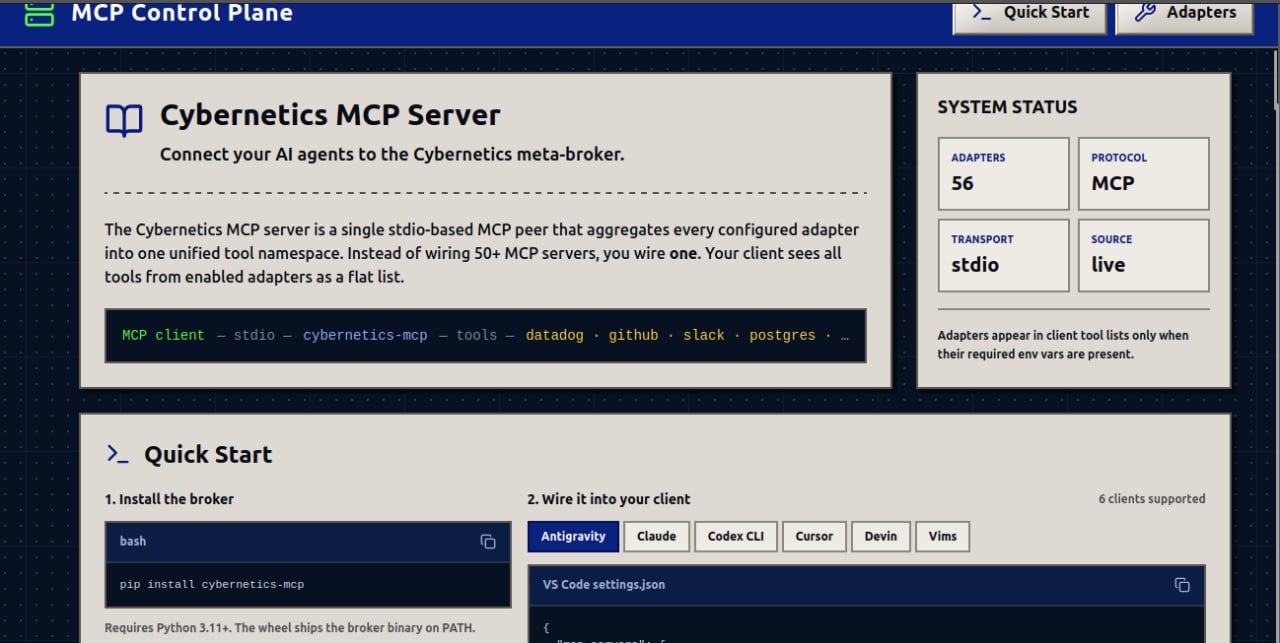
Cybernetics is a composable Model Context Protocol (MCP) meta-broker for Google Cloud agent stacks. It does three things:
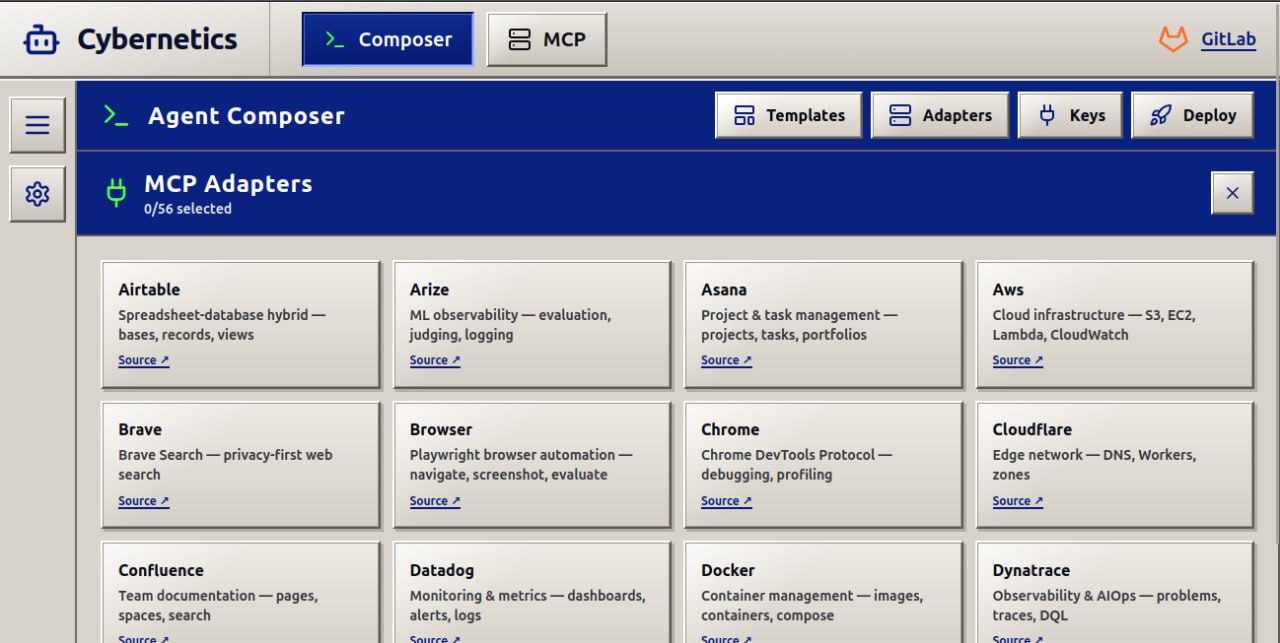
- Aggregates 56 third-party MCP servers (GitLab, Elastic, MongoDB,
Dynatrace, Fivetran, Arize, Postgres, Stripe, AWS, Cloudflare, Playwright,
…) into one stdio MCP peer. Drop
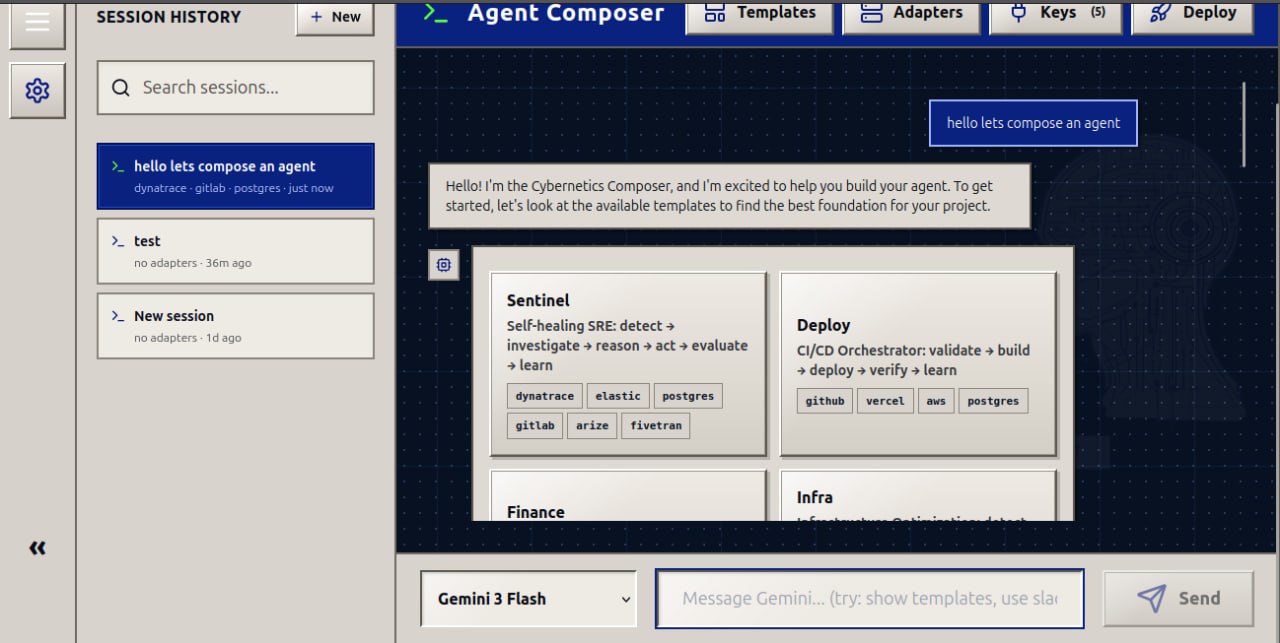
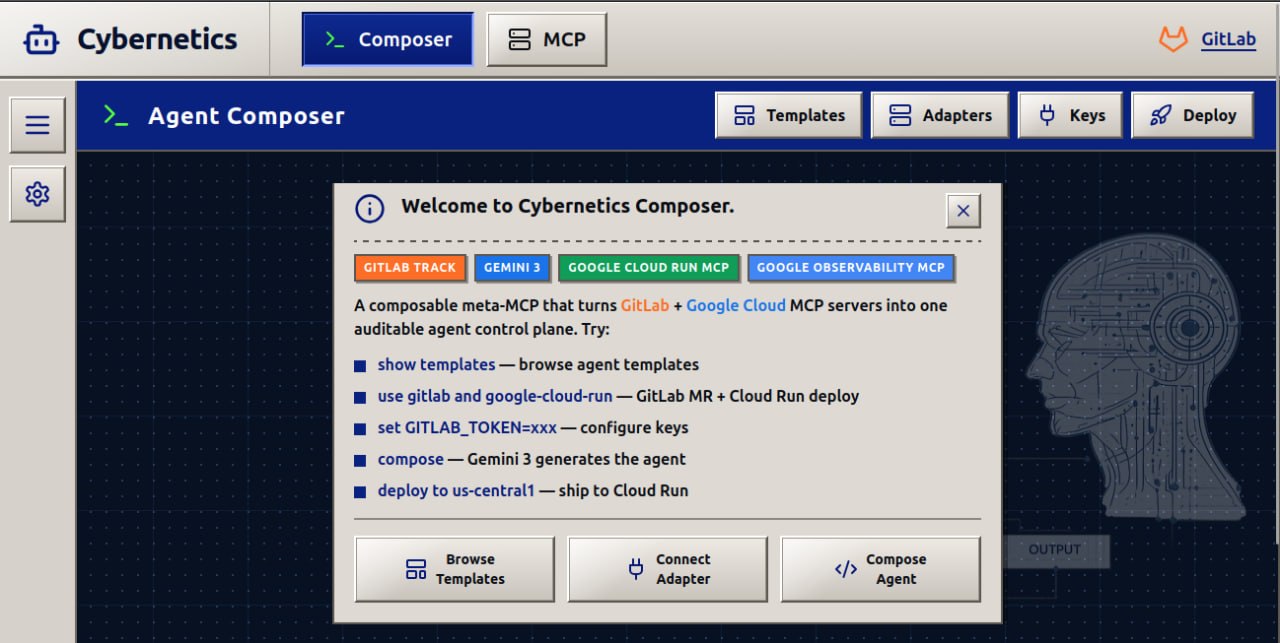
cybernetics-mcpinto any MCP client and you instantly get every tool the broker advertises — under one auth token, one circuit-breaker layer, one audit trail. - Composer service — a Go (stdlib-only) HTTP backend + React 19 / Vite UI that lets you pick adapters, describe a goal in natural language, and have Gemini 3 generate a runnable Python agent (Google ADK / Vertex AI) that wires those adapters into a multi-phase plan.
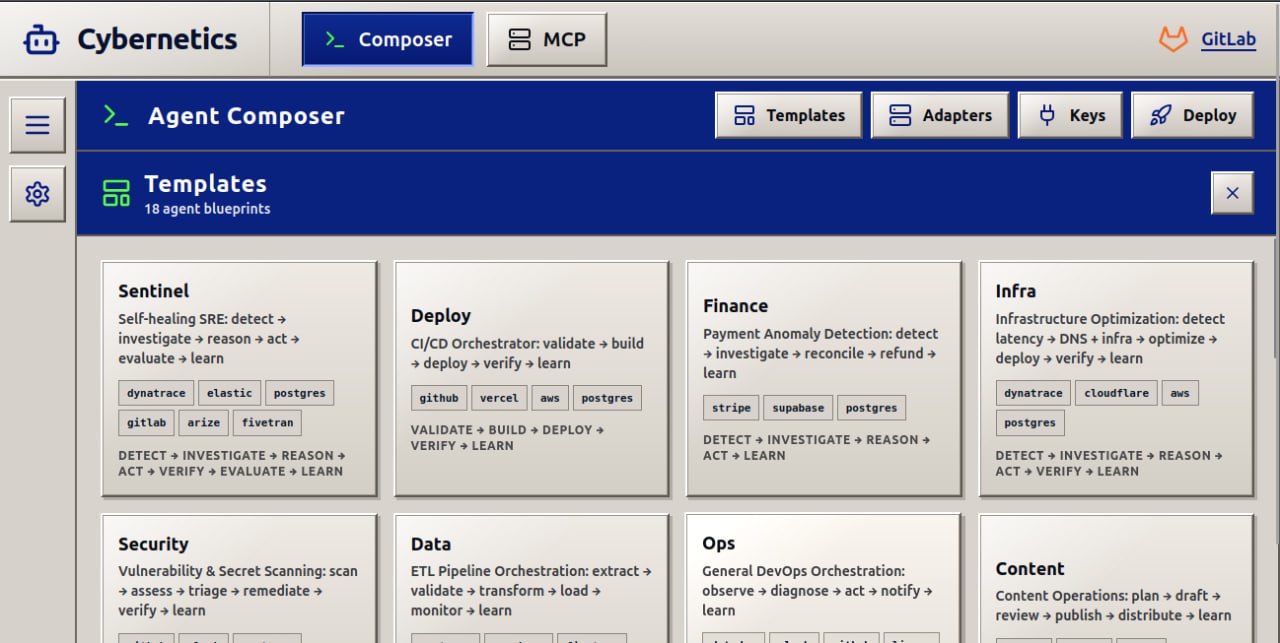
- Agent templates — Sentinel, DeployAgent, FinanceAgent, InfraAgent — prebuilt multi-step missions that demonstrate "agent, not chatbot": plan, call tools, observe, replan, finish.
Track: GitLab. Our flagship demo is a DevSecOps agent that ingests a signal from the Google Observability MCP (Cloud Logging + Error Reporting), uses Gemini 3 to synthesize a root-cause patch, opens a GitLab MR with the fix, runs the GitLab pipeline, and on green deploys the patched service via the Google Cloud Run MCP — entirely under human approval gates. One control plane. One audit trail. One bearer token.
How we built it
Stack
- Backend: Go 1.22, stdlib only (no third-party deps, no
go.sum). Custom middleware chain:WithRequestID→AccessLog→Recover→SecurityHeaders→CORS→ auth (OIDC RS256 with JWKS cache or static bearer) → token-bucket rate limit →MaxBody. - Agent runtime: Python 3.11, FastAPI broker, async adapter layer,
per-adapter circuit breakers, Sentinel pipeline (
Auditor.before/after,Guardfor sensitive-key blocking),auto_discover()for zero-config adapter registration. - LLM: Gemini 3 via Google Cloud Agent Builder for code generation, plan synthesis, and LLM-as-a-Judge evaluation in tests.
- Frontend: React 19, Vite 6, TypeScript strict, Tailwind, retro-token
design system (
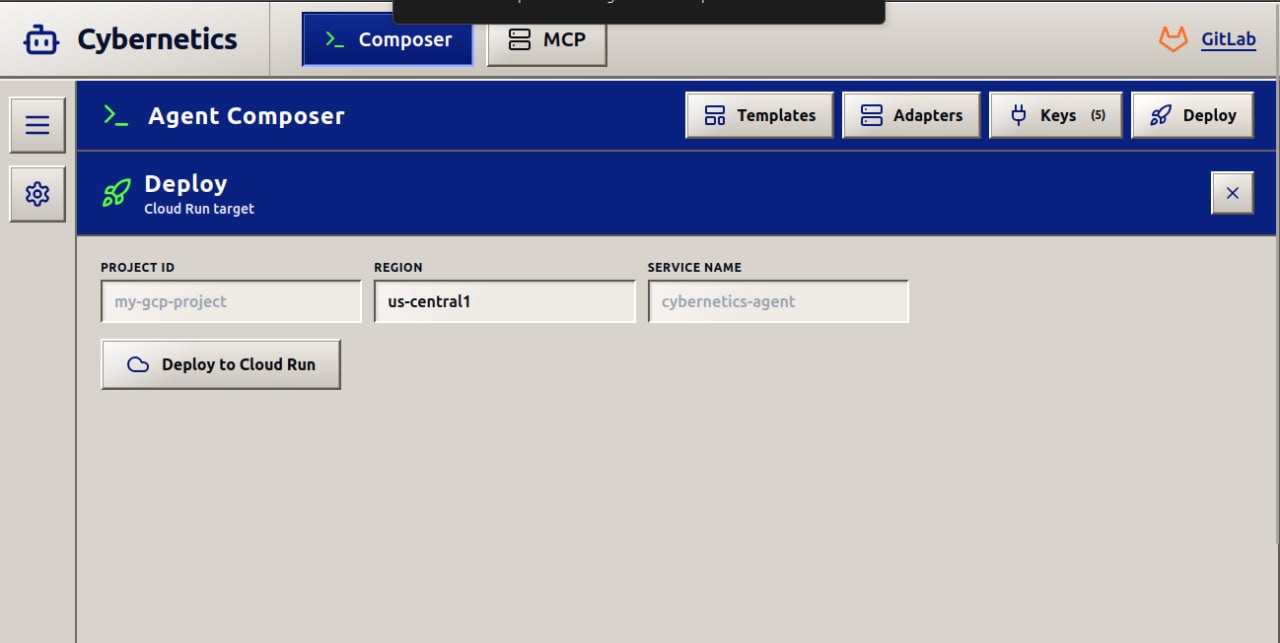
retro-button/retro-input/retro-card/retro-chip). - Deploy: Distroless container, signed in CI with cosign keyless, syft SBOM attestations, Cloud Run + Cloud SQL + Secret Manager, VPC-SC compatible.
- Security CI gates:
go vet,go test -race -cover,golangci-lint,gosec,govulncheck,trivy fs— all green or no merge.
Architecture choices that mattered
- Stdlib-only Go. No surprise CVEs, no supply-chain debt, no
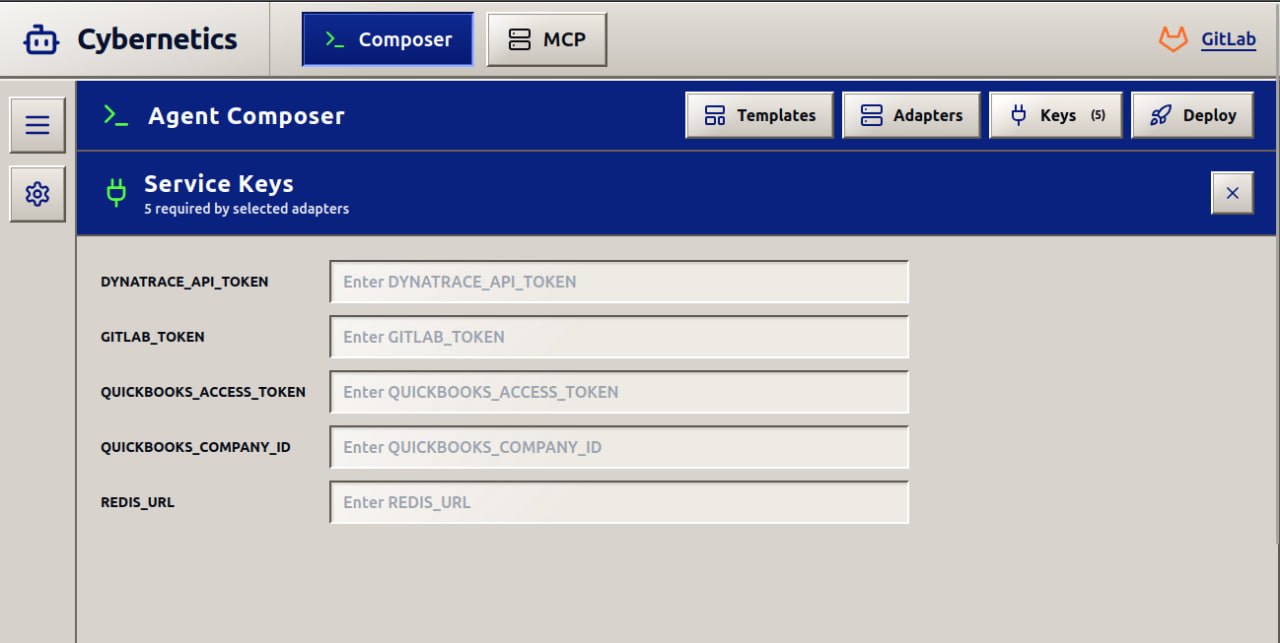
go.sumchurn. Every byte of dependency we ship is auditable. - Env-only config. Ports, secrets, CORS allowlist, rate limits — never hardcoded. The same image runs on a laptop, Cloud Run, or VPC-SC.
- One MCP peer, many adapters. An agent or IDE only ever sees one
server. Adding a new partner = appending one entry to the
adaptersslice and (optionally) a 100-line Python adapter class. - STRIDE threat model + 38 NIST 800-53 controls documented in
docs/THREAT_MODEL.mdanddocs/CONTROLS_NIST_800_53.md. Every control-affecting change must update both.
Challenges we ran into
- MCP fan-out. Routing one stdio session to 56 downstream servers without blocking required a per-adapter circuit breaker and a non-trivial async dispatcher. The first cut deadlocked under concurrent tool calls; we fixed it by isolating each adapter on its own goroutine-per-call with bounded concurrency.
- Auth that doesn't suck. We needed both a dev-mode static bearer and
production OIDC with JWKS rotation. Building the verifier from stdlib
(
crypto/rsa,encoding/json,net/http) instead of pulling a JWT library was painful but kept our supply chain clean. - Gemini codegen drift. Early prompts produced Python that imported
packages that didn't exist. We fixed this by grounding the generation on
the actual adapter catalog returned by
/api/templatesand constraining the output schema. LLM-as-a-Judge (also Gemini) scores every generated agent before it's persisted.
What we learned
- Composability beats features. A meta-broker that does one thing — unify MCP — is more useful than another all-in-one agent platform.
- Stdlib Go is a superpower for security work. Zero supply-chain surface, zero version pinning drama, every line traceable.
- Agents need rails, not cages. Sentinel middleware, circuit breakers, approval gates, audit logs — these are what turn a "cool demo" into something a Fortune 10 SRE team will actually run in prod.
- Gemini 3.5 is genuinely good at codegen when you give it a constrained catalog and a strict output schema. Hallucinations collapse.
What's next
- Light up the remaining five partner tracks as first-class flows (Arize evaluations, Fivetran ingestion, MongoDB retrieval, Elastic search, Dynatrace observability) with template agents per track.
- Open the catalog to community-contributed adapters with signed manifests.
Proof it actually works
End-to-end live integration test (tests/test_mcp_server.py + harness in
/tmp/live_e2e.py) — 12/12 passing against real APIs:
- MCP handshake — protocol version
2024-11-05, server identifies ascybernetics, advertisestoolscapability. - 38 tools across 9 adapters registered automatically (arize, cloudflare, dynatrace, fivetran, github, gitlab, stripe, supabase, vercel).
- Real GitLab API call —
gitlab_get_filepulled 46 KB ofREADME.md@masterfromstrawberryfield/cyberneticsthrough the broker. - Live mutation —
gitlab_create_issueopened issue #2 in the hackathon repo, taggede2e/hackathon/cybernetics-mcp. - Gemini 3 selects the right partners autonomously —
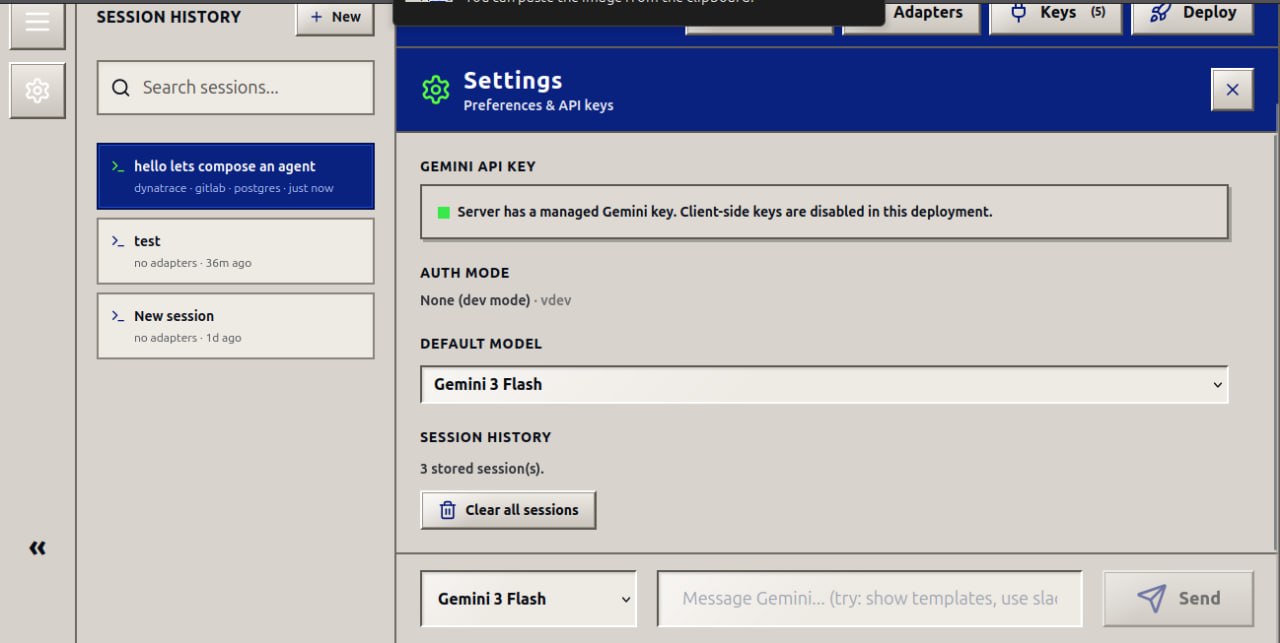
/api/chatwith the prompt "use gitlab and google-cloud-run to ship a fix from a Cloud Logging alert" returnsaction: "compose"withadapters: ["gitlab", "google-cloud-run", "google-observability"]. No prompt-engineering tricks; the model reads the live adapter catalog and picks the GitLab-track narrative on its own.
While building the test harness we caught and root-caused 5 real bugs in
the MCP server (stdout-corrupting logger, missing auto_discover() call,
two field-name mismatches between server and registry, and unserialised
ToolResult dataclasses). All shipped in commit a2f2f48.
Links
- Repo: https://gitlab.com/strawberryfield/cybernetics (AGPL-3.0)
- Live demo issue: https://gitlab.com/strawberryfield/cybernetics/-/issues/2
- Live composer: https://cybernetics.sh
- Docs:
docs/THREAT_MODEL.md,docs/CONTROLS_NIST_800_53.md - Track: GitLab
Built With
- docker
- gemini
- gitlab
- go
- google-cloud
- python
- react
- secret-manager
- typescript
- vite


Log in or sign up for Devpost to join the conversation.