-
-
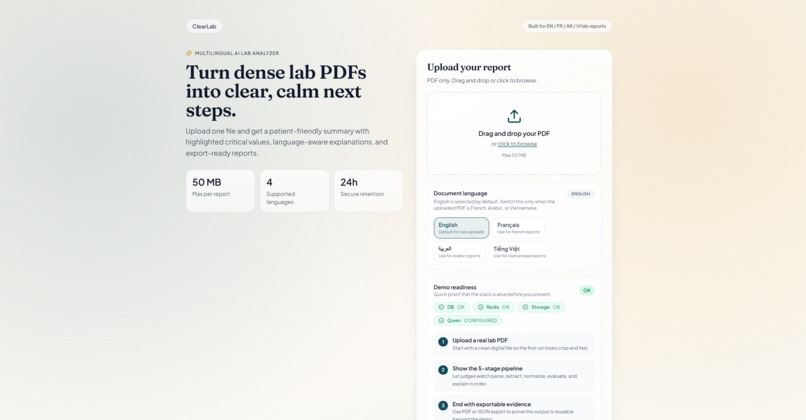
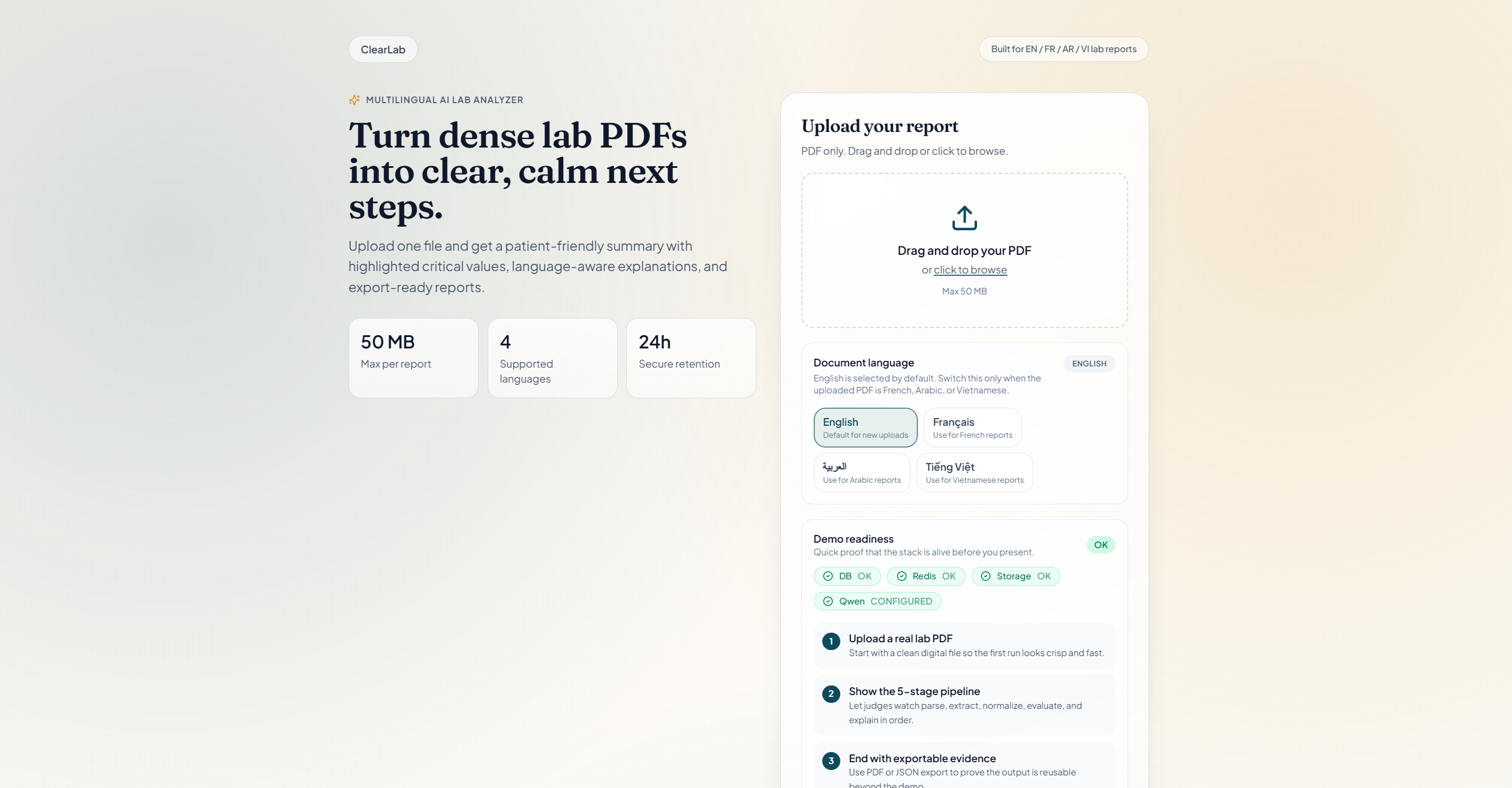
Home page
Inspiration
- First, we noticed a significant inconvenience: patients often have to return to the doctor immediately after receiving test results just for basic explanations. This is both troublesome and time-consuming, especially for those with mobility issues.
- Therefore, CyberLabs was created with a mission to streamline the healthcare process. We aim to transform cumbersome procedures into swift convenience, reducing patient fatigue and giving them more time to rest and recover. More importantly, our solution frees doctors from repetitive tasks and the cycle of waiting to explain simple metrics. By doing so, doctors can enjoy a better mental balance and dedicate their full focus to complex cases and critical professional tasks that truly require their expertise.
What it does
CyberLabs acts as a smart medical analysis assistant. Users simply need to upload their test result PDF files, and the system will automatically perform the following:
- Automated Data Scanning: The system scans all metrics, measurement units, and results contained within the PDF file.
- Analysis & Abnormality Detection: The app automatically compares and identifies whether any indicators fall outside the safe range.
- Insights & Recommendations:
- If abnormalities are found: The system explains why those metrics are unusual, provides advice on the next steps, and suggests the appropriate medical specialty for a focused consultation.
- If results are normal: The system will confirm that everything is within range and will not suggest unnecessary follow-up visits, providing users with immediate peace of mind.
How we built it
We developed CyberLabs using a rigorous 5-step data pipeline to ensure medical accuracy and technical reliability:
- Parse: We utilized PyMuPDF (fitz) to read and analyze the structure of the uploaded PDF test results.
- Extract: We integrated advanced AI models, including Qwen3-VL-Plus (for vision-based extraction from PDF pages) and Qwen3-Max (for text extraction), ensuring precise data capture even from complex layouts.
- Normalize: Qwen3-Max was used to map medical indicators to standard LOINC codes, ensuring data consistency regardless of the laboratory source.
- Evaluate: For safety and precision, we implemented a Deterministic Rule Engine to classify severity and critical levels. By avoiding LLMs for this specific task, we ensure that clinical evaluations strictly follow medical thresholds without "hallucinations."
- Explain: Finally, Qwen3-Max acts as a medical assistant to translate complex jargon into easy-to-understand language and generate personalized "Next Steps" for the user.
Challenges we ran into
During the development process, we encountered three major challenges:
- The Complexity of PDF Structures: Medical PDF files lack a unified format; every hospital has its own way of presenting tables and units. Using AI to accurately "scrape" data from these files without losing information was an extremely difficult technical hurdle.
- The LOINC Mapping Struggle: Mapping medical test names into the international LOINC standard was challenging due to the vast diversity in terminology across different laboratories. We had to fine-tune our AI extensively to handle "fuzzy misses" and ensure consistent data normalization.
- Guaranteeing Absolute Accuracy: In healthcare, a single digit error can lead to serious consequences. Our biggest challenge was ensuring that the AI outputs perfectly matched reality. We implemented a rigorous verification pipeline, combining AI extraction with a deterministic Rule Engine to eliminate AI hallucinations, ensuring every insight is strictly based on verified medical thresholds
Accomplishments that we're proud of
- User-Friendly Interface: We are proud to have developed a minimalist interface focused on simplicity. Users only need a single action—uploading the file—while all the complexities of AI and data processing are handled behind the scenes to deliver the most intuitive and readable results.
- Visual Warning System: The outputs are clearly categorized by severity levels. This allows users to immediately identify which indicators are normal and which require attention without needing any specialized medical knowledge.
- Relieving the Stress of General Health Screenings: We have successfully achieved our goal of saving users unnecessary costs and travel time. By confirming when results are within normal ranges, we help eliminate needless anxiety and clinic visits.
- Multi-language Support: Currently, the platform supports Vietnamese, English, French, and Arabic. This provides essential assistance to users in these regions, and we plan to expand to even more languages in the near future.
What we learned
Throughout the development of CyberLabs—from exploring the technology to delving into the real-world problems patients face—our team has learned several key lessons:
- Zero Tolerance for Errors: In healthcare, one wrong digit can change everything. We learned that AI, while smart, isn't perfect and can "hallucinate." Our biggest takeaway was combining AI's flexibility with a strict Rule Engine to ensure every output is reliable and medically sound.
- Focus on Reality, Not Flashy Features: We realized that an anxious patient doesn't care about a "fancy" UI. They just want an answer: "Am I okay?". That’s why we kept it simple—just one upload. Simplicity is how we show we truly care about the user's experience.
- Embracing Complexity for the User: Parsing medical PDFs is honestly a nightmare. We struggled with multiple AI models to get the data right. But we’d rather take on the technical debt ourselves so that the patient can have a seamless, "one-click" experience.
- Building for the Long Haul: We didn't want a "quick fix" project. To truly help the medical community, we focused on technologies that are scalable and sustainable. We're building CyberLabs as a platform that can grow and support the industry for years to come.
- Real Innovation Comes from Empathy: The more we learned about the long hospital lines and wasted costs for normal results, the more motivated we became. We learned that technology's best role is to relieve pressure—saving patients money and letting doctors focus on those who truly need urgent care.
What's next for CyberLabs
- We want to emphasize that CyberLabs is not just a temporary project, but a long-term and reliable journey dedicated to everyone. With just a simple upload of test results, the system will provide insights and recommend the most appropriate next steps.
- In the future, CyberLabs will expand to multiple countries to serve people worldwide. Most importantly, we will partner directly with medical professionals to gain in-depth expert advice. This invaluable information will be used to retrain our AI and tighten the system's Rule Engine, ensuring that absolutely no errors occur. Our ultimate goal is to provide analysis results that are not only 100% accurate but also extremely accessible and easy to understand for everyday users.


Log in or sign up for Devpost to join the conversation.