About the Project
The Problem
Modern security scanners are good at finding potential vulnerabilities, but a long list of scanner alerts does not always tell a developer what actually matters.
A single codebase can generate many findings, including warnings that are technically valid but not exploitable in the application's context. This creates alert fatigue, makes security reviews slower, and can cause important vulnerabilities to get buried among low-value alerts.
We wanted to build something that could answer a more useful question:
“Which security findings actually deserve my attention?”
Our Idea — CyberJudge
CyberJudge is an AI-assisted application security intelligence platform that combines traditional static security scanning with AI-based analysis.
Instead of simply displaying scanner output, CyberJudge takes each finding and evaluates it to determine whether it is:
- CONFIRMED — strong evidence that the finding represents a real security issue
- FALSE POSITIVE — the scanner alert does not represent an exploitable vulnerability in the available context
- NEEDS REVIEW — there is not enough evidence for the AI to make a confident decision
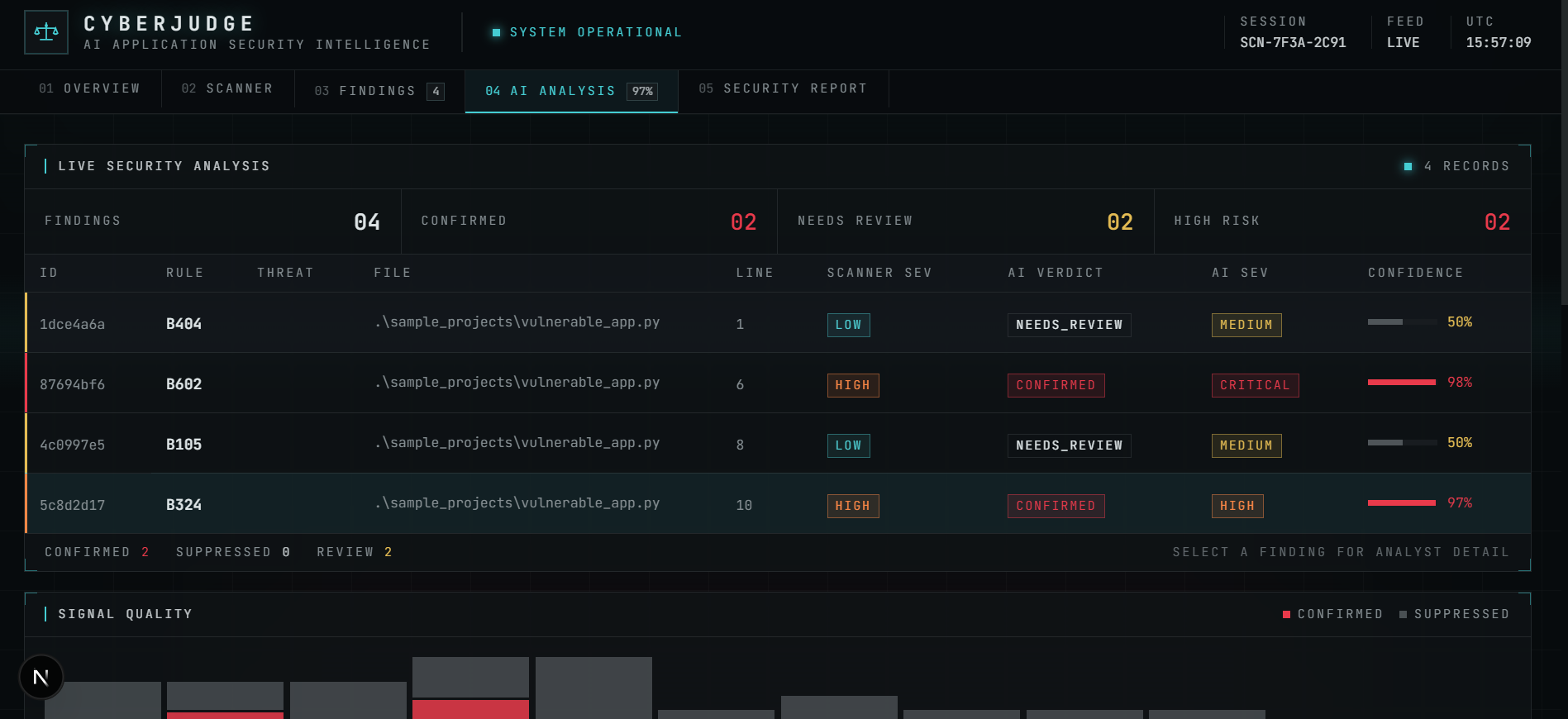
It then assigns an AI severity, confidence score, reasoning, potential impact, and remediation recommendation.
The goal is not to replace security scanners or security professionals. The goal is to make their output more understandable, actionable, and prioritized.
How We Built It
CyberJudge was built as a full-stack security analysis platform.
The backend is built with Python and FastAPI, providing an API for scans, findings, reports, and system health.
For static analysis, we integrated Bandit to detect security issues in Python code. The scanner findings are normalized into a consistent structure before being passed through our analysis pipeline.
The AI analysis layer evaluates the available context around each finding and produces a verdict, severity, confidence score, explanation, impact assessment, and recommendation.
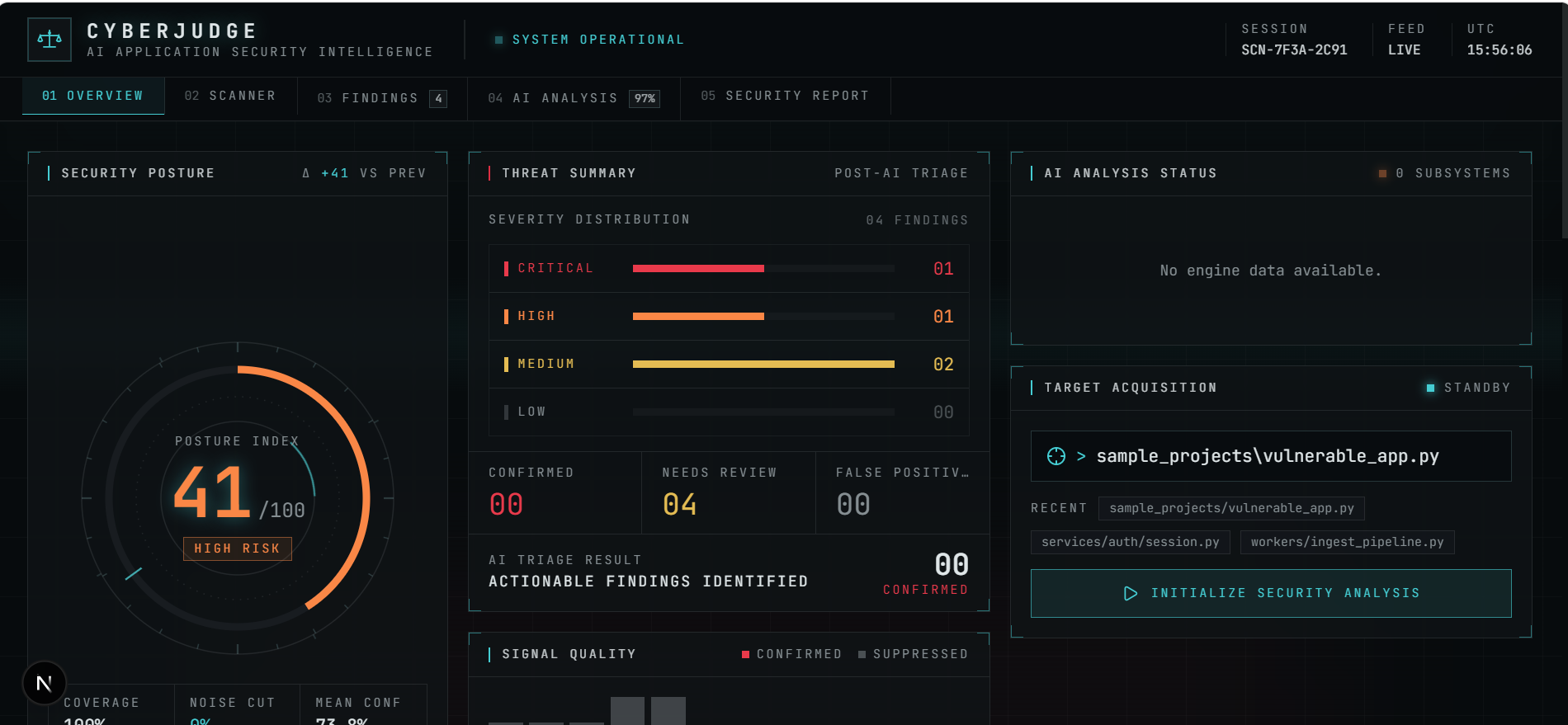
The frontend is built with Next.js, React, TypeScript, and Tailwind CSS. We designed it as a security operations-style dashboard with:
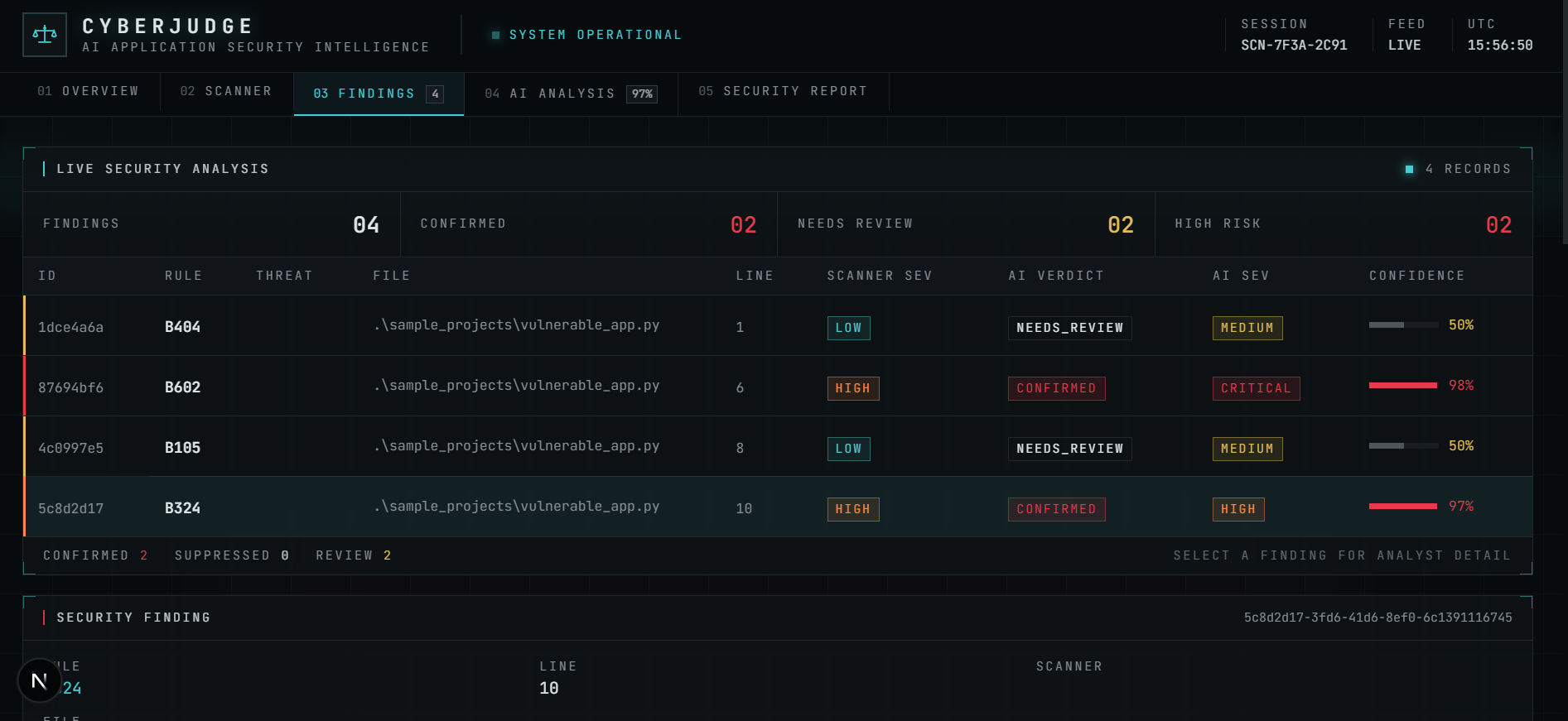
- Live security findings
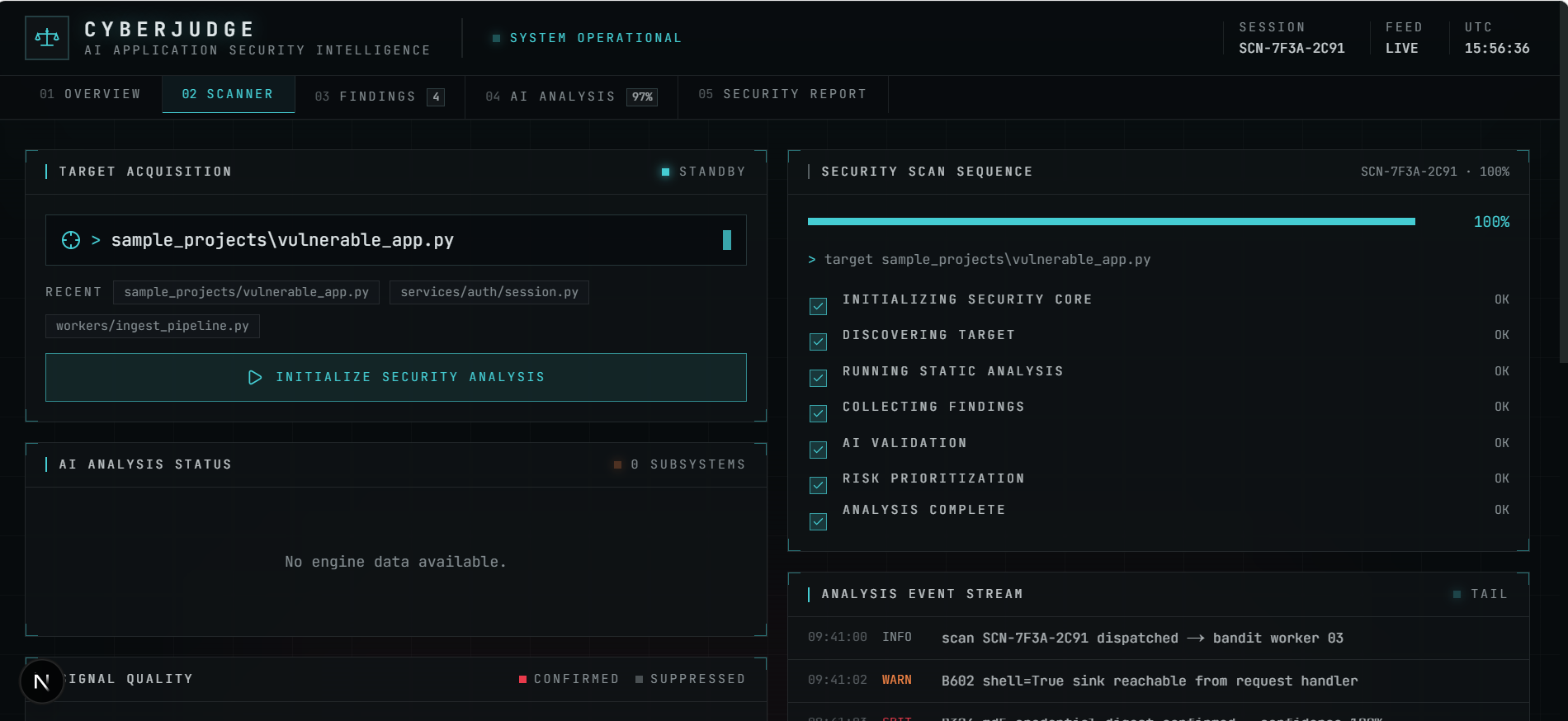
- Scanner engine status
- Threat severity summary
- Security posture score
- Scan pipeline
- AI verdicts and confidence
- Detailed AI reasoning
- Impact and remediation recommendations
- Security reports
What We Learned
Building CyberJudge taught us that creating an AI security product is not just about connecting an AI model to a scanner.
We had to think carefully about how scanner results should be represented, how AI decisions should be structured, how confidence should be communicated, and how to distinguish between an automated judgment and something that still requires human review.
We also learned a lot about connecting a Python backend to a modern web frontend, designing APIs, handling asynchronous scan workflows, and building an interface that presents technical security information without overwhelming the user.
Challenges We Faced
One of our biggest challenges was making the scanner and AI pipeline reliable from end to end.
During development, we encountered backend connection failures, API integration issues, data-model mismatches, scanner output differences, and frontend synchronization problems. We had to repeatedly test the complete flow:
Target → Scan → Static Analysis → Finding Normalization → AI Analysis → Verdict → Report → Dashboard
Another challenge was avoiding overconfidence in AI-generated security decisions. A security tool should not pretend that every AI judgment is certain. That is why CyberJudge includes confidence scores and a NEEDS_REVIEW category rather than forcing every finding into a binary decision.
What Makes CyberJudge Different
Traditional scanners answer:
“What might be wrong?”
CyberJudge aims to go one step further:
“What is actually important, why does it matter, and what should I do about it?”
By combining deterministic security scanning with contextual AI analysis and a human-readable security dashboard, CyberJudge turns raw scanner alerts into security intelligence that developers and security teams can act on.
Our Vision
We want CyberJudge to become a practical bridge between automated security tools and human security judgment.
Security should not depend on someone manually reading hundreds of alerts and deciding which ones deserve attention.
CyberJudge helps security teams focus their time on the vulnerabilities that matter most.
Built With
- bandit
- fastapi
- next.js
- python
- react
- tailwind-css
- typescript

