-
CyberHub AI
Inspiration
Cyber fraud and online scams are increasing rapidly, affecting people of all age groups. Many users fall victim to phishing websites, OTP scams, fake investment schemes, and deepfake content because they lack awareness and immediate guidance. We were inspired to build CyberHub AI after observing how common people panic during fraud incidents and do not know the correct steps to take. Our goal was to create a single intelligent platform that not only detects suspicious content but also guides users through recovery and prevention. Instead of building just a chatbot, we wanted a complete cybersecurity dashboard that combines detection, response, and education in one place.
What it does
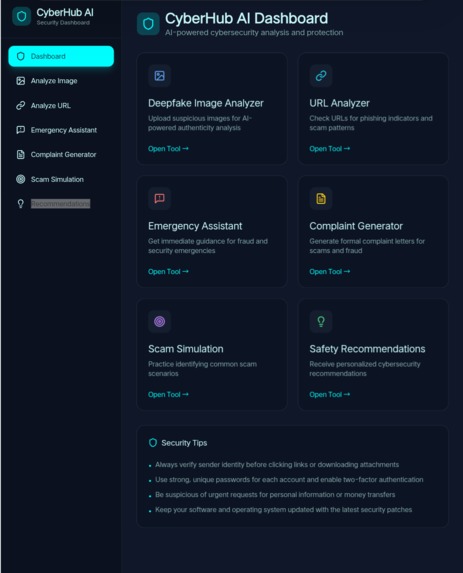
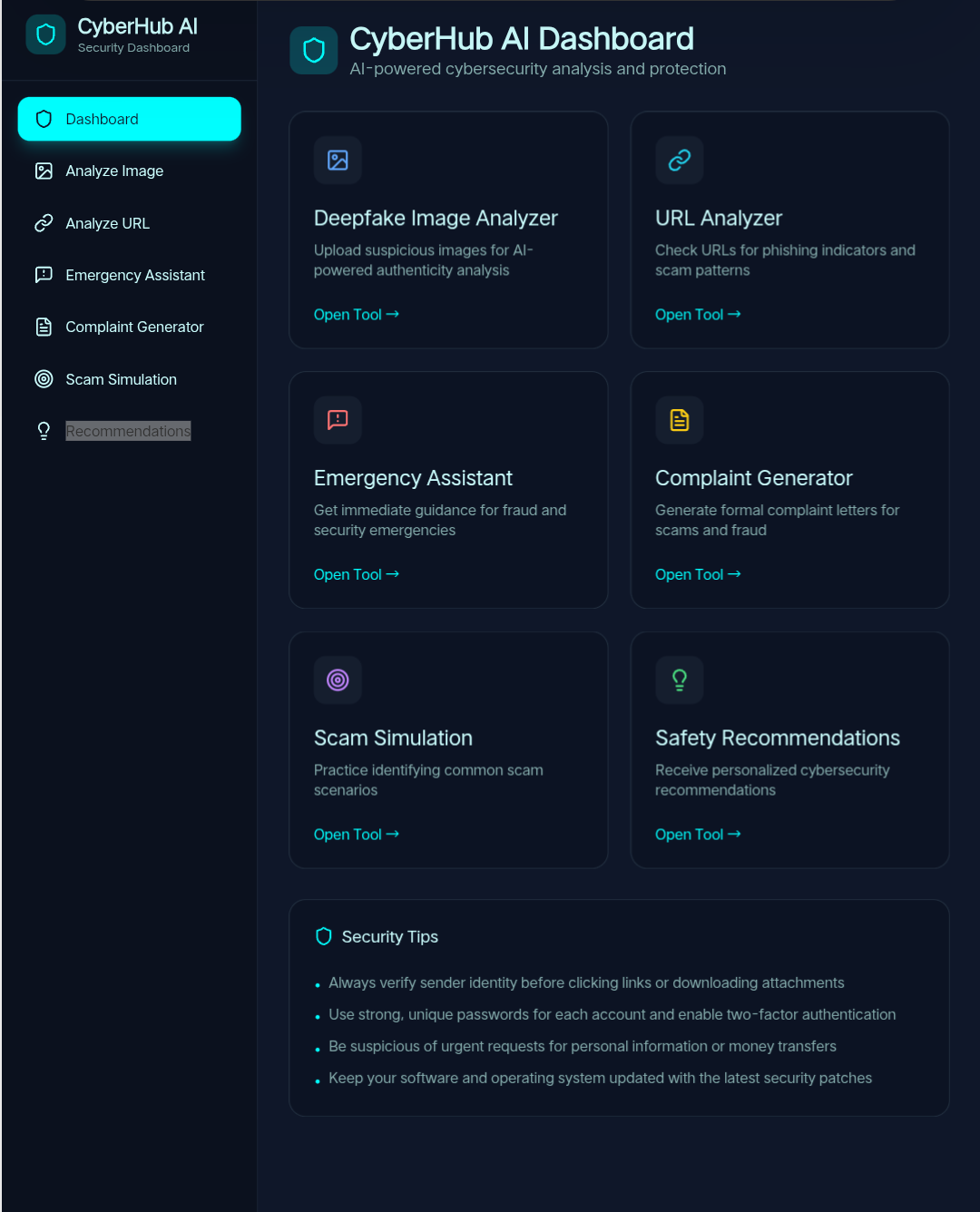
1️⃣ Deepfake Image Analyzer Allows users to upload an image. Uses AI to detect possible AI-generated or manipulated content. Generates an authenticity score (0–100). Assigns a risk level (Low / Medium / High). Provides a short explanation of why the image may be suspicious.
2️⃣ URL Risk Analyzer Lets users enter a suspicious website URL. Analyzes the URL for phishing indicators. Checks for risky patterns like suspicious keywords or unsecured domains. Calculates a risk score. Displays scam type and red flags. Explains why the link may be unsafe.
3️⃣ Emergency Cyber Assistant Provides instant step-by-step guidance in case of fraud. Helps in situations like OTP scams, account hacking, or money loss. Suggests immediate actions (contact bank, block account, change passwords). Gives structured and calm advice.
4️⃣ Complaint Generator Collects user details (name, date, amount, incident description). Automatically generates a formal complaint letter. Formats it professionally for submission to banks or authorities. Saves users time during emergency situations.
5️⃣ Scam Simulation Lab Provides interactive scam scenarios. Shows fake scam messages in a safe environment. Lets users choose how they would respond. Explains correct and incorrect choices. Educates users on scam tactics like urgency and fear manipulation.
6️⃣ Smart Recommendation Engine Analyzes results from image and URL checks. Generates personalized cybersecurity safety tips. Suggests preventive measures like enabling 2FA or avoiding suspicious links. Helps reduce future cyber risks.
How we built it
CyberHub AI was built using a modular dashboard architecture. The frontend was designed with a modern dark cybersecurity theme using reusable UI components to maintain consistency across features. We integrated Mocha’s built-in AI for image analysis, URL detection, emergency guidance, complaint generation, and personalized recommendations. To ensure stability, we implemented internal rule-based logic and fallback mechanisms so the system remains functional even if AI responses fail. The backend processes user input, validates AI outputs, calculates risk levels, and displays structured results in a clean and user-friendly format.
Challenges we ran into
One major challenge was handling structured AI responses correctly, especially ensuring valid JSON formatting. We solved this by carefully designing prompts and validating responses before parsing. Another challenge was balancing AI intelligence with system reliability. We addressed this by combining AI analysis with rule-based fallback logic. Time constraints also required us to focus on building a clean, stable, and demo-ready system without overcomplicating the architecture.
Accomplishments that we're proud of
We successfully built a complete cyber fraud detection and response ecosystem within hackathon time limits. The integration of AI with fallback logic ensures reliability and professional-level stability. We are especially proud of the Scam Simulation Lab, which adds an interactive educational layer to the platform. The modular structure and clean UI design make the project scalable and production-ready.
What we learned
We learned how to integrate AI into real-world applications while maintaining system stability. We improved our skills in backend validation, frontend UI design, and error handling. Most importantly, we learned how to convert a real-world cybersecurity problem into a structured, user-focused digital solution.
What's next for CyberHub AI
In the future, we plan to integrate real-time threat intelligence APIs, domain age verification, and advanced fraud detection models. We aim to add user authentication, history tracking, and integration with official cybercrime reporting systems. With further development, CyberHub AI can evolve into a full-scale public cybersecurity assistance platform.
Built With
- ai
- built-in
- complaint-generation
- css3
- emergency-guidance
- html5
- javascript
- mocha
- node.js
- phishing-url-analysis

Log in or sign up for Devpost to join the conversation.