-
-
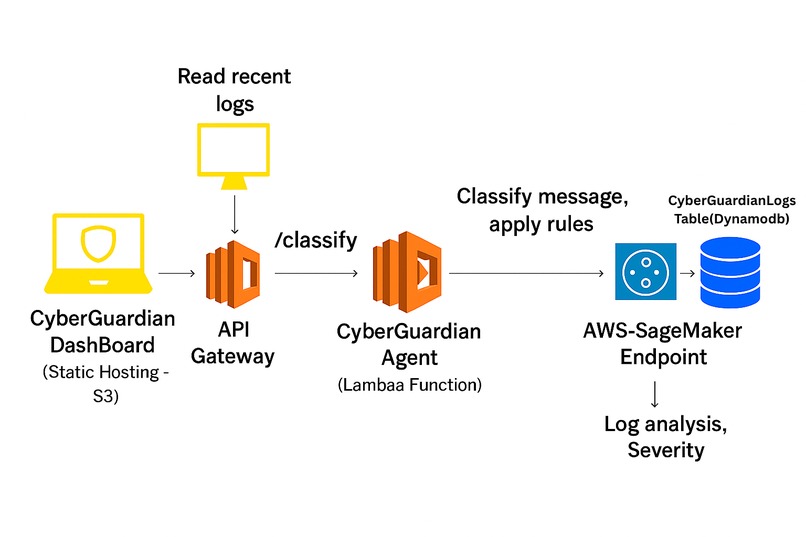
Architecture Diagram
🌟 Inspiration
CyberGuardian was born from a simple but urgent question:
How can we protect everyday users from phishing threats before they fall victim?
With rising cases of SMS and email scams targeting vulnerable populations, we envisioned a real-time, multilingual safety agent that could classify suspicious messages, offer clear recommendations, and scale across platforms. We wanted something lightweight, serverless, and accessible — a tool that could be deployed anywhere, by anyone, with minimal cost and maximum impact.
🛡️ What It Does
CyberGuardian is a serverless phishing detection system that:
- Accepts messages via a public dashboard
- Classifies them using rule-based logic and ML-powered severity scoring
- Stores results in DynamoDB with structured logs
- Displays verdicts, severity, source, and recommendations in real time
Endpoints:
POST /analyze— Classifies incoming messagesGET /logs— Returns recent classification results for dashboard display
🏗️ How We Built It
We used a modular AWS architecture:
- Frontend: HTML/CSS/JS dashboard hosted on Amazon S3
- API Gateway: Two OpenAPI-defined endpoints (
/analyze,/logs) - Lambda Functions:
CyberGuardianAgent.py: Applies phishing rules, invokes SageMaker, logs to DynamoDBDashboardReader.py: Fetches logs for frontend display
- SageMaker: Lightweight model for severity scoring
- DynamoDB: Stores structured logs with timestamps, verdicts, and recommendations
We followed reproducible design principles:
- OpenAPI specs for API Gateway
- Schema files for DynamoDB
.gitattributesand.gitignorefor clean version control
🧗 Challenges We Ran Into
- Branch sync errors during initial GitHub setup (
mainvsmaster) - CORS configuration for dashboard-to-API communication
- Schema validation for DynamoDB logs
- SageMaker integration with Lambda required precise IAM permissions
- Line ending normalization across YAML, JSON, and Python files
🏆 Accomplishments That We're Proud Of
Fully deployed dashboard:
🔗 CyberGuardian LiveClean, reproducible GitHub repo:
🔗 CyberGuardian GitHubReal-time classification with ML-enhanced severity scoring
Reviewer-friendly architecture diagram and OpenAPI specs
Modular design ready for multilingual and plugin-based expansion
📚 What We Learned
- How to architect serverless systems using AWS Lambda, API Gateway, and SageMaker
- How to write and validate OpenAPI specs for reproducible deployment
- How to normalize line endings and structure GitHub repos for public launch
- How to design dashboards that are both functional and visually clear
- How to think like a product architect — balancing cost, impact, and scalability
We also explored how to express classification logic using mathematical thresholds, such as:
[ \text{Severity Score} = \alpha \cdot \text{Keyword Risk} + \beta \cdot \text{Model Confidence} ]
Where (\alpha) and (\beta) are tunable weights based on context.
🚀 What's Next for CyberGuardian
- Multilingual support for SMS and email classification
- Plugin architecture for integration with Gmail, WhatsApp, and mobile apps
- Real-time alerts via push notifications or browser extensions
CyberGuardian is more than a tool — it’s a mission to protect users before harm occurs.

Log in or sign up for Devpost to join the conversation.