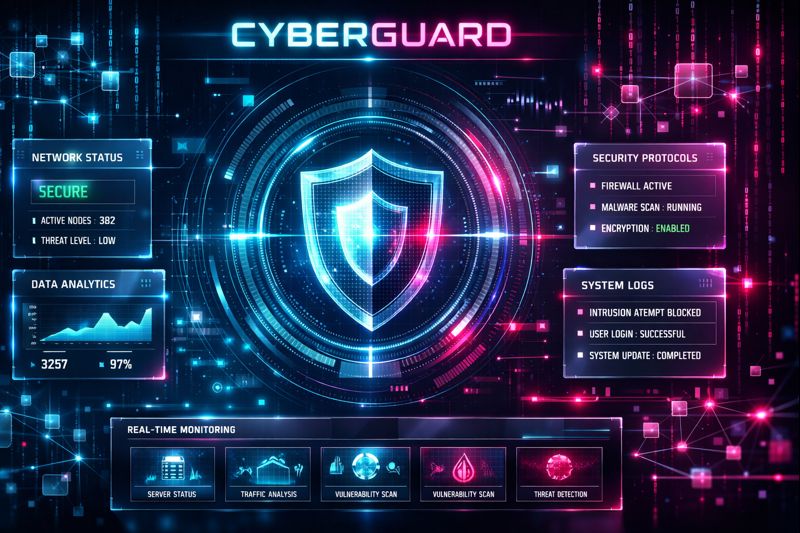
🐙 Project Inspiration: The Octopus MindsetIn the vast ocean of the internet, threats move like predators—fast, camouflaged, and unpredictable. Our team was inspired by the Octopus, a symbol of distributed intelligence and adaptability. We realized that modern cybersecurity shouldn't be a static wall; it needs to be a multi-tentacled system capable of sensing, reacting, and educating simultaneously.CyberGuard was born to bridge the gap between complex security data and human understanding, turning every user into an active defender.
🛠️ How We Built ItWe focused on creating a "Command Center" aesthetic using a modern, high-performance tech stack:Architecture: Built with a mobile-first, responsive Bento Grid layout for maximum data density without clutter.Frontend: Leveraged HTML5 and CSS3 (Custom Properties & Grid) to create a "Cyberpunk" glassmorphism UI.Interactivity: Used Vanilla JavaScript to power the "Simulation Engine," managing state transitions for real-time quizzes and threat analysis.Visuals: Integrated FontAwesome for iconography and custom keyframe animations to simulate system scans and digital "glitches.
"🧠 What We LearnedBuilding CyberGuard was a deep dive into UI/UX Psychology. We learned that:Data Visualization is Key: Users respond better to "Threat Levels" (Critical/Warning) than to raw text logs.Gamification Works: By adding a timer and scoring system to the Simulation Lab, we increased user engagement significantly.Performance Matters: Handling multiple neon glow effects and glassmorphism filters required optimizing CSS to maintain a smooth 60fps experience.
🚧 Challenges We FacedThe biggest hurdle was the Information Density vs. Layout challenge. Cybersecurity data is heavy. Initially, our "Threat Intelligence Database" felt overwhelming.Solution: We implemented a compact grid system and "Security Vault" accordions. This allowed us to hide complex details until the user explicitly requested them, maintaining a clean "Command Center" feel.The "Burger" Logic: Ensuring the mobile navigation handled the complex site structure without losing the "Cyber" aesthetic required multiple iterations of JavaScript event listeners.
🔬 The Math of SecurityTo emphasize the importance of entropy in our Security Vault, we utilized the concept of password strength, where the search space $S$ for a password of length $L$ with a character set $R$ is:$$S = R^L$$We teach users that increasing $L$ (length) is exponentially more effective than just increasing $R$ (complexity), helping them build "Cryptographic Passwords" that are mathematically resilient to brute-force attacks.
