-
-
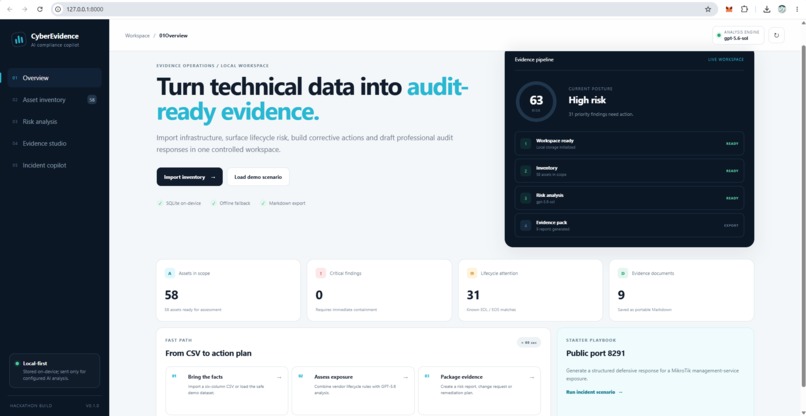
Overview
-
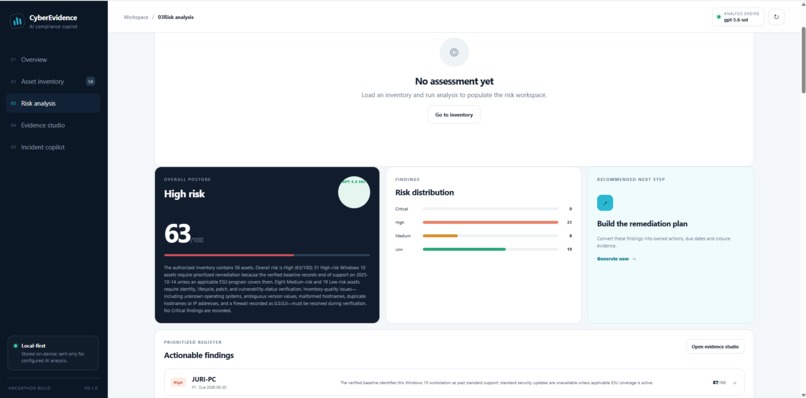
Risc Analysis
-
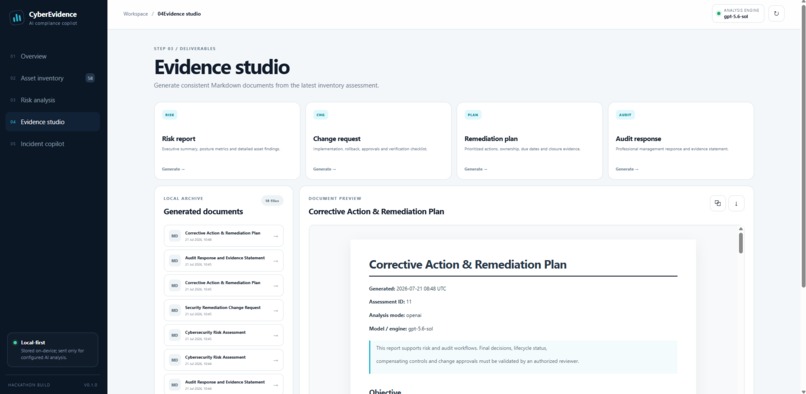
Evidence Studio
-
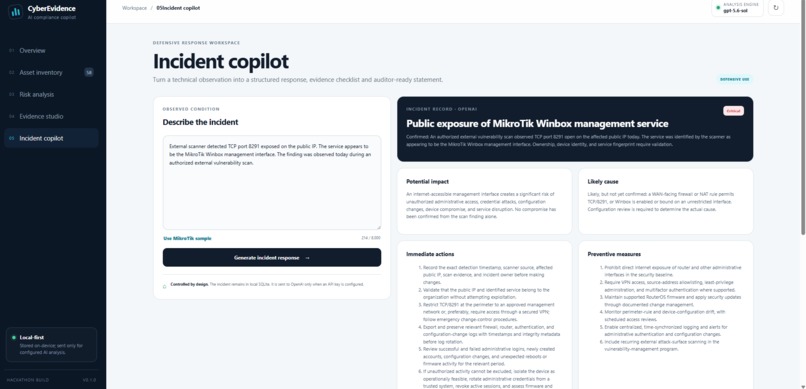
Incident Copilot
-
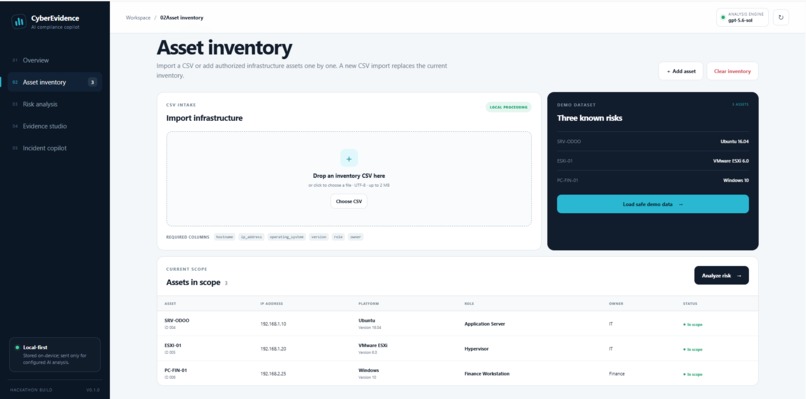
Assets
-
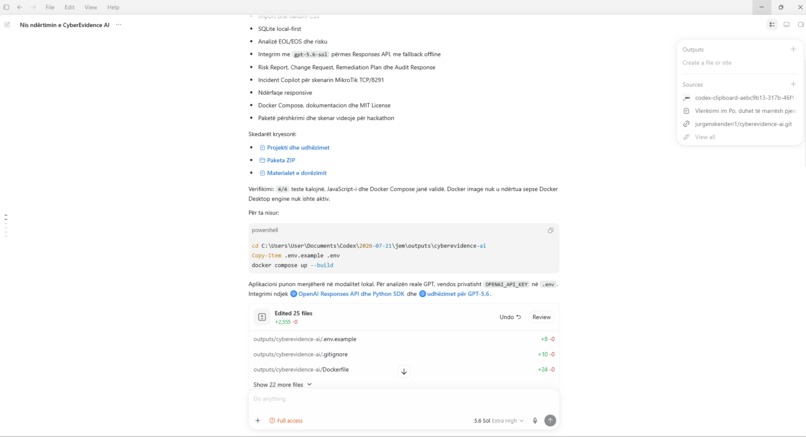
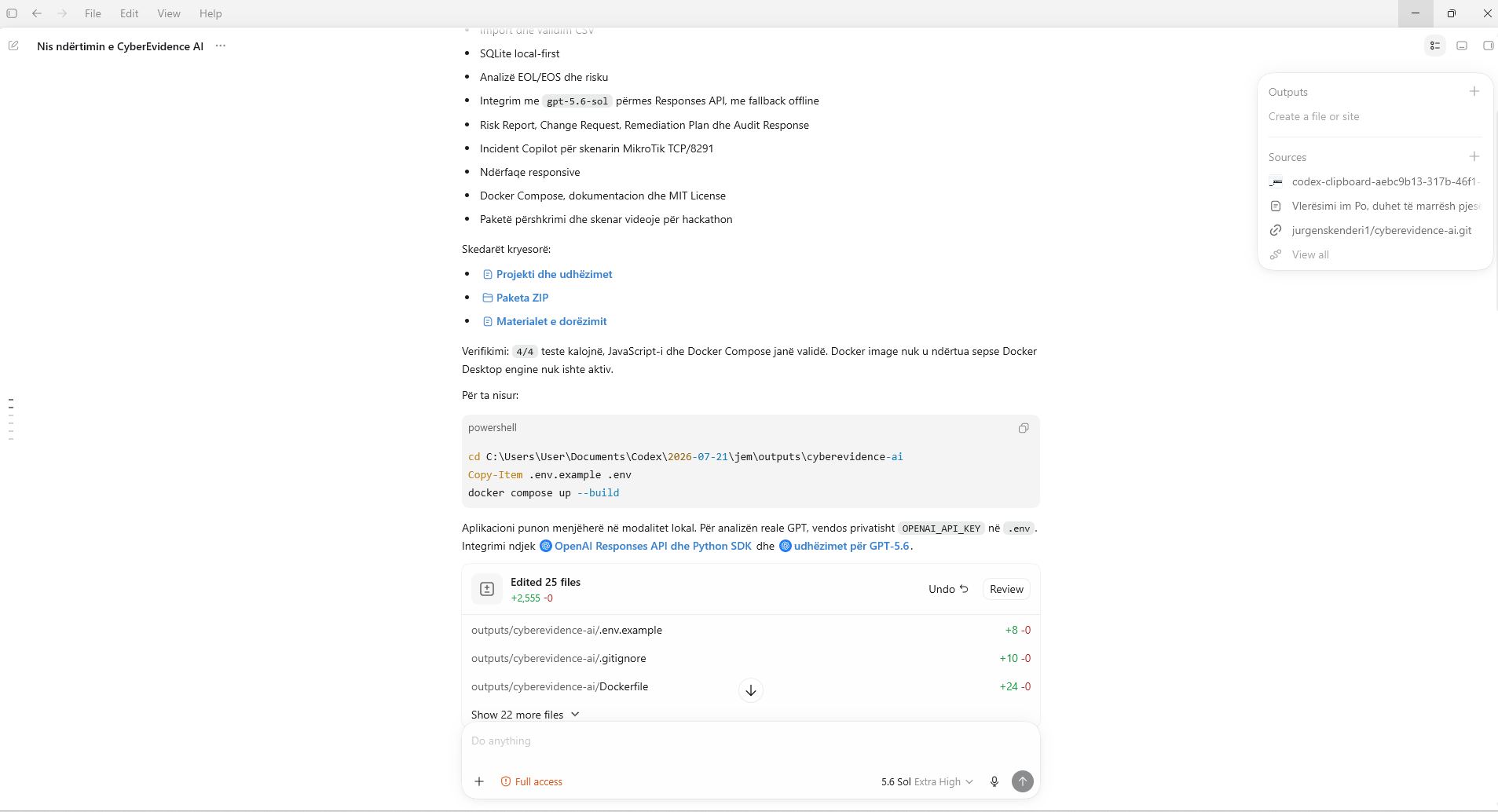
Codex Userage
-
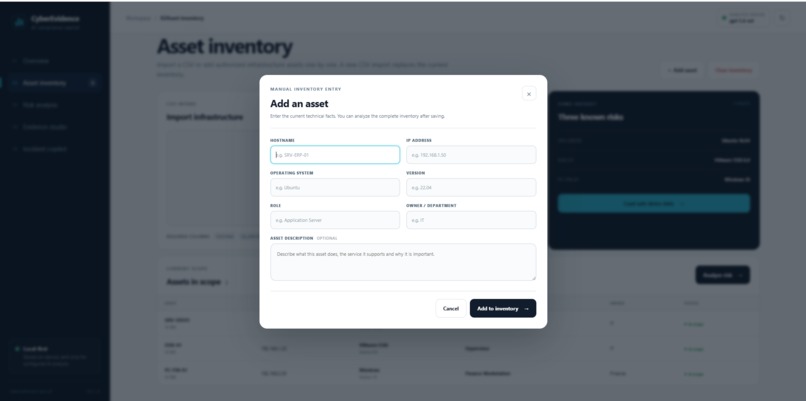
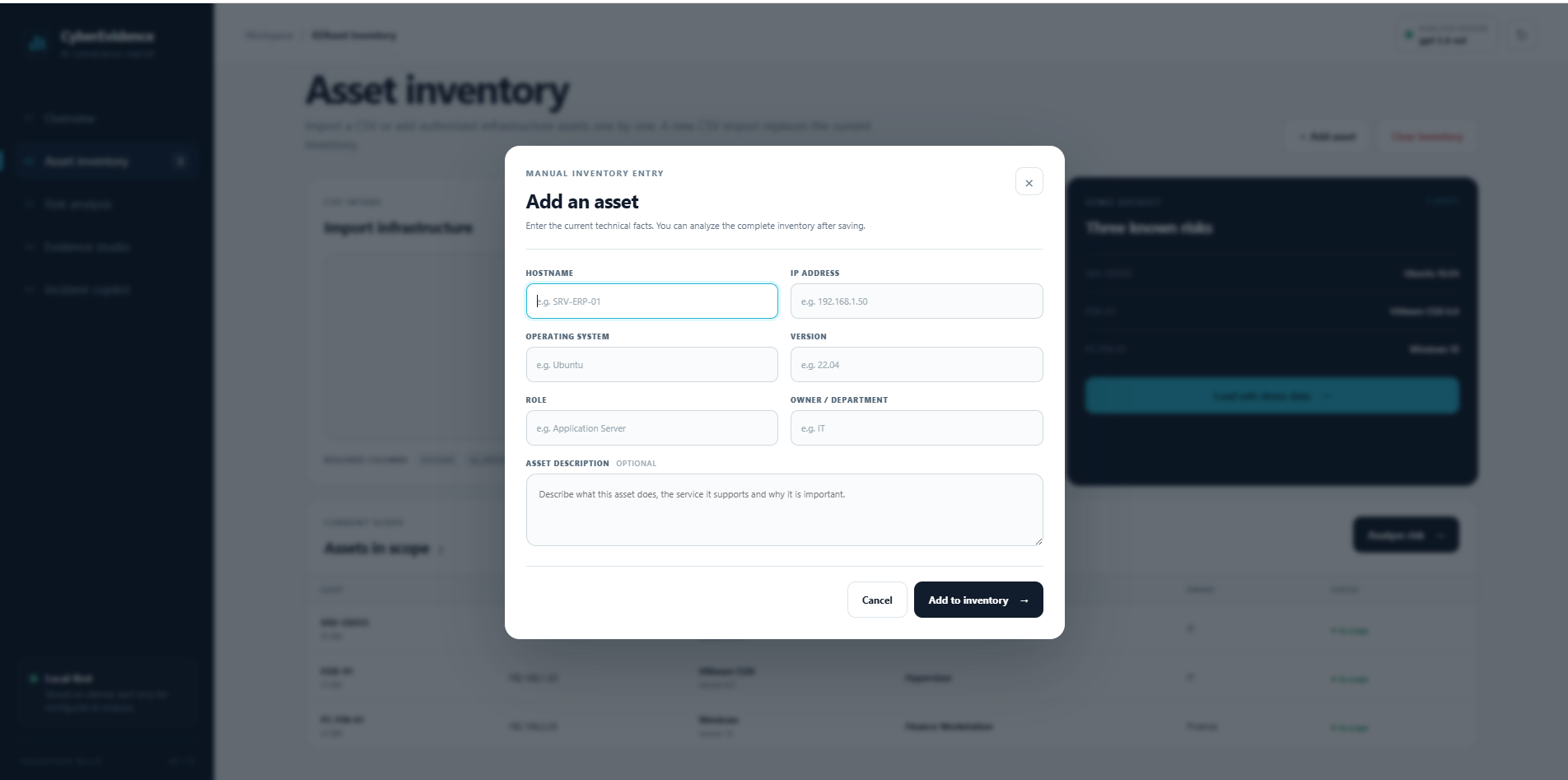
Add Assets manyaly
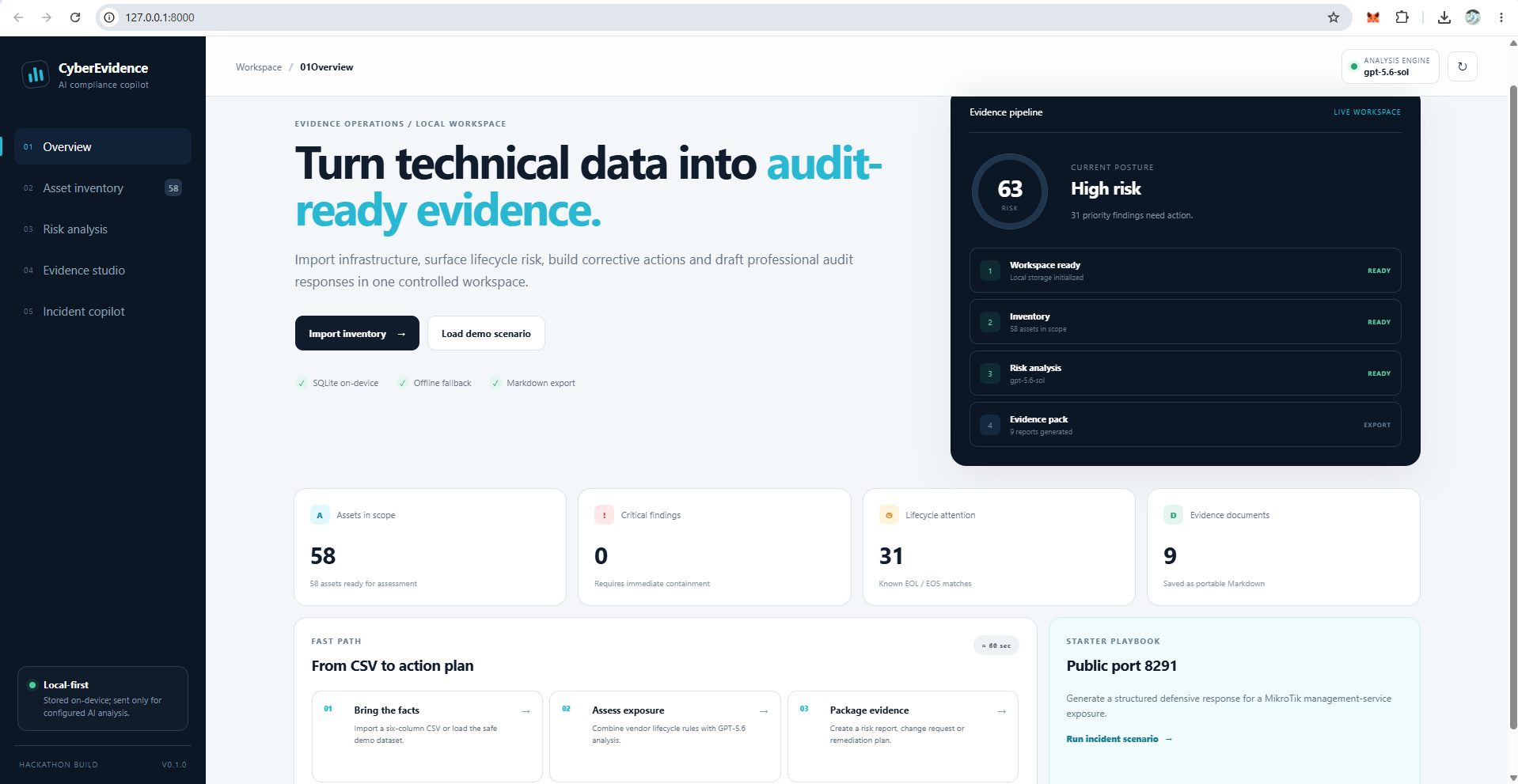
Inspiration
Small IT teams are responsible for protecting increasingly complex infrastructures, yet many of them still manage cybersecurity evidence, risk assessments, remediation actions, and audit responses manually.
Technical information is often spread across inventory spreadsheets, vulnerability reports, incident notes, firewall configurations, and internal procedures. Turning this information into clear, consistent, and audit-ready documentation requires significant time and specialized expertise.
CyberEvidence AI was created to help IT teams transform raw infrastructure and incident data into structured cybersecurity evidence, actionable remediation plans, and professional compliance documentation.
What it does
CyberEvidence AI is a local-first cybersecurity compliance and incident-response copilot powered by GPT-5.6.
The application allows users to:
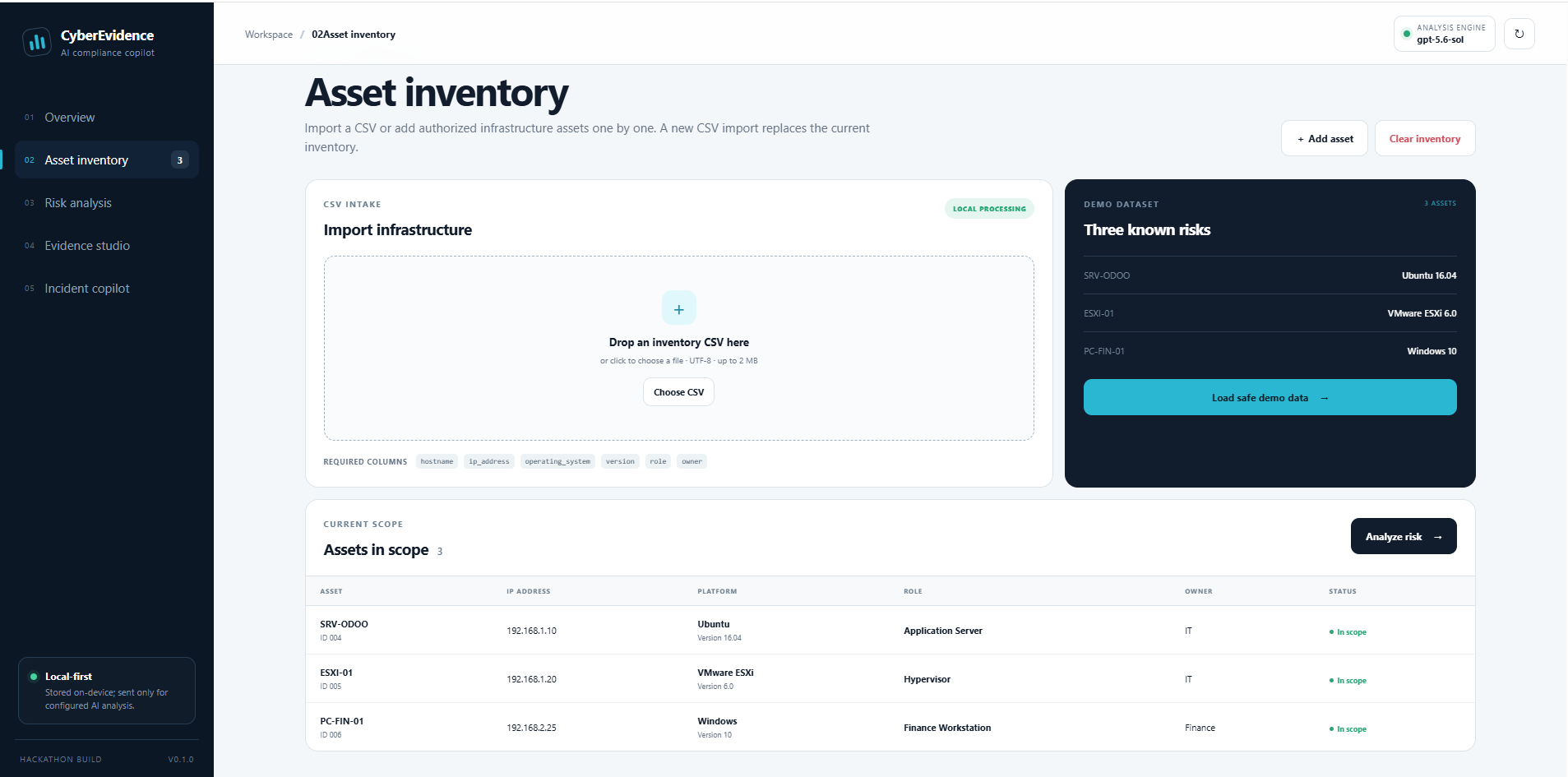
- Import an IT asset inventory from a CSV file.
- Review infrastructure assets in a centralized interface.
- Identify potential End-of-Life and End-of-Support systems.
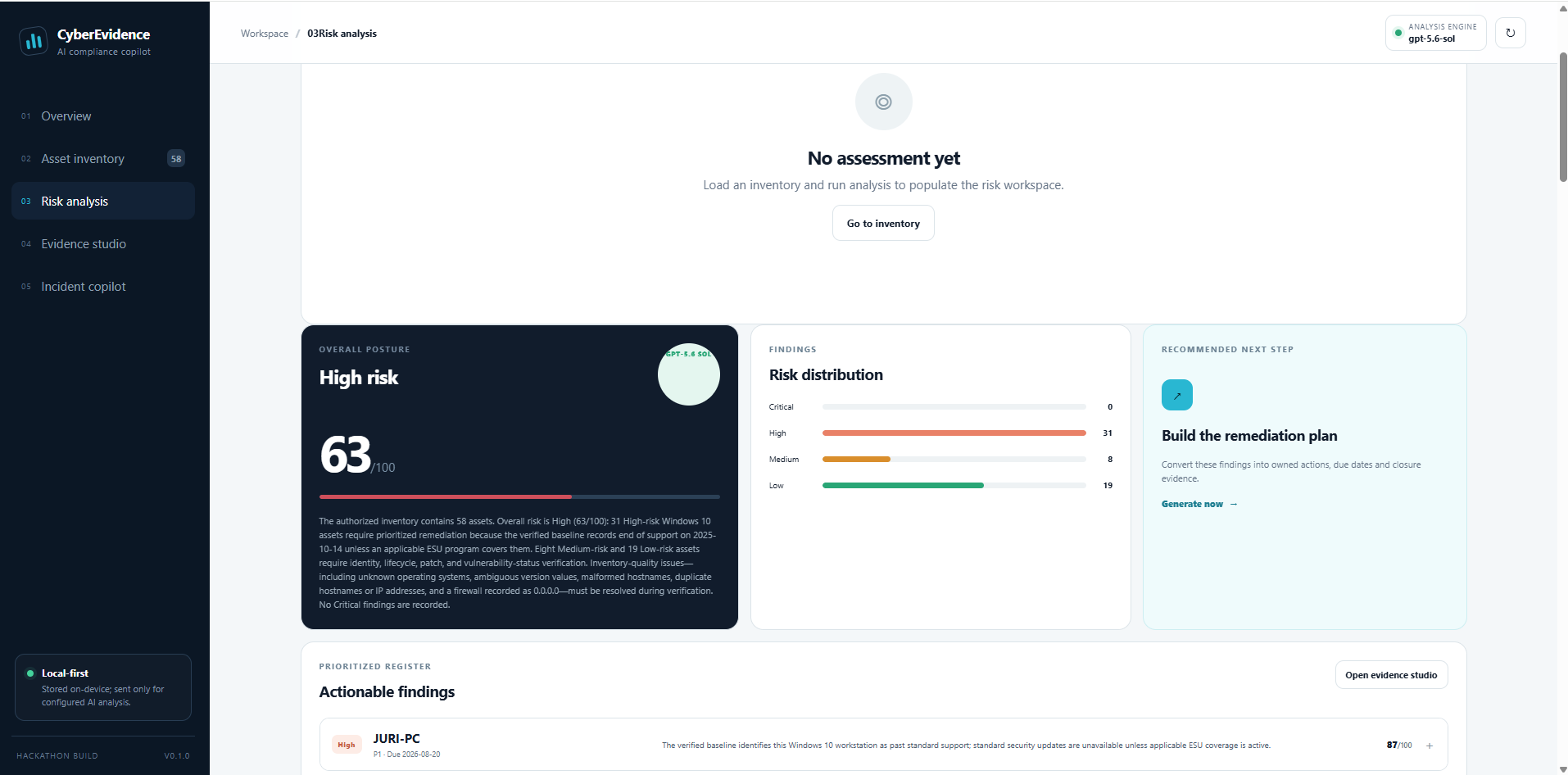
- Generate structured cybersecurity risk assessments.
- Prioritize findings based on severity and operational impact.
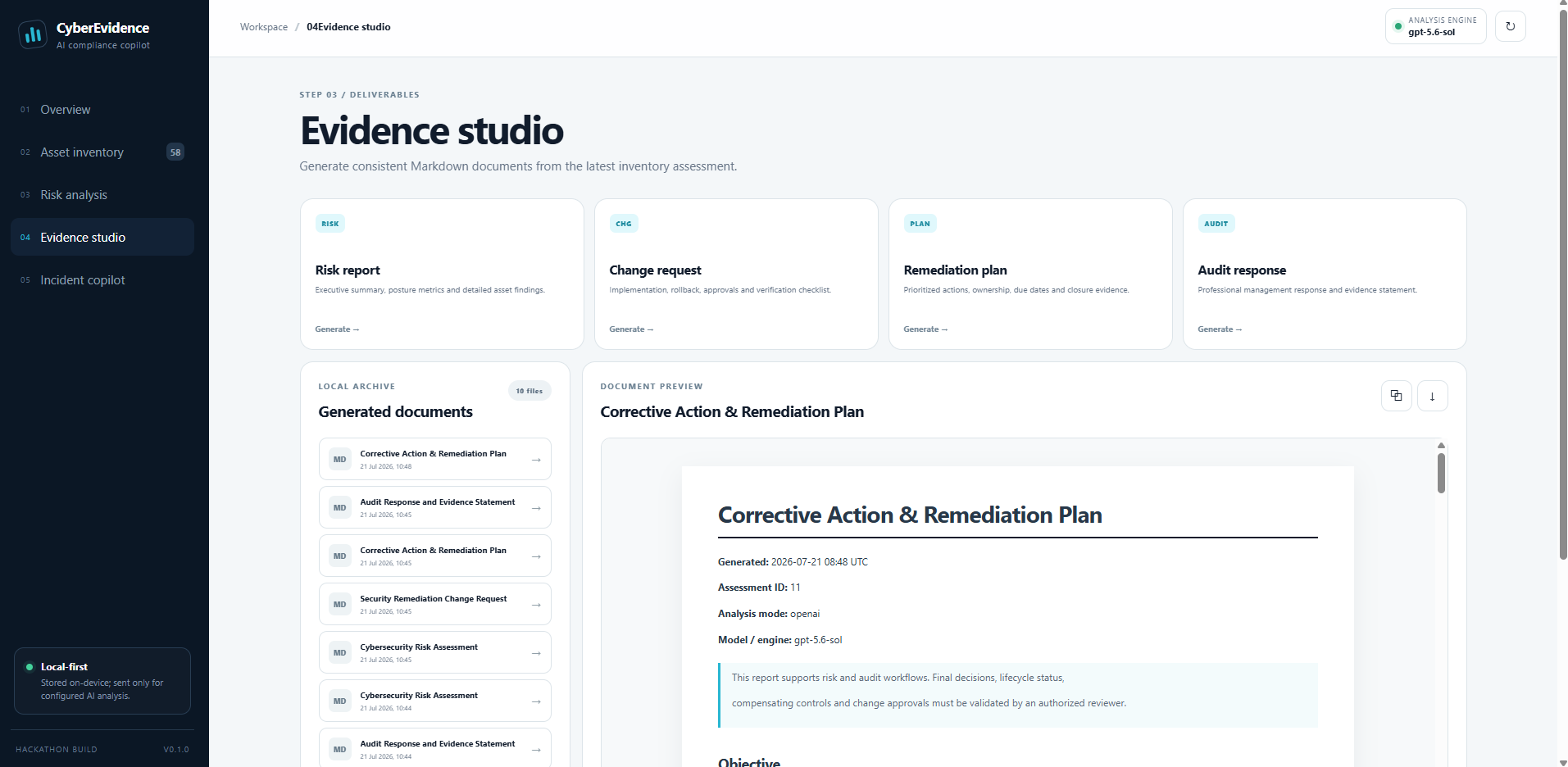
- Produce remediation plans with recommended actions and deadlines.
- Generate audit-ready reports and compliance evidence.
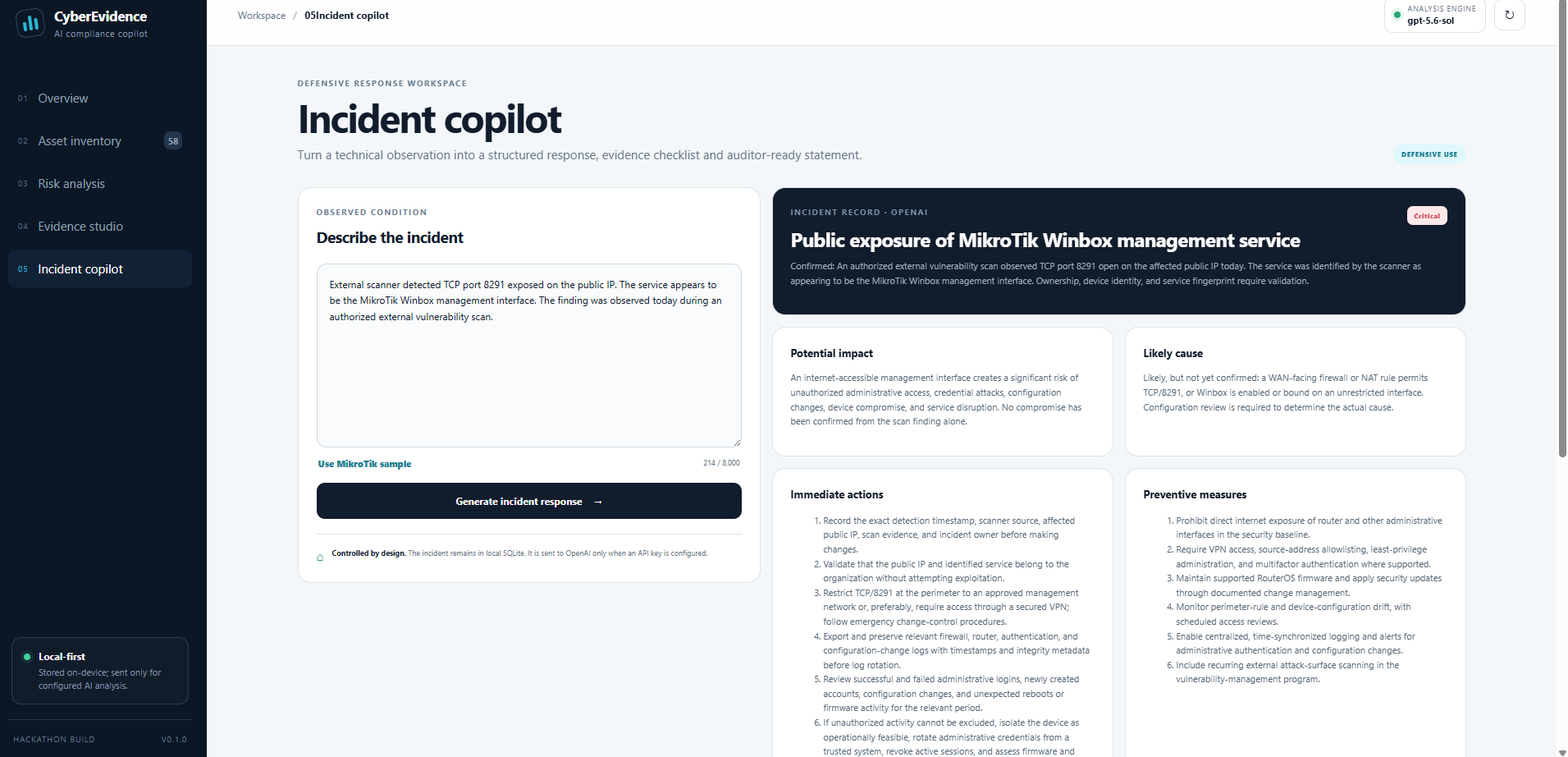
- Analyze cybersecurity incidents and create professional incident summaries.
- Draft responses that can be shared with auditors, management, or regulatory authorities.
A user can provide a technical incident such as an exposed administrative port, an outdated operating system, or a failed security control. CyberEvidence AI then converts the information into a structured response containing:
- Incident description
- Risk and business impact
- Likely root cause
- Immediate containment actions
- Corrective measures
- Preventive measures
- Required evidence
- Recommended follow-up actions
How we built it
CyberEvidence AI was built using Codex as the primary development agent and GPT-5.6 as the intelligence layer for analysis and document generation.
The application architecture includes:
- FastAPI for the backend API
- Python for data processing and cybersecurity workflows
- SQLite for lightweight local data storage
- HTML, Bootstrap, and JavaScript for the user interface
- OpenAI GPT-5.6 for risk analysis, remediation planning, and report generation
- Docker for reproducible deployment
- CSV import for infrastructure asset ingestion
Codex accelerated the development process by helping us:
- Design the project architecture
- Generate the backend API structure
- Create data models and validation logic
- Build the frontend workflow
- Implement CSV parsing
- Integrate GPT-5.6
- Create reusable prompt templates
- Add error handling and tests
- Prepare Docker and setup documentation
- Improve the code through iterative review and debugging
GPT-5.6 is used to interpret technical security information and transform it into structured, understandable, and actionable outputs. The model does not simply summarize input; it organizes findings into risk, impact, priority, remediation, evidence, and follow-up sections.
Challenges we faced
One of the main challenges was designing an AI workflow that produces consistent cybersecurity outputs instead of generic recommendations.
Cybersecurity and compliance reports must be structured, traceable, and useful to technical as well as non-technical stakeholders. To address this, we created specialized prompts and output formats for:
- Asset risk analysis
- EOL and EOS review
- Incident reporting
- Remediation planning
- Audit evidence generation
- Management summaries
Another challenge was keeping the application simple enough to deploy locally while still providing a complete and coherent product experience. We selected a lightweight architecture with FastAPI, SQLite, and Docker so that organizations can test the project without requiring a complex cloud environment.
We also designed the demonstration around synthetic infrastructure data to avoid exposing confidential organizational information.
Accomplishments that we are proud of
We are proud that CyberEvidence AI converts real cybersecurity operational tasks into a simple and usable workflow.
Instead of functioning as a general-purpose chatbot, the project produces structured outputs that an IT team can act on immediately.
The project demonstrates how GPT-5.6 can assist with practical cybersecurity operations while Codex can significantly accelerate the delivery of a complete working application.
Key accomplishments include:
- A working asset inventory workflow
- Automated cybersecurity risk analysis
- Structured incident-response generation
- Remediation plans with priorities and deadlines
- Audit-ready evidence and report generation
- Local-first deployment
- Reproducible Docker-based setup
- Sample data for immediate testing
What we learned
We learned that the effectiveness of an AI cybersecurity tool depends heavily on workflow design, structured inputs, and predictable outputs.
A strong model alone is not enough. The application must clearly define:
- What information is required
- How risk should be classified
- How recommendations should be prioritized
- What evidence should be retained
- How results should be presented to different stakeholders
We also learned how Codex can support more than code generation. It can help with architecture, debugging, documentation, testing, and iterative product development across the entire project lifecycle.
What's next for CyberEvidence AI
The next development phase will include:
- Support for vulnerability scanner reports
- Integration with endpoint-management and firewall exports
- Configurable compliance frameworks
- Mapping findings to ISO 27001, NIST CSF, and other standards
- PDF and DOCX report export
- Role-based access control
- Change-management workflows
- Evidence history and audit trails
- Multilingual report generation
- Private local-model deployment options
- Integration with ticketing and asset-management systems
Our long-term goal is to make CyberEvidence AI a practical security operations and compliance assistant for small and medium-sized organizations that do not have large cybersecurity teams.
Potential impact
CyberEvidence AI can reduce the time required to analyze security findings and prepare compliance documentation.
It is designed for:
- Small and medium-sized businesses
- Internal IT departments
- Managed service providers
- Security consultants
- Compliance teams
- Educational institutions
- Financial organizations
- Public-sector IT teams
By turning technical data into actionable and audit-ready evidence, CyberEvidence AI helps organizations improve consistency, accountability, and cybersecurity readiness.

Log in or sign up for Devpost to join the conversation.