Inspiration
I am a cybersecurity enthusiast with a passion for staying up-to-date on the latest technologies and trends in the field. I love learning about new ways to protect my networks and devices, and I am always eager to put my knowledge to the test by participating in various cybersecurity challenges and competitions. 2 years ago i was more concerned about automotive cyber security, and i found out the perfect solution to put an end to many cyberattacks that happen to vehicles and that gives access to criminals to steal it from you.
What it does
This invention ensures that the communication between the receiver and transmitter systems is
well secured to prevent unauthorized access attempts, repetition or modification of the transmitted signal.
According to a preferred embodiment, the invention will contain 3 main steps as can be seen in Figure 1 (Figure 1 : link ).
The first step is synchronization and encryption: (see Figure 2) (Figure 2 : link ). In our transmitter device we will have an RTC module which is used to calculate the real time in a way that it is synchronized with the receiver device and we know that each device must contain its own code (16 bits in size), this code will be added to the real time of the system which has already been synchronized (of size 16 bits). And like that we obtain a final code (of size 256 bits) which is a combination between the synchronized time and the code of the system. The final code will then be encrypted using a hash function (SHA-256).
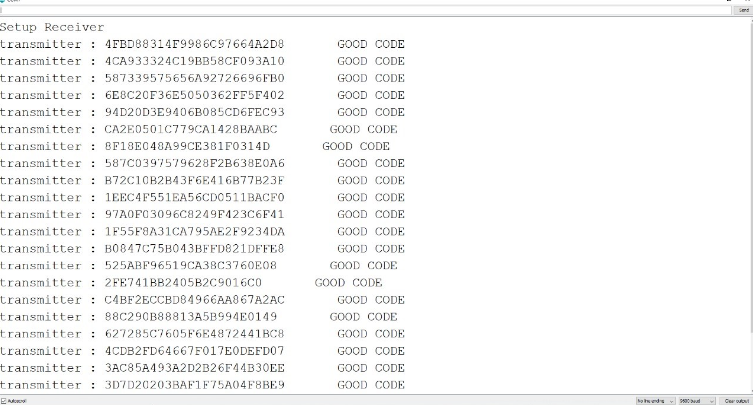
The second step is the Transmission (see figure 3): after the encryption of the code by the transmitter system, this code must be converted into binary so that it can be sent according to a desired frequency in the form of a signal using 2 channels RF. the first rf channel will transmit 128 bits of the signal and the other will transmit the rest of the signal which is also 128 bits in size. The receiving system will receive the two signals in binary, it will first concatenate them to have a single binary code and then convert it to obtain the original encrypted code which was calculated previously by the sending system. (Figure 3 : link).
The third step is comparison and verification: (see figure 4) Once the receiving system receives the encrypted code that was sent by the transmitting system, the receiving system will verify and compare the code obtained with the code precalculated by the receiver system, following the same parameters used in the first stage by the transmitter system.
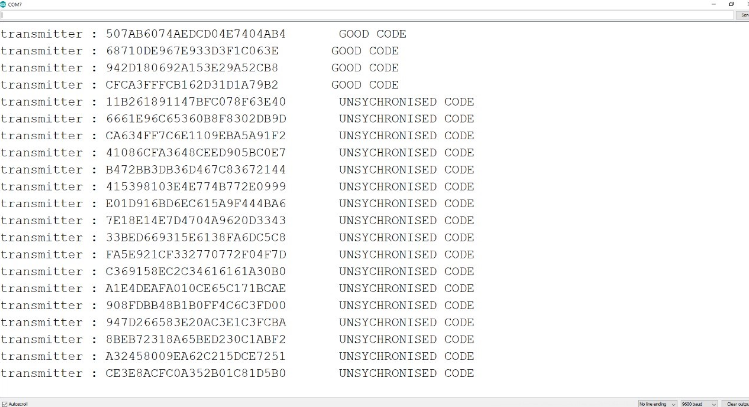
The code obtained will be considered obsolete if the result of the comparison indicates that the two codes are different.
Each code sent by the transmitter system expires in 4 seconds, after these 4 seconds the code becomes obsolete and useless. (Figure 4 : link).
How we built it
For now we tested our algorithms using a raspberry pi , arduino and esp32, and ofc some modules and components like: -RTC. -Module NE06M. -Kryptor FPGA. -433MHz transmitter. -433MHz receiver. -Transistors. i'll share a link to the code we used down below !
Challenges we ran into
it was hard to actually find this solution since i had to try all known cyber attacks on my solution each time i change something about it , and that was the hardest part i believe, but i didnt stop trying until i made it !
Accomplishments that we're proud of
i was ranked the second at a Moroccan innovation/invention Competition, And of course i got my project patented !
What we learned
I believe that cybersecurity is essential in today's world, and I am determined to make a difference in this field by continuing to educate myself and others about the importance of staying safe online.
What's next for Cyberense
I would like to see this solution implemented on vehicles in real life to make them more secure !


Log in or sign up for Devpost to join the conversation.