-
-
Cybersecurity image
Inspiration
About the Project
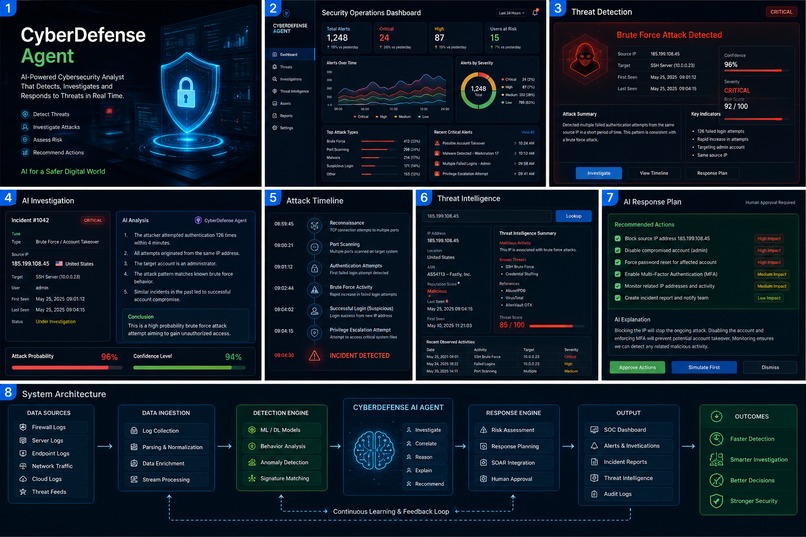
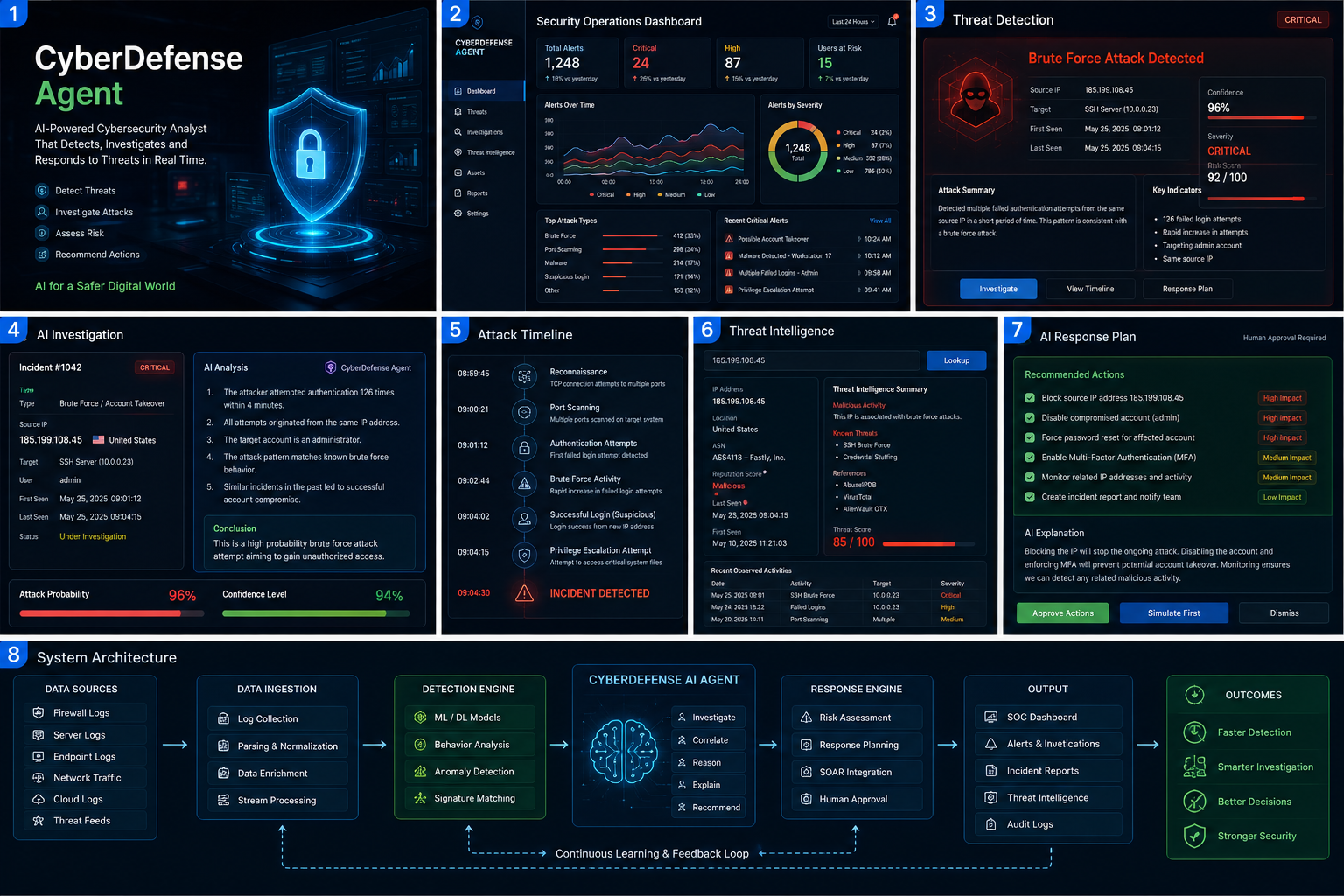
CyberDefense Agent is an AI-powered cybersecurity platform designed to act as an intelligent security analyst. It analyzes security logs and suspicious activities, detects potential threats, investigates attack patterns, evaluates risk, and provides actionable response recommendations. The goal is to reduce the time and effort required for security teams to identify and understand cyber incidents.
Inspiration
Cyberattacks are becoming increasingly sophisticated, while security teams have to process huge volumes of alerts every day. Many alerts require manual investigation, which can delay incident response and allow serious threats to go unnoticed.
We were inspired to build CyberDefense Agent as an AI-powered security analyst that can continuously analyze security events, connect related activities, explain why an incident is dangerous, and help security teams make faster and better decisions.
What it does
CyberDefense Agent provides an intelligent workflow for cybersecurity monitoring and incident investigation.
Key capabilities include:
- Real-time threat detection from security events and logs.
- AI-powered investigation of suspicious incidents.
- Threat correlation to identify relationships between multiple alerts.
- Risk scoring based on severity, confidence, and potential impact.
- Attack timeline generation to visualize how an incident developed.
- AI explanations that convert complex security events into understandable reports.
- Response recommendations such as blocking suspicious activity, isolating affected systems, or strengthening authentication.
- AI SOC Assistant that allows analysts to ask questions about incidents using natural language.
- Automated incident reports for faster documentation and analysis.
How we built it
We designed CyberDefense Agent as a modular AI cybersecurity architecture.
Security Logs / Events ↓ Data Processing & Normalization ↓ Threat Detection ↓ CyberDefense AI Agent ↓ Threat Correlation & Investigation ↓ Risk Assessment ↓ Response Recommendations ↓ Security Operations Dashboard
The platform combines machine-learning-based threat detection with generative AI and agentic workflows. NVIDIA-accelerated technologies can be used to improve AI inference and large-scale security-data processing.
The system is designed around specialized capabilities for detection, investigation, threat intelligence, risk analysis, and response planning. A dashboard provides security analysts with an overview of incidents, severity levels, attack timelines, and AI-generated explanations.
Challenges We Ran Into
One of our biggest challenges was transforming large amounts of raw security information into useful intelligence. Security logs can contain noisy, incomplete, and highly varied data, making reliable threat detection difficult.
We also had to balance automation with security. An AI system should not blindly execute defensive actions without understanding the potential consequences. Therefore, our approach focuses on providing explainable recommendations and keeping sensitive response actions under human supervision.
Another challenge was designing an AI agent that could reason across multiple security events rather than treating every alert as an isolated incident.
Accomplishments That We're Proud Of
We are proud of creating a cybersecurity platform that goes beyond simple threat classification.
CyberDefense Agent can:
- Turn raw security events into understandable security insights.
- Correlate multiple alerts into a potential attack scenario.
- Generate an automated attack timeline.
- Assign an interpretable risk score.
- Explain the reasoning behind security alerts.
- Recommend appropriate defensive actions.
- Provide a natural-language interface for security investigation.
Most importantly, we built the project around the idea of AI assisting security professionals rather than replacing human decision-making.
What We Learned
Through this project, we learned how to combine cybersecurity concepts with artificial intelligence and agentic workflows.
We gained experience in:
- Security log analysis
- Threat detection and classification
- AI agents and LLM-based reasoning
- Threat correlation
- Risk assessment
- Explainable AI
- Security dashboards
- AI-assisted incident response
- GPU-accelerated AI workflows
We also learned that an effective cybersecurity AI system needs more than a powerful model. It needs reliable data, good context, explainability, careful evaluation, and human oversight.
What's Next for CyberDefense Agent
Our next goal is to evolve CyberDefense Agent into a more capable autonomous security operations platform.
Future improvements include:
- Integration with real-time SIEM systems.
- More advanced threat-intelligence integration.
- Multimodal analysis of logs, network data, and endpoint events.
- Improved attack-chain reconstruction.
- Continuous learning from historical incidents.
- Automated security playbook generation.
- Human-approved automated response workflows.
- Support for larger enterprise-scale security environments.
- More advanced NVIDIA-accelerated AI inference and data processing.
Our long-term vision is to build an AI security analyst that can continuously monitor, investigate, explain, and help defend digital environments while keeping humans in control of critical decisions.
What it does
How we built it
Challenges we ran into
Accomplishments that we're proud of
What we learned
What's next for CyberDefense Age
Built With
- ai
- css
- deep
- fastapi
- generative
- html
- intelligence
- javascript
- language
- machine
- models
- nemotron
- node.js
- react
