Inspiration
Cyber threats are becoming increasingly complex, and analyzing large volumes of network traffic manually can be time-consuming. We wanted to explore how AI and machine learning could help identify suspicious network behavior and make cybersecurity monitoring easier to understand.
This inspired us to build Cyber Sentinel – AI-Based Cyber Threat Detection, a platform focused on passive, one-directional network monitoring. Our goal is to make network activity more visible and help users identify potential security threats without actively interfering with normal network communication.
What it does
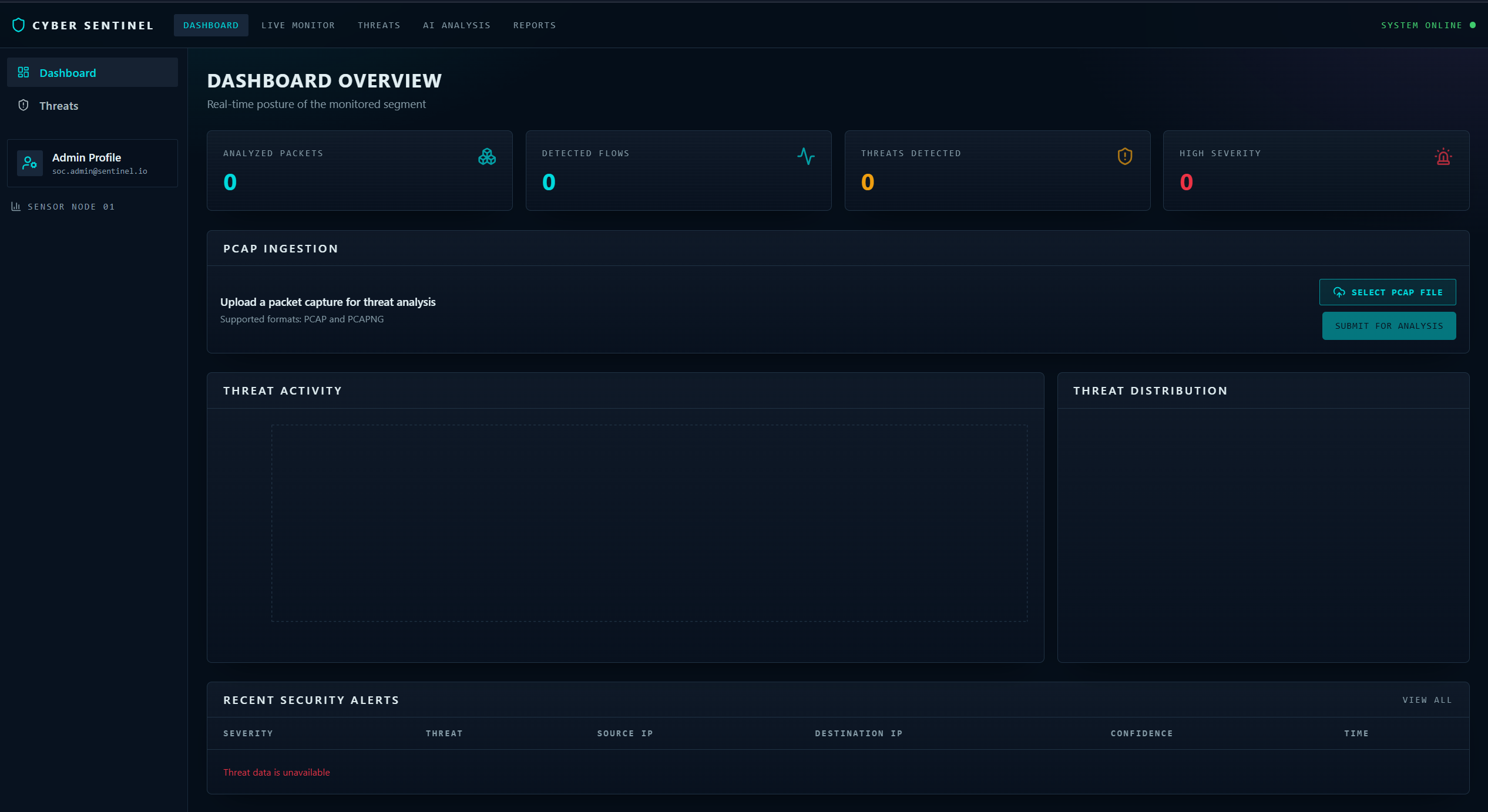
Cyber Sentinel provides a centralized dashboard for network monitoring and potential cyber threat analysis. Its key features include:
- Security Dashboard:Displays an overview of network activity, analyzed packets, network flows, and threat metrics.
- PCAP/PCAPNG Analysis: Provides an interface to upload captured network traffic for analysis.
- Live Network Monitor: Displays packet information such as source and destination IP addresses, ports, protocols, and timestamps.
- Threat Landscape:Organizes potential security incidents and displays threat categories, severity, and related information.
- AI/ML Analysis:Provides an interface for examining anomalies and suspicious traffic patterns.
- Reports and Analytics:Presents incident summaries, trends, and security-related metrics.
The project is designed to support the identification of six types of cyber threats and help users investigate suspicious network activity more efficiently.
How we built it
We developed Cyber Sentinel using a modular approach, separating the main functions into dashboard, network monitoring, threat analysis, AI/ML analysis, and reporting modules.
The planned analysis workflow starts with observing network traffic or uploading a PCAP/PCAPNG file. Relevant packet information can then be processed to examine traffic patterns and identify potential anomalies. The results are organized in the dashboard to make security information easier to understand.
We designed the interface to bring these different functions together in one place, allowing users to move from monitoring network activity to reviewing potential threats and examining reports.
Our focus was on combining network visibility, AI-assisted analysis, and a user-friendly interface into a single cybersecurity solution.
Challenges we ran into
One of our main challenges was organizing complex cybersecurity information into an interface that users could understand easily. Details such as IP addresses, protocols, anomaly scores, and threat severity need to be presented clearly without overwhelming the user.
Another challenge was understanding how passive network monitoring, packet capture analysis, and AI/ML-based detection could work together as part of a single workflow.
We also recognized that unusual network activity does not always indicate a real attack. Distinguishing legitimate behavior from potential threats requires suitable datasets, careful testing, and validation to reduce false positives and improve reliability.
Accomplishments that we're proud of
We are proud to have developed a unified project concept that brings network monitoring, threat analysis, AI/ML insights, and security reporting together in one platform.
We created separate interfaces for important cybersecurity tasks, including packet monitoring, threat overview, anomaly analysis, and incident reporting. This modular approach gives the project a clear structure and provides a foundation for future improvements.
We are also proud of exploring how passive network monitoring can be combined with AI-assisted threat analysis to support a more organized approach to cybersecurity.
What we learned
Through Cyber Sentinel, we explored the fundamentals of network traffic monitoring, packet capture analysis, anomaly detection, and cybersecurity reporting.
We learned the importance of presenting technical information in a clear and useful way, organizing software into independent modules, and considering the reliability of AI-based detection.
We also learned that building a useful cybersecurity solution involves more than creating a dashboard. The underlying analysis must be tested against appropriate data, and detection results must be evaluated carefully to ensure they are meaningful.
What's next for Cyber Sentinel – AI-Based Cyber Threat Detection
Our next step is to strengthen the detection engine and validate its performance using labeled network traffic datasets.
We plan to improve the identification of six threat categories, evaluate detection accuracy and false-positive rates, and refine the analysis workflow. Other future improvements include real-time alert notifications, more detailed incident investigation, improved reporting, and deployment for practical testing.
We also aim to make the platform more scalable and reliable so that it can support security analysts, network administrators, students, and cybersecurity researchers.
Our long-term vision is to develop Cyber Sentinel into a dependable network security monitoring solution that helps users understand suspicious activity and respond to potential threats more effectively.
Built With
- anonmalydetection
- artificialintelligence
- backenddevelopment
- cybersecurity
- dashboard
- data
- deeplearning
- frontenddevelopment
- machine-learning
- networkmonitoring
- networksecurity
- pcapanalysis
- python
- tcp/ip
- threatdetection
- visualization

Log in or sign up for Devpost to join the conversation.