



Inspiration
I sat perched on a small ledge, with my backs pressed against a dung wall, in the smoky room of a tiny bar, shocked by the news that Google would again cooperate with Chinese authorities to run a censored version of its search engine. The same day, a group of 800 web developers were meeting in San Francisco to discuss a grand idea to circumvent internet gatekeepers like Facebook and Google. They want a new, better web where all people are able to create and access information without having to rely on centralized operators that amass our data for profit and make it easier for adaptive governance. It was 31 July, 2018, when I realized that the time for a decentralized web (later called web3) had come.
For the past 4 years, my colleagues and I have been working on technologies that equipped the web with decentralization, which later composed the backbone of the Cyber Frontier Platform.
What we learned
The Internet and the World Wide Web are the largest communication systems humanity has ever seen. The inventors of the Web wished for the entire planet’s population can create and access information. However, the things we do on it every day are controlled by just a few internet giants. 4 companies control over 70% of the world's cloud infrastructure. If any of them shuts down, people’s data and connections are lost. If any of them spies the data, people’s privacy is gone. Below are just a few examples of the unhealthy.
- StepN collapsed due to Google Cloud's limiting bandwidth
- dYdX was hit by AWS outage
- Hackers stole $120M BadgerDAO by modifying its website
- Binance and Metamask users were affected by the major Infura outage
- Lawrence’s (my best friend) DeFi platform halted due to AWS’s shutting down
If the applications had been supported by decentralized computing, such tragedies could not have happened.
What we do
We build Cyber Frontier, an unstoppable, confidential and high-performance computing services to Web3. The platform provides uncompromising and eternal infrastructure for Dapps to achieve true decentralization. It also supports AI, metaverse and other computationally intensive applications by low-latency and expanded-capacity computing. It works as follows:
Public Cloud
It provides a ubiquitous and decentralized computing platform that enables unstoppable and confidential computing for web 3. It is organized by blockchain, managed by DAO and owned by its users. The computing nodes are decentralized disseminated in the global internet without having to rely on big companies. The decentralized computing paradigm also achieves superior features of significantly faster processing, expanded bandwidth and 50% lower carbon footprint that provide more tangible benefits for a next-generation internet.
Computing Miner
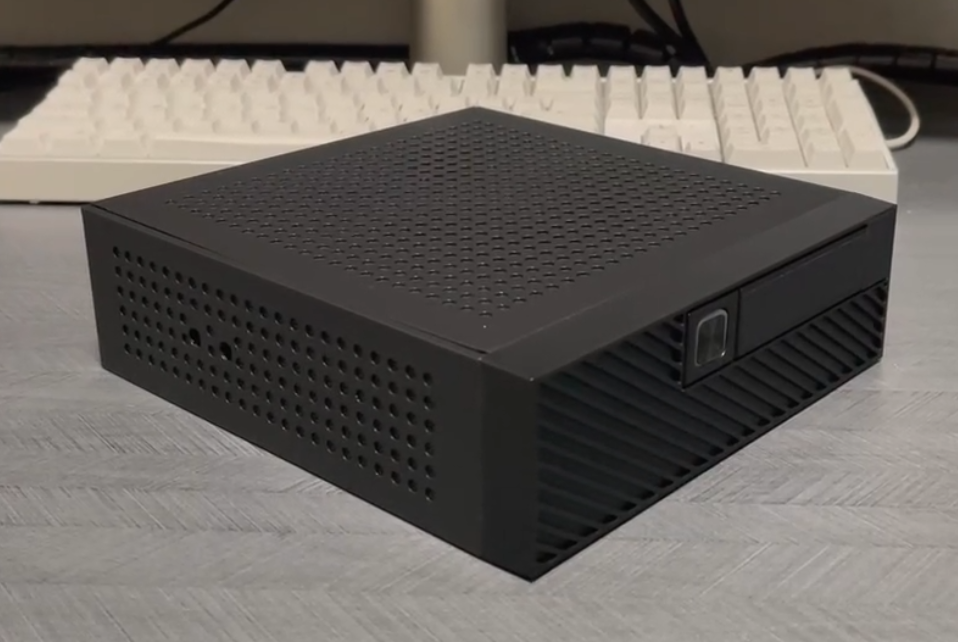
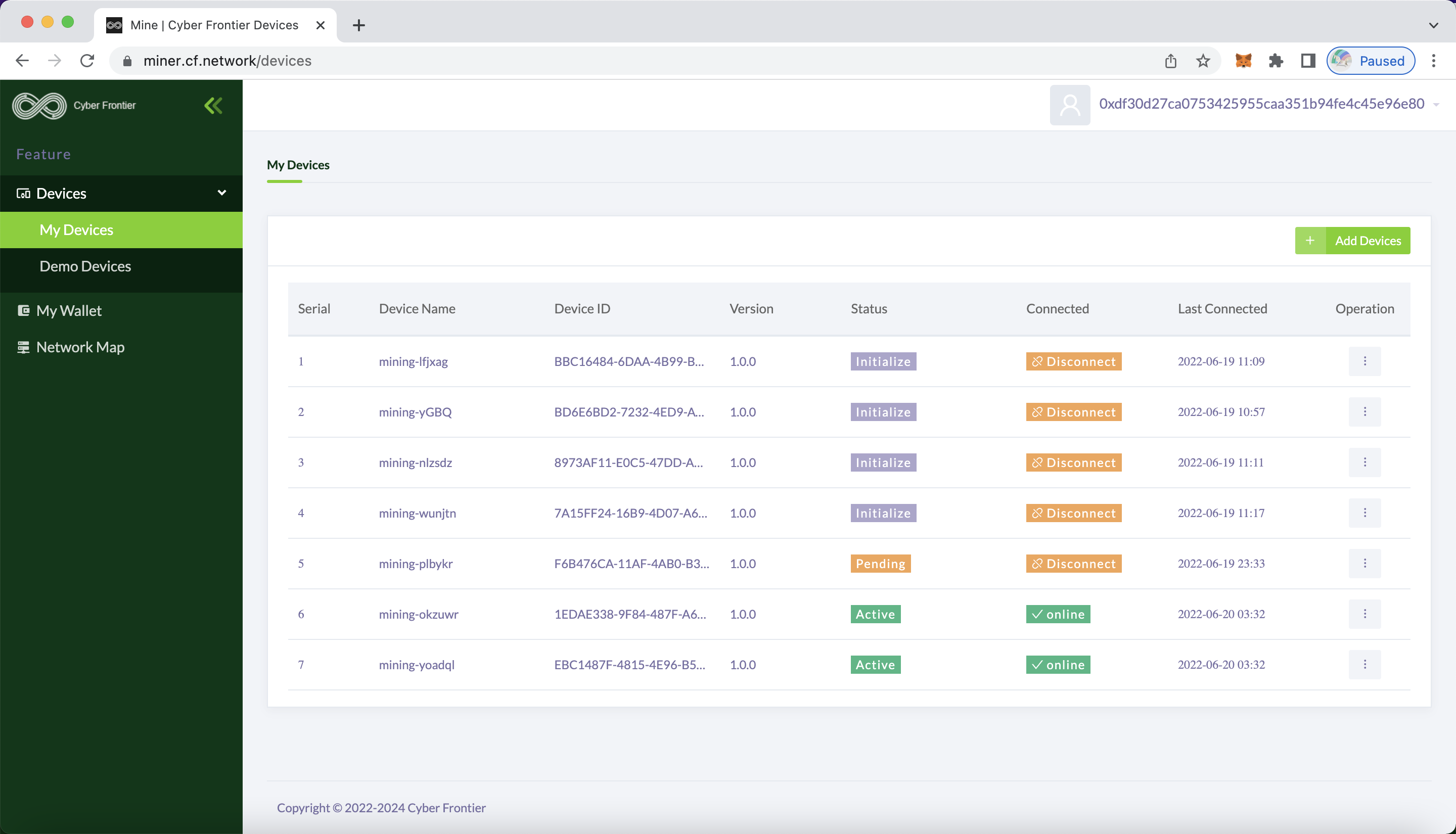
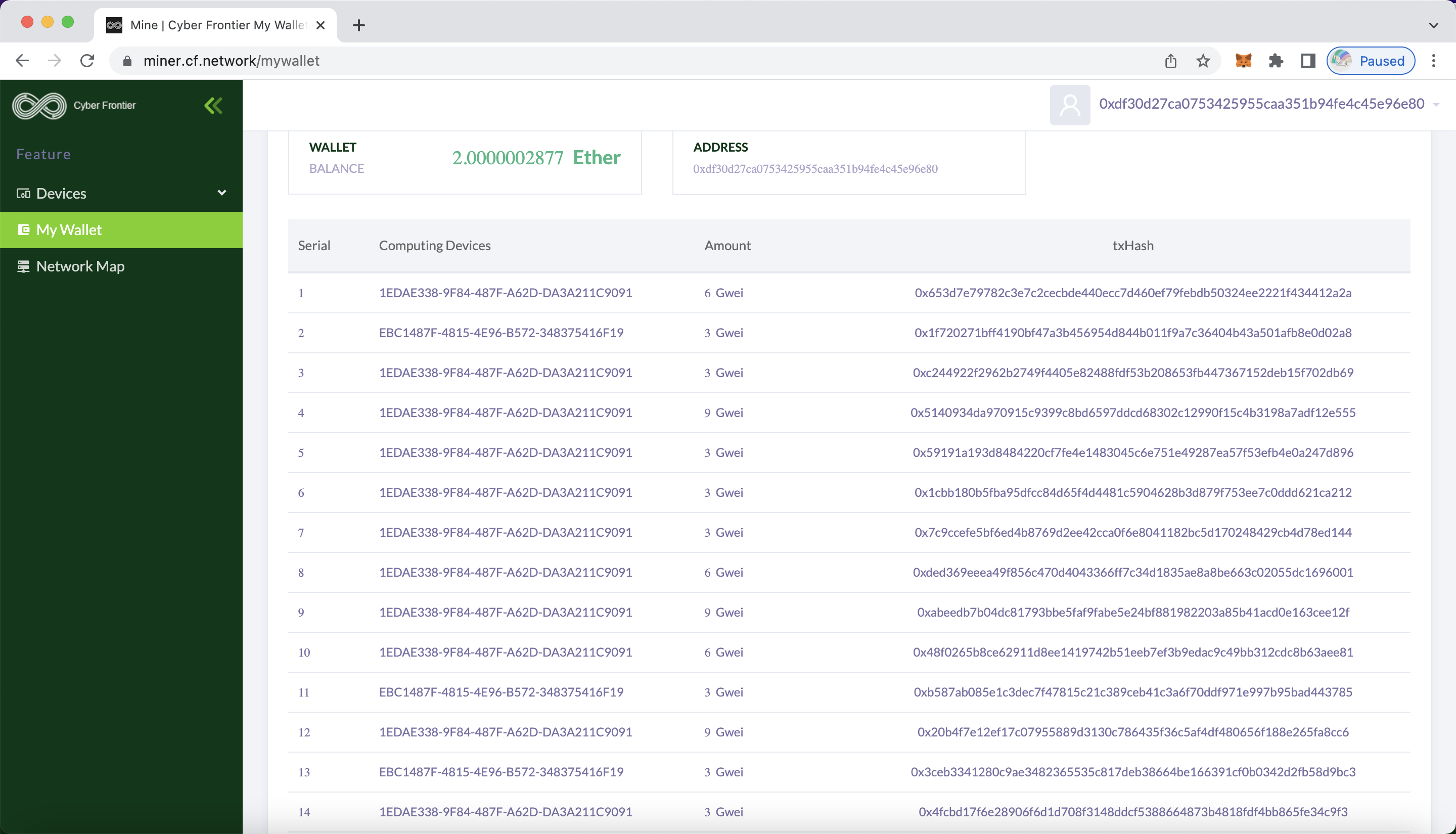
It provides a mining machine that enables individuals to contribute to the decentralized web and receive computing rewards. It provides one-click configuration, automatic computing service and continuous rewards immediately when powered on. By deploying a simple device in an individual’s home or office, he/she can provide the city with miles of computing coverage for Dapps and earn cryptocurrencies. Powered by computing miners, Cyber Frontier implements a paradigm shift for a decentralized computing infrastructure with the help of people’s power.
The Cyber Frontier Token
- Payment
- Payment for using the cloud computing service
- Reward
- Reward for providing computing service
- Reward for building consensus and mining blocks
- Reward for managing a computing pool
- Staking
- Stake for discounts of using computing services
- Stake for certification of providing computing services
- Stake for certification of becoming a node of the consensus group
- Stake for certification of becoming a node of a computing pool
- Ecology DAO
- Donation and investment incubation to support high-quality ecological projects
- Governance
- Right for submitting proposals and voting to promote ecological development
How we built it
Cyber Frontier leverages blockchain to adaptively disseminate individual computing nodes to the network edge, pushing for the computing force to the computing power to become essential services like water and electricity.
Thanks to blockchain technology, the computing power can be organized in a decentralized manner without relying on a centralized authority. Superior technologies such as 1) computing pooling, 2) task scheduling and resource orchestration, and 3) computing and network convergence and symbiosis, provide a coherent solution that a simple composition of previous solutions cannot achieve.
Accomplishments that we're proud of
Backed by a fabulous team with experienced members from Harvard, Princeton, Microsoft, Facebook, VMWare and crypto-native projects, our technology has been tested and commercially validated on a mobile network of 2,000+ machines.
We are headquartered in San Francisco, and have remote teams in places such as the UK, Israel and Hong Kong.
Challenges we ran into
This is an area with a huge market and of course, severe competitions. But we are confident because we have a fabulous team with deep insights into this field. A brief competition analysis is as follows:
Decentralized storage
Decentralized storage systems such as Filecoin and Arweave offer a distributed storage solution. They allow users to share and use spare storage. However, they only focus on distributed storage, and thus it is not a direct competitor for Cyber Frontier.
Cyber Frontier can launch similar decentralized storage services further down the road, or just use Filecoin and Arweave’s storage as a remote database. Therefore, the development efforts of both projects are complementary at the moment.
PC-based solutions
There are projects proposing using spare PCs for decentralized computing. While the idea is cool, it faces a number of practical issues that prevent its adoption. Some major issues include:
- It is impossible to precisely measure the computing resources provided by heterogeneous PCs in a reliable manner;
- The computing power of heterogeneous PCs are hard to be pooled;
- It is unrealistic to expect a PC to provide reliable online services for a consistently long time;
- The uncertain OS and softwares running on the PCs pose significant security issues.
Cyber Frontier is using standard miners to build the backbone of the network. The resources provided by the standard miners can be accurately measured. The security is protected by tamper-proof encryption chips. The miners are also much stronger from the perspectives of computing convergence, performance and reliability.
How do we collaborate with ICP
ICP’s vision of limitless blockchain and web-speed serverless computing greatly inspired us. We are keen to learn from ICP, leverage ICP’s technology and contribute to ICP’s ecosystem. The commitment to engage in the ecosystem of ICP will include but not limited to:
- Adoption of the Internet Computer blockchain to build the controller of the Cyber Frontier Platform;
- Adoption of ICP’s serverless computing paradigm to enhance the ability of Cyber Frontier;
- Interaction with and build more use cases for ICP tokens;
- Implementation of interoperability to attract developers and entrepreneurial activities to explode in the ICP ecosystem;
- ......
We are Team Cyber Frontier, please help us for a truly decentralized Web3!
Built With
- anycloudservice
- faas
- gdb
- golang
- kubernetes
- mongodb


Log in or sign up for Devpost to join the conversation.