-
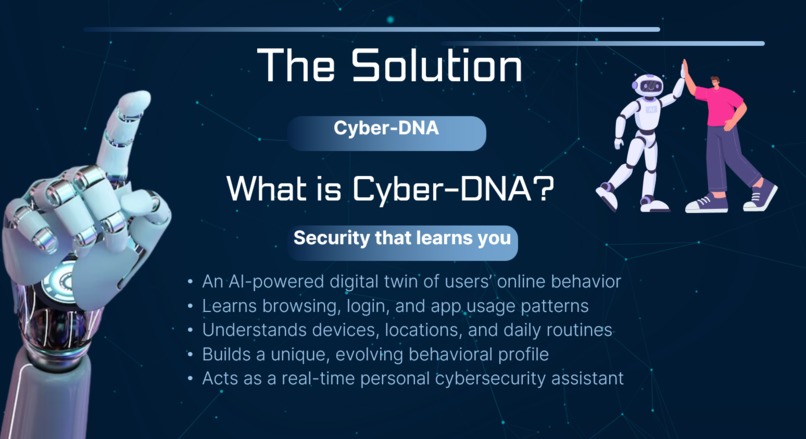
What is Cyber-DNA
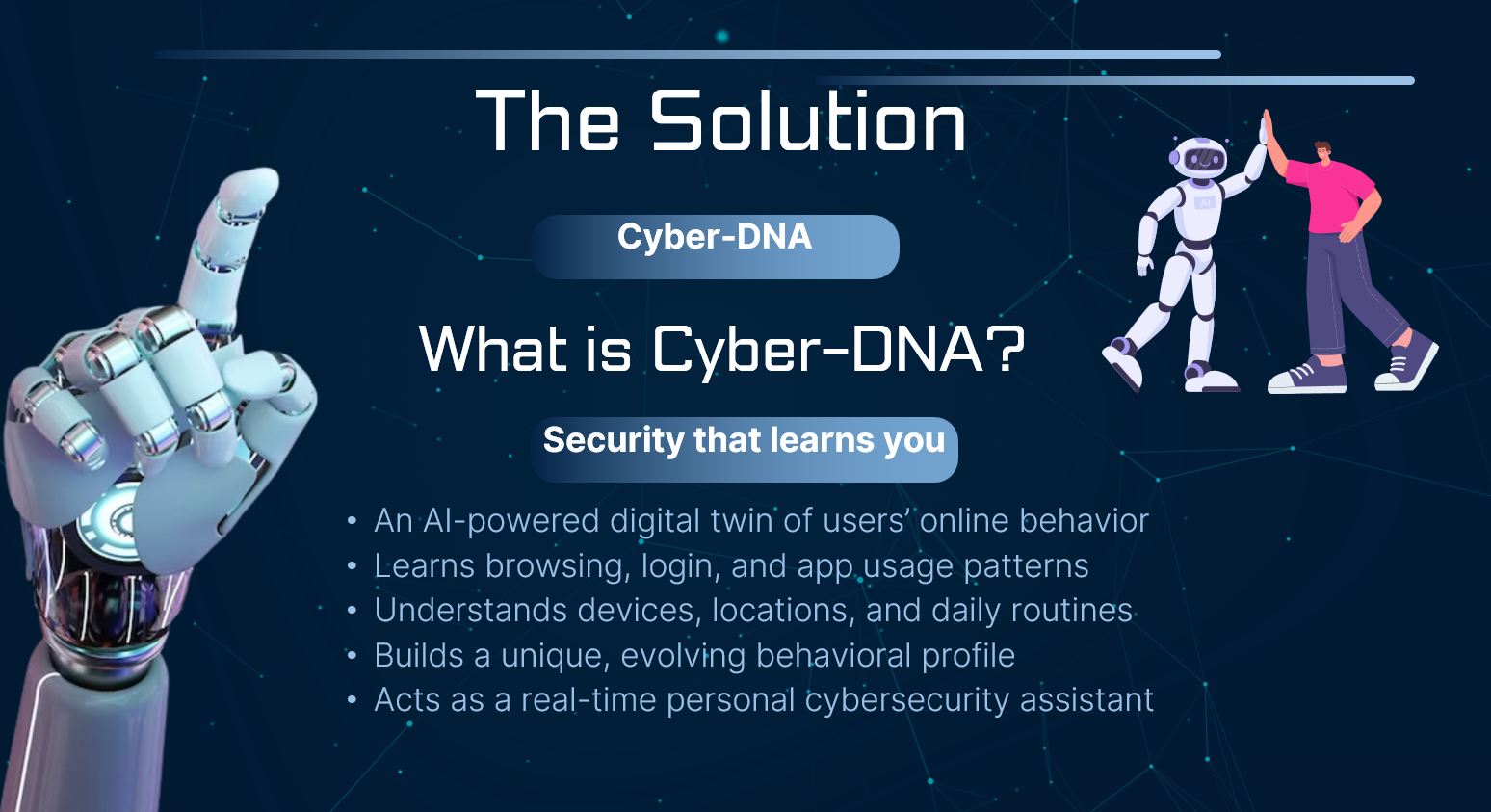
Inspiration
With the rise of data breaches and account takeovers, we noticed that most security systems still rely heavily on static credentials like passwords and OTPs. Even when users follow best practices, stolen credentials can allow attackers to gain access easily.
We were inspired by the idea that every user behaves differently online, just like fingerprints or DNA. This led us to the concept of Cyber-DNA—a system that secures users based on how they behave, not just what they know.
What it does
Cyber-DNA creates a personal digital twin of a user based on their normal online behavior. It continuously monitors user activity such as browsing patterns, login timing, device usage, and interaction behavior.
By learning this behavior, Cyber-DNA can:
- Detect anomalies in real time
- Identify suspicious activity even if credentials are correct
- Block or alert on potential account takeovers
- Adapt automatically as user behavior changes
The system focuses on prevention rather than reaction, stopping threats before damage occurs.
How we built it
We built Cyber-DNA using a behavior-based security approach:
- Collected anonymized behavioral metadata (no personal content)
- Created a baseline behavior profile (Cyber-DNA) for each user
- Implemented a rule-based AI risk engine to score deviations
- Used anomaly detection logic to identify abnormal behavior
- Built a lightweight backend API to process behavior data in real time
- Designed the system with privacy-first principles, storing only patterns, not sensitive data
The initial version is focused on desktop and browser-based monitoring, making it suitable for rapid deployment and hackathon prototyping.
Challenges we ran into
- Designing behavior analysis without invading user privacy
- Balancing sensitivity to avoid false positives
- Defining “normal behavior” for users with dynamic usage patterns
- Implementing real-time detection with limited training data
- Keeping the system lightweight and scalable within hackathon constraints
Accomplishments that we're proud of
- Built a working concept of behavior-based authentication
- Designed a user-specific security model, not one-size-fits-all
- Created a system that can detect threats even with valid credentials
- Successfully combined AI concepts with cybersecurity
- Delivered a project that is both innovative and practical
What we learned
- User behavior is a powerful security signal when handled correctly
- Privacy-aware design is essential in security products
- Rule-based AI can be highly effective in early-stage security systems
- Security works best when it is continuous and adaptive, not static
What's next for Cyber-DNA
- Add machine learning models for advanced behavior prediction
- Expand support to mobile devices and cloud environments
- Integrate with enterprise SOC and SIEM tools
- Introduce password-less authentication using Cyber-DNA
- Improve visualization and dashboards for users and security teams

Log in or sign up for Devpost to join the conversation.