-
-

Logo
-
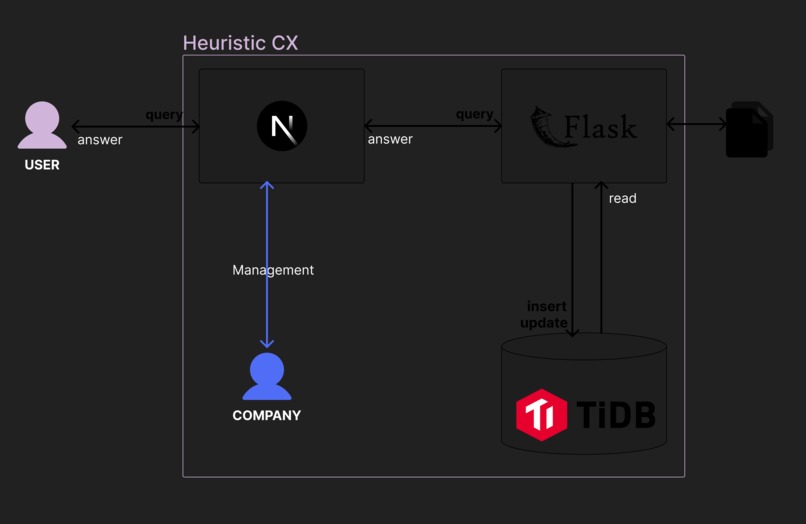
Architecture

Inspiration
People have problems with their machines. Sometimes, they get errors or failure codes in the equipment and have no clue how to interpret the issue. So user calls directly the customer service which is most of the time full, and there is no way to allow consumers to interpret the error code or ask any supplement questions regarding the product.
What it does
We have developed the platform to allow manufacturers to index the manuals for all their products and have a search bar for every product. And it gives direct insight correlated to their internal task list and readjusts automatically when a user asks a question.
How we built it
The tech stack is used from the online database TiDB. The tables are:
- Users: to store user information
- Analytics: to store analytics like user's questions, datetime
- Products: to store products information
- Document: to store documents related to a product
- Sessions: to store the authentications sessions
- Tasks: to store internal tasks of the company
- IP: to track the number of visitors on the product search page for the dashboard

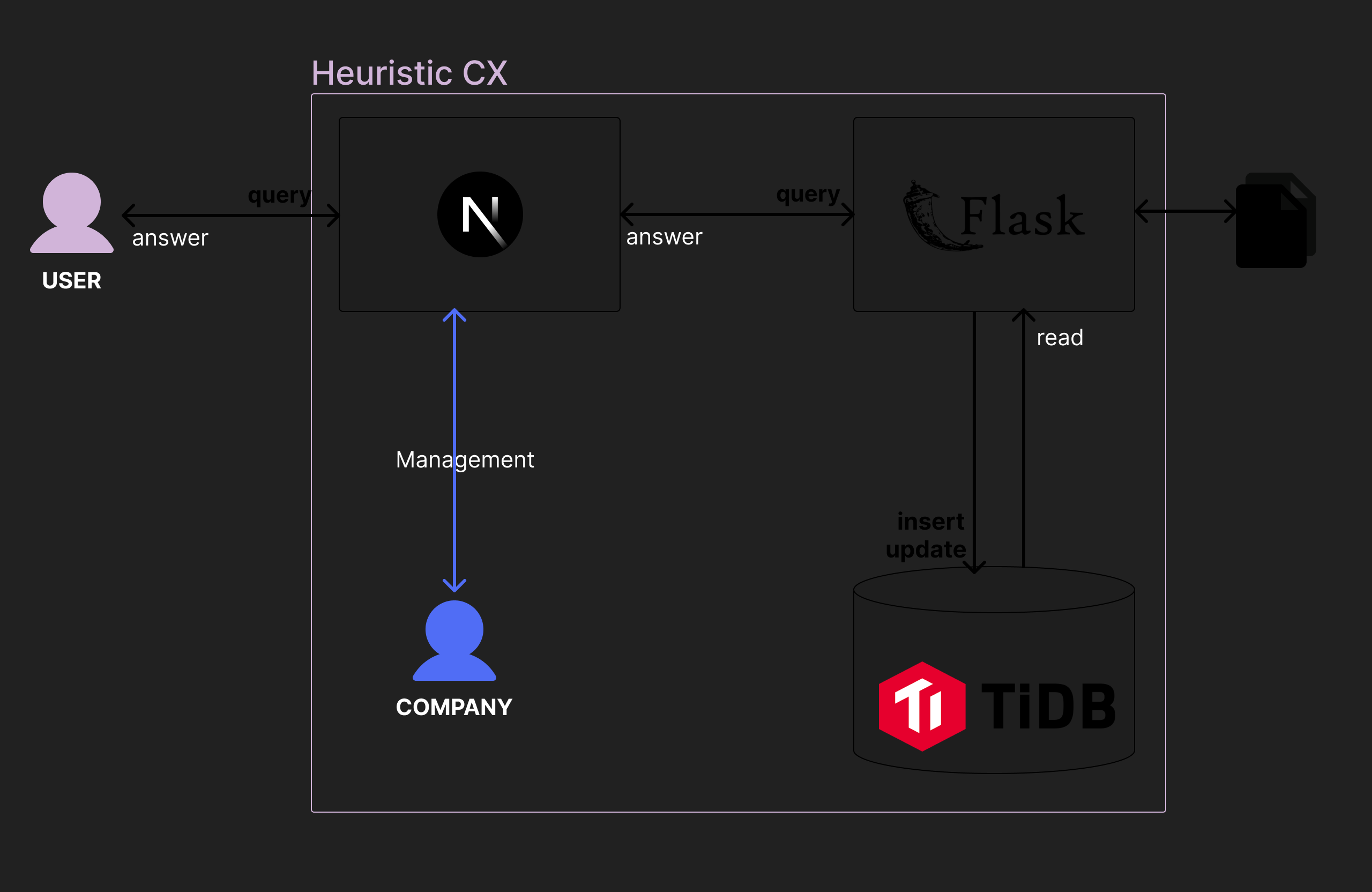
For the backend, we used Flask to handle the user queries. The Backend is hosted on AWS EC2 and the IP user query are forwarded via Ngrok for the security purpose. TiDB to handle the handle users, and company information in Real-time, and the monitoring of the task using HTAP operations for retrieving the task by desc order from a REPLICATED table. The documents are indexed into Qdrant to allow the semantic search. OpenAI to ensure the generative Context-based QA to the consumer. We control the output of the Generative model via a prompt, to not invent the answer if there is no answer in a given context. Cohere to vectorize the user queries and the documents(whatever the language of the text). And lastly, a cross-encoder to ensure the readjustment of the user query to the internal company task. For the frontend, we used Next.js and Tailwindcss for the styling.
How it works
Our use case <company> is samsung.
- Role : company & Action : Create a product (product name) via
/<company>/products/ - Role : company & Action : Index the document of the product (select the manual from the storage: the Samsung instruction manual ) via
/<company>/indexing/ - Role : company & Action : Stick the QR code to the equipment.
- Role : user & Action : Ask questions and get answers via
/<company>/<product-id>/search/ - Role : company & Action : Check user questions via
/<company>/questions/ - Role : company & Action : Monitor the internal company task via
/<company>/analytics/
Challenges we ran into
The challenge we ran into was about handling the Replicate into our SQUAD dataset (extracted only questions, which represent the internal company task)
Accomplishments that we're proud of
We are proud to successfully use Replicate our Tasks table with 13127 rows and apply analytical processing via TiFlash.
What we learned
We learned that it was possible to handle analytical processing while querying the DB via TiFlash.
What's next for Heuristic AI
The next step of Heuristic AI is to
- Improve UX by integrating feedback
- Integrate clients authentication
- Map multiple user manuals to improve their integration in the index
- Test use cases.
- And design integration to the most popular CRM in order to open tickets directly from Heuristics.
Built With
- cohere
- flask
- nextjs
- openai
- tailwindcss
- tidb


Log in or sign up for Devpost to join the conversation.