-
-
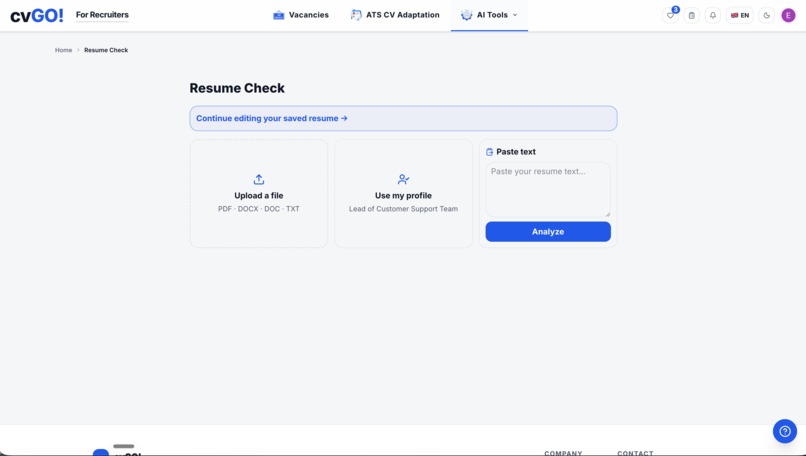
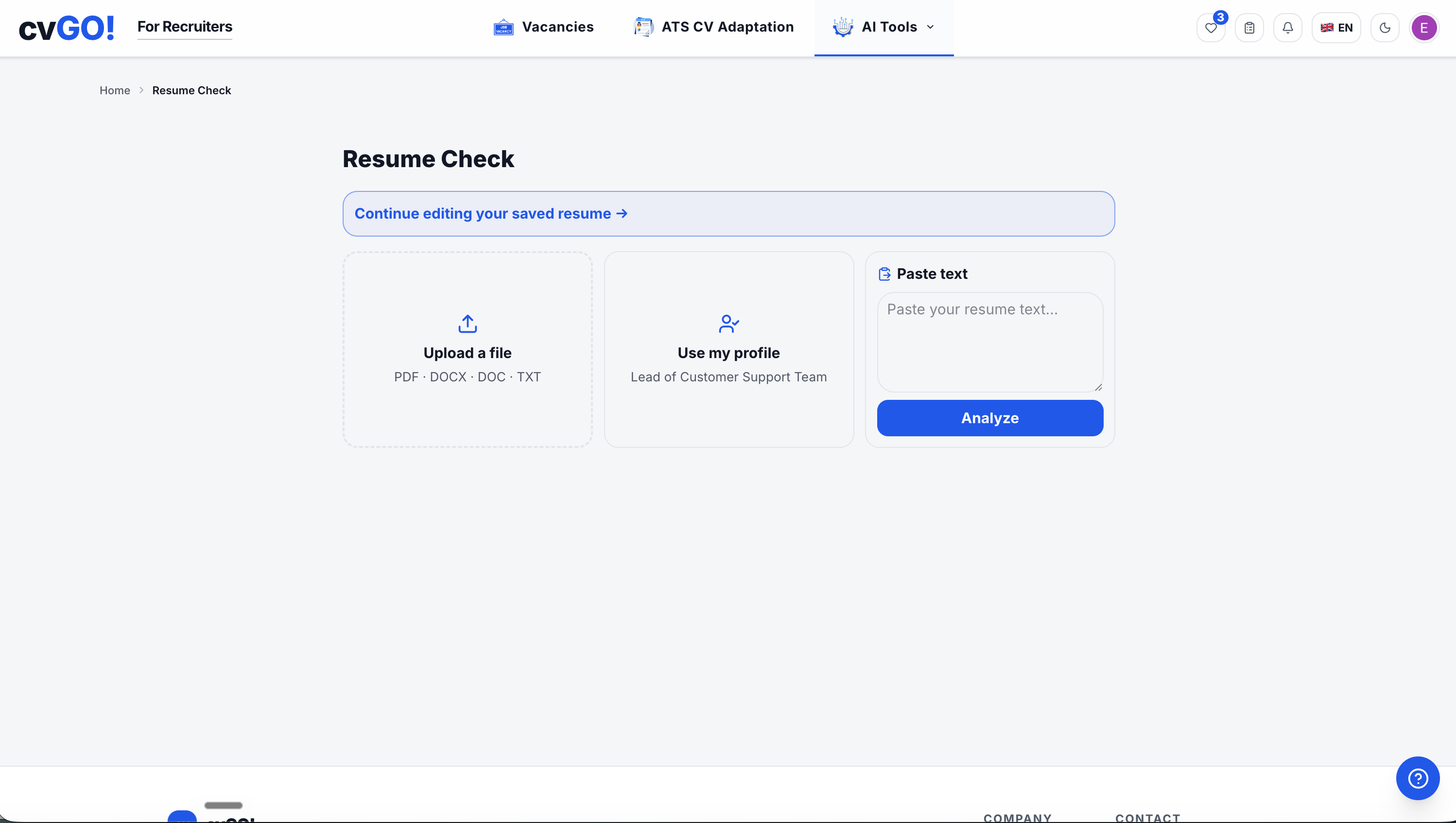
Resume analyze
-
-
-
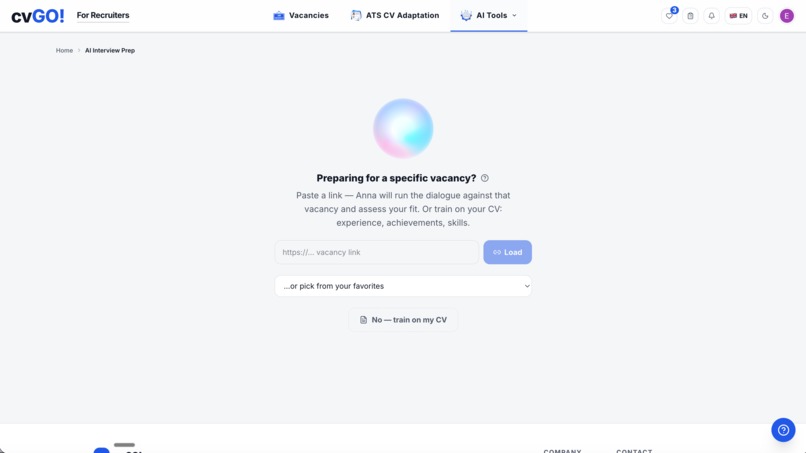
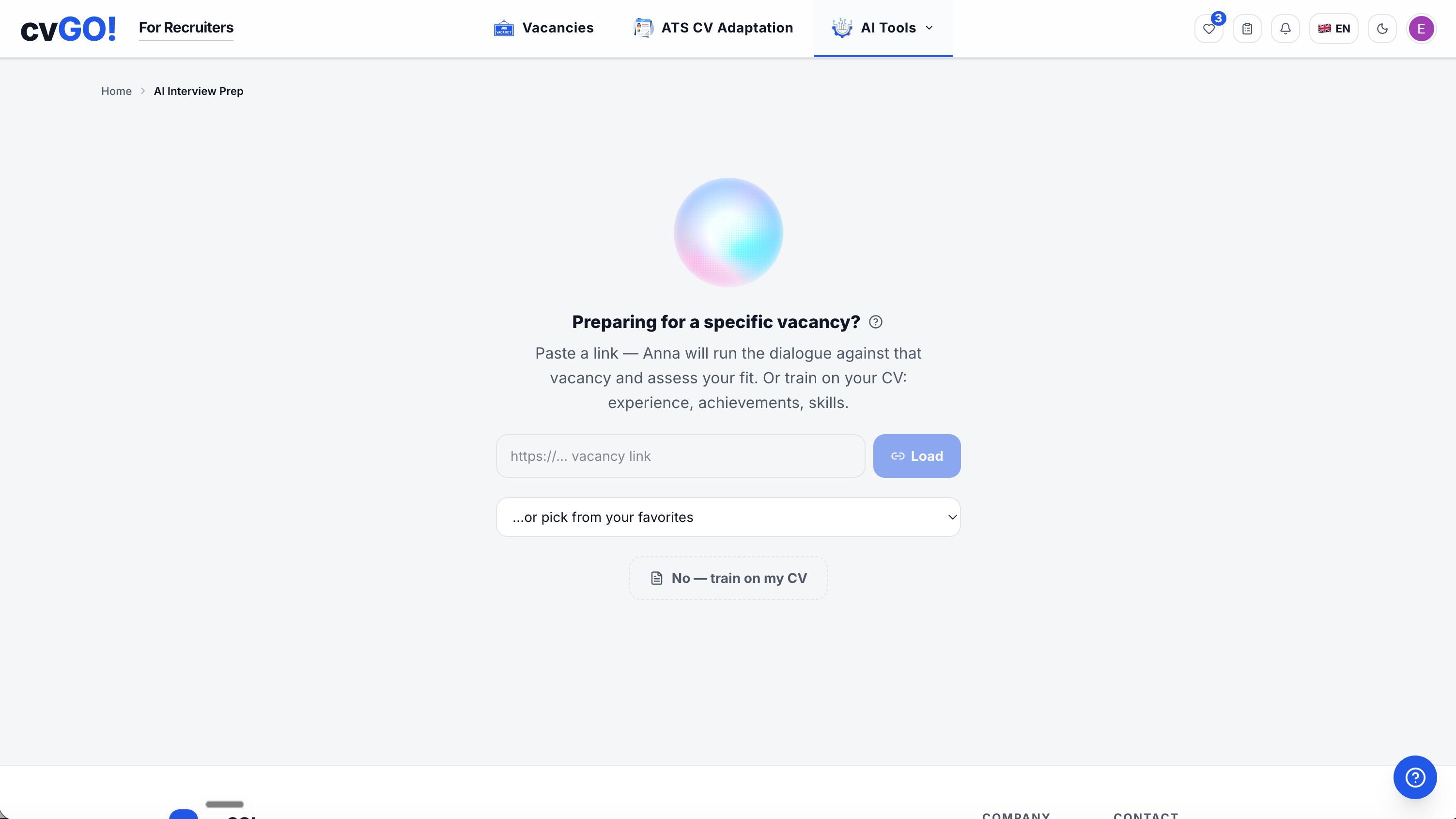
AI Interview preparation
-
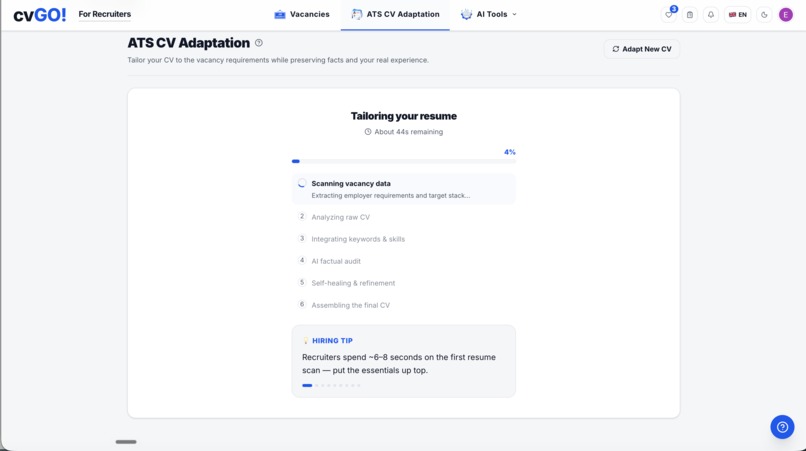
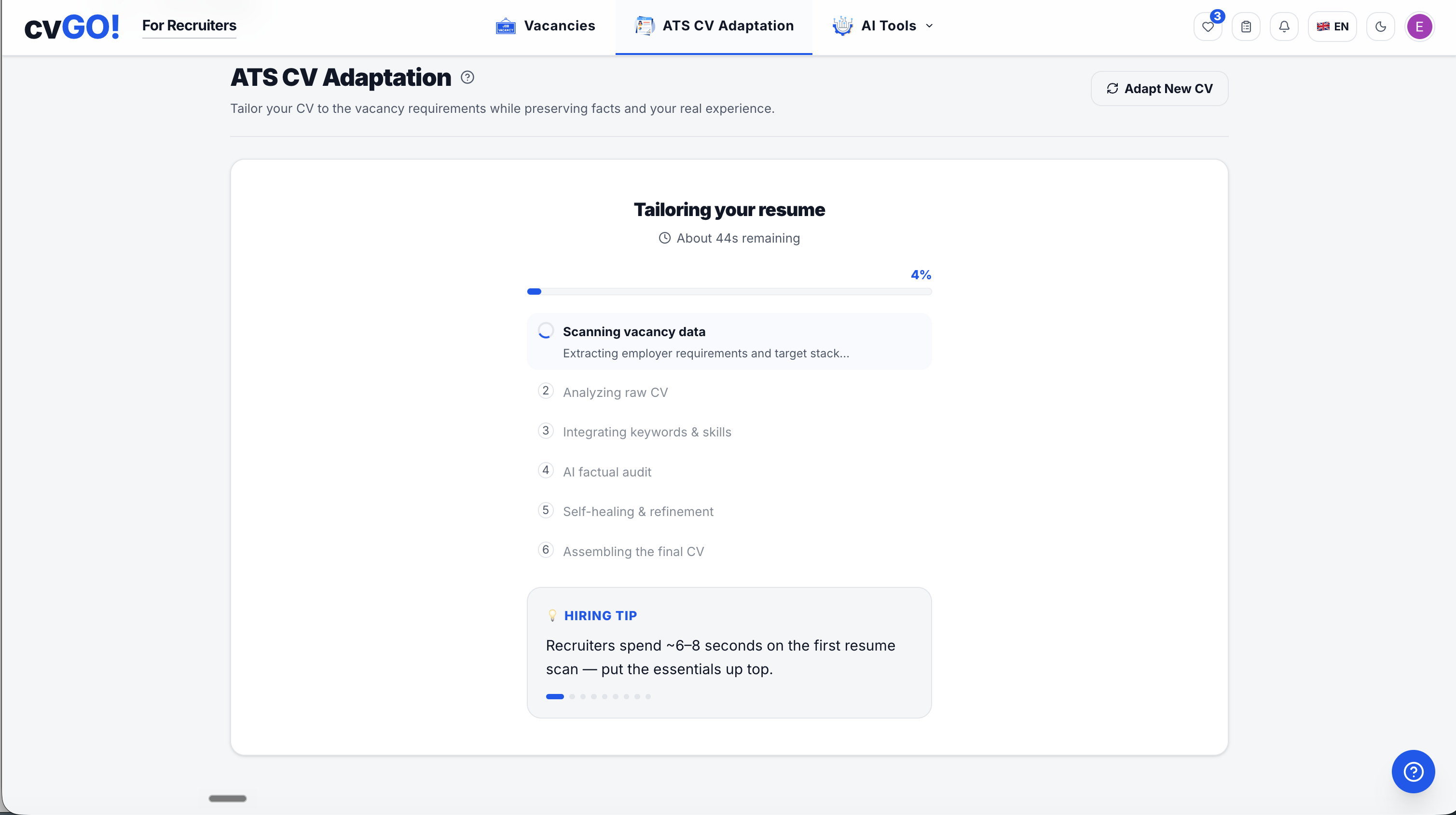
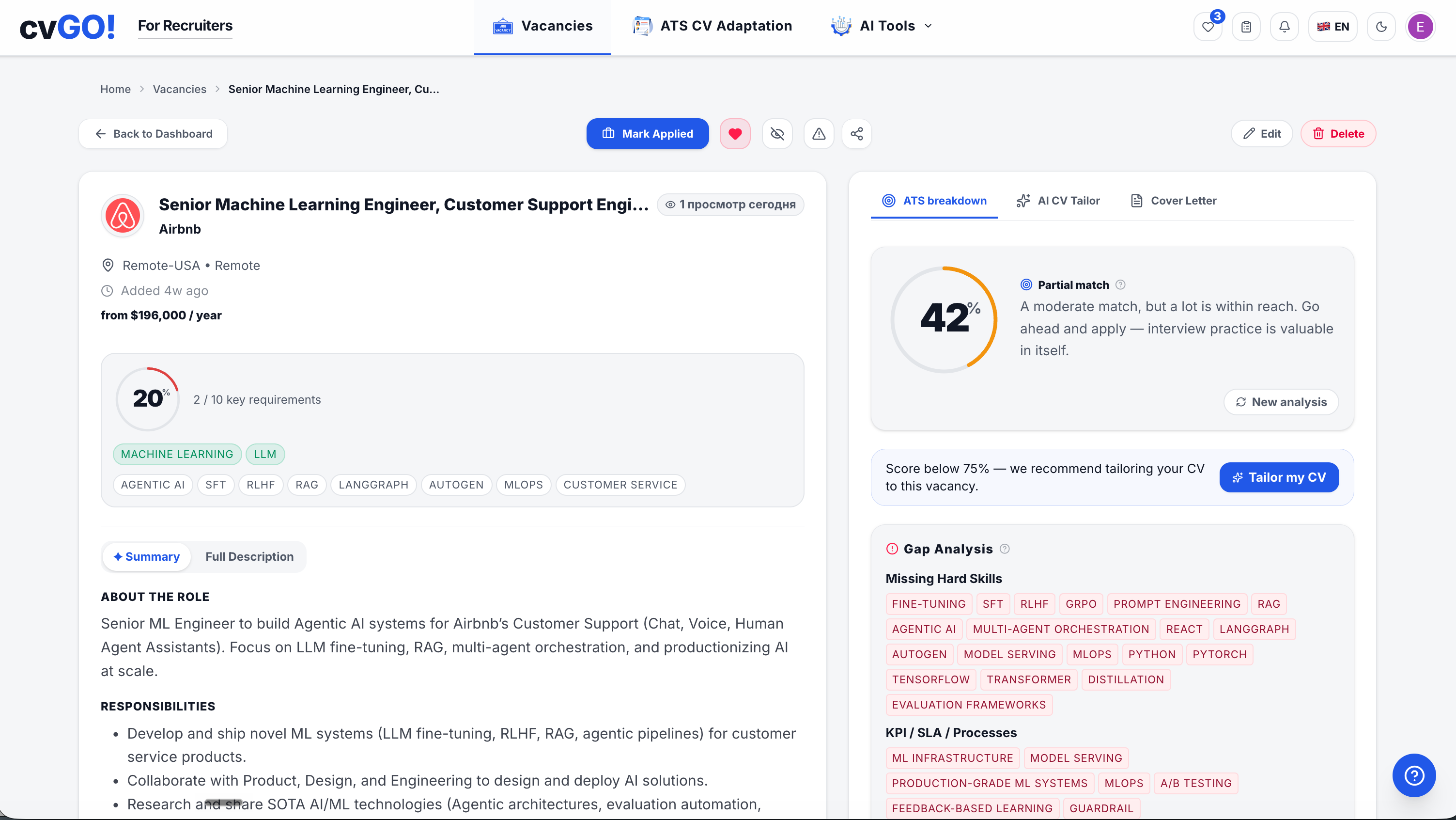
ATS analysis
-
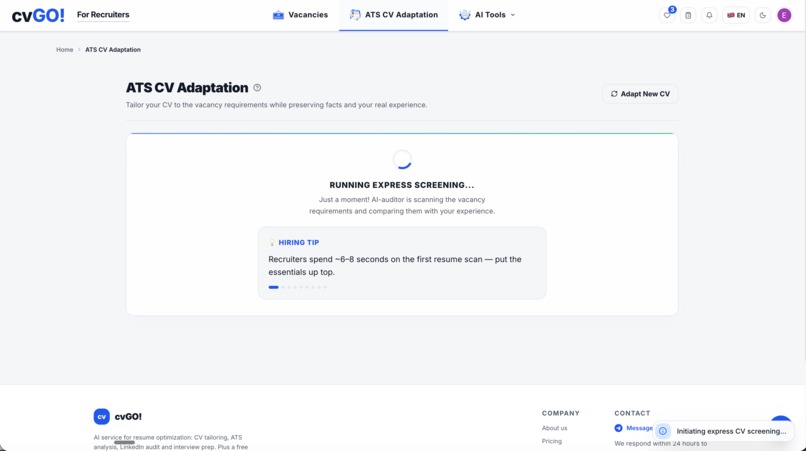
-
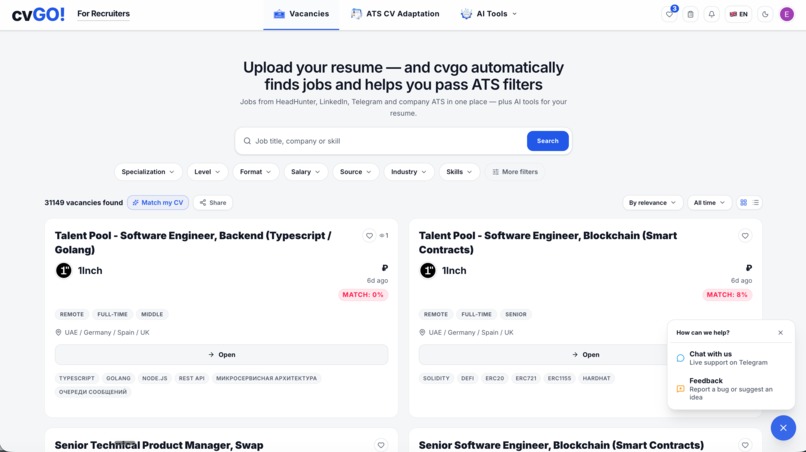
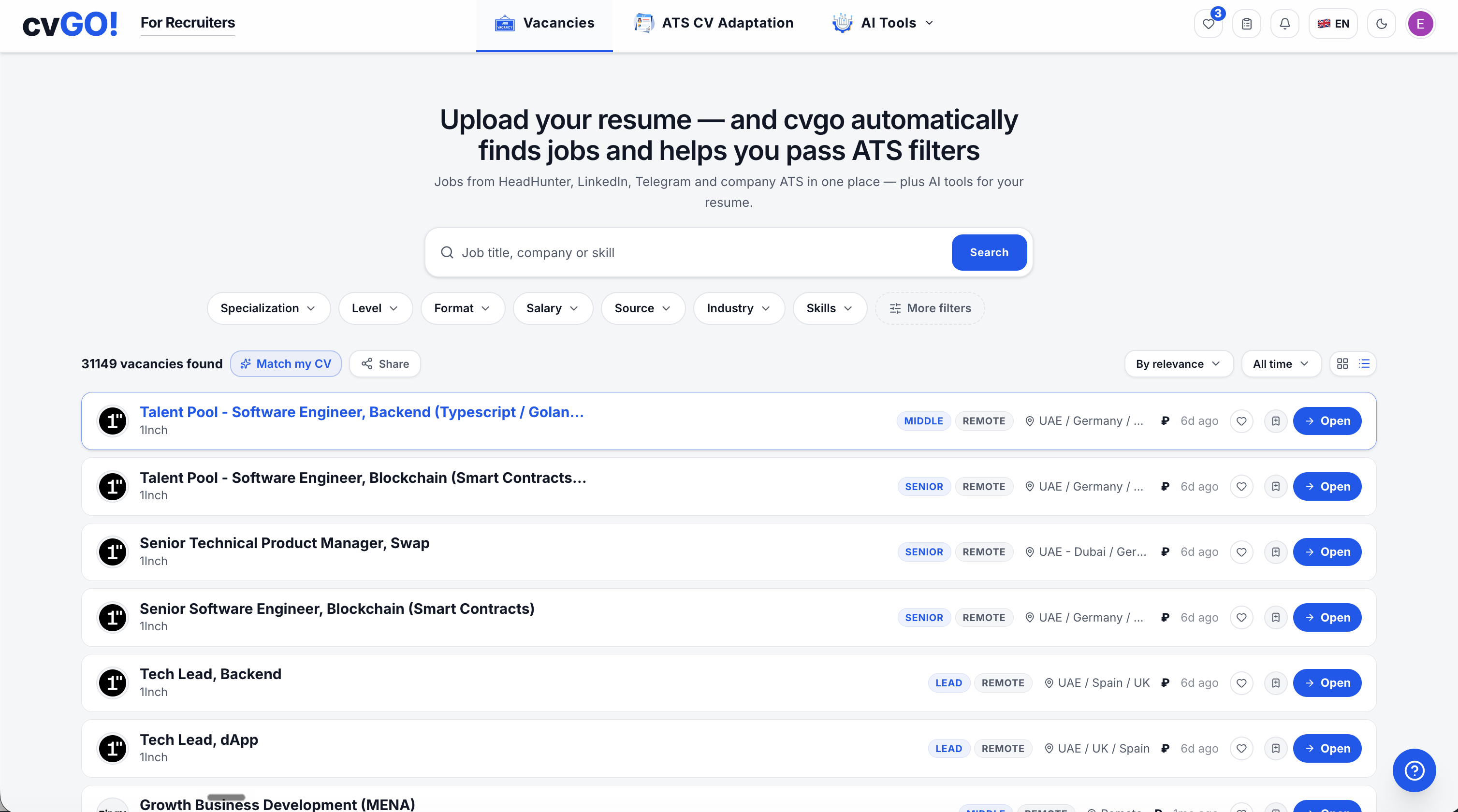
vacancies block
-
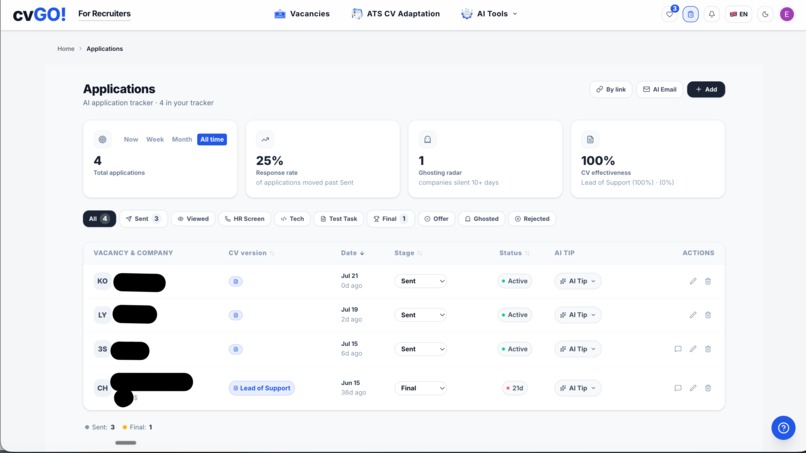
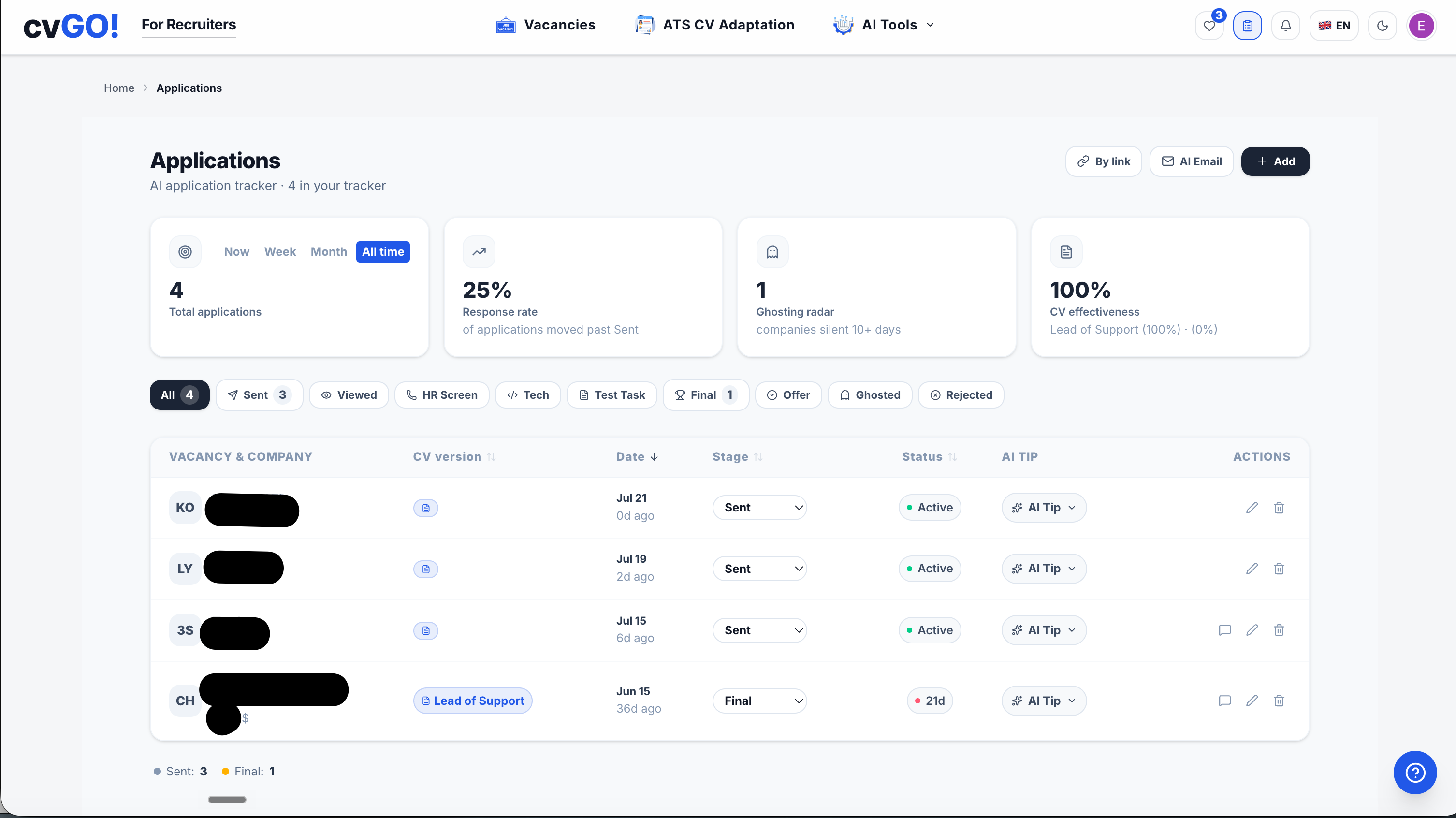
Applications
-
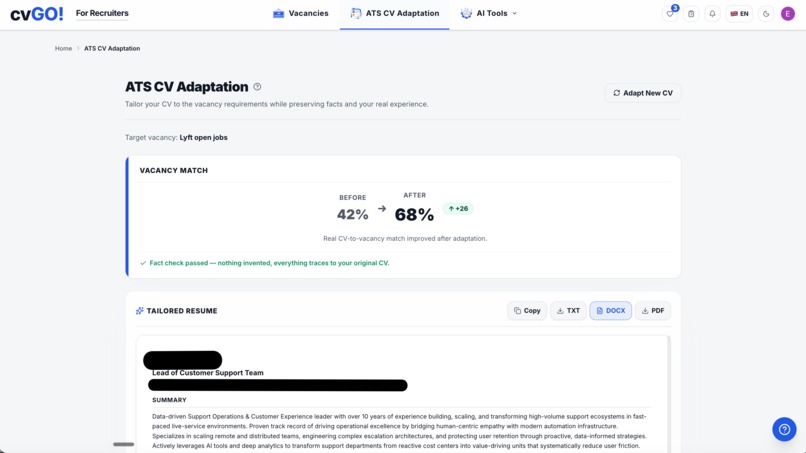
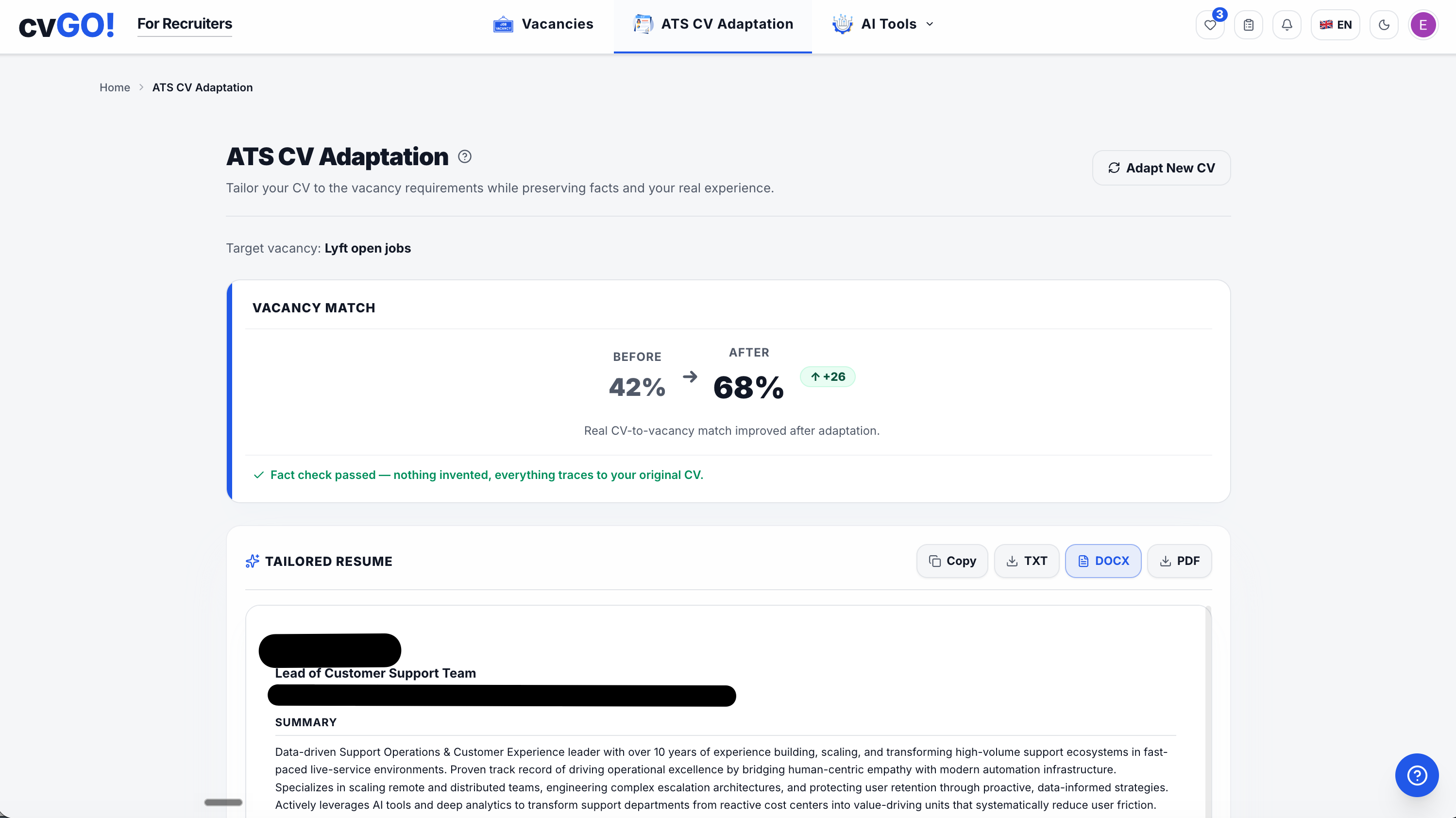
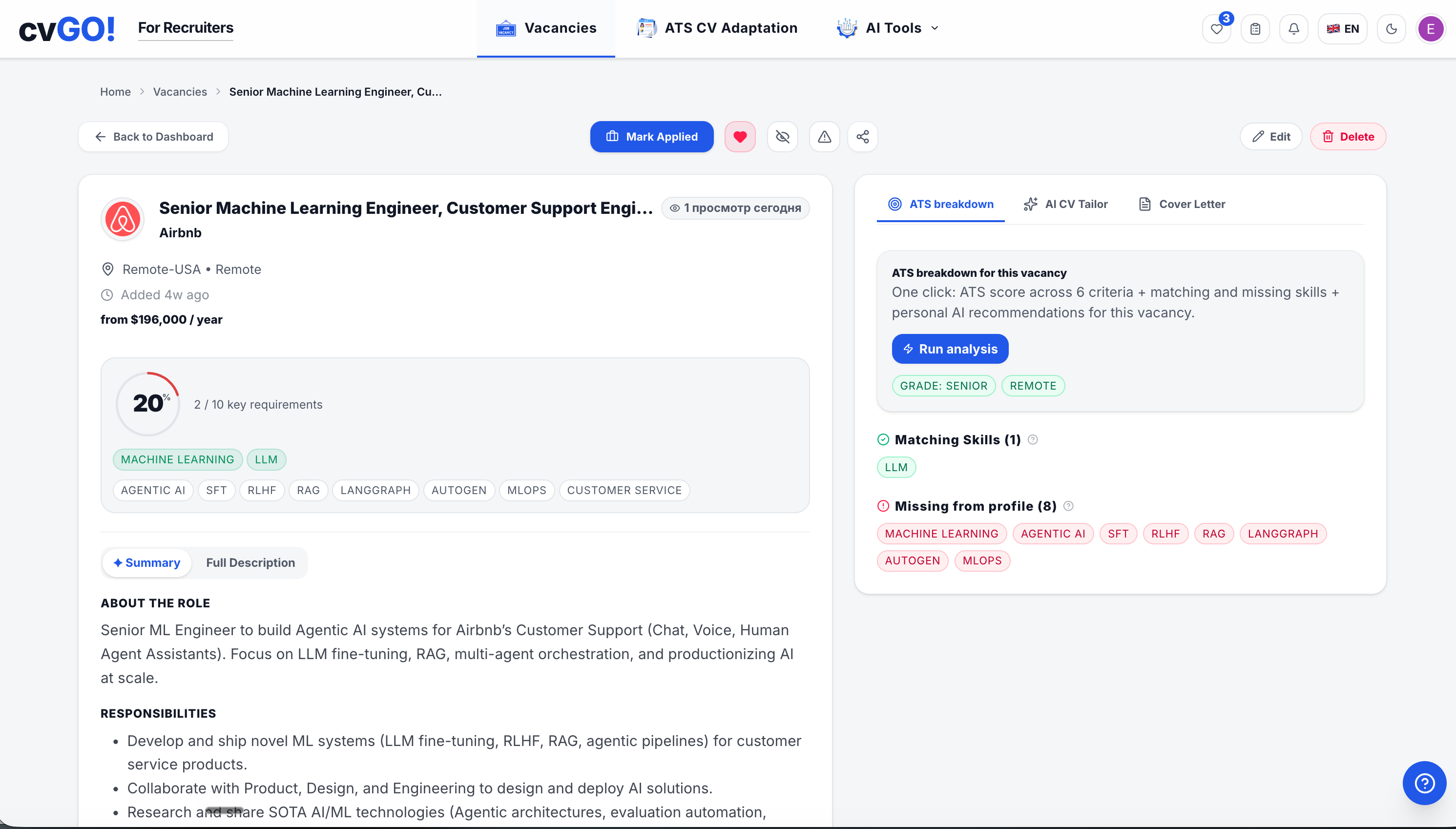
ATS analysis result
-
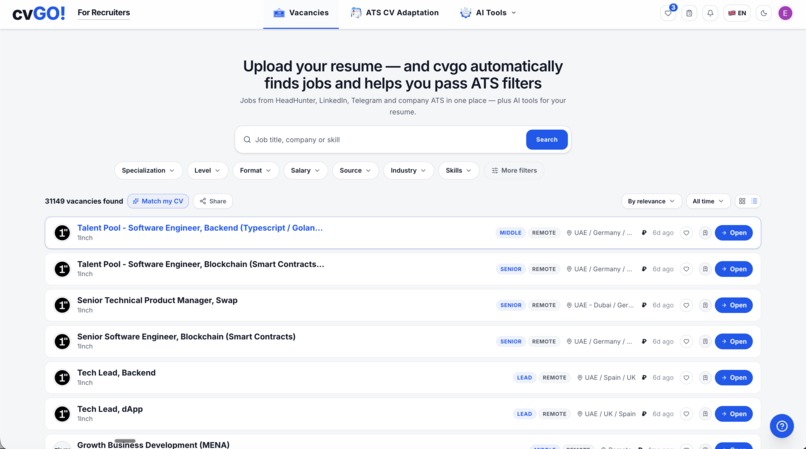
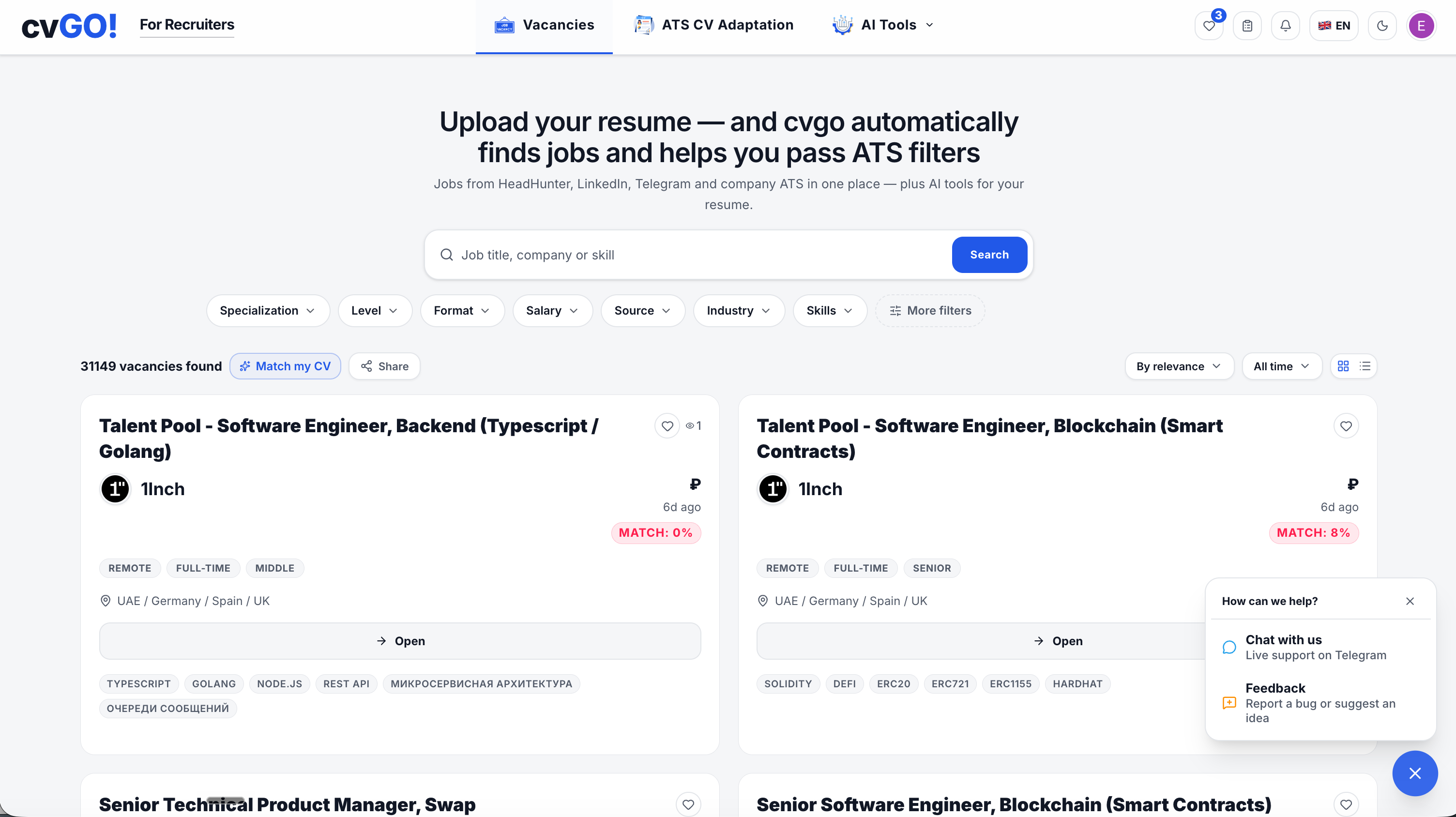
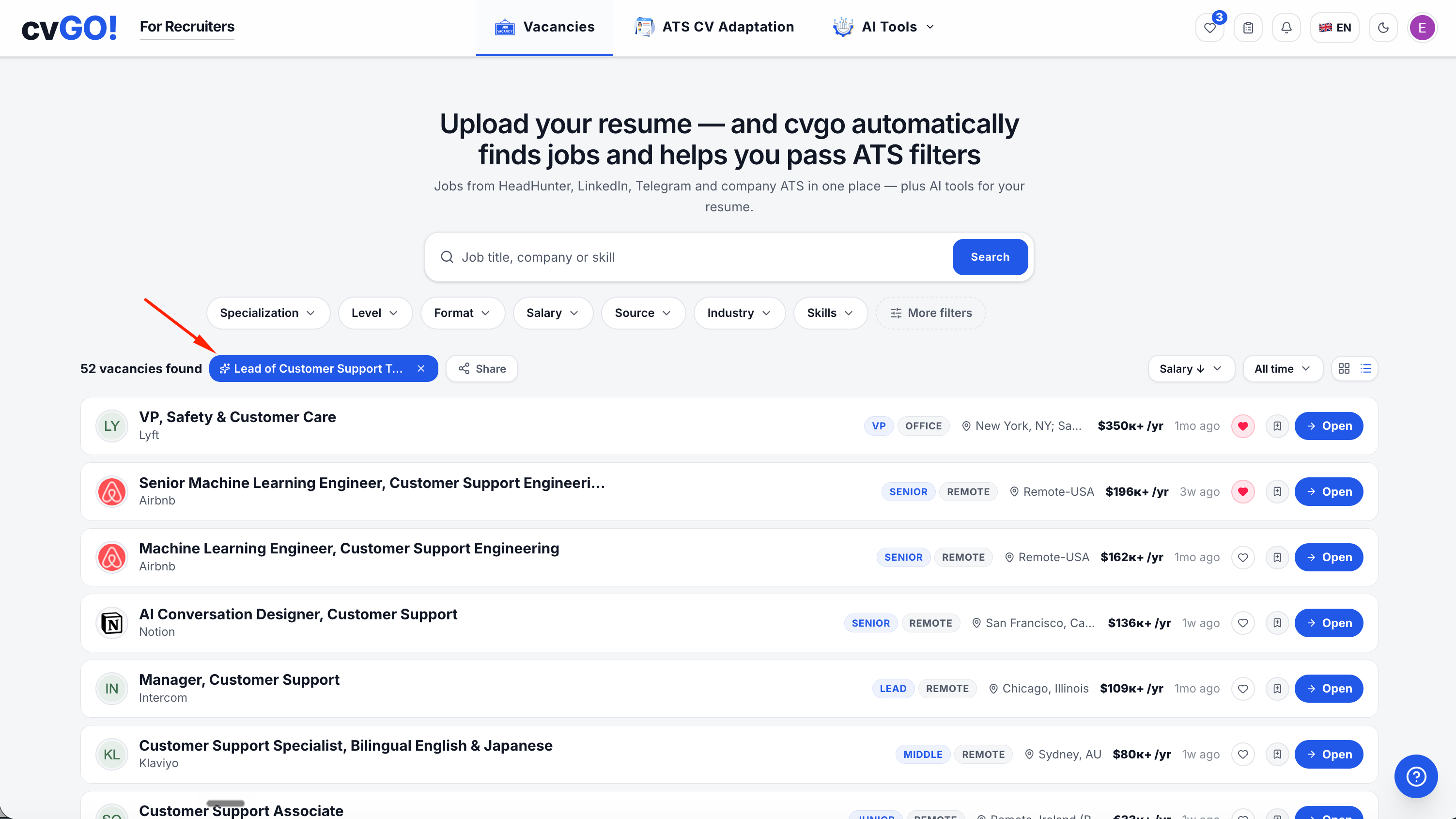
vacancies list
-
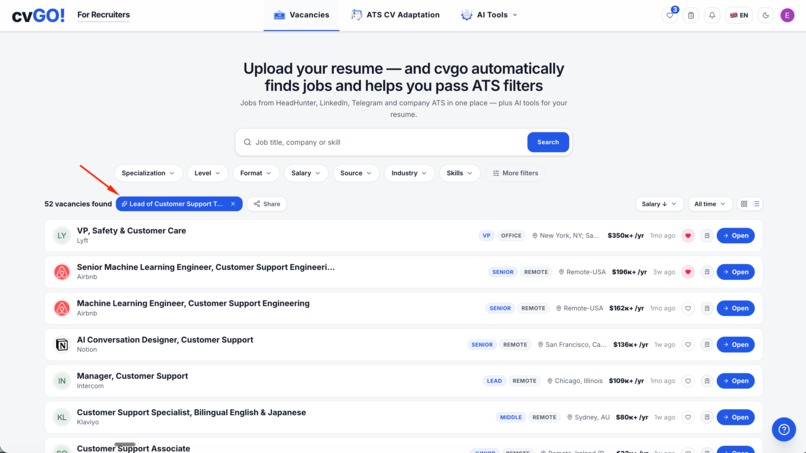
website adaptation for the vacancy
-
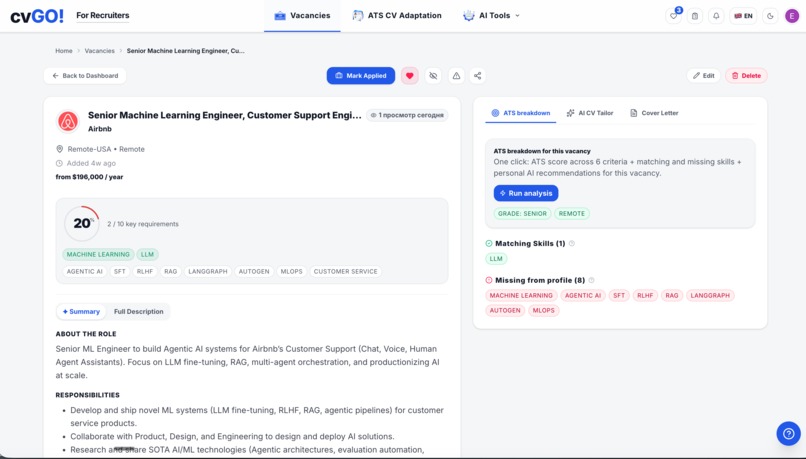
vacancy page
-
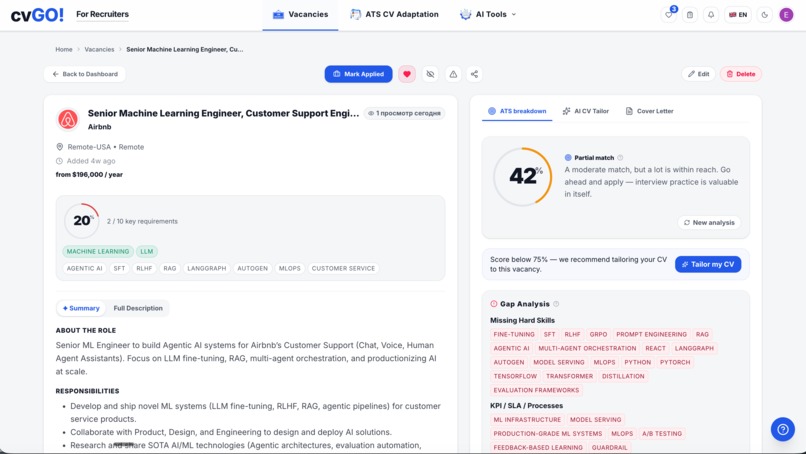
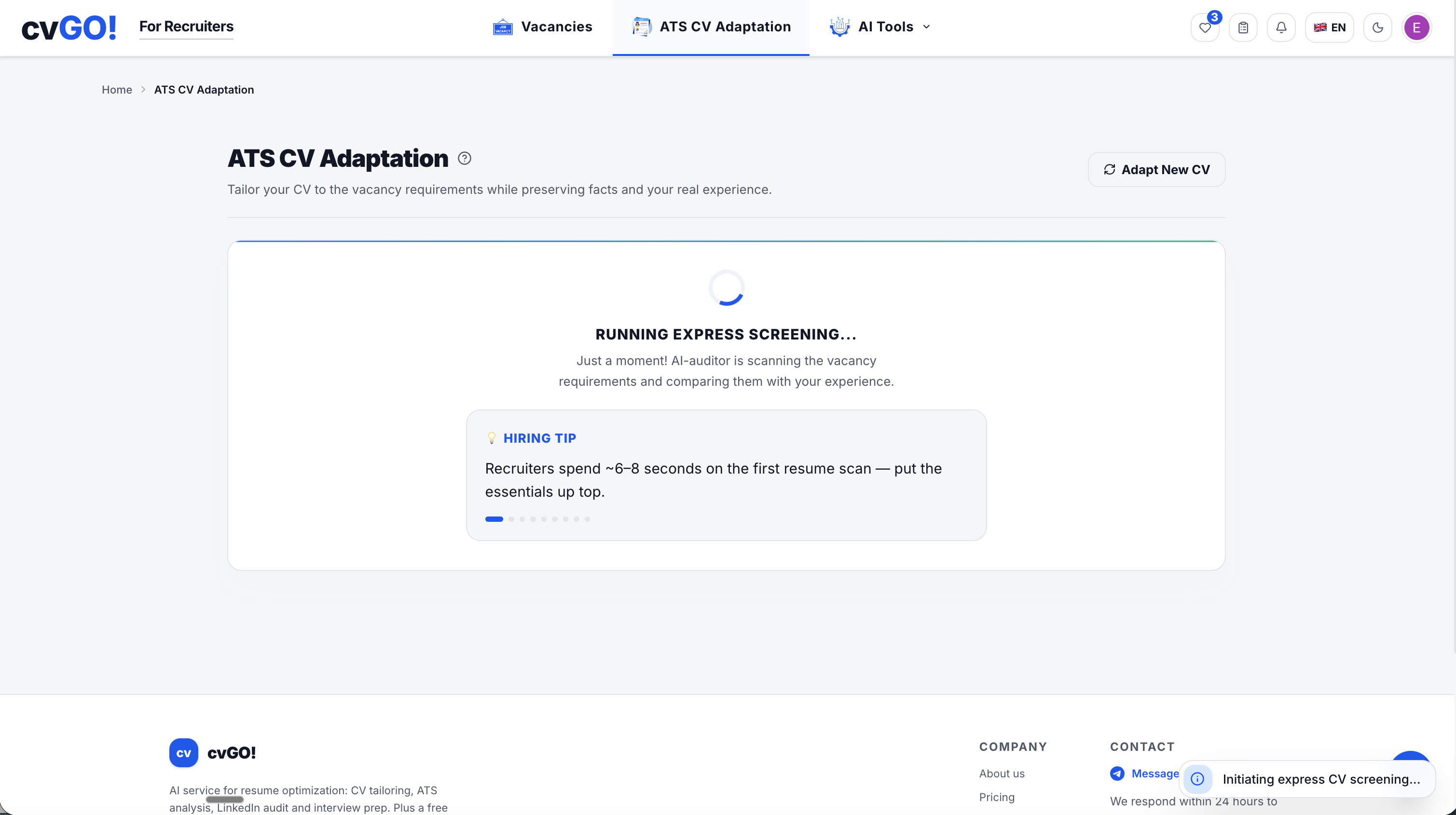
vacancy and ats analyzing
cvGO - The AI Workspace for the Entire Job Search Journey
Inspiration
Finding a job is still a fragmented, repetitive, and time-consuming process.
Candidates search across multiple job boards, compare hundreds of vacancies, repeatedly rewrite their resumes, create cover letters, research employers, and prepare for interviews using separate tools.
Even highly qualified candidates can be rejected before a recruiter reviews their experience because their resume is not aligned with an applicant tracking system or does not clearly demonstrate how their background matches a specific position.
Interview preparation creates another challenge. Static lists of common questions cannot recreate the unpredictability of a real conversation. Candidates may know what they want to say but still struggle to communicate their experience clearly and confidently during an actual interview.
We created cvGO to connect the entire job search journey in one AI-powered workspace.
Our goal is simple: help candidates find suitable opportunities faster, build stronger applications, and prepare for real interviews using their actual professional experience.
What it does
cvGO supports candidates throughout the complete job application journey.
The platform allows users to:
- discover vacancies aggregated from more than 1,000 job sources;
- search and review relevant opportunities in one interface;
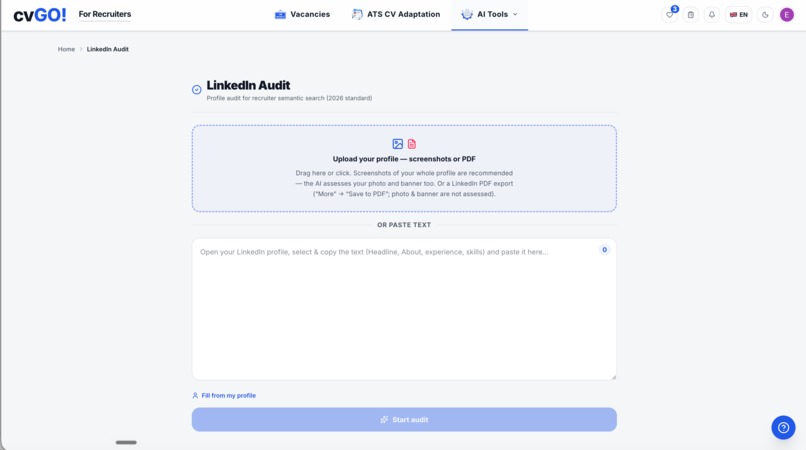
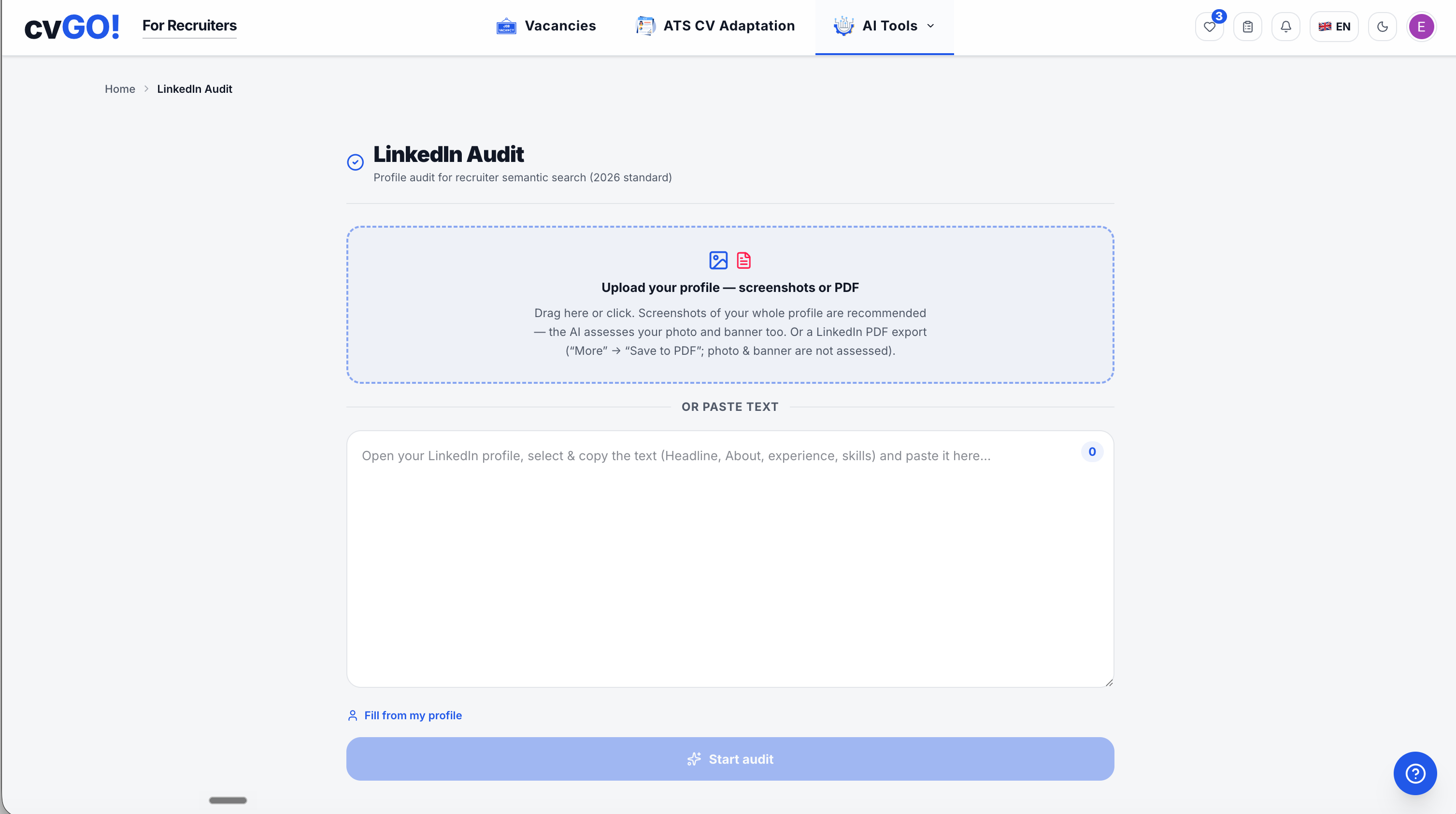
- analyze resumes and professional profiles;
- identify professional strengths, weaknesses, gaps, and missing information;
- compare a candidate's experience with a selected vacancy;
- evaluate how well a resume matches specific job requirements;
- adapt resumes for individual vacancies and ATS filters;
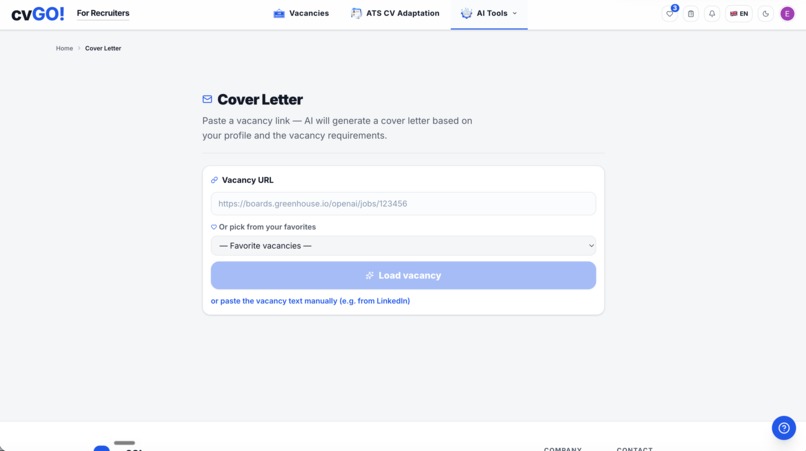
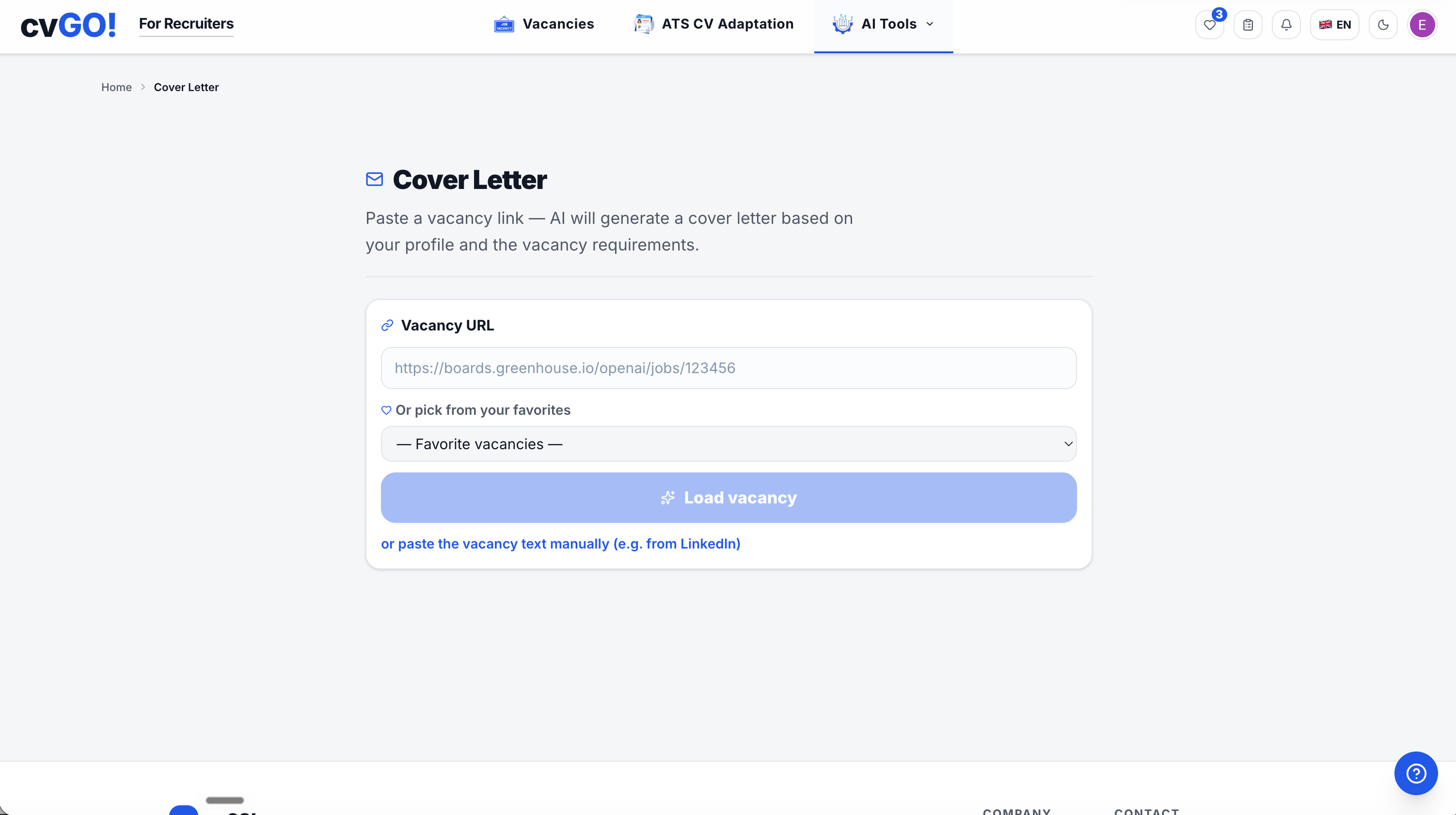
- generate personalized cover letters;
- create vacancy-specific interview preparation materials;
- conduct realistic AI-powered voice interviews;
- receive contextual follow-up questions based on previous answers;
- receive personalized feedback on interview performance.
Instead of switching between job boards, resume tools, AI writing assistants, and interview preparation services, users can complete the entire workflow inside cvGO.
The main value of cvGO is not simply generating more text.
The platform helps candidates focus on relevant opportunities, understand how their experience matches a role, communicate their strengths more effectively, and move faster toward the right job.
How we built it
We designed cvGO as a modular platform connecting three core types of information:
- Vacancy data
- Candidate data
- AI-generated analysis, recommendations, and career tools
Each part of the platform uses the same candidate and vacancy context, creating one continuous workflow instead of a collection of disconnected AI features.
Job ingestion and normalization
cvGO collects vacancy data from more than 1,000 job sources.
Different sources use different formats, job titles, locations, employment types, skill descriptions, and data structures.
We normalize this information into a consistent format that can be searched, filtered, and analyzed.
This allows candidates to access opportunities from a large number of sources without manually checking every platform.
Resume and professional profile analysis
Users can upload their resume or provide professional profile information.
cvGO extracts and analyzes:
- work experience;
- professional skills;
- measurable achievements;
- responsibilities;
- career progression;
- education;
- professional strengths;
- missing or unclear information.
This information forms a structured candidate profile that can be reused across the platform.
Job-to-candidate matching
When a user selects a vacancy, cvGO compares the job requirements with the candidate's resume.
The platform identifies:
- areas of strong alignment;
- relevant professional experience;
- transferable skills;
- missing or unclear requirements;
- important terminology and keywords;
- experience that should be explained more clearly;
- potential reasons the application may be rejected.
The objective is not to create a fictional perfect candidate.
cvGO helps users understand how their real experience relates to a specific opportunity and how to present that experience more effectively.
ATS resume adaptation
cvGO helps candidates adapt their resumes to individual vacancies and applicant tracking systems.
The platform improves the relevance of skills, terminology, achievements, and experience descriptions while preserving readability for recruiters and hiring managers.
AI-generated recommendations remain grounded in the candidate's actual professional background.
cvGO is designed to improve the presentation of real experience, not to invent qualifications, responsibilities, skills, or achievements.
Cover letter generation
Using the candidate's resume and the selected vacancy, cvGO generates a contextual cover letter.
Instead of producing a generic template, the platform connects the employer's requirements with the candidate's relevant experience, achievements, motivation, and professional strengths.
Interview preparation
cvGO creates personalized interview preparation materials based on the selected vacancy and candidate profile.
The platform can generate:
- role-specific interview questions;
- behavioral and technical questions;
- questions about the candidate's experience;
- questions related to possible resume gaps;
- preparation topics;
- suggested talking points;
- recommendations for improving answers.
This helps candidates prepare for a specific opportunity instead of practicing with a generic list of questions.
AI voice interview coach
cvGO includes an AI-powered voice interview coach that allows candidates to practice a realistic interview directly inside the platform.
Before the interview begins, cvGO analyzes:
- the candidate's resume;
- the selected vacancy;
- the role's required skills;
- the candidate's relevant achievements;
- possible gaps or unclear areas in the candidate's experience.
The AI interviewer then conducts a personalized voice interview based on this context.
Unlike a static interview simulator, the voice interviewer can react to the candidate's responses and continue the conversation with contextual follow-up questions.
The AI interviewer can:
- ask vacancy-specific questions in real time;
- generate follow-up questions based on previous answers;
- explore incomplete or unclear responses;
- ask candidates for specific examples and measurable results;
- evaluate how clearly candidates communicate their experience;
- identify weak, vague, or overly general answers;
- provide personalized feedback after the interview.
This allows candidates to practice not only what they want to say, but also how they communicate their experience under realistic interview conditions.
How we used Codex and GPT-5.6
We used Codex and GPT-5.6 throughout the development of cvGO.
Codex helped us:
- analyze and navigate the codebase;
- transform product requirements into implementation plans;
- develop and refine product features;
- improve the platform architecture;
- debug technical issues;
- review integrations;
- identify edge cases;
- improve user flows;
- implement the AI voice interview experience;
- accelerate iteration across the product.
GPT-5.6 supported reasoning-intensive workflows, including:
- resume analysis;
- vacancy analysis;
- job-to-candidate comparison;
- ATS resume adaptation;
- cover letter generation;
- interview question generation;
- contextual follow-up questions;
- candidate answer evaluation;
- personalized interview feedback.
One of our main priorities was keeping AI-generated outputs grounded in real candidate and vacancy data instead of producing generic, exaggerated, or fabricated content.
Challenges we ran into
Normalizing data from different job sources
Job platforms use different data structures, naming conventions, employment formats, locations, and descriptions.
Transforming heterogeneous vacancy data into a consistent and searchable format was one of our most significant technical challenges.
Avoiding generic AI output
AI-generated resumes, cover letters, and interview questions are only useful when they reflect the candidate's actual experience and the requirements of a specific vacancy.
We had to design workflows that produce contextual and actionable results instead of generic career advice.
Preventing fabricated experience
When adapting a resume to a vacancy, an AI system may attempt to fill missing requirements with plausible but unverified information.
We focused on ensuring that cvGO improves the presentation of existing experience without inventing skills, qualifications, responsibilities, or achievements.
Balancing ATS optimization with human readability
Optimizing a resume only for keyword matching can create unnatural, repetitive, and difficult-to-read content.
We worked to balance ATS relevance with credibility, clarity, and readability for human recruiters and hiring managers.
Building a realistic voice interview
A realistic interview requires more than reading a predefined list of questions aloud.
The AI interviewer needs to understand the vacancy, use information from the resume, remember previous answers, recognize incomplete responses, and determine which follow-up question should come next.
Creating a coherent voice conversation while keeping the interview grounded in the candidate's actual experience and target vacancy was one of the most complex parts of the product.
Connecting multiple features into one workflow
Job aggregation, resume analysis, ATS adaptation, cover letter generation, interview preparation, and voice interviews can easily feel like separate products.
One of our main product challenges was connecting these capabilities into a coherent journey where every completed step leads to a clear next action.
Building under time constraints
Building and refining a complete working product within a limited timeframe required fast but controlled iteration.
Codex helped us move efficiently from product requirements and architectural decisions to implementation, debugging, testing, and refinement.
Accomplishments that we're proud of
- Built an end-to-end job search and application workflow in one platform
- Connected vacancy discovery with resume analysis and application preparation
- Created a vacancy parser covering more than 1,000 job sources
- Developed vacancy-specific candidate and resume analysis
- Built ATS-focused resume adaptation grounded in real candidate data
- Added contextual cover letter generation
- Added personalized interview preparation
- Built an AI-powered voice interview coach
- Connected voice interviews to the candidate's resume and selected vacancy
- Added contextual follow-up questions during interview practice
- Designed a clear workflow across several complex AI features
- Used Codex and GPT-5.6 to accelerate product development
- Prioritized accuracy, transparency, and user control
What we learned
We learned that AI career products should not be built as isolated text generators.
The real value comes from connecting structured vacancy data, candidate context, and actionable next steps.
A useful AI career platform needs to understand:
- which position the candidate is targeting;
- what professional experience the candidate actually has;
- how that experience relates to the vacancy;
- which requirements are missing or unclear;
- what the candidate should improve;
- what action the candidate should take next.
We also learned that interview preparation becomes significantly more valuable when AI can participate in a real conversation.
A static list of questions cannot react to an unclear answer, request a concrete example, or investigate a potential gap in the candidate's experience.
An interactive voice interview creates a continuous learning loop:
- The AI asks a contextual question.
- The candidate answers in their own words.
- The AI evaluates the response.
- The AI asks a relevant follow-up question.
- The candidate receives personalized feedback.
Trust remains essential throughout the process.
Candidates need to understand why a change or recommendation is suggested and remain in control of their final resume, cover letter, application strategy, and interview answers.
AI should help candidates communicate their real experience more effectively, not create an unrealistic professional identity.
What's next for cvGO
Our next step is to make the AI voice interview coach even more realistic and useful.
Planned improvements include:
- deeper answer evaluation;
- structured interview performance scoring;
- communication and clarity analysis;
- multilingual voice interviews;
- different interviewer personalities and difficulty levels;
- role-specific technical interview modes;
- detailed post-interview reports;
- progress tracking across multiple practice sessions;
- comparisons between previous and current interview performance.
We also plan to improve:
- personalized job recommendations;
- application tracking;
- feedback loops based on application outcomes;
- regional and language coverage;
- recruiter-style resume evaluation;
- explanations for AI-generated suggestions;
- progress tracking from application to interview and job offer.
Our long-term vision is to make cvGO a complete AI career workspace that supports candidates through every stage of the hiring journey - from discovering the right opportunity and preparing an application to practicing a realistic voice interview and receiving a job offer.
Built With
- ai
- codex
- css
- docker
- fastapi
- github
- gpt-5.6
- javascript
- natural
- next.js
- node.js
- openai
- playwright
- postgresql
- processing
- python
- react
- rest
- scraping
- tailwind
- typescript
- vercel


Log in or sign up for Devpost to join the conversation.