Inspiration
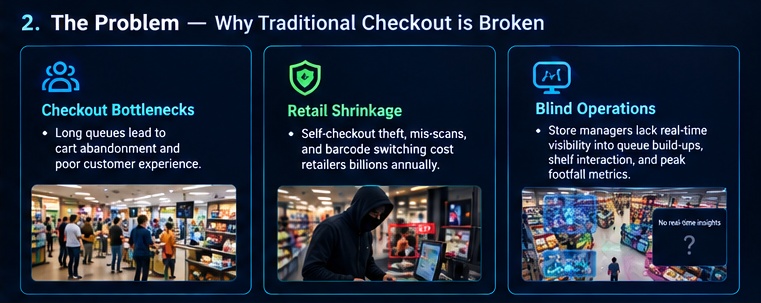
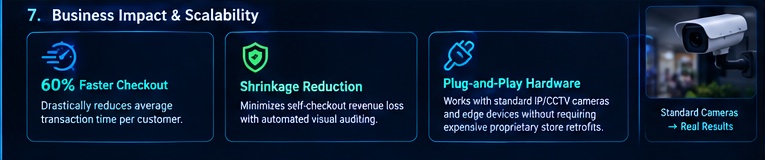
Long checkout lines, human cashier bottlenecks, and retail shrinkage continue to plague physical retail stores. While automated grab-and-go technology exists, legacy solutions often require thousands of dollars in specialized ceiling sensors and shelf weight scales. We wanted to build a accessible, edge-to-cloud automated checkout and shopper analytics system using standard computer vision cameras powered by OpenCV and scalable AWS cloud infrastructure.
What it does
CV-Powered Retail Checkout & Analytics automates the entire in-store journey:
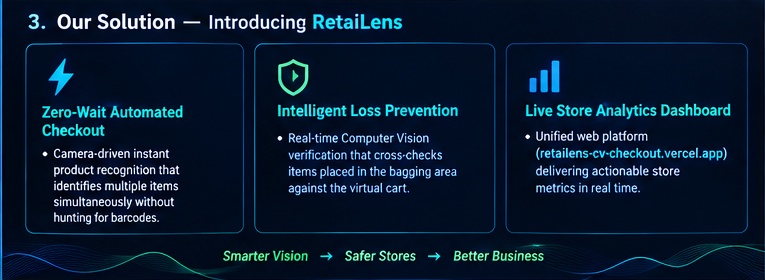
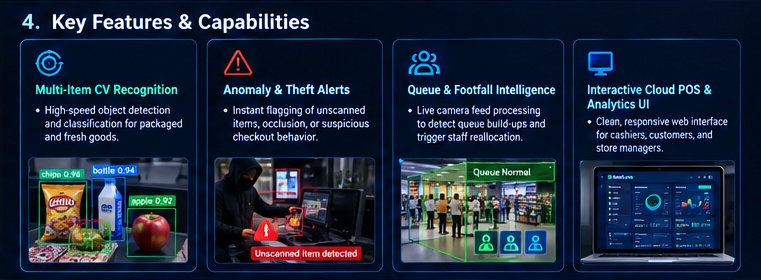
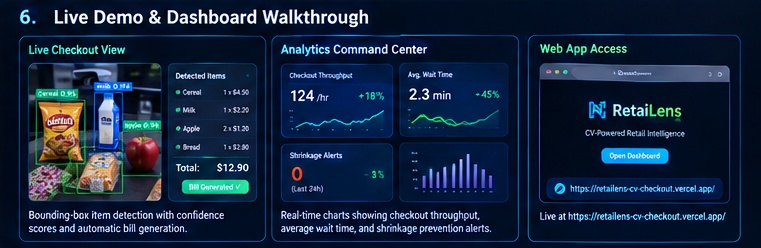
- Frictionless Checkout: Detects and classifies products placed on a checkout counter or scanned by customer view in real time using edge computer vision, instantly generating a digital cart without manual barcode scanning.
- Loss Prevention & Cart Verification: Tracks hand-to-item interactions to ensure all items packed correspond to the generated bill, flagging unpaid or occluded items.
- Store & Shopper Analytics: Measures footfall, queue dwell times, and shelf engagement heatmaps, sending aggregated telemetry to the cloud to help store managers optimize layouts and restock shelves proactively.
How we built it
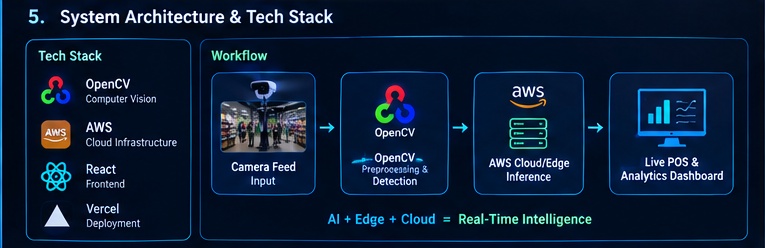
- Computer Vision & Inference (OpenCV & Python): We built an edge pipeline utilizing OpenCV for video feed ingestion, pre-processing, object detection, and multi-object tracking.
- Model Training & Fine-Tuning: Trained a lightweight object detection model to identify retail packaging, labels, and SKUs under varying lighting conditions and angles.
- Cloud Architecture & Scalability (AWS):
- AWS IoT Core / Kinesis: Streamed video metadata and retail event telemetry from edge cameras to the cloud.
- AWS Lambda & Amazon DynamoDB: Handled serverless processing of transaction events, cart state management, and instant bill generation.
- Amazon S3 & QuickSight: Stored historical data and generated executive analytics dashboards covering store occupancy, product turnover, and shrinkage alerts.
Challenges we ran into
- Handling Occlusion & Fast Motion: Multiple items held close together or items being moved quickly created intermittent bounding-box flicker. We addressed this by integrating persistent centroid tracking alongside confidence thresholds in OpenCV.
- Edge vs. Cloud Latency: Processing raw high-resolution video streams entirely in the cloud introduced bandwidth constraints and latency. We optimized our pipeline to execute lightweight inference at the edge, sending only extracted bounding-box metadata and transaction events to AWS.
- Varying Retail Lighting: Overhead store glare made barcode and label recognition difficult, which we mitigated using OpenCV histogram equalization and adaptive thresholding techniques.
Accomplishments that we're proud of
- Achieved sub-second detection and billing updates on standard edge camera hardware.
- Maintained low operational cloud costs by offloading video processing to the edge and using serverless AWS resources solely for event handling.
- Built an end-to-end working pipeline that bridges edge computer vision with actionable enterprise store analytics.
What we learned
- Best practices for designing real-time, fault-tolerant video processing pipelines with OpenCV.
- Structuring efficient edge-to-cloud IoT architectures on AWS without incurring high streaming bandwidth costs.
- The nuances of synthetic data generation and data augmentation for retail shelf items.
What's next for CV-Powered Retail Checkout & Analytics
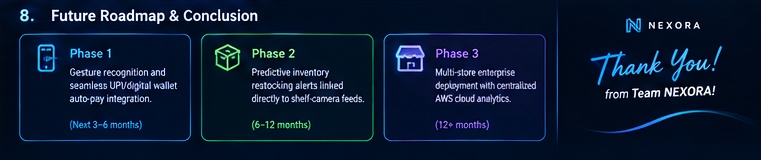
- Edge Acceleration: Deploying and quantizing the model to run on dedicated edge AI silicon (such as OAK cameras / AWS Panorama) for even higher FPS.
- Omnichannel Payment Integration: Integrating one-tap mobile and biometrics-assisted checkout for instant walk-out transactions.
- Predictive Stock Replenishment: Using AWS SageMaker forecasting models on accumulated shopper dwell data to predict stock-outs before shelves run empty.
Built With
- lucid-react
- react
- tailwind-css


Log in or sign up for Devpost to join the conversation.