Inspiration
I run a kids' educational YouTube channel. Every video needs animated visuals, voiceover, music, and editing — which means expensive software and 4-8 hours per upload. Most teachers and educational content creators have the same problem: great lesson ideas, no practical way to turn them into engaging videos. I wanted to make video creation as simple as describing a lesson in a conversation.
## What it does
CutTo is an AI Video Director that turns any idea into a finished cinematic video. You describe what you want (via text or voice), and CutTo:
- Shapes the vision — A creative AI director collaborates on the concept with genuine enthusiasm and strong creative opinions
- Plans the video — Gemini generates a scene-by-scene plan with inline preview images (interleaved text + image output) so you see the visual direction before committing
- Lets you edit — An interactive scene editor lets you modify narration, visuals, speakers, reorder scenes, and ask the AI for revisions in natural language
- Generates the video — Veo 3.0 creates cinematic video clips using FLOW-decomposed prompts, Cloud TTS produces natural voiceover, and FFmpeg assembles everything with crossfade transitions
- Delivers the result — Watch, download, and upload the finished MP4
Supports 6 video categories: animated stories, science explainers, documentaries, tutorials, marketing videos, and motivational pieces.
## How we built it
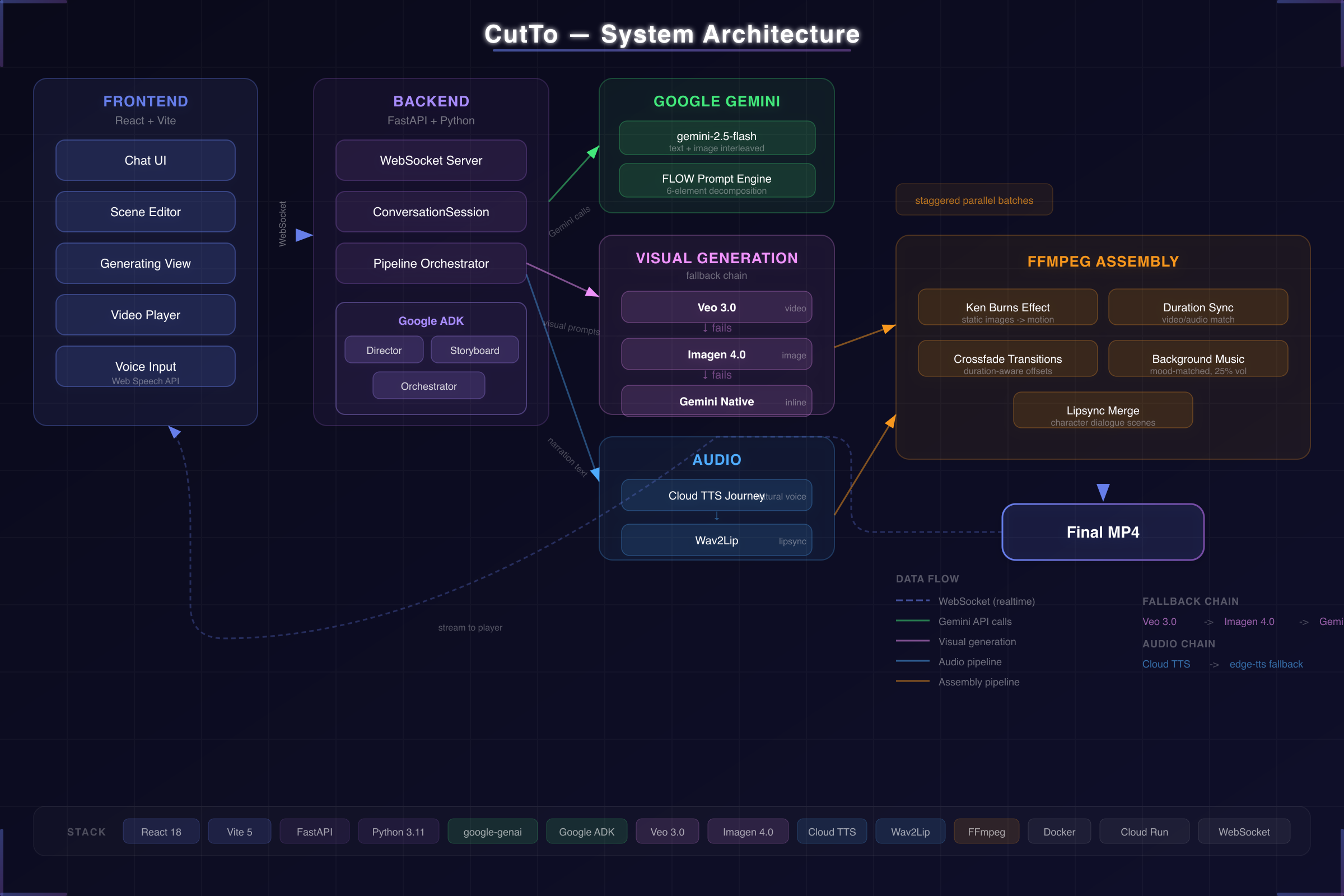
- Frontend: React 18 + Vite 5, WebSocket communication, Web Speech API for voice input
- Backend: Python 3.11 + FastAPI, WebSocket server, pipeline orchestrator
- AI Conversation: Gemini 2.5 Flash (interleaved text + image) via google-genai SDK
- ADK Integration: Multi-agent architecture with 3 specialized agents (Creative Director, Storyboard Artist, Orchestrator) using Google ADK with 4 function tools
- Video Generation: Veo 3.0 with FLOW-decomposition prompt engineering and fallback chain to Imagen 4.0
- Prompt Engineering: Every visual prompt is decomposed into 6 elements (subject, action, camera, lighting, palette, texture) then reconstructed into a cinema-grade shot brief
- Voice Synthesis: Google Cloud TTS (Journey/Chirp3 HD voices) with edge-tts fallback
- Video Processing: FFmpeg for fps normalization, crossfade transitions, Ken Burns effect, and clip assembly
- Testing: 119 automated tests covering pipeline, services, agent, API, and ADK agents
## Challenges we ran into
- Veo rate limits required staggered batching and a multi-level fallback chain (Veo → Imagen → Gemini native image)
- Mixed frame rates (24fps vs 30fps) from different Veo generations broke crossfade transitions — solved by normalizing all clips before assembly
- Audio/video duration sync — implemented two modes with FFmpeg atempo chaining
- Gemini interleaved output requires specific model + modality configuration that differs from text-only calls
## Accomplishments that we're proud of
- End-to-end video generation from a single conversation — no editing tools needed
- FLOW prompt decomposition produces dramatically more cinematic Veo output than raw prompts
- Multi-agent ADK architecture with specialized roles
- Voice input, reference image upload, interactive scene editor, real-time progress tracking
- 119 automated tests — production-quality engineering
## What we learned
- Gemini's interleaved text + image output is the killer feature for creative tools — showing previews during conversation makes planning feel immediate
- Prompt decomposition (FLOW method) is critical for realistic Veo output
- The gap between "AI generates content" and "AI directs a production" is about persona and workflow design
- ADK's agent framework provides clean separation of concerns for multi-step creative workflows
## What's next for CutTo
- Veo 3.1 integration with native audio and reference images
- Multi-language support for global classrooms
- Template library for common educational topics
- Export to social media formats (vertical, square)
Built With
- docker
- fastapi
- ffmpeg
- gemini
- google-adk
- google-cloud-tts
- imagen
- javascript
- python
- react
- veo
- websockets

Log in or sign up for Devpost to join the conversation.