-
-
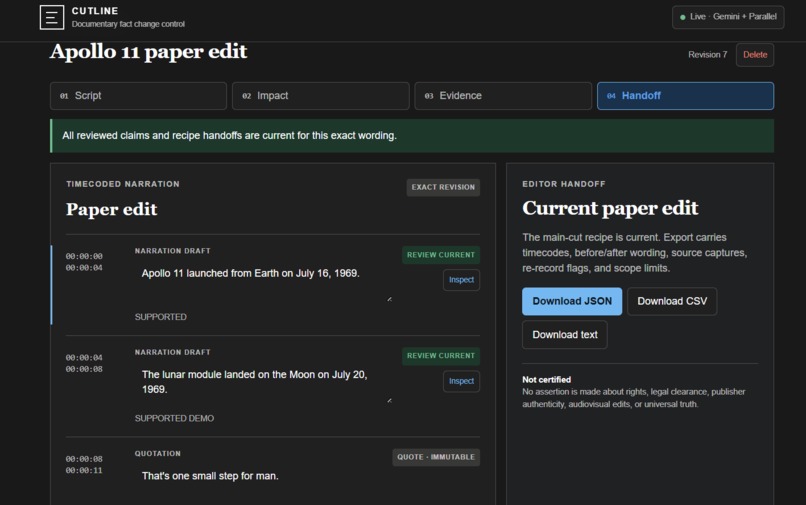
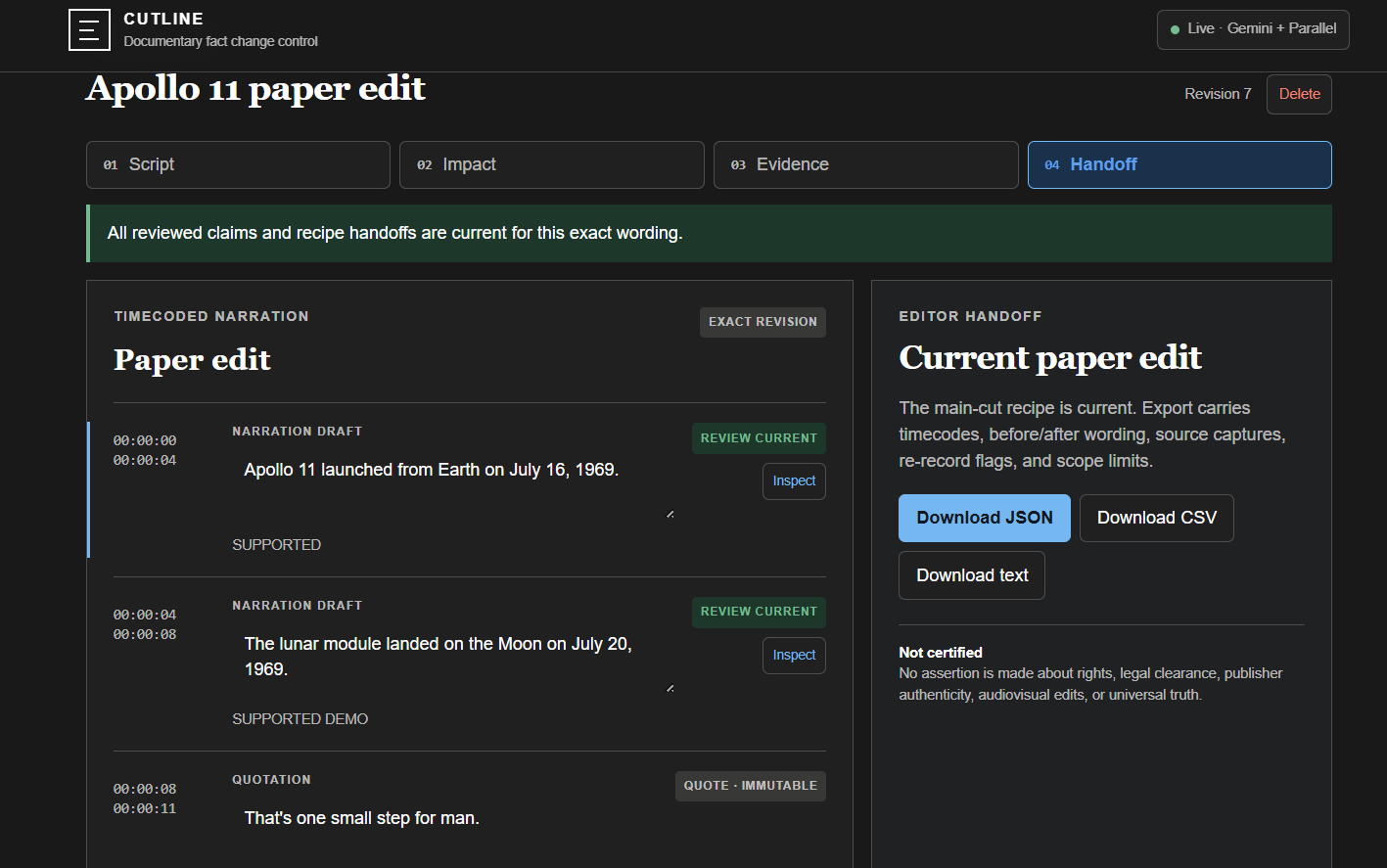
Handoff tab of Cutline
-
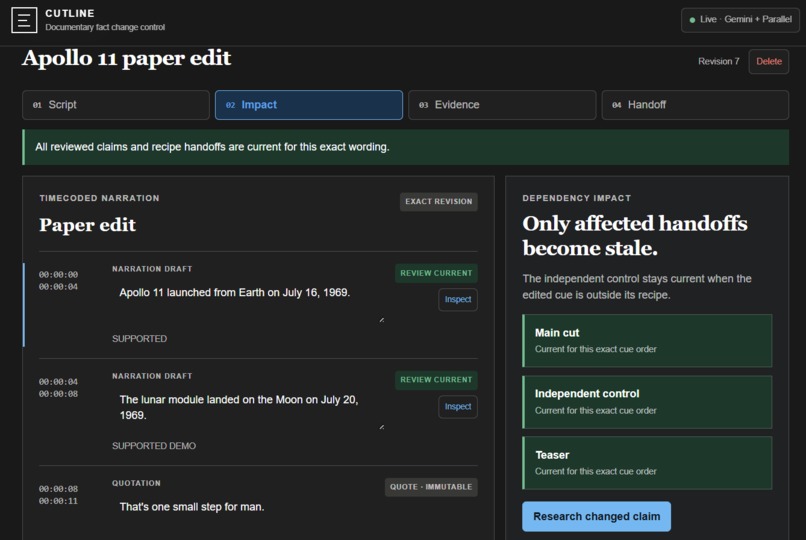
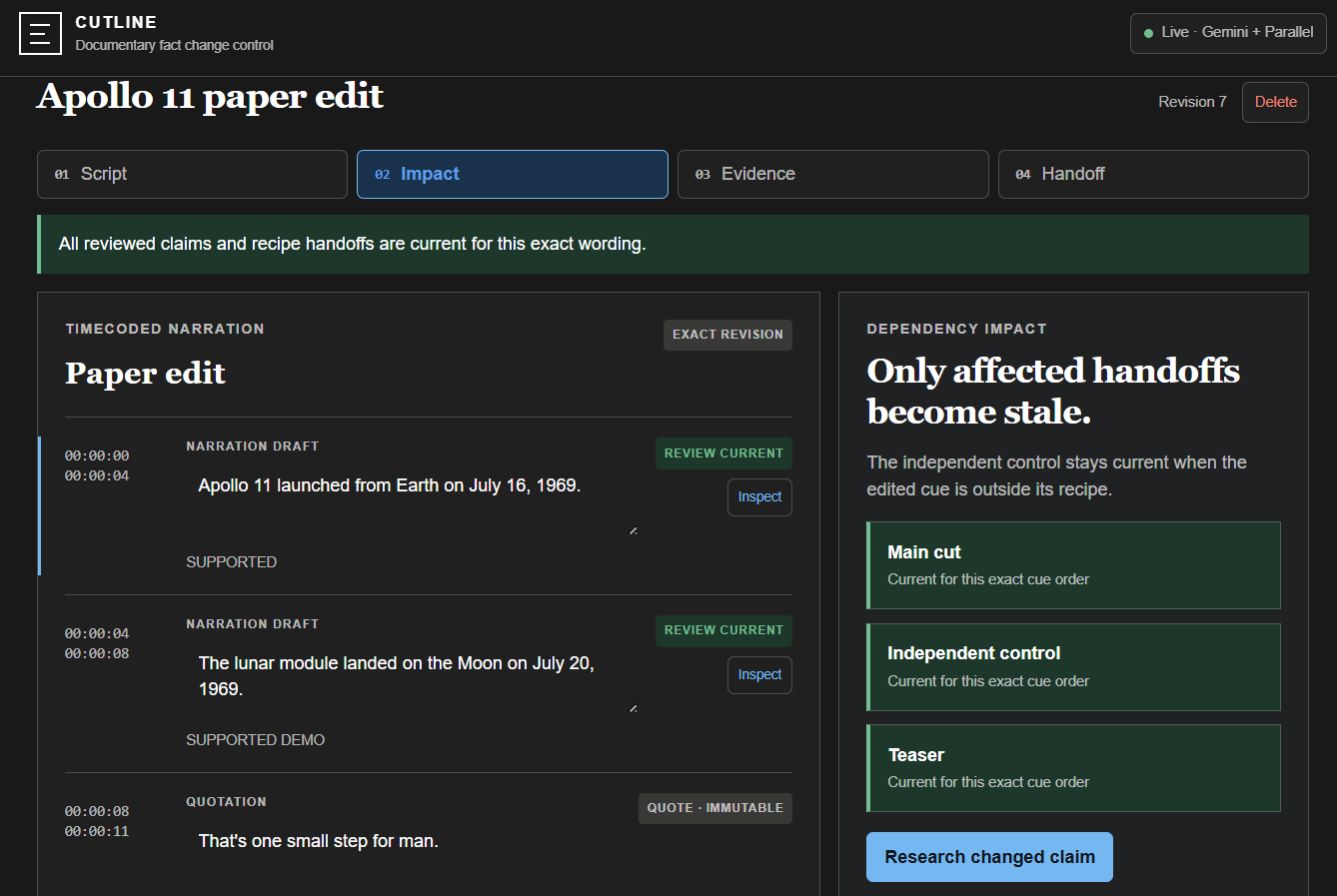
Impact tab of Cutline
-
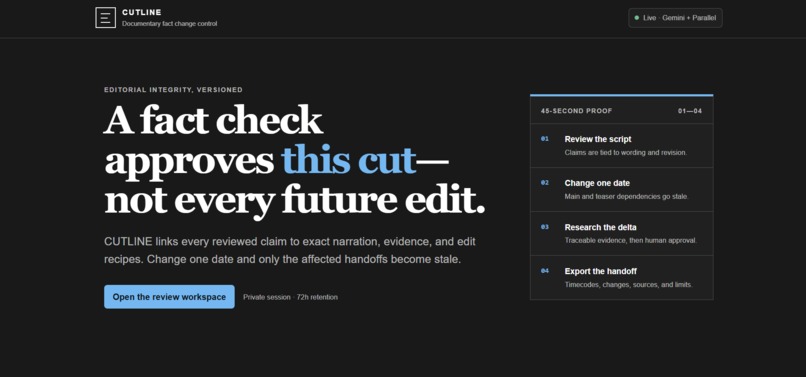
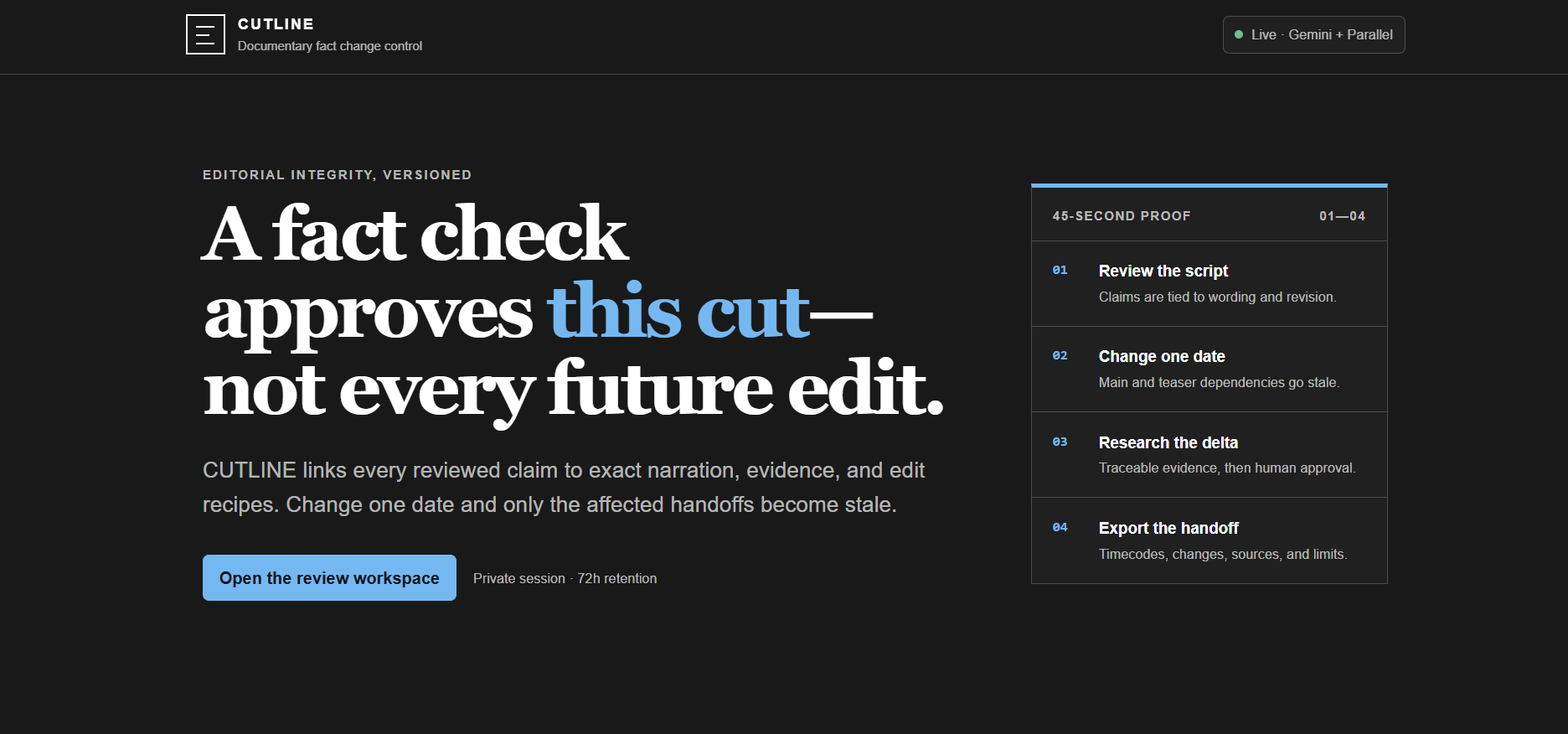
Landing Page of Cutline
-
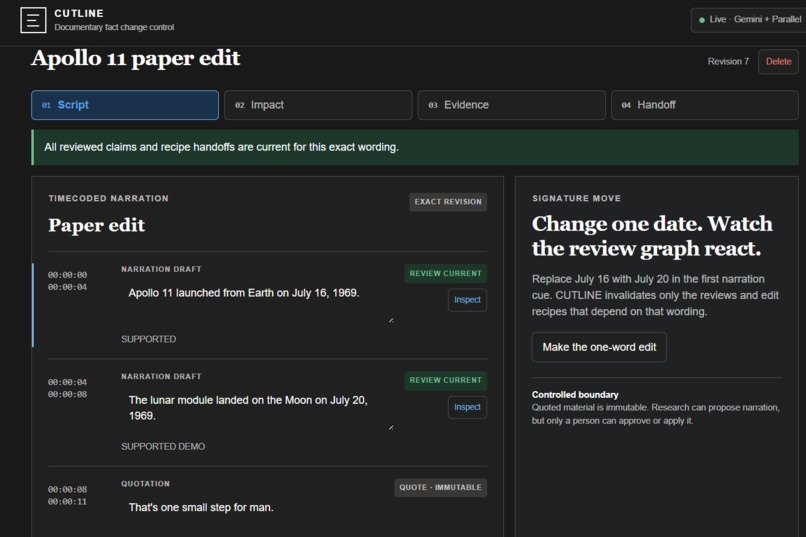
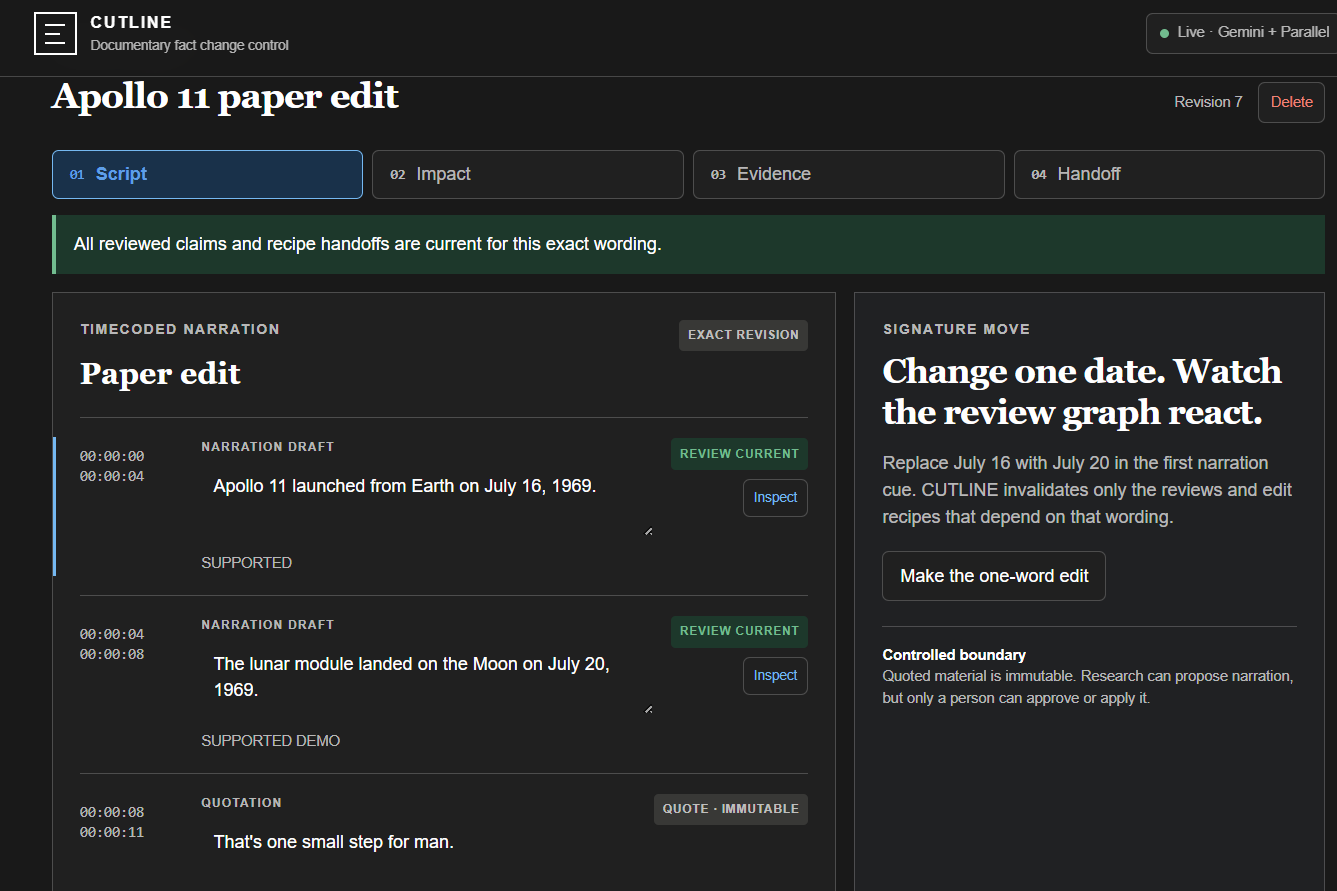
Script tab of Cutline
-
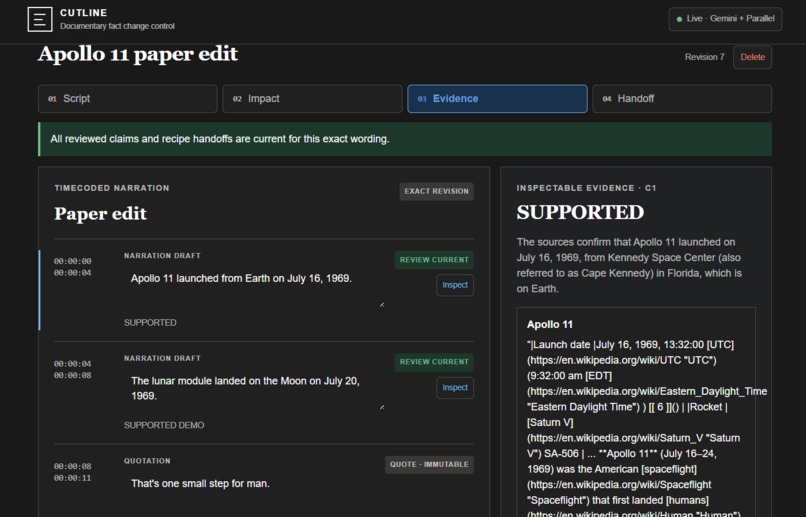
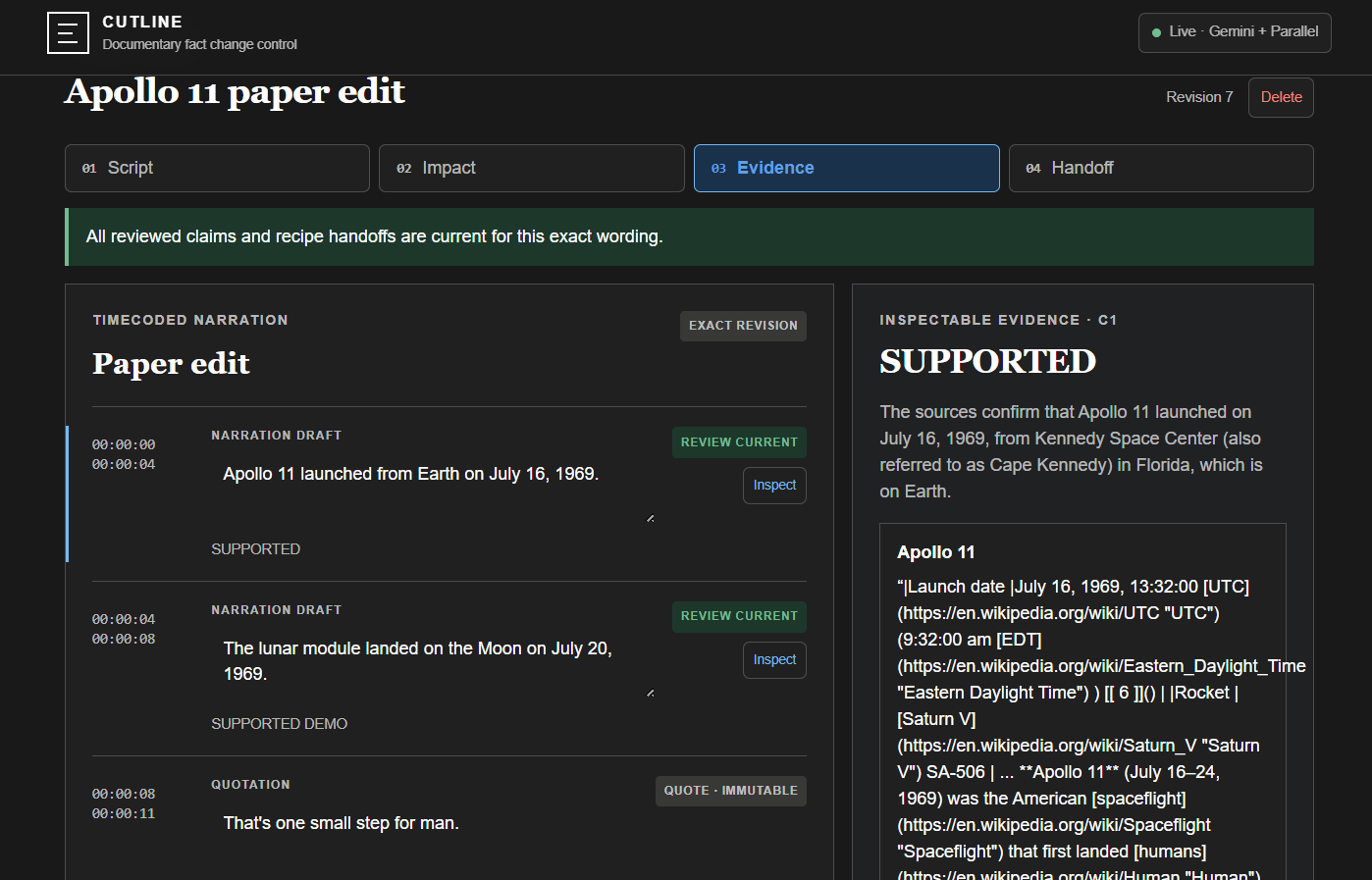
Evidence tab of Cutline
Inspiration
Documentary teams make hundreds of editorial decisions while scripts, narration, and cuts continue to change. Fact-checking is often fragmented across browser tabs, spreadsheets, chat threads, and review notes. That creates two risks: unsupported claims can survive until late in production, and evidence collected for an earlier version of a sentence can be mistaken for evidence supporting the final cut.
We built CUTLINE to make documentary research part of the editorial workflow itself. The goal is not to let AI publish facts autonomously. It is to help researchers and editors find evidence faster while preserving revision history, source traceability, and human sign-off.
What it does
CUTLINE is an evidence-aware review workspace for documentary narration.
An editor can:
- Select a narration cue containing a factual claim.
- Ask CUTLINE to research that exact wording.
- Review public sources retrieved through Parallel Search.
- See whether Gemini assesses the claim as supported, contradicted, or unresolved.
- Apply a proposed factual repair without changing quoted source material.
- Re-run research whenever the wording changes.
- Complete human review and sign-off.
- Export the approved result as JSON, CSV, or text.
CUTLINE treats evidence as revision-specific. If an editor changes a cue after research or approval, dependent evidence and review state become stale. Export remains blocked until the corrected revision has current evidence and approval.
How we built it
The public web application runs on Google Cloud Run with a FastAPI backend and a focused HTML, CSS, and JavaScript interface.
The production workflow uses:
- Gemini on Google Cloud for evidence-aware assessment and repair suggestions.
- Parallel Search API for live retrieval of public documentary evidence.
- Google ADK and Agent Engine for the deployed claim-research agent.
- Cloud Firestore for revisioned project persistence and optimistic concurrency.
- Secret Manager for runtime provider credentials.
- Cloud IAM for least-privilege service identities.
- Cloud Build and Artifact Registry for reproducible container deployment.
- Cloud Logging for sanitized operational diagnostics.
The browser never receives the Parallel credential. The Cloud Run application and Agent Engine runtime obtain access through separate service identities, and the Agent Engine identity receives access only to the required secret.
How Parallel powers the workflow
Parallel is an active runtime dependency, not a label or static dataset.
The search_documentary_evidence agent tool calls Parallel Search with the current claim, normalizes the returned records, validates public URLs, and passes structured evidence to Gemini. CUTLINE stores source IDs separately from claim assessments so editors can inspect exactly which records support a result.
In our release validation, the remotely deployed Agent Engine created a managed session, invoked the Parallel tool, returned five public source records from domains including NASA, the Smithsonian, and the Lunar and Planetary Institute, and produced a final Gemini response.
Challenges we faced
Production deployment exposed several real-world issues beyond the local prototype.
Cloud Run initially rejected its startup probe because framework host validation did not recognize the probe host. We implemented a narrowly scoped health-probe middleware rather than weakening host validation for the entire application.
We also diagnosed a rotated Parallel credential, pinned the valid secret version, and verified both direct provider access and the complete application workflow.
Agent Engine required additional work around SDK packaging, delayed service-agent provisioning, package-relative imports, Cloud Resource Manager availability, and model endpoint compatibility. We corrected those issues while preserving the existing resource and preventing accidental duplicate deployments.
Accomplishments
We are proud that CUTLINE is more than a prompt wrapped in a form.
It includes:
- A complete research, repair, re-research, review, sign-off, and export workflow.
- Live Parallel and Gemini calls.
- Revision-aware evidence invalidation.
- Immutable source quotations.
- Human-controlled approval.
- Firestore persistence across Cloud Run revisions.
- Explicit deletion and TTL-based cleanup.
- CSRF protection, owner isolation, secure cookies, security headers, and validated public URLs.
- A remotely deployed Google ADK Agent Engine with a verified Parallel tool call.
- Public source code with automated linting, tests, policy validation, and container builds.
What we learned
We learned that reliable agentic systems need more than good model output. Identity propagation, model-region availability, secret boundaries, state transitions, and stale-result prevention all affect whether an agent can be trusted inside a real production workflow.
We also learned that human-in-the-loop design is strongest when it is enforced by state and revision rules, not merely requested in a prompt.
What's next
Next, we want to add transcript and subtitle ingestion, batch cue review, team assignments, source-quality controls, and deeper production-system integrations. We also plan to move the Agent Engine to a compatible multi-region endpoint so it can use the newest supported Gemini model while retaining the same evidence and approval guarantees.
CUTLINE's long-term goal is simple: help documentary teams move faster without losing the chain of evidence behind the final cut.

Log in or sign up for Devpost to join the conversation.