Inspiration
Studios spend millions on trailers. Then they change the trailers on instinct. Analytics tools report the view-through rate. That number tells an editor that people stopped watching. It does not tell the editor where they stopped, or why. An editor has two questions:
- At which second did the 18-24 group stop watching this cut?
- What was on the screen in those frames?
The first question is a database question. The second question is a perception question. No tool answered both. So we built an agent that answers both. The agent also runs on its own. No person starts it.
What it does
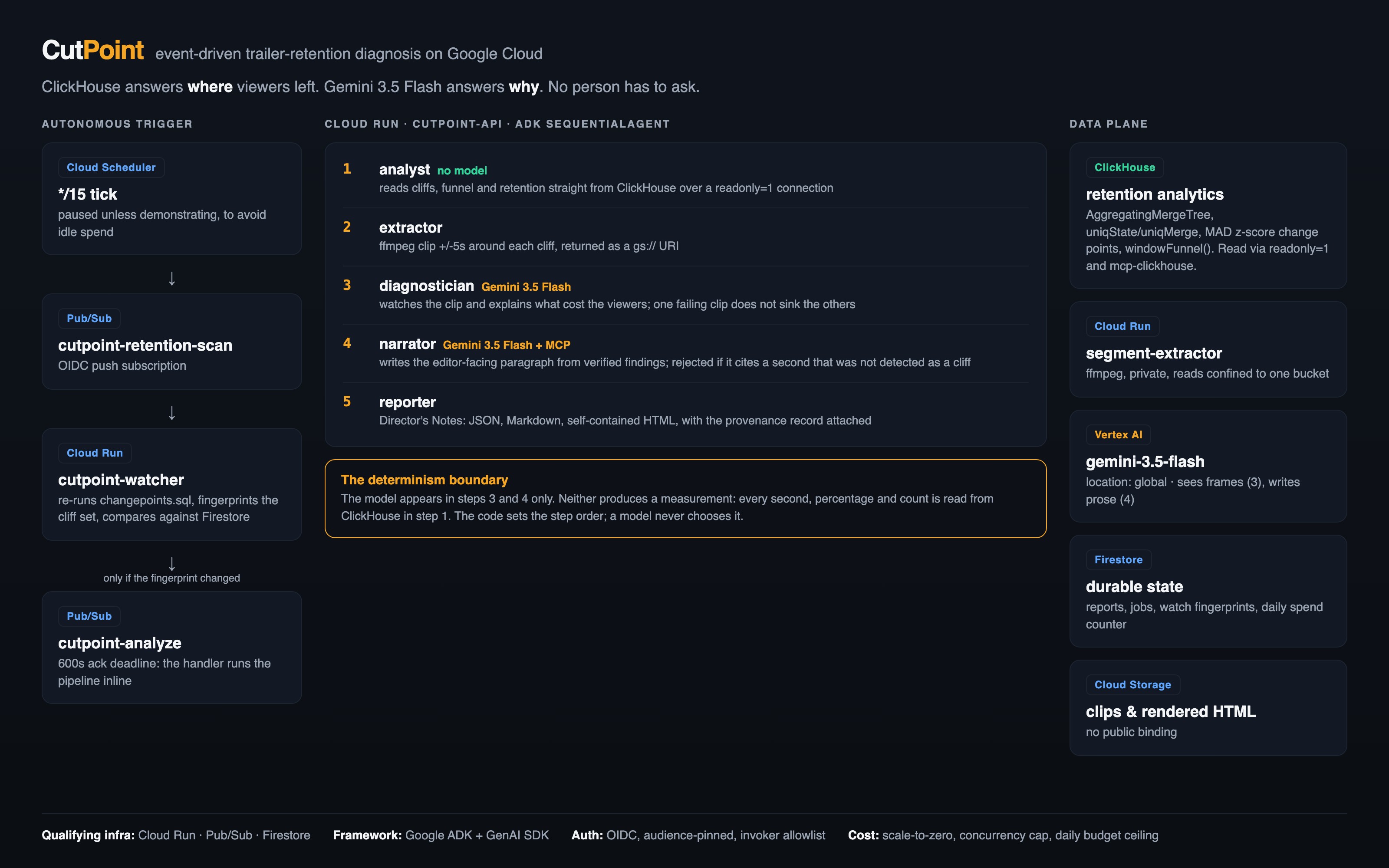
Cloud Scheduler sends a message to a Pub/Sub topic every 15 minutes. The scheduler job starts in the paused state. We resume it only for a demonstration, because a tick with no reader only costs money. A watcher on Cloud Run then does three things. It runs the change-point detection again on the live ClickHouse data. It makes a fingerprint of the set of cliffs. It compares that fingerprint with the last fingerprint in Firestore. If the fingerprint did not change, the watcher stops. This is what keeps it from becoming an expensive cron job. If a new cliff appeared, the watcher sends a message to a second topic. The pipeline then runs from start to end. No person is involved:
- Analyst reads the cliffs, the funnel and the retention directly from ClickHouse. It uses a
readonly=1connection. This step uses no model. - Extractor cuts a clip five seconds before and after each cliff. It uses ffmpeg on Cloud Run.
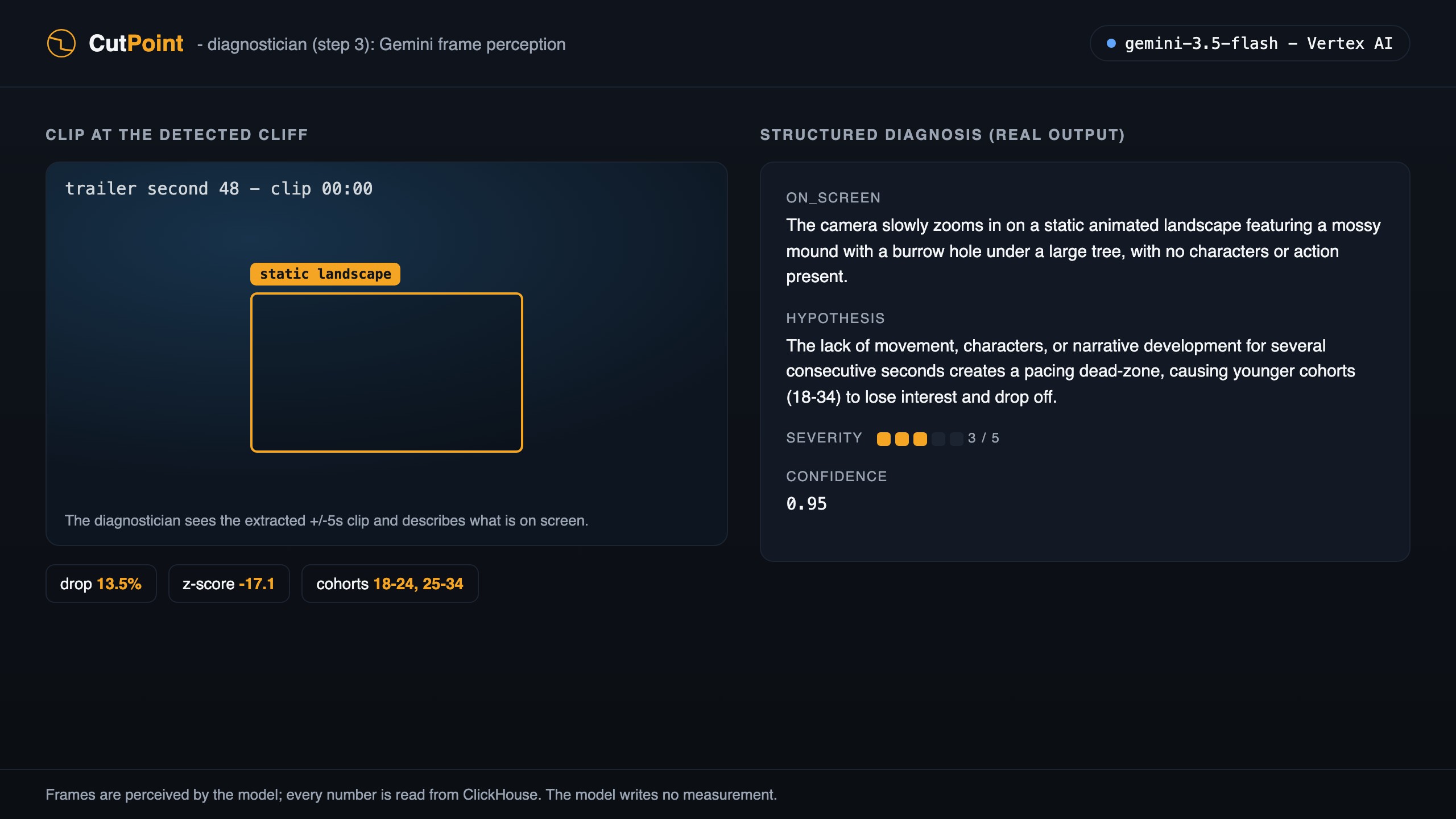
- Diagnostician sends each clip to Gemini 3.5 Flash. It asks what is on the screen, and why the clip lost viewers.
- Narrator uses Gemini to write the verified findings into one paragraph. An editor can act
on that paragraph. The step can also read
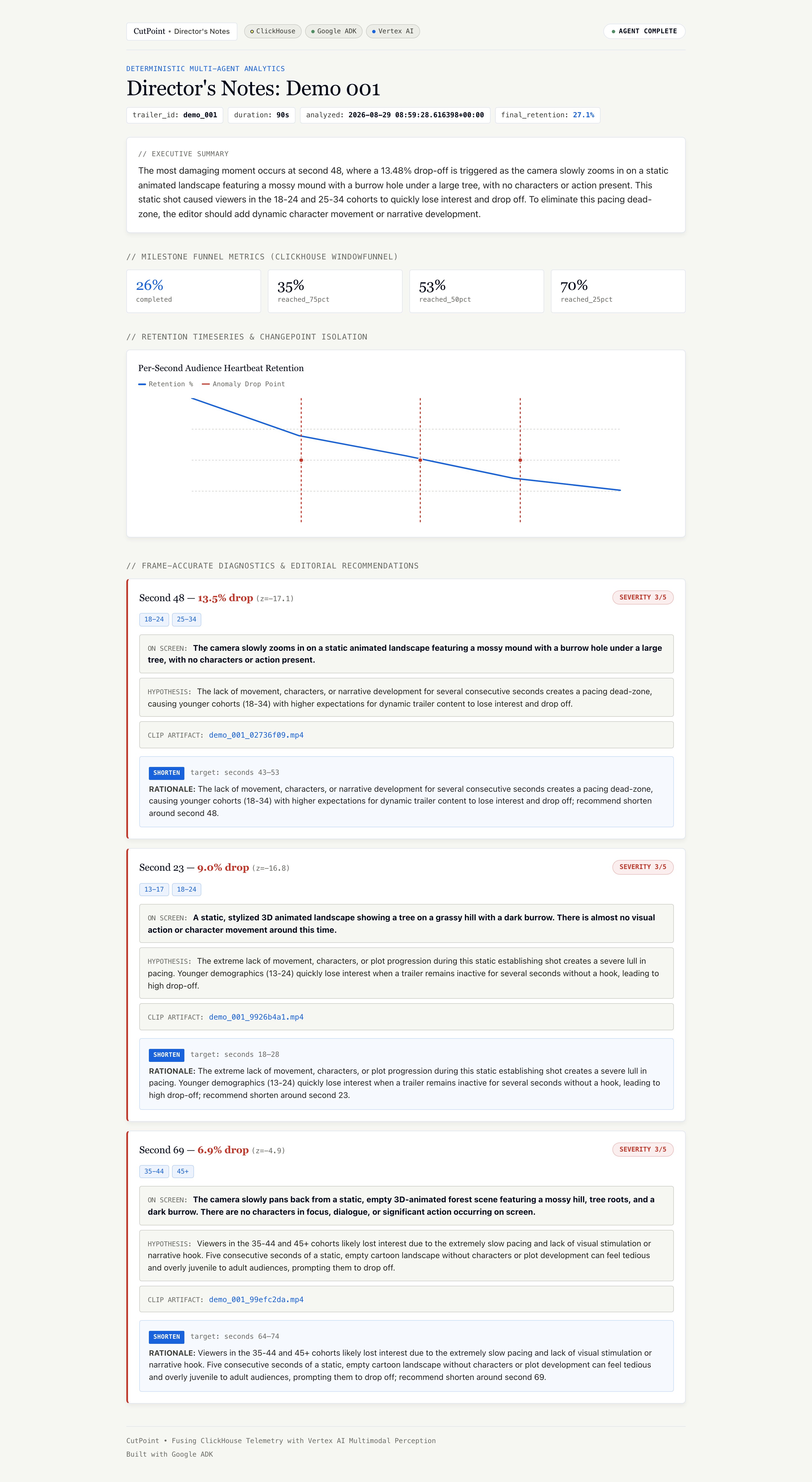
mcp-clickhousefor more context. The system rejects the paragraph if it names a second that is not a detected cliff. - Reporter writes the Director's Notes to Firestore and Cloud Storage, in JSON, Markdown and self-contained HTML. Each cliff gets a recut action and a target range.
How we built it
- Google ADK gives us a
SequentialAgent. The code sets the step order. No model chooses the next step. The model does perception and language only. - Model Context Protocol (
mcp-clickhouse) handles all database access from the agent. This access path is read-only by design. - Vertex AI serves Gemini 3.5 Flash. In the cloud, the system sends the clip as a
gs://URI, not as inline bytes. This keeps whole videos out of the service memory. - Cloud Run runs three services from two images. The API and the watcher share one image. They
differ only in the
APP_MODULEvalue. - Pub/Sub separates detection from diagnosis. It uses OIDC push subscriptions and a 600-second ack deadline. This deadline covers one full pipeline run.
- Firestore stores the reports, the job state and the watch fingerprints. The fingerprints make the loop safe to repeat.
- ClickHouse does the statistics. It uses
AggregatingMergeTreewithuniqState/uniqMergefor the count of unique viewers per second. It uses MAD-based z-scores for change-point detection. It uses the nativewindowFunnel()for the milestone funnel.
Challenges
The model was wrong about the data, and we could show it. The analyst step was an LlmAgent
at first. It copied the tool output into a schema. output_schema checks the shape of the copy.
It does not check the numbers. On a real run, the model reported one cliff at second 2. Second 2
is not a cliff in the database. The model also missed all three real cliffs, at seconds 48, 23
and 69:
llm cliffs claimed : 1
db-verified cliffs : 3
second 48 / 23 / 69 : missed by the analyst, restored from ClickHouse
second 2            : reported by the analyst, absent from ClickHouse
The model invented findings when we stopped giving it data. The first narrator named the session-state keys in its instruction. It did not read the values. So ADK gave it no data. The model then described a "poorly rendered CGI explosion" and "3,525 viewers". Neither is in the diagnoses. The system has no viewer counts at all. We changed the prompt to read the real values. A grounding check now rejects any summary that names a second that is not a detected cliff.
Gemini refused to answer, and the cause was our prompt. We sent a clip for trailer seconds 43 to 53. We told the model to describe second 48. But the clip timeline starts at 00:00. So the model correctly said that it cannot describe a moment outside the clip. The system wrote that refusal into the report as a diagnosis. We made the prompt use clip-relative time. This fixed the problem.
Deployment broke things that worked on a local machine. The extractor returned a file path
from its own container. The diagnostician is a different Cloud Run service. It tried to open that
path and failed. So every extraction was lost. Also, gcloud run deploy --source uses
.gitignore when there is no .gcloudignore. So the build did not upload a file that it needed.
Also, the Google frontend catches /healthz and returns 404 before the container sees the
request. Also, an unreachable database returned a 5xx response to a Pub/Sub push. Pub/Sub retries
a 5xx. So one scheduled tick became a billing loop. We fixed each of these.
Accomplishments that we are proud of
- No model produces a number. ClickHouse computes every statistic: the MAD z-scores, the cohort divergence, the funnels. Gemini only diagnoses cliffs the database has already proven.
- Fail loud, never corrupt. The architecture surfaces every failure as a specific error and writes no partial report. Chaos tests validate this across four failure scenarios.
- Autonomous Director's Notes. The watcher completes the workflow with no human step, and a concurrency cap and a daily budget ceiling bound the cost.
What we learned
When you join an OLAP database with a multimodal model, one failure mode appears: the model speaks with confidence about numbers that it did not compute. A better prompt does not fix this. An architectural boundary fixes it. Let the database own every number. Let the model own perception and language. Make the pipeline work even when the model fails completely. Ours does. If the analyst gives a wrong answer, times out, or returns broken JSON, the report is still correct. Separating workflow determinism from generative perception is what makes the agent reliable.
What is next
- Add Veo replacement shots and Lyria music beds for the cliff with the highest severity.
- Add connectors for YouTube Studio, Twitch and TikTok data, in place of synthetic events.
- Test alternative cuts against synthetic audience personas before release.
Built With
- clickhouse
- cloud
- vertex

Log in or sign up for Devpost to join the conversation.