-
-
Overview
-
-
-
Data Inventory
-
-
-
Customer Search
Inspiration
- Every enterprise faces the same problem: one customer leaves traces across a dozen disconnected systems — sales, support tickets, reviews, social, product usage, contracts.
- Nobody can see the whole person; teams spend weeks stitching together a partial picture that's stale by the time it lands.
- We wanted to collapse that fragmentation into one living, explainable view of each customer.
- The bet behind Neural 360: instead of building yet another warehouse, make MongoDB Atlas the corporate master datastore an AI can read directly.
- Goal: let anyone ask a plain-English question and get a trustworthy answer in seconds.
What it does
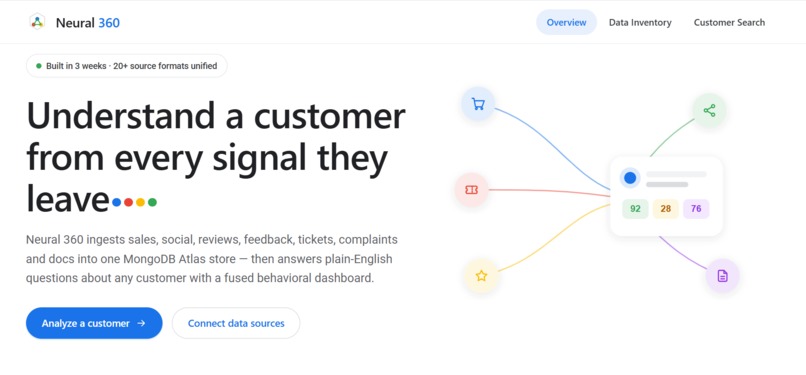
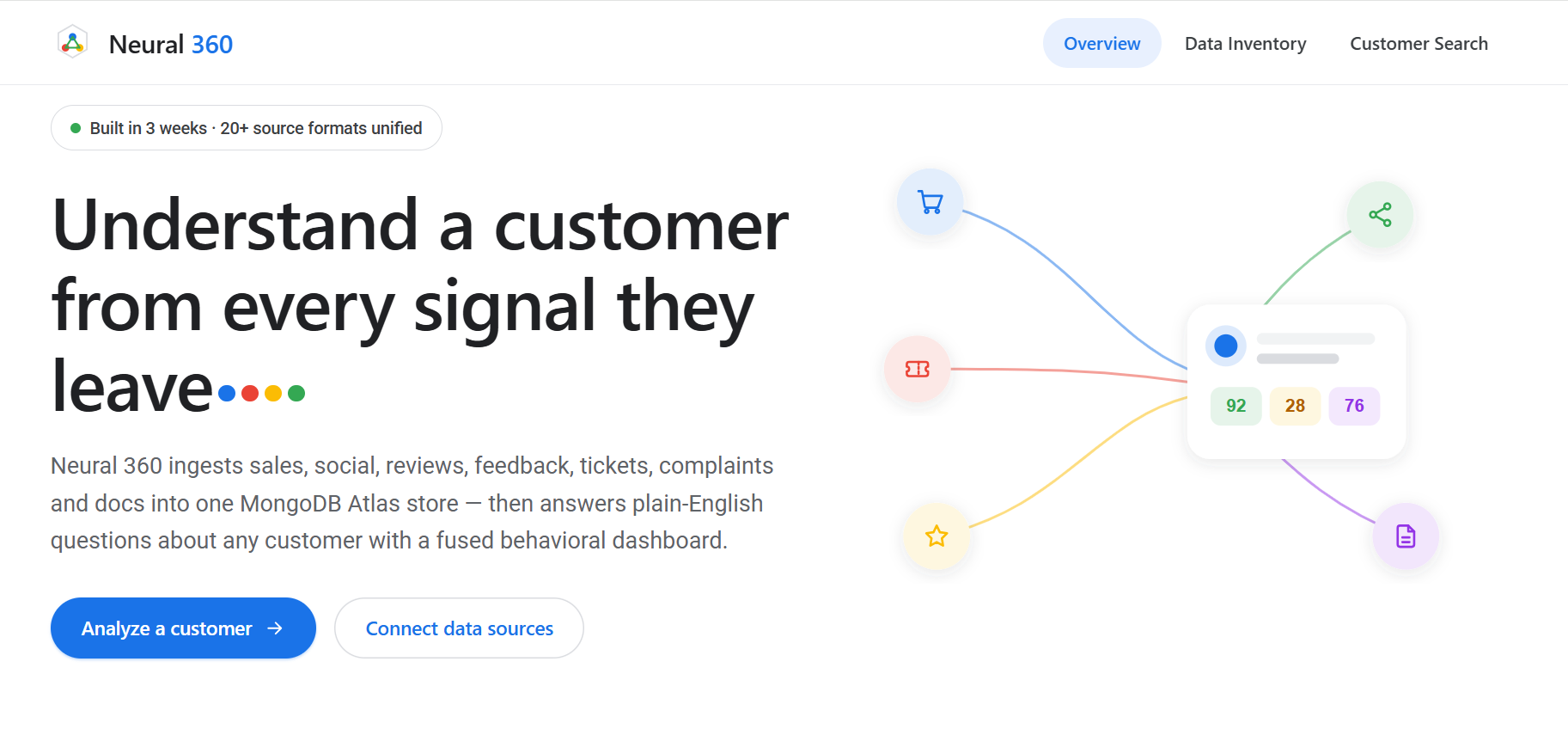
- Unifies every customer signal into one AI-powered behavioral profile.
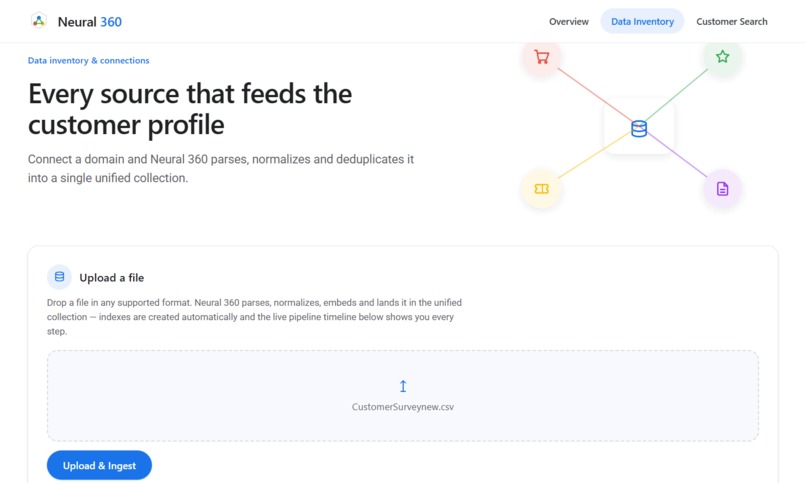
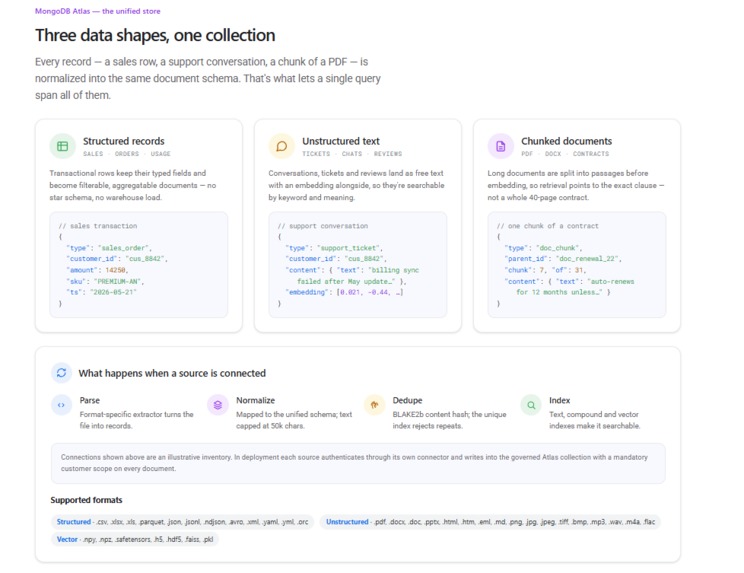
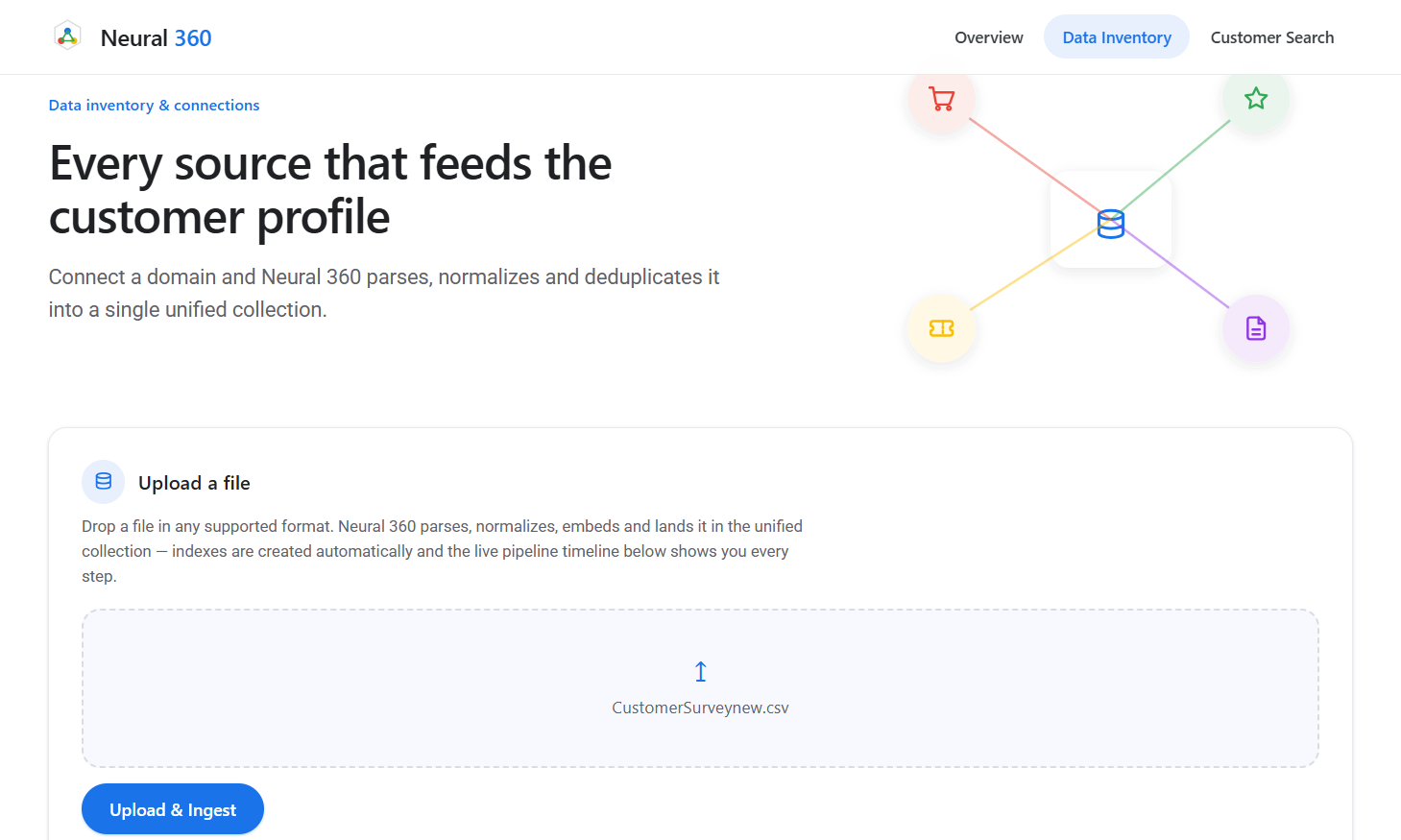
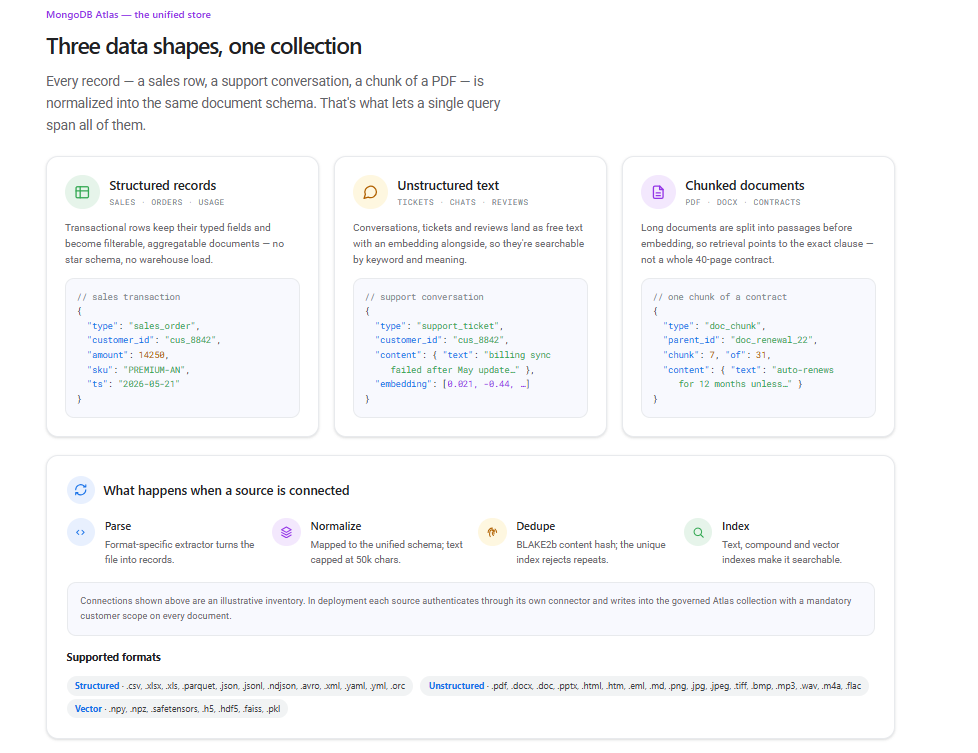
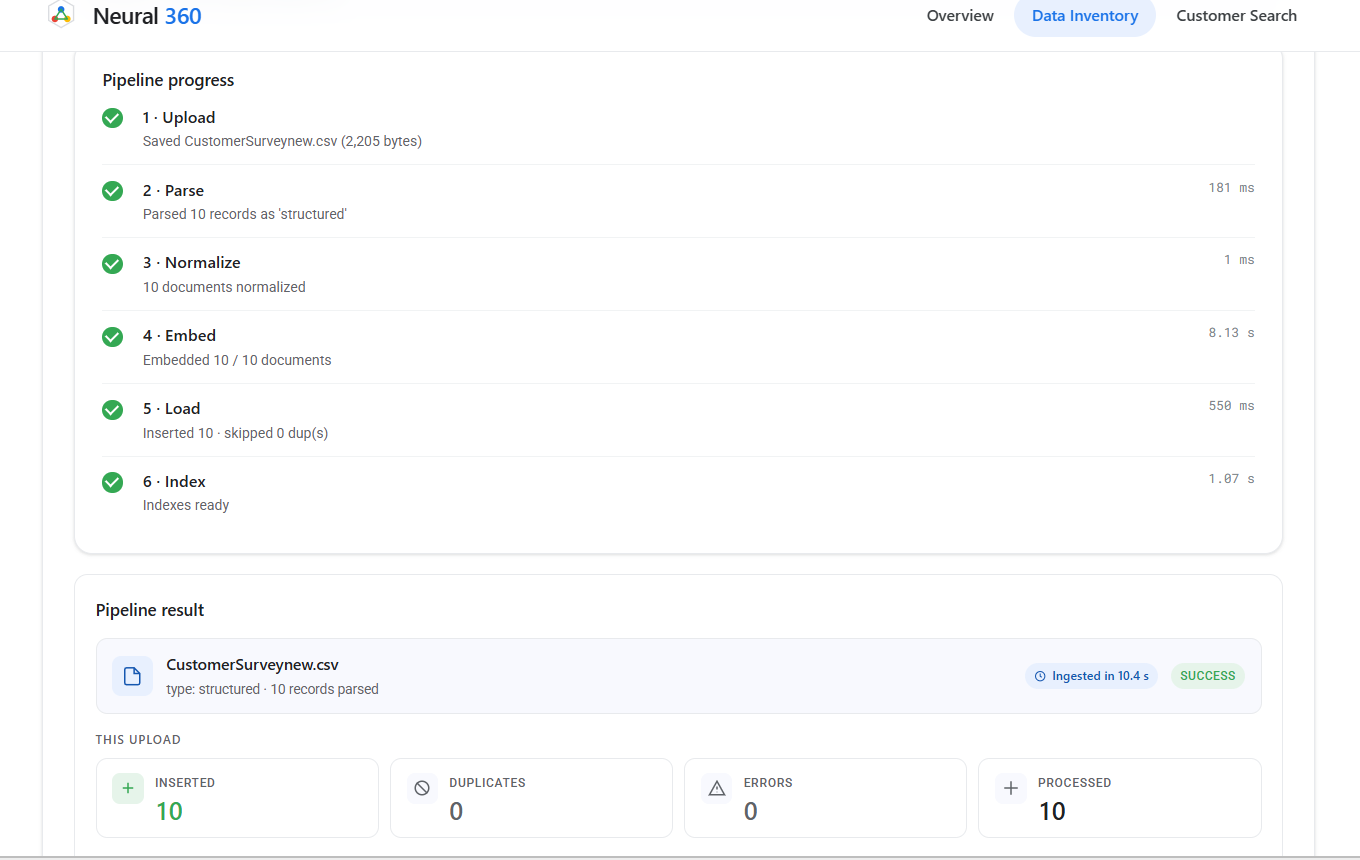
- Ingests structured records, unstructured conversations, and documents into a single MongoDB Atlas collection.
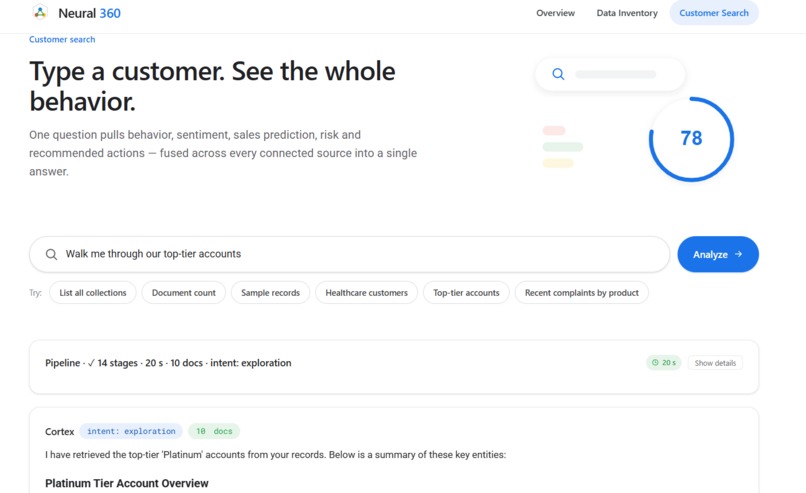
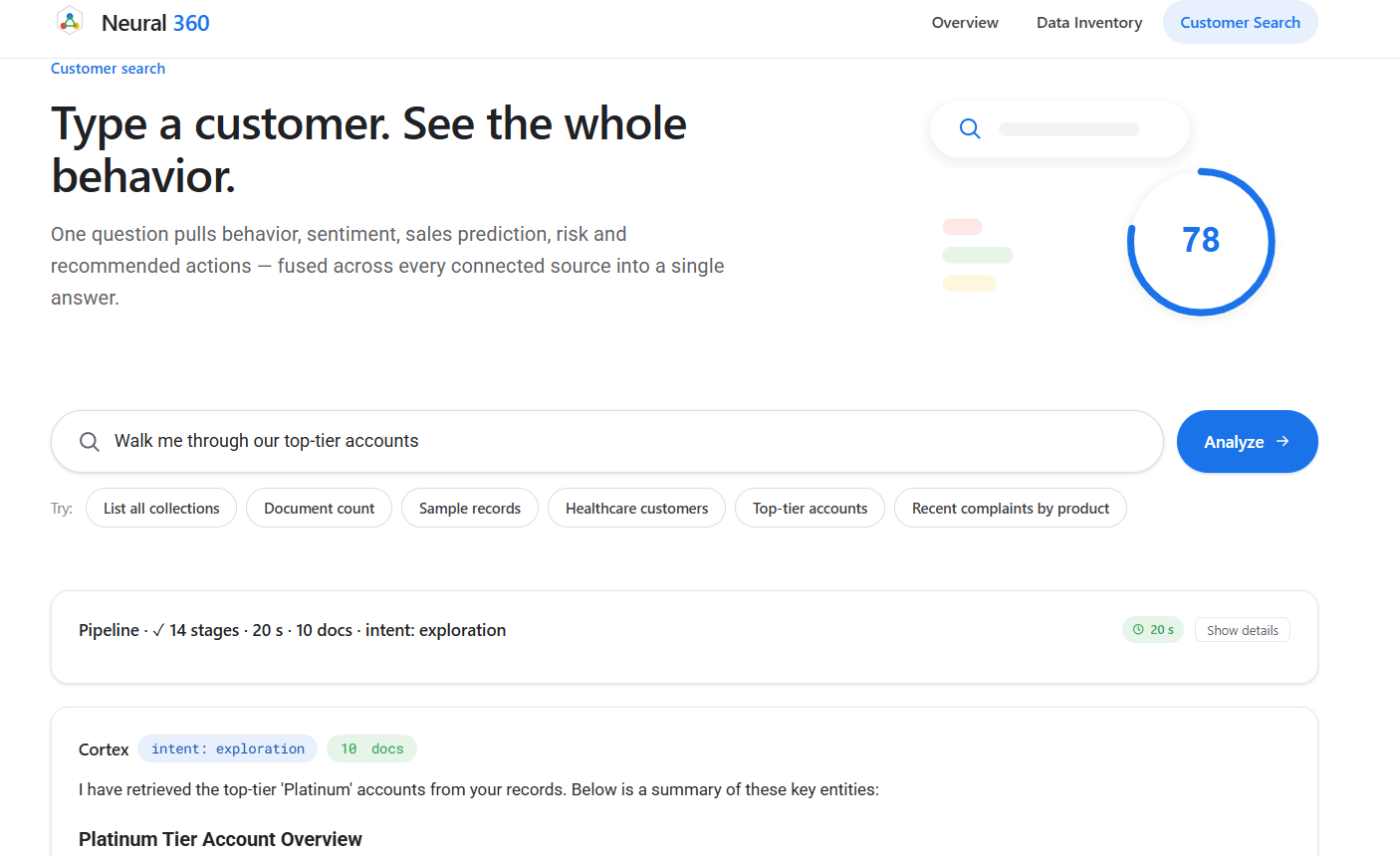
- Answers natural-language questions with a fused dashboard covering:
- Health, churn risk, growth, and adoption scores
- Spend trajectory and sales prediction
- Sentiment analysis
- Recommended next actions
- A behavioral timeline
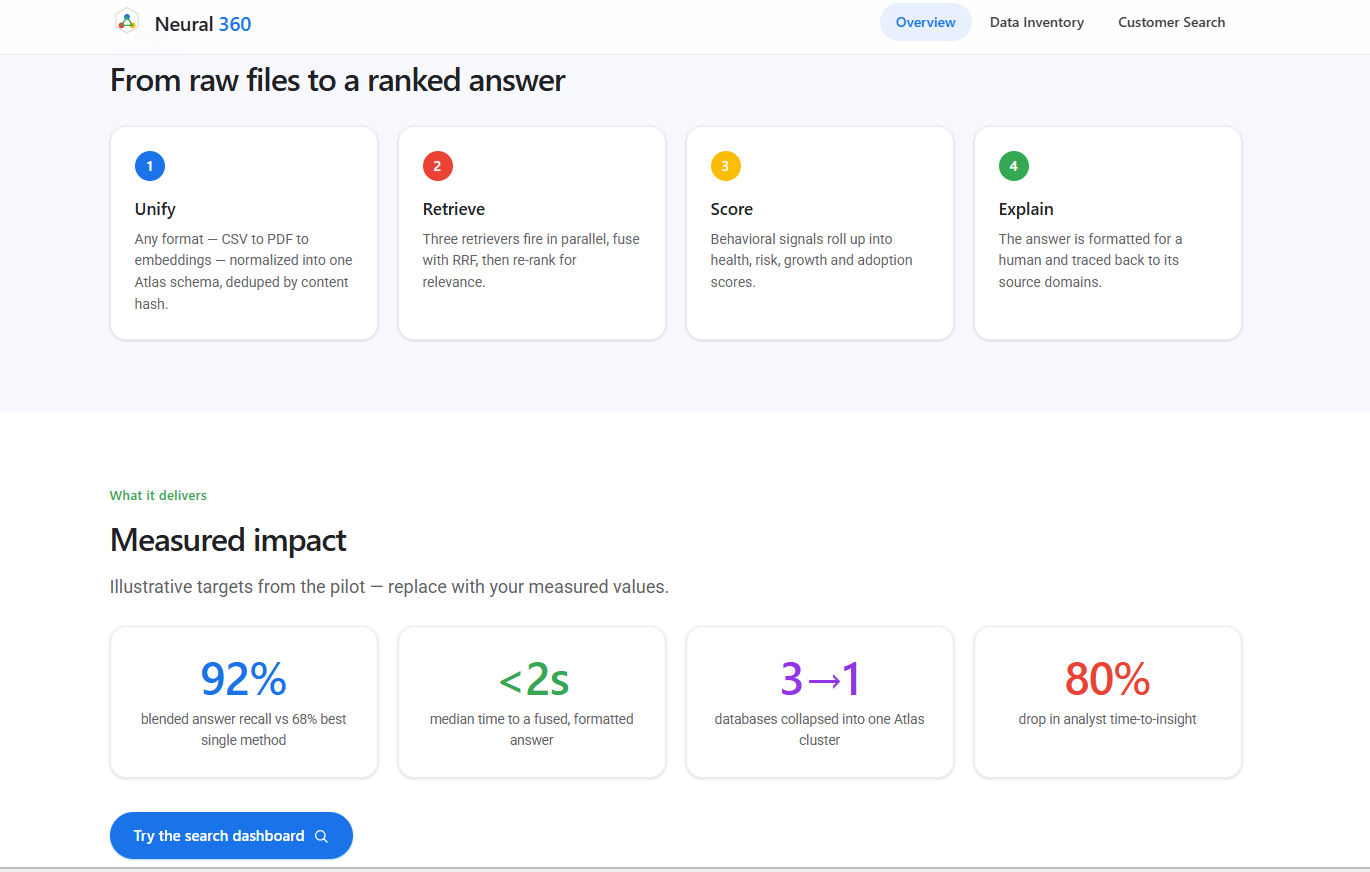
- Every figure is traceable back to its source.
How we built it
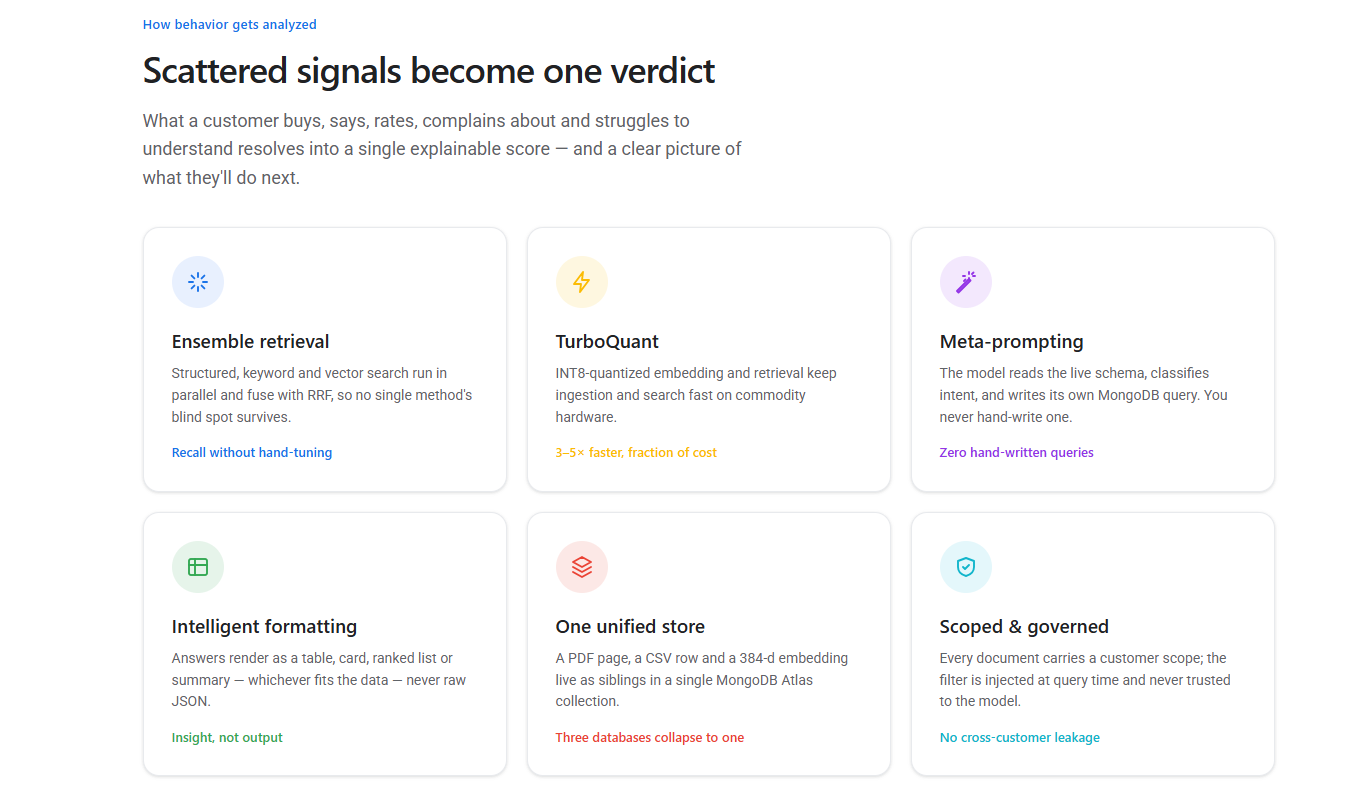
- Made MongoDB Atlas the single master datastore, normalizing 20+ formats into one unified JSON schema.
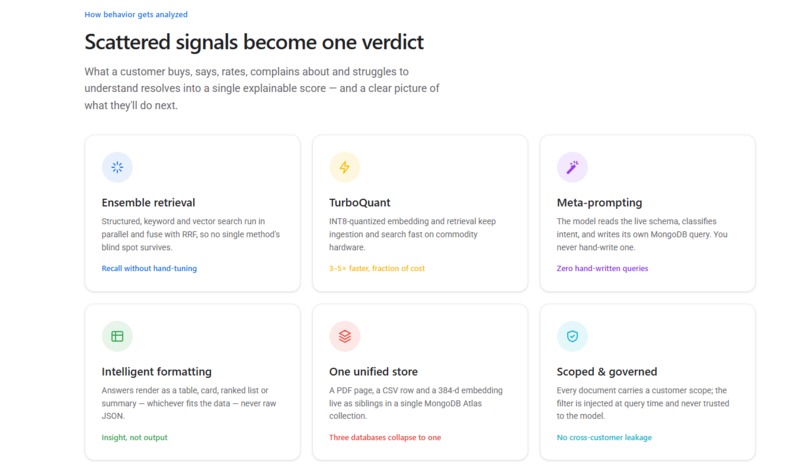
- Structured rows, text, and 384-dimensional embeddings live as siblings in the same collection.
- Atlas does triple duty — operational store, Atlas Search for keyword (BM25) retrieval, and native
$vectorSearch— collapsing three databases into one. - The MongoDB MCP Server makes the store directly addressable by an LLM.
- A meta-prompting layer inspects the live schema, classifies intent, and writes its own aggregation pipeline.
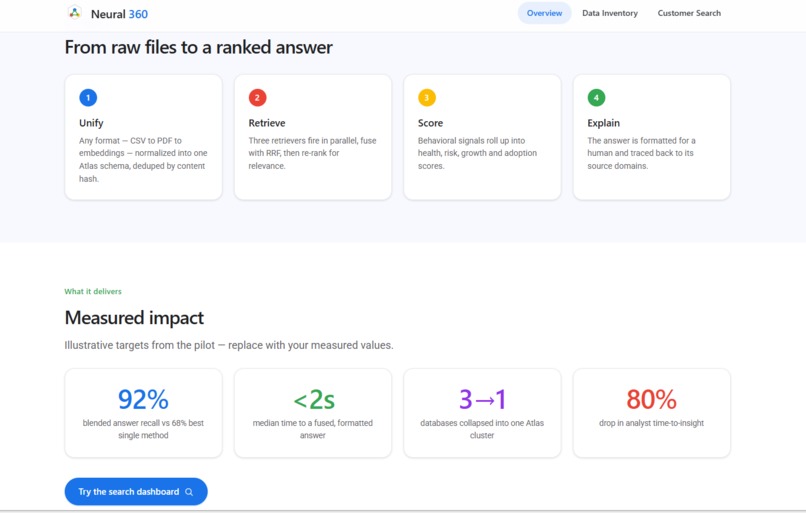
- Retrieval fires structured, keyword, and vector queries in parallel, fuses them with reciprocal rank fusion, and reranks with a cross-encoder.
- A scoring layer rolls signals into explainable customer scores.
- Autonomous agents handle PII detection, data protection, and quality continuously alongside human stewards.
Challenges we ran into
- Cross-customer data leakage — fusing tickets, contracts, and reviews could mix records; we made a customer scope mandatory on every document and injected the filter at query-generation time rather than trusting the model.
- Vector recall on long documents — the embedding window was far smaller than our text cap; we fixed it by chunking before embedding and linking chunks back to their parent.
- BM25 scaling — an in-memory index didn't scale and went stale on new ingests, so we moved keyword search onto native Atlas Search.
- Mixed-modality fusion — reconciling exact aggregations with fuzzy
$vectorSearchhits in one ranked list forced an explicit intent-routing and tie-break policy.
Accomplishments that we're proud of
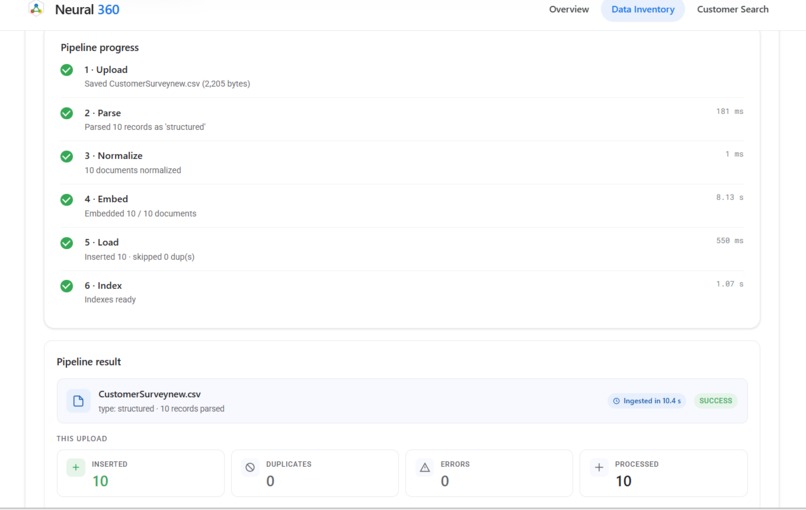
- Went from raw files to a working platform in three weeks.
- Unified 20+ source formats into one Atlas collection.
- Stood up a parallel ensemble retriever — structured, Atlas Search, and vector fused by RRF — that beats any single method on recall.
- Shipped a dashboard that reconstructs a full customer profile from just a name.
- Every answer is explainable and scoped to a single customer — no black-box numbers, no leakage across boundaries.
- No separate query API to maintain, thanks to the MCP Server.
What we learned
- The hard part of customer intelligence isn't the model — it's the data shape.
- Once every format shares one MongoDB schema, retrieval and reasoning get dramatically simpler, and a new source onboards in hours instead of a quarter.
- No single retrieval method is enough.
- Letting Atlas serve as operational store, search engine, and vector index removes enormous integration glue.
- Cheap models should handle volume while large models handle nuance.
- Governance — scope, purpose, and PII handling — has to be designed into the document schema from day one, not bolted on later.
What's next for Neural 360
- Harden the tenant-scoping and PII model for production data, with mandatory filter injection and PII classification baked into the schema.
- Expand the autonomous agent workforce for deeper data-quality and protection coverage.
- Close the recommendation loop with feedback and realized-impact tracking.
- Add more connectors into the unified collection.
- Enable richer agentic reasoning over Atlas via the MCP Server.
- Tighten integration with the workflows where teams actually act on these insights.


Log in or sign up for Devpost to join the conversation.