-
-
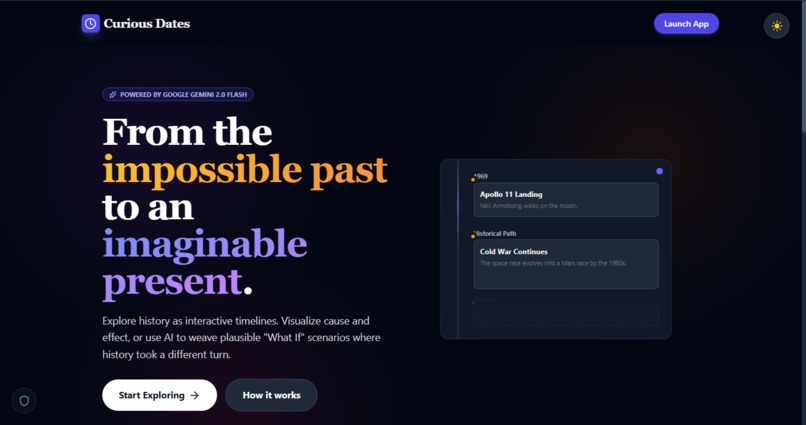
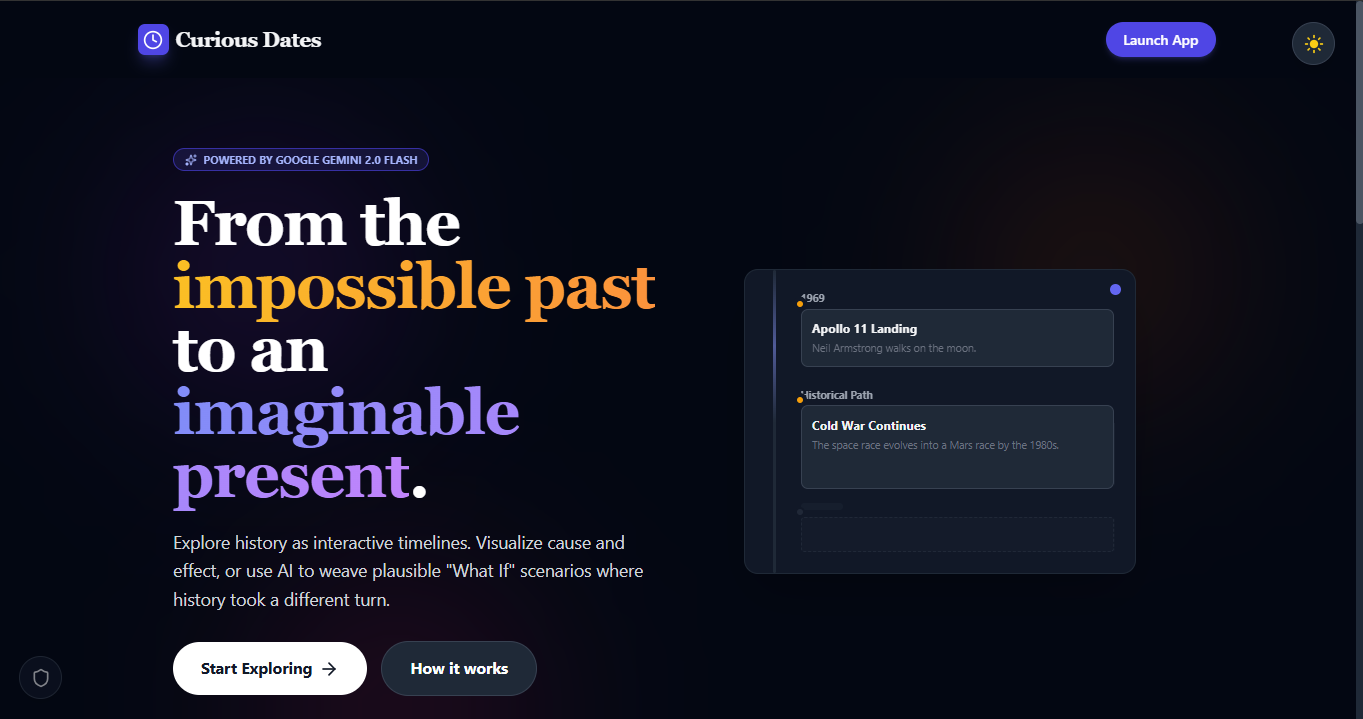
project landing page
Inspiration
Many people experience history as isolated moments, famous speeches, dates, or names, such as Martin Luther King Jr.’s “I Have a Dream” speech. While these moments are powerful, they often lack deeper context: What led to them? What followed? How much time passed between key events?
The vivid idea for this project came while playing a game called The Alters, which explores alternate versions of reality based on different choices and timelines. That experience made me realize that history itself can be viewed as a system of branching possibilities, not just fixed outcomes.
What if AI could help us explore history as a living, branching timeline rather than a static list of facts? And even more intriguingly. what if we could imagine alternate versions of history, visualizing how the world might look today if certain events had unfolded differently?
That curiosity ultimately led to the creation of Curious Dates.
What it does
Curious Dates is an AI-powered historical exploration platform designed for historians, students, and history enthusiasts. Unlike traditional AI chat tools, Curious Dates treats historical events as structured, time-aware entities that can branch into multiple alternate outcomes.
Users can:
- Ask questions about historical events or periods
- Generate accurate, chronological timelines
- Visually understand time gaps between events
- Explore alternate timelines based on “what if” scenarios
For example, while exploring the Seven Wonders of the World, I was able to clearly see how ancient the Great Pyramid of Giza is compared to the others. The platform even allowed me to creatively add an “8th wonder”, the creation of Curious Dates itself, and visualize how that event could reshape future history.
History becomes not just informative, but interactive and imaginative.
How I built it
The project was built primarily using Google AI Studio, leveraging multiple Gemini APIs for:
- Timeline generation
- Event sequencing
- Alternate history simulation
- Image generation for visual storytelling
While some minor integrations were handled locally, over 99% of the development was done inside Google AI Studio, demonstrating the power of AI-first development workflows.
Challenges I ran into
One major technical challenge was managing API rate limiting. A single user prompt often required multiple AI services: text generation, image generation, and timeline structuring, leading to a high number of API calls.
To address this, I optimized prompt design and request sequencing to reduce unnecessary calls while maintaining output quality. Managing these constraints taught me valuable lessons about scalable AI system design.
Accomplishments that I am proud of
- Built a fully functional AI history platform with creative and educational value
- Enabled users to visualize history, not just read it
- Introduced alternate history ideation, which even helped me conceptualize a historical game idea based on my country’s mythic past
Beyond education, the platform demonstrated real creative value by generating new ideas and narratives from historical data.
Curious Dates proves that learning history can be both analytical and playful.
What we learned
This project taught me:
- How AI agents can significantly enhance complex task execution
- How prompt engineering affects output quality and system efficiency
- The power of Google AI Studio as a free, end-to-end AI development environment
Most importantly, I learned how an idea can evolve during development. Curious Dates inspired new creative directions even before it was officially published.
What's next for Curious Dates
The next phase of Curious Dates is to evolve it from a single application into a timeline intelligence engine. Future versions will allow users to branch, compare, and simulate multiple historical timelines side by side, enabling deeper cause-and-effect analysis.
Long-term, the platform will support education, storytelling, and game design by exposing timeline generation and alternate-history modeling as reusable components. This opens the door for historians, educators, and creators to build entirely new experiences on top of Curious Dates.
Built With
- gemini-3
- google-ai-studio
- react
- vite


Log in or sign up for Devpost to join the conversation.